
Quick verdict
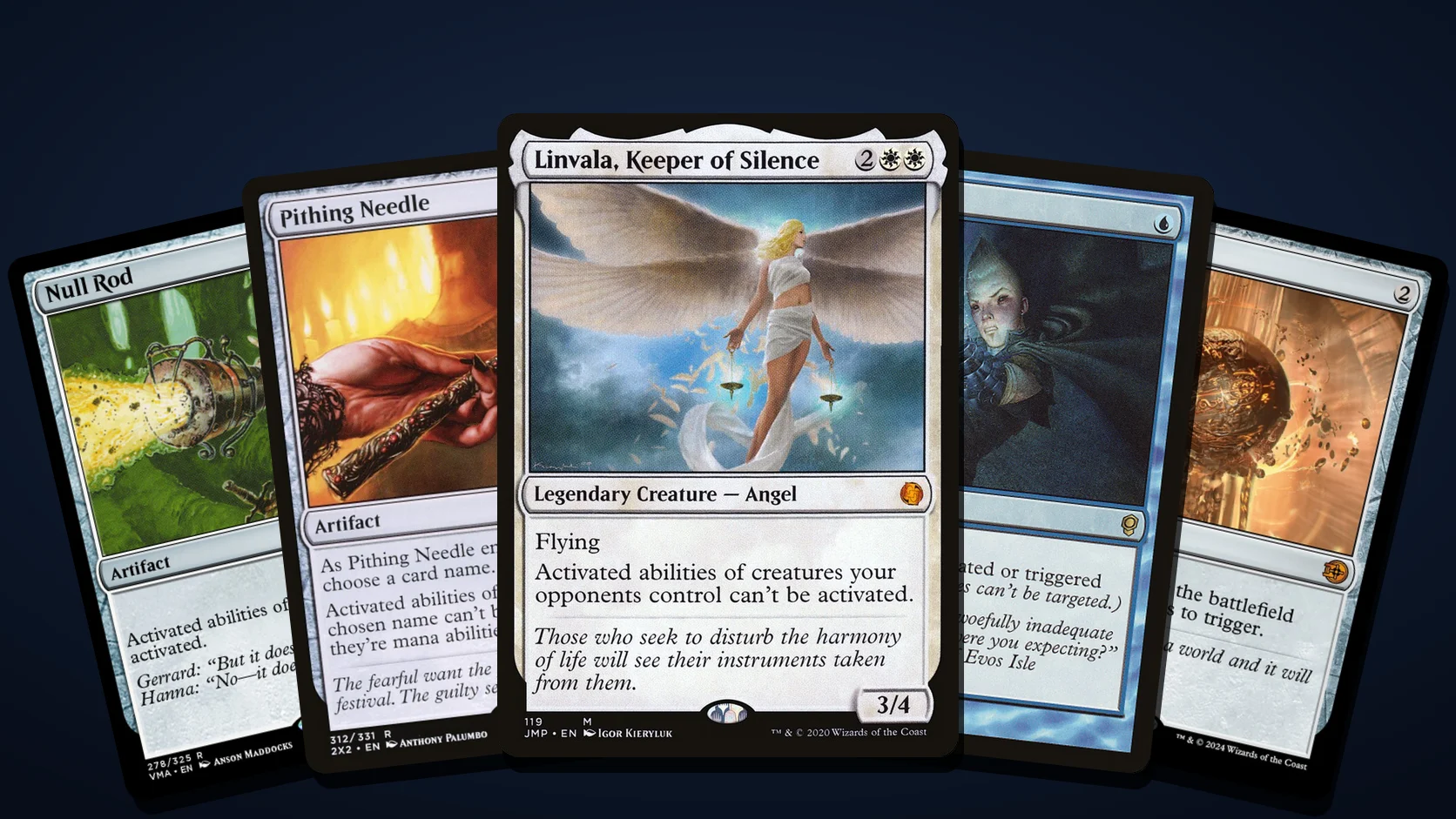
An activated ability is written '[cost]: [effect]' and you choose when to use it by paying the cost (CR 602). A triggered ability starts with 'when', 'whenever' or 'at' and goes on the stack by itself when its event happens (CR 603). A static ability is a plain statement that is simply true while the card is in play (CR 604). Activated and triggered abilities use the stack, so they can be responded to and countered by cards like Stifle; static abilities and mana abilities don't use the stack. Pithing Needle, Null Rod and Linvala, Keeper of Silence stop activated abilities only; Torpor Orb and Hushbringer stop certain triggers only.
Activated vs triggered abilities in MTG: an activated ability is written "[cost]: [effect]" and you choose to use it by paying the cost (CR 602). A triggered ability starts with "when," "whenever" or "at" and goes on the stack by itself when its event happens (CR 603). A static ability is a plain statement that is always true while the card is in play (CR 604). Activated and triggered abilities use the stack, so they can be responded to and countered; static abilities can't. Mana abilities (CR 605, usually activated, sometimes triggered) and planeswalker loyalty abilities (CR 606, always activated) have their own rules.
The Comprehensive Rules (effective 6 November 2026) list four categories of ability in rule 113.3: spell abilities, activated, triggered and static.
The four types of ability
Activated (CR 602). Look for the colon. Everything before it is the cost; everything after it is the effect. Tormod's Crypt reads "{T}, Sacrifice this artifact: Exile target player's graveyard." You can activate an ability any time you have priority (CR 117.1b), unless its text restricts it.
Triggered (CR 603). Look for "when," "whenever" or "at." Felidar Sovereign has one: "At the beginning of your upkeep, if you have 40 or more life, you win the game." Nobody activates it. When the event happens it triggers, and it goes on the stack the next time a player would receive priority (CR 603.3). If it says "may," it still goes on the stack, and you make the choice as it resolves (CR 603.5).
Static (CR 604). A statement that is "simply true." Glorious Anthem: "Creatures you control get +1/+1." No stack, no timing, nothing to respond to. It works for as long as the card is on the battlefield with the ability.
Spell abilities (CR 113.3a). The instructions on an instant or sorcery, followed as the spell resolves. Lightning Bolt's "deals 3 damage" is a spell ability.
One card can have all three. Beledros Witherbloom has flying (static), "At the beginning of each upkeep, create a 1/1 black and green Pest creature token..." (triggered), and "Pay 10 life: Untap all lands you control. Activate only once each turn." (activated).
Activated vs triggered vs static: comparison table
| Activated | Triggered | Static | |
|---|---|---|---|
| How to recognise it | "[Cost]: [Effect]" (a colon) | Starts with "when," "whenever" or "at" | A plain statement |
| Who decides when it happens | You, by paying the cost | The game, when the event happens | Always on |
| Uses the stack? | Yes (mana abilities don't) | Yes | No |
| Can be responded to? | Yes (mana abilities can't) | Yes | No |
| Countered by Stifle? | Yes, except mana abilities | Yes | No, nothing to target |
| Stopped by Pithing Needle? | Yes, except mana abilities | No | No |
| Stopped by Null Rod / Linvala, Keeper of Silence? | Yes, including mana abilities (artifacts / opponents' creatures on the battlefield) | No | No |
| Stopped by Torpor Orb? | No | Only triggers from creatures entering | No |
| Affected by summoning sickness? | Only if the cost has {T} or {Q} | No | No |
Triggered abilities work even when nobody could activate anything. Rule 603.2a says they trigger "even when it isn't legal to cast spells and activate abilities," and effects that stop activation don't affect them.
The hate cards: what each one actually stops
- Stifle ({U}): "Counter target activated or triggered ability. (Mana abilities can't be targeted.)" Disallow does the same and also counters spells. Stifle's rulings add that turn-based and special actions, like turning a face-down creature face up, can't be targeted.
- Pithing Needle: name a card; "Activated abilities of sources with the chosen name can't be activated unless they're mana abilities." It works in every zone, so it stops cycling from hand too. Its rulings confirm the named card's triggered and static abilities still work. Naming a planeswalker shuts off its loyalty abilities, because those are activated.
- Null Rod and Collector Ouphe: "Activated abilities of artifacts can't be activated." That includes mana abilities, which is why Null Rod hits mana rocks. It covers only artifacts on the battlefield.
- Linvala, Keeper of Silence: "Activated abilities of creatures your opponents control can't be activated." Mana abilities are included (Llanowar Elves stops making mana), but only on the battlefield, so unearth from a graveyard still works. Cursed Totem does the same for every creature, yours too.
- Torpor Orb: "Creatures entering don't cause abilities to trigger." This stops a creature's own enters trigger and other permanents' triggers on a creature entering. Hushbringer adds dying. Neither touches replacement effects such as a creature entering with counters.
"Activate only..." restrictions
Text after the effect can limit when you activate (CR 602.1b):
- "Activate only as a sorcery": your main phase, empty stack (CR 602.5d). Equip has this built in.
- "Activate only as an instant": any time you could cast an instant (CR 602.5e).
- "Activate only once each turn": Beledros Witherbloom, Steel Hellkite, Quirion Ranger. The restriction stays with the object even if its controller changes (CR 602.5b).
Loyalty abilities have their own built-in timing: main phase, empty stack, your turn, and only one loyalty ability per planeswalker per turn (CR 606.3). Liliana of the Veil can +1 or -2, not both.
Summoning sickness and {T} abilities
Rule 302.6 stops a creature from using an activated ability with {T} or {Q} in its cost unless you've controlled it continuously since your most recent turn began. That's why a fresh Llanowar Elves or Prodigal Sorcerer can't tap the turn it comes down. It doesn't touch other costs: Sakura-Tribe Elder ("Sacrifice this creature: Search your library for a basic land card...") works immediately. Haste turns the rule off (what haste does).
Edge cases
Intervening "if" (CR 603.4). "At the beginning of your upkeep, if you have 40 or more life" checks the condition twice: when it would trigger and again on resolution. Drop Felidar Sovereign's controller below 40 in response and the ability does nothing.
Delayed triggers (CR 603.7). Some effects create a trigger for later. Sneak Attack's activated ability puts a creature in with haste and says "Sacrifice the creature at the beginning of the next end step." That sacrifice is a delayed triggered ability, and Stifle's rulings confirm delayed triggers can be targeted. Stifle it and you keep the creature.
State triggers (CR 603.8). Triggered by a game state, not an event. Emperor Crocodile: "When you control no other creatures, sacrifice this creature." It triggers the moment the state is true and won't trigger again until the first one has left the stack.
Reflexive triggers (CR 603.12). "When you do" inside another ability. Inti, Seneschal of the Sun: "Whenever you attack, you may discard a card. When you do, put a +1/+1 counter on target attacking creature." The target is chosen only after you discard.
Removing the source doesn't stop it. Once an ability is on the stack it exists independently of its source (CR 113.7a). Killing a creature in response to its enters trigger doesn't stop the trigger.
Costs are paid up front. Activating follows the same steps as casting a spell (CR 602.2b), so the cost is paid before anyone can respond. Stifle a Tormod's Crypt activation and the Crypt is still sacrificed.
Not everything is an ability. Turning a morph face up is a special action (CR 116.2b), so it doesn't use the stack and Stifle can't stop it.
Keywords: which type is each?
Many keywords are shorthand for one of the three. The Comprehensive Rules say which:
| Keyword | Type | Notes |
|---|---|---|
| Equip | Activated (702.6a) | "Activate only as a sorcery" |
| Cycling | Activated from hand (702.29a) | Pithing Needle stops it; Linvala doesn't |
| Ninjutsu | Activated from hand (702.49a) | Not cast, but Stifle counters it |
| Unearth | Activated from graveyard (702.84a) | |
| Crew | Activated (702.122a) | |
| Prowess | Triggered (702.108a) | "Whenever you cast a noncreature spell" |
| Annihilator | Triggered (702.86a) | "Whenever this creature attacks" |
| Ward | Triggered (702.21a) | |
| Cascade | Triggered (702.85a) | Triggers on cast |
| Flying | Static (702.9a calls it an evasion ability) | Always on, no stack |
| Deathtouch, lifelink, vigilance, flash | Static (702.2a, 702.15a, 702.20a, 702.8a) |
The quick test from the rulings on Null Rod and Torpor Orb: activated keywords have a colon in their reminder text; triggered keywords have "when," "whenever" or "at." For the full list, see the MTG keywords glossary.
Sources
- Comprehensive Rules, effective 6 Nov 2026: 113.3, 113.7a, 116.2b, 117.1b, 302.6, 602, 603, 604, 605, 606, 702
- Oracle text and rulings for every card named, from Scryfall, checked 19 Nov 2026
Related Guides
- The stack explained: priority and how abilities resolve
- Ninjutsu explained: an activated ability that works from your hand
- Prowess explained: a triggered keyword on cast
- Annihilator explained: an attack trigger
- Hexproof vs shroud: two static abilities compared