
Quick verdict
Cascade is a keyword ability that triggers when you cast the spell and finds a nonland card with lower mana value than that spell. Discover N is a keyword action that finds a nonland card with mana value N or less, from whatever ability tells you to discover. Both exile until they hit, cast the card free and put the rest on the bottom in a random order. Only discover lets you put the card into your hand instead of casting it.
Cascade triggers when you cast the spell that has it, exiles cards from the top of your library until it hits a nonland card with lower mana value than that spell, and lets you cast that card free. Discover N exiles until it hits a nonland card with mana value N or less, and lets you cast it free or put it into your hand. Both put every other exiled card on the bottom in a random order. That hand option, and what sets the mana value limit, are the whole discover vs cascade difference.
This page is the side-by-side. For each mechanic on its own, read our cascade guide and our discover guide.
Discover vs Cascade: The Comparison Table
| Cascade | Discover N | |
|---|---|---|
| Rules type | Keyword ability (CR 702.85) | Keyword action (CR 701.57) |
| What triggers it | Casting the spell that has cascade | Whatever ability says "discover N": an ETB, a cast trigger, an activated ability, a spell, an end step |
| Mana value it finds | Less than the cascading spell's mana value | N or less |
| If you don't cast the card | Bottom of library, random order | Into your hand |
| If you can't cast it (no legal target) | Bottom of library | Into your hand |
| Skips lands | Yes | Yes |
| The card is cast | Free, from exile | Free, from exile |
| Other exiled cards | Bottom, random order | Bottom, random order |
| Spell countered in response | Cascade still resolves | Depends on the source (see below) |
| Debuted | Alara Reborn, 2009 | The Lost Caverns of Ixalan, 2023 |
| Cards on Scryfall (19 Nov 2026) | 38 | 34 |
The Rules Side by Side
Put cascade (CR 702.85a) next to discover (CR 701.57a) in the Comprehensive Rules effective 6 November 2026 and they read as almost the same sentence: exile from the top until a nonland card qualifies, you may cast it without paying its mana cost if the resulting spell also qualifies, the rest go to the bottom in a random order. Three things differ.
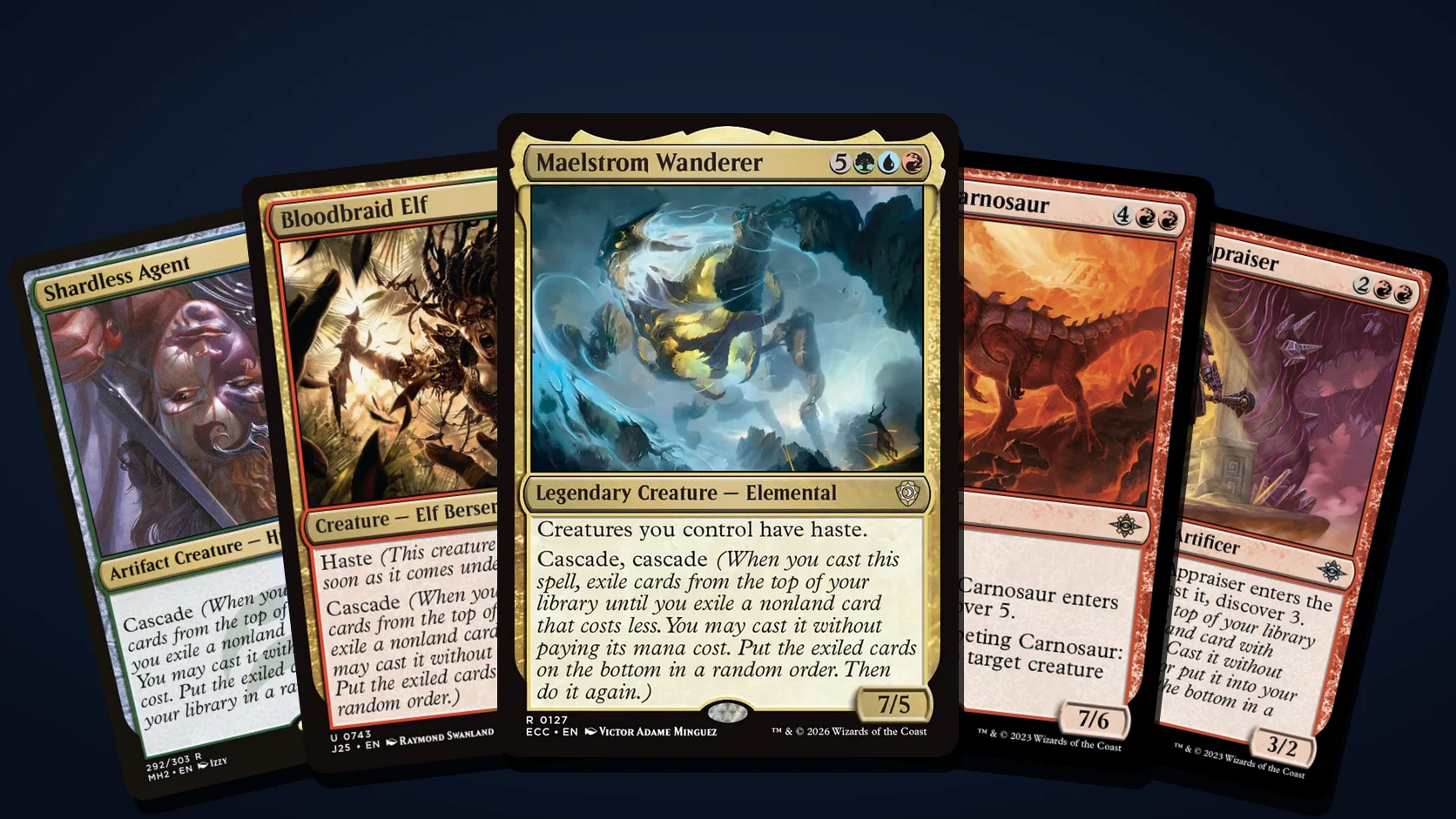
1. Strictly less vs N or less. Cascade on a 4-mana Bloodbraid Elf finds mana value 3 or less. Discover 4 finds mana value 4 or less. A discover number usually sits one below the card's own cost (Geological Appraiser costs 4 and discovers 3; Trumpeting Carnosaur costs 6 and discovers 5), so in practice the reach is often the same. It doesn't have to be: Hit the Mother Lode costs 7 and discovers 10.
2. Hand vs bottom. Discover never loses the card. If cascade finds a removal spell with no target, or a counterspell with nothing to counter, it goes to the bottom.
3. Ability vs action. Cascade is printed on a spell (or granted to one) and only triggers when that spell is cast. Discover is an instruction any card can give, so it shows up on enters triggers, planeswalker abilities, sorceries, lands and end-step triggers.
Countered Spells: It Depends on the Discover Source
Cascade triggers on cast, so the trigger goes on the stack above its spell and resolves first. Countering the cascade spell doesn't stop the free card (Scryfall ruling on Bloodbraid Elf).
Discover depends on where it comes from:
- Enters triggers (Trumpeting Carnosaur, Geological Appraiser): counter the creature and there is no discover.
- Cast triggers (Monstrous Vortex: "Whenever you cast a creature spell with power 5 or greater, discover X, where X is that spell's mana value"): works like cascade and survives the counter.
- Spells (Hit the Mother Lode): counter the sorcery and the discover never happens.
Edge Cases: Mana Value 0, Split Cards, X
Mana value 0. Cards with no mana cost, such as Living End and Crashing Footfalls, have mana value 0 (CR 202.3a). Any cascade can hit them, and so can any discover. That is how Modern's Violent Outburst decks turn cascade into a tutor: with no other nonland card under mana value 3 in the deck, the suspend card is the only legal hit. Our suspend guide covers those cards.
Split cards. Outside the stack a split card's mana value is both halves added together (CR 202.3d). Fire // Ice counts as 4, so cascade off a 4-mana spell skips past it, while discover 4 stops on it. Either way you cast only one half, and that half must fit the limit.
Adventures and modal double-faced cards. Since a 2021 rules change, the spell you cast has to fit too, not only the card that stopped the exile. Scryfall's example: Galvanic Giant (mana value 4) has the Adventure Storm Reading (mana value 7). Discover 4 can cast the Giant but not Storm Reading; discover 7 can cast either. Cascade applies the same check with "less than".
X spells. X counts as 0 in your library (CR 202.3e), and a spell cast without paying its mana cost must take X = 0 (CR 107.3b). Cascade wastes the card. Discover can put it into your hand to cast later for real.
Copies. A copy of a cascade spell isn't cast (CR 707.10), so it doesn't cascade.
When Each Is Better
Cascade is better when:
- You expect counterspells. The free card arrives first.
- The spell is huge. Maelstrom Wanderer cascades twice into anything up to 7; Apex Devastator cascades four times into anything up to 9.
- You build the deck around one hit. Living End and Crashing Footfalls in Modern rely on cascade's relative limit and a curve with nothing else under 3.
- You can grant it. Imoti, Celebrant of Bounty gives your spells with mana value 6 or greater cascade; Zhulodok, Void Gorger gives colorless spells you cast from hand with mana value 7 or greater cascade twice.
Discover is better when:
- Your deck has situational cards. The hand option means nothing gets buried.
- You want it again and again. Chimil, the Inner Sun discovers 5 at the beginning of each of your end steps; Quintorius Kand's −3 is discover 4.
- You want reach above the card's cost. Hit the Mother Lode discovers 10 and makes Treasure for the difference; Pantlaza, Sun-Favored discovers X equal to an entering Dinosaur's toughness.
Both cast from exile, so both feed Quintorius Kand's "whenever you cast a spell from exile" damage.
Notable Cards
| Card | Mechanic | Cost | Finds |
|---|---|---|---|
| Violent Outburst | Cascade (instant) | 3 | Mana value 2 or less |
| Shardless Agent | Cascade | 3 | Mana value 2 or less |
| Bloodbraid Elf | Cascade, haste | 4 | Mana value 3 or less |
| Maelstrom Wanderer | Cascade, cascade | 8 | Two cards, mana value 7 or less |
| Apex Devastator | Cascade ×4 | 10 | Four cards, mana value 9 or less |
| Geological Appraiser | Discover 3 if cast | 4 | Mana value 3 or less |
| Trumpeting Carnosaur | Discover 5 on enter | 6 | Mana value 5 or less |
| Chimil, the Inner Sun | Discover 5 on your end step | 6 | Mana value 5 or less |
| Hit the Mother Lode | Discover 10 (sorcery) | 7 | Mana value 10 or less |
Geological Appraiser is banned in Pioneer. Maelstrom Wanderer and Apex Devastator are not legal in Modern; they are Commander cards. For the dinosaur discover deck, see the best dinosaur commanders.
The Bottom Line
Cascade is tied to casting a spell, reaches anything cheaper than it, and buries what you decline. Discover is an instruction any card can give, reaches a fixed number, and always lets you keep the card. Same exile-until-hit engine, different trade-offs.
Sources
- Comprehensive Rules, effective 6 Nov 2026: 107.3b, 202.3a, 202.3d, 202.3e, 701.57, 702.85, 707.10
- Scryfall: every card with cascade and every card with discover, counted 19 Nov 2026
- Scryfall rulings on Bloodbraid Elf (2021) and Trumpeting Carnosaur (2023); Oracle text and format legality for every card named, checked 19 Nov 2026
Related Guides
- What cascade means in MTG: the full cascade rules and the Modern decks built on it
- Discover in MTG: the full discover rules, best cards and the Pioneer ban
- The stack explained: why a cast trigger resolves before its spell
- Hexproof vs shroud: another pair of look-alike keywords, compared
- The MTG keywords glossary: every keyword in one place