
Quick verdict
Discover N exiles cards from the top of your library until it exiles a nonland card with mana value N or less, then you either cast that card without paying its mana cost or put it into your hand, with the rest going to the bottom in a random order. It looks like cascade and differs in three ways that matter: a fixed mana value ceiling instead of a relative one, a guaranteed floor because you can always take the card into hand, and no dependency on casting a spell.
WHERE TO GET DISCOVER CARDS
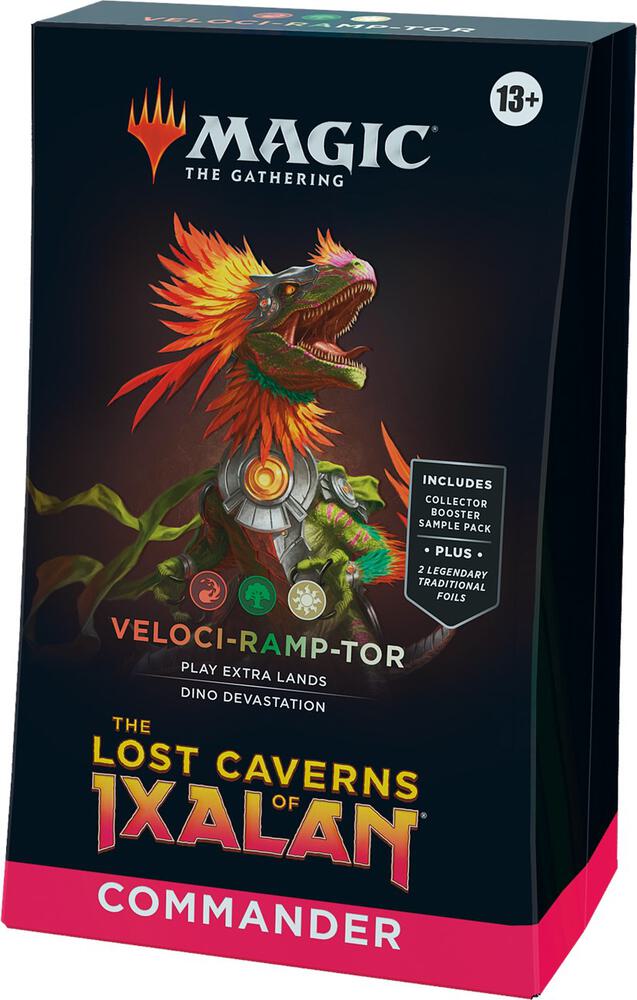
Lost Caverns of Ixalan Commander Deck: Veloci-Ramp-Tor
The discover precon - a dinosaur deck from the mechanic's home set, with a commander that discovers
- ✓Pantlaza, Sun-Favored discovers when dinosaurs enter
- ✓Built around dinosaurs and discover triggers from the mechanic's home set
Discover in MTG is a keyword action from The Lost Caverns of Ixalan: discover N exiles cards from the top of your library until you hit a nonland card with mana value N or less, then you either cast it without paying its mana cost or put it into your hand. Everything else exiled goes to the bottom in a random order. Here is how the discover rules work, and why they are a quiet upgrade on cascade.
Cascade has a problem that took Magic fourteen years to fix: it is a coin flip you cannot decline.
You cast your spell, you exile until you hit something cheaper, and then you either cast that thing or lose it to the bottom of your library. There is no third option. If cascade finds your one situational answer at the wrong moment, that card is gone.
Discover keeps the exciting part — free spells off the top of your library — and removes the coin flip. Same exile-until-you-hit structure. Same free cast. But if the card is not right for this moment, you put it in your hand instead.
That single clause is why discover reads as tamer than cascade and plays as more consistent. And it is why a discover card, not a cascade card, is the one that got banned in Pioneer.
The rule: exile until you hit a nonland card of mana value N or less, then cast it free or take it to hand.
Discover Rules in MTG
Discover is a keyword action with a number attached. The reminder text is explicit:
Exile cards from the top of your library until you exile a nonland card with mana value N or less. Cast it without paying its mana cost or put it into your hand. Put the rest on the bottom in a random order.
Breaking that into the parts that decide games:
"Nonland." Lands are skipped and buried. A deck with 38 lands digs a lot further per discover than one with 22.
"Mana value N or less." This is a fixed, inclusive ceiling. Discover 3 finds a 3-drop. It cannot find a 4-drop no matter what.
"Cast it without paying its mana cost or put it into your hand." Your choice, made on resolution. This is the whole design.
"The rest on the bottom in a random order." Not the top, and not in an order you choose. Every discover shuffles a chunk of your library into unknown territory.
X counts as zero
A card with X in its mana cost has a mana value of zero everywhere except on the stack. So an X spell sitting in your library is legal for discover 1, and it will be cast with X equal to zero — which usually means it does nothing at all. Discover decks either avoid X spells or accept that hitting one is close to a miss.
Discover vs Cascade
The two mechanics look nearly identical and behave differently in three specific ways.
| Discover N | Cascade | |
|---|---|---|
| Target range | Mana value N or less — fixed | Costs less than the cascading spell — relative |
| If you don't cast it | Goes to your hand | Goes to the bottom of your library |
| What triggers it | Usually an ETB or activated ability | Casting the spell that has cascade |
| Works if the spell is countered | N/A — not tied to casting | Yes, cascade already triggered on cast |
| Skips lands | Yes | Yes |
| Rest of exiled cards | Bottom, random order | Bottom, random order |
| Ceiling | Capped at N | As high as the spell's cost allows |
| Floor | You always keep the card | You can lose the card entirely |
The "works if the spell is countered" row is the subtle one. Cascade is an ability that triggers when you cast the spell, so it resolves even if the spell itself gets countered — a cascade spell answered by a counterspell still gives you the free card underneath. Discover is normally attached to a creature entering the battlefield, so countering the creature means no discover at all.
Cascade gambles for a bigger prize. Discover pays out every time, but the prize has a ceiling.
Our guides to cascade and the stack cover why the cast trigger and the enters-the-battlefield trigger behave so differently under interaction.
The Cards That Define It
Geological Appraiser — 4 mana, discover 3 when it enters if you cast it. Modest on paper, format-warping in practice, for reasons below.
Trumpeting Carnosaur — 6 mana, trample, discover 5 on entry. The best pure value discover card: it finds almost anything in a normal deck, and its discard mode makes it removal when you do not want the body.
Quintorius Kand — a 5-mana planeswalker whose minus ability is discover 4, giving a repeatable engine rather than a one-shot.
Chimil, the Inner Sun — a 6-mana artifact that discovers 5 at the beginning of every end step, and makes your spells uncounterable while it does. The most Commander-shaped discover card printed.
Monstrous Vortex and Hit the Mother Lode — the payoff-and-payoff-again designs that reward stacking discover triggers.
Deckbuilding around a fixed ceiling
Because discover N cannot exceed N, the mechanic rewards a deliberately shaped mana curve. A discover 3 deck that runs almost no cards above three mana turns every trigger into a guaranteed hit on something meaningful. Add anything expensive and you are not adding a better hit — you are adding a card discover will skip past and bury.
Why Geological Appraiser Was Banned in Pioneer
The card that broke was not the biggest discover card. It was the cheapest one that could find another copy of itself.
Discover 3 can hit a three-mana creature. If that creature also discovers, it triggers on entry, and finds another. Add enough cheap discover-and-creature density and a single four-mana play chains through a large portion of the deck for free, ending in a win before an opponent with an untapped land has a meaningful window to act.
The critical property is that the chain is free and deterministic enough — because discover skips lands and can always take the card, a well-built deck rarely fizzles. That is exactly the consistency discover was designed to have, taken past the point of a fair game.
Geological Appraiser is banned in Pioneer. It remains legal in Standard, Modern and Commander, where the surrounding card pools either offer faster answers or do not support the same density. Trumpeting Carnosaur, the more obviously powerful card, is legal everywhere — a good illustration that formats ban consistency more often than they ban raw power. Our formats guide covers how these ban lists diverge.
In Commander
Discover is a strong Commander mechanic for a reason that has nothing to do with combo: it is card advantage that does not care about your mana.
A discover 5 off Trumpeting Carnosaur is a free five-drop in a format where six-mana turns are routine. Chimil doing it every end step is an engine that generates a free spell per turn cycle while protecting the rest of your hand from counterspells.
Two format-specific cautions:
The random-order bottom is a real cost. Commander decks are singleton, so every card buried is a unique card. Repeated discovers progressively randomise the bottom half of your deck, which matters for any tutoring or top-of-library plan.
Free casts still use the stack. A card cast off discover can be countered, and its own enters-the-battlefield triggers happen normally — which is the good half, because chaining discover into discover is where the format's most explosive turns come from.
The most-played discover cards in Commander
Ranked by how many Commander decks play them (EDHREC data, via Scryfall). Prices are for the cheapest printing on Scryfall in October 2026.
- Chimil, the Inner Sun — about $7.85
- Brass's Tunnel-Grinder // Tecutlan, the Searing Rift — about $3.02
- Trumpeting Carnosaur — about $2.08
- Hit the Mother Lode — about $0.49
History
Discover debuted in The Lost Caverns of Ixalan in November 2023, thematically tied to the set's cavern-exploration flavour.
It is a small mechanic by design — barely twenty cards have it, and all but a handful were printed in that one set. It did not stay put, though: the Lost Caverns lands were reprinted into Modern Horizons 3 Commander, and genuinely new discover cards arrived in Edge of Eternities Commander in 2025 and Marvel Super Heroes Commander in 2026.
Its lineage is clear. Cascade arrived in Alara Reborn in 2009 and has been a permanent balance headache ever since, precisely because its relative cost ceiling scales without limit. Discover is the same idea rebuilt with a fixed ceiling and a guaranteed floor — a deliberately more designable version of an effect Wizards clearly likes but has never fully controlled.
Common Misconceptions
"Discover is just cascade." Fixed ceiling instead of relative, hand instead of bottom, and usually not a cast trigger.
"Discover can find a land." It cannot. Lands are exiled and buried.
"Discover 3 finds a 4-drop if nothing cheaper is there." It does not. N is a hard cap; it keeps digging.
"If I don't cast it, I lose it." That is cascade. Discover puts it in your hand.
"Countering the spell stops the discover." For a creature with an entry trigger, yes. That is the opposite of how cascade works.
"Discover shuffles my library." It puts only the exiled cards on the bottom, in a random order. The rest of your library is untouched.
Conclusion: Consistency Is the Mechanic
Discover is what happens when a designer looks at cascade, identifies the coin flip as the problem rather than the appeal, and removes it. Everything else about the two mechanics is nearly the same. The difference is that discover never wastes the card it finds.
That reliability is both its strength and the reason it needed a ban. A fixed ceiling and a guaranteed floor is exactly what you want when building a deck — and exactly what a format does not want when the thing you are reliably finding is another copy of the engine.
Build for it deliberately. Keep the curve under the number, count your lands honestly, and remember that every discover quietly randomises part of your deck. Play it well and it is the most consistent free spell in Magic.
Citations & Resources
- Wizards of the Coast: Comprehensive Rules — discover and keyword actions
- Wizards of the Coast: Banned and Restricted list — Geological Appraiser in Pioneer
- Scryfall: Every card with discover
- Scryfall: The Lost Caverns of Ixalan — where discover debuted
Related Guides
- The Ultimate MTG Keywords Glossary — every keyword, with a printable cheat sheet
- What Cascade Means in MTG — the mechanic discover was built to fix
- MTG Formats Explained — why Pioneer bans differ from Modern and Standard
- MTG The Stack Explained — why countering a discover creature stops the trigger
- MTG State-Based Actions — what happens between a free cast and its resolution
- MTG Phases and Turn Structure — when an end-step discover engine fires
- What Surveil Means in MTG — the other way modern Magic manipulates the top of your library
- Best MTG Commander Decks — where the free-spell engines live
Frequently Asked Questions
🔗 Related Resources
More Reviews:
Related Articles

Monarch and Initiative MTG: Full Rules Explained (2026)
Monarch and the initiative in MTG reward whoever holds them and pass on combat damage. Full monarch rules, initiative rules, and why initiative got banned.
Proliferate MTG: What It Means, Rules and Best Cards (2026)
Proliferate in MTG adds one more of each counter already on the permanents and players you choose. It doesn't target. Full proliferate rules and best cards.

MTG Protection: What Protection Does and the DEBT Rule (2026)
Protection in MTG stops a creature being Damaged, Enchanted, Blocked or Targeted by the named quality. Full protection rules (DEBT) and every edge case.