
Quick verdict
Plot lets you pay a card's plot cost during your main phase and exile it from your hand. On any later turn you may cast it from exile without paying its mana cost, again only in your main phase with the stack empty. Plotting is a special action, so it can't be responded to, and it lets you spend mana on a slow turn so that a later turn can hold two or three spells. Some cards make other cards plotted, and a few trigger when they become plotted.
Plot in MTG is a keyword that lets you pay a card's plot cost during your main phase and exile it from your hand. On any later turn you may cast it from exile without paying its mana cost, as a sorcery. You spend mana now, on a turn where you had nothing better to do, and get a free spell later.
Plot is the signature mechanic of Outlaws of Thunder Junction (2024). Its whole point is turns with more than one spell: plot a creature on turn three, and on turn four you can cast it for free next to whatever else you draw.
Plot Rules in MTG
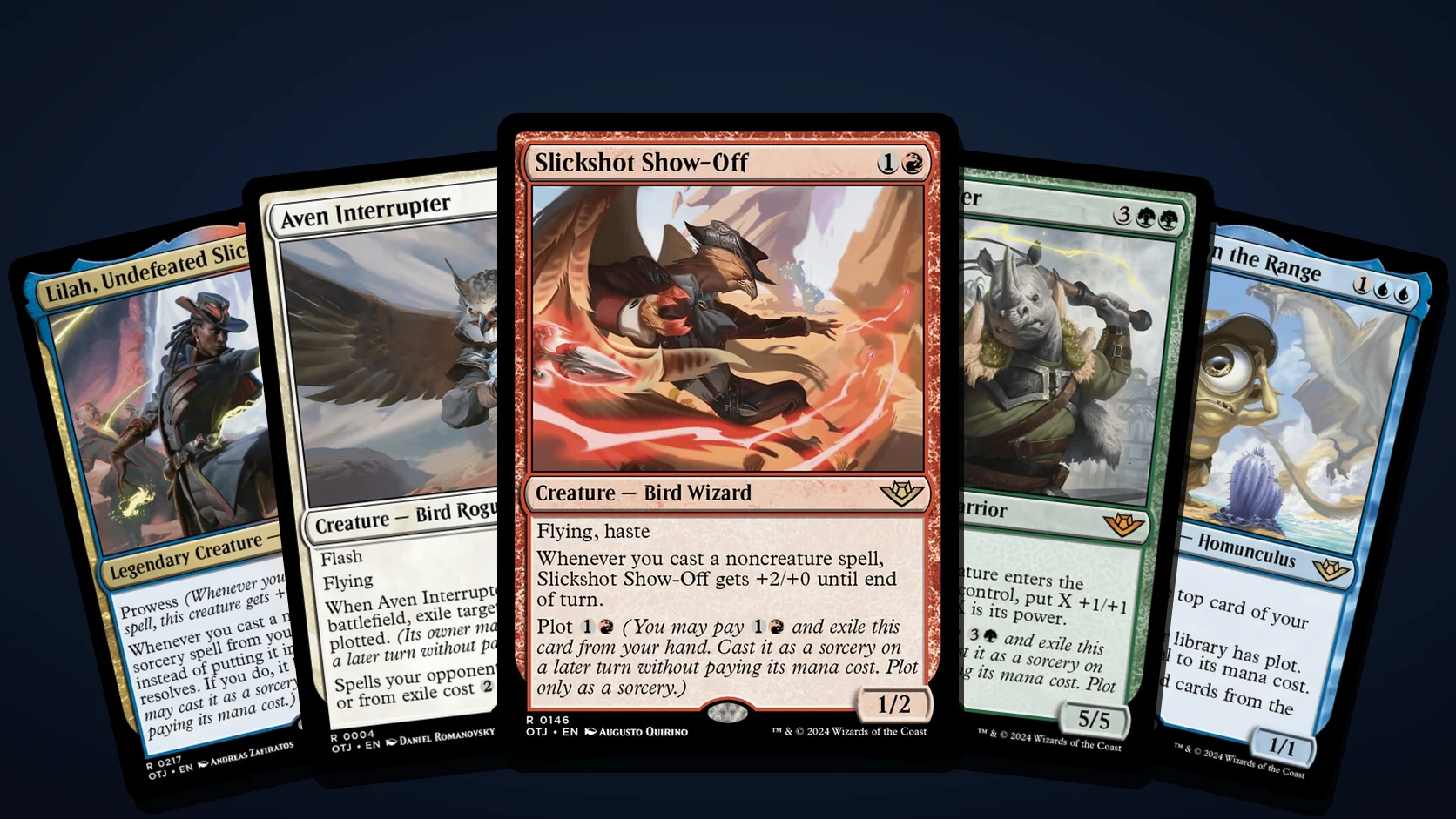
The reminder text on Slickshot Show-Off covers the basics:
Plot {1}{R} (You may pay {1}{R} and exile this card from your hand. Cast it as a sorcery on a later turn without paying its mana cost. Plot only as a sorcery.)
The Comprehensive Rules (702.170) define it in two steps.
- Plotting. "Plot [cost]" means any time you have priority during your main phase while the stack is empty, you may exile this card from your hand and pay the cost. It becomes a plotted card.
- Casting. A plotted card's owner may cast it from exile without paying its mana cost during their main phase while the stack is empty, on any turn after the turn in which it became plotted.
Everything else follows from those two rules.
Plotting is a special action. Exiling a card with plot doesn't use the stack. Once you announce it, nobody can respond by trying to take the card out of your hand. A counterspell has nothing to hit.
Not the same turn. You can't cast a plotted card on the turn it became plotted. From your next turn on, you can cast it whenever you like, as long as it's your main phase and the stack is empty. There is no deadline.
The card sits in exile face up. Exiled cards are kept face up by default, and any player may look at them. Your opponent knows exactly what you have plotted.
It's a free cast, so it's an alternative cost. You can't combine it with another alternative cost. You can pay additional costs, such as kicker, and you must pay any mandatory additional costs. If the card has {X} in its mana cost, X is 0.
Slickshot Show-Off
- Plot cost
- 1R
- What you get on the free turn
- A 1/2 flying, haste creature that gets +2/+0 per noncreature spell
1R
Mana cost
Railway Brawler
- Plot cost
- 3G
- What you get on the free turn
- A 5/5 reach, trample creature that doubles the power of later creatures with +1/+1 counters
3GG
Mana cost
Outcaster Trailblazer
- Plot cost
- 2G
- What you get on the free turn
- A 4/2 that adds one mana and draws when big creatures enter
2G
Mana cost
Stingerback Terror
- Plot cost
- 2R
- What you get on the free turn
- A 7/7 flying, trample Dragon that shrinks for each card in your hand
2RR
Mana cost
Pitiless Carnage
- Plot cost
- 1BB
- What you get on the free turn
- Sacrifice any number of permanents, draw that many cards
3B
Mana cost
Plan the Heist
- Plot cost
- 3U
- What you get on the free turn
- Draw three, with surveil 3 first if your hand is empty
2UU
Mana cost
Highway Robbery
- Plot cost
- 1R
- What you get on the free turn
- Discard a card or sacrifice a land to draw two
1R
Mana cost
Step Between Worlds
- Plot cost
- 4UU
- What you get on the free turn
- Each player may shuffle hand and graveyard away and draw seven
3UU
Mana cost
Notice that the plot cost is sometimes cheaper than the mana cost (Railway Brawler, Pitiless Carnage), sometimes the same (Slickshot Show-Off) and sometimes more expensive (Plan the Heist, Step Between Worlds). You pay a premium on those to move the spell to a turn where your mana is busy.
When Can You Plot a Card and Cast It?
Both halves of plot are sorcery speed.
- Plotting: your own turn, in a main phase, with the stack empty and while you have priority. The reminder text puts it as "plot only as a sorcery".
- Casting the plotted card: the same window, on any later turn. See our guide to MTG turn phases for where the main phases fall.
That second window applies even to instants. If an instant or a card with flash becomes plotted, you can still cast it only during your main phase while the stack is empty. This is the main difference from cards that let you cast something from exile "at any time".
Cards That Become Plotted by Other Effects
Rule 702.170c says some spells and abilities cause a card in exile to become plotted, and 702.170d says a plotted card can be cast even if it doesn't have plot itself. Five cards in Outlaws of Thunder Junction use this, and a sixth, Fblthp, works the other way round by giving cards plot:
- Aven Interrupter ({1}{W}{W}). Flash, flying. When it enters, exile target spell, and it becomes plotted. The owner can recast it on a later turn for free, but Aven Interrupter also makes spells your opponents cast from graveyards or from exile cost {2} more. While Aven Interrupter is still on the battlefield, that tax applies to their free plotted spell, so they pay {2} for it. A spell that can't be countered can still be exiled this way.
- Jace Reawakened ({U}{U}). Its second +1 lets you exile a nonland card with mana value 3 or less from your hand, and it becomes plotted. Jace can't be cast during your first three turns.
- Kellan Joins Up ({G}{W}{U}). When it enters, you may exile a nonland card with mana value 3 or less from your hand, and it becomes plotted.
- Lilah, Undefeated Slickshot ({1}{U}{R}). Whenever you cast a multicolored instant or sorcery from your hand, it is exiled as it resolves and becomes plotted, so you get to cast it a second time for free. If the spell is countered or doesn't resolve, Lilah doesn't exile it.
- Make Your Own Luck ({3}{G}{U}). Look at the top three cards, exile a nonland card from among them, and it becomes plotted. The rest go to your hand.
- Fblthp, Lost on the Range ({1}{U}{U}). Ward {2}. You may look at the top card of your library any time. The top card of your library has plot, with a plot cost equal to its mana cost, and you may plot nonland cards from the top of your library. That uses rule 702.170f, which lets plot work outside your hand.
Outside the set, the Secret Lair card Mohiam, Imperial Truthsayer also makes exiled cards plotted.
A recast spell is a new object. When Aven Interrupter's victim casts the plotted card, none of the choices made for the original spell carry over.
"Becomes Plotted" Triggers
Two cards care about the moment they are plotted, not when they are cast:
- Aloe Alchemist ({1}{G}, plot {1}{G}). When this card becomes plotted, target creature gets +3/+2 and gains trample until end of turn. You get a combat trick now and a 3/2 trampler later.
- Longhorn Sharpshooter ({2}{R}, plot {3}{R}). When this card becomes plotted, it deals 2 damage to any target. A removal spell now, a 3/3 reach creature later.
The trigger says "becomes plotted", not "is plotted using its plot ability". Both cards have mana value 3 or less, so exiling them with Jace Reawakened or Kellan Joins Up makes them plotted and triggers them too.
Plot Rulings and Edge Cases
A countered plotted spell goes to the graveyard. Unlike flashback, plot doesn't exile the spell when it leaves the stack. Once you cast it, it's an ordinary spell.
Casting it triggers "whenever you cast". A plotted card is cast from exile, so prowess, Slickshot Show-Off and "second spell each turn" cards such as Brimstone Roundup all see it. Plotting itself is not casting, so it triggers none of them.
Mana value doesn't change. It still comes from the printed mana cost. Effects that reduce costs, like Doc Aurlock, Grizzled Genius, can make plotting cheaper (Doc reduces plot costs by {2} of generic mana) but never touch a card's mana value.
Leaving exile ends it. No rule says this outright, but under rule 400.7 a card that changes zones becomes a new object with no memory of its previous existence. So if a plotted card leaves exile and comes back, it should no longer be plotted.
Lands can't be made plotted by these cards. Jace Reawakened, Kellan Joins Up, Make Your Own Luck and Fblthp all specify a nonland card.
Why Plot Is Good: Two Spells in One Turn
Plot is a way of moving mana from one turn to another. Its value shows up in three ways:
- Double-spell turns. Casting a plotted card is free, so it adds a spell to a turn without using any of that turn's mana. Cards like Loan Shark and Brimstone Roundup reward casting two spells in a turn, and Outlaw Stitcher makes a bigger Zombie token the more spells you've cast that turn.
- Using awkward mana. A turn with two spare mana and nothing to cast becomes a turn where you plot Slickshot Show-Off for next turn.
- Playing around counterspells. You can't counter the plot itself. You can still counter the spell when it's cast, but you have to have the counter ready on their turn.
The cost is information and tempo. Your opponent sees the card in exile, and the card doesn't affect the board until the turn after you plot it.
Plot vs Suspend vs Foretell
Plot has two close relatives: suspend from Time Spiral and foretell from Kaldheim. All three exile a card from your hand now so you can cast it later.
What you pay now
- Plot
- The plot cost
- Suspend
- The suspend cost
- Foretell
- Two generic mana
How it's exiled
- Plot
- Face up
- Suspend
- Face up, with time counters
- Foretell
- Face down
What you pay later
- Plot
- Nothing
- Suspend
- Nothing
- Foretell
- The foretell cost
When you can cast it
- Plot
- Any later turn, main phase, empty stack
- Suspend
- When the last time counter comes off, in your upkeep
- Foretell
- Any later turn, with normal timing
Creatures get haste
- Plot
- No
- Suspend
- Yes
- Foretell
- No
The key difference from suspend is control. A suspended card can only be cast on the upkeep its last time counter comes off, and if you pass, it stays in exile for good. A plotted card waits until you choose to cast it, but always at sorcery speed.
The Best Plot Cards
Prices are TCGplayer market prices from Scryfall for the regular Outlaws of Thunder Junction printing on 19 November 2026.
Slickshot Show-Off ($4.67). A two-mana flier with haste that gets +2/+0 for every noncreature spell you cast. Plotting it means a later turn where it arrives for free, attacks right away and still leaves all your mana for pump spells.
Railway Brawler ($7.03). A 5/5 with reach and trample. Every other creature you control that enters gets +1/+1 counters equal to its power. Plotting it for {3}{G} and casting it free next turn next to another big creature gives you two big threats for one turn's mana.
Aven Interrupter ($2.80). A flash flier that works like a counterspell with a delay. It exiles a spell, makes it plotted, and charges your opponent {2} extra to recast it.
Jace Reawakened ($3.54). A two-mana planeswalker that loots or plots a card each turn, with an ultimate that copies every spell you cast for the rest of the turn.
Outcaster Trailblazer ($2.38). A 4/2 that adds a mana when it enters and draws a card whenever another creature with power 4 or greater enters. Plotted, it gives you a free body and a mana on the turn you need it.
Pitiless Carnage. Plot costs {1}{B}{B}, less than its {3}{B} mana cost. Then cast it free to sacrifice permanents (including tokens and clues) and draw that many.
Lilah, Undefeated Slickshot. Every multicolored instant or sorcery you cast from your hand becomes plotted as it resolves, so you get to cast it twice.
Fblthp, Lost on the Range. A legendary creature that lets you plot the top card of your library, so it works like an extra card in hand.
Aloe Alchemist and Longhorn Sharpshooter. Two cards that give you an effect the moment you plot them, so even if you never cast them, the plot cost bought you something.
Where Plot Came From: Outlaws of Thunder Junction
Plot debuted in Outlaws of Thunder Junction, released on 19 April 2024. It fits the set's heist and Wild West theme: you set something up ahead of time and cash it in later. According to Scryfall, 33 cards are printed with plot: 31 in the main set and two, Lock and Load and Pyretic Charge, in the Outlaws of Thunder Junction Commander decks.
Every plot card in this guide comes in Outlaws of Thunder Junction boosters. A play booster box traded at $189.20 (TCGplayer market price, 18 November 2026) on TCGplayer today, and our Thunder Junction play booster box value tracker shows what the cards inside are worth against that price. The collector booster box tracker does the same for the $490.12 (TCGplayer market price, 18 November 2026) collector box. If you only want the plot cards for a deck, singles are far cheaper: every card above was under $8 on 19 November 2026.
Not sure which box is which? Our collector booster vs play booster guide explains the difference.
Common Misconceptions
"I can cast my plotted card at instant speed." You can't. A plotted card is cast during your main phase with the stack empty, even if it's an instant or has flash.
"I can plot a card and cast it the same turn." You can't. It has to be a later turn.
"Plotting triggers prowess." It doesn't. Plotting is a special action, not casting a spell. Casting the plotted card later does trigger prowess.
"A plotted spell that gets countered goes back to exile." It goes to the graveyard, like any other countered spell.
"I get to pick X when I cast a plotted card." X is always 0 when you cast a card without paying its mana cost.
"Plotted cards are hidden." They're exiled face up, so every player can see them.
Where Plot Fits Among the Keywords
Plot is one of several ways to cast a spell from somewhere other than your hand. For every other keyword you'll run into, our complete MTG keywords glossary has them all, and the cascade guide covers another way to get a spell without paying its mana cost.
Citations & Resources
- Wizards of the Coast: Comprehensive Rules, 702.170 (plot) and 116.2k (special actions)
- Scryfall: Every card with plot
- Scryfall: Every card that makes a card plotted
- Scryfall: Slickshot Show-Off and the plot rulings
- Scryfall: Aven Interrupter and its rulings
Related Guides
- MTG Suspend Explained — the older way to exile a card now and cast it free later
- MTG Flashback Explained — casting from the graveyard, and why a flashback spell is always exiled
- The Ultimate MTG Keywords Glossary — every keyword, with a printable cheat sheet
- MTG Stack Explained — why a special action like plotting can't be responded to
- MTG Turn Phases — where the main phases fall, the only time you can plot
- What Cascade Means in MTG — another free spell, cast the moment it's found