Quick Verdict
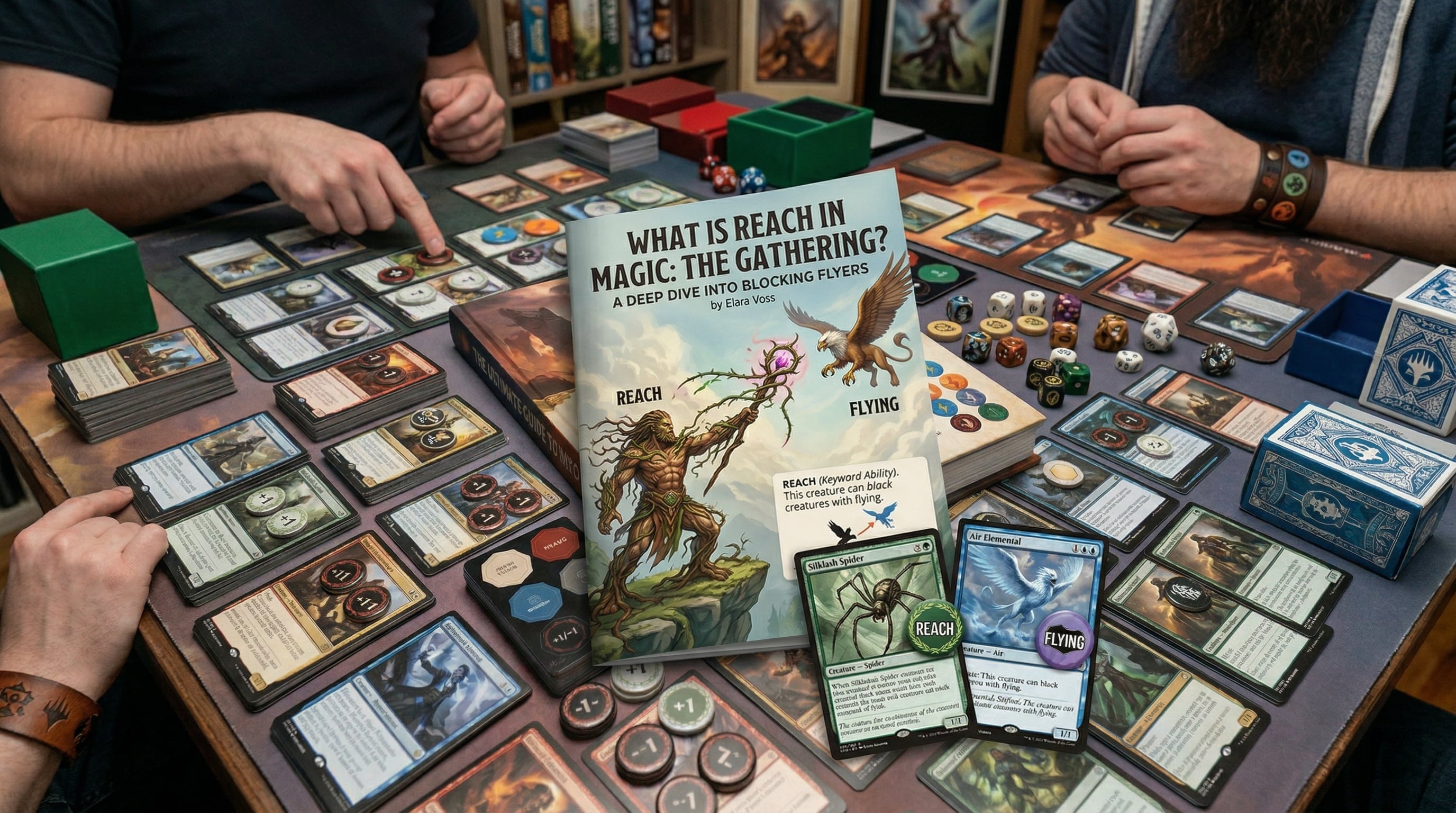
Reach is a static, purely defensive keyword: a creature with flying can't be blocked except by creatures with flying and/or reach. It gives no evasion when attacking, does nothing against horsemanship, shadow or menace, and multiple instances are redundant. The ability dates back to Giant Spider in Alpha and became a keyword in Future Sight in 2007. Green has by far the most reach creatures.
SEALED PRODUCTS


Tarkir: Dragonstorm Play Booster Box
Best for Flying Meta - Dragon-themed set where reach blockers earn their place
- ✓Dragon-heavy set makes reach creatures useful defenders
- ✓Includes reach cards such as Dragon Sniper and Jade-Cast Sentinel
Giant Spider has been blocking flyers since Alpha in 1993. The 2/4 for {3}{G} could block creatures with flying long before the word "reach" existed. For fourteen years that ability was spelled out as rules text on each card. Then, in 2007, it became a keyword.
Reach is how green deals with flyers. Green gets the biggest ground creatures and very few flying ones, and without reach those big creatures could do nothing against drakes and angels. The rule itself is one line long. The confusion comes from what it does not do.
This guide covers the rule, what reach can and can't block, where the keyword came from, and which reach creatures are worth playing.
The Core Mechanics: How Reach Works on the Battlefield
Reach is simple. It changes who can block a flying creature, and nothing else.
The Official Rulebook Definition (CR 702.17)
In the Magic: The Gathering Comprehensive Rules (effective 25 September 2026), reach is a static ability.
CR 702.17a: Reach is a static ability.
CR 702.17b: A creature with flying can't be blocked except by creatures with flying and/or reach.
CR 702.17c: Multiple instances of reach on the same creature are redundant.
The key words are "and/or reach." Reach adds creatures to the pool of legal blockers for a flying attacker. That is all it does.
Defence Only
Reach changes blocking and has no effect on attacking. When your reach creature attacks, any creature can block it. Reach gives no evasion at all.
Offensive vs. Defensive: Why Reach Is Not Flying
A common beginner mistake is to treat reach as a weaker kind of flying. It isn't.
Flying (CR 702.9b) gives both:
- Evasion — a flying attacker can only be blocked by creatures with flying or reach
- Blocking range — a flying creature can block attackers with or without flying
Reach gives only:
- Blocking range — a reach creature can block flying attackers as well as ground attackers
A reach creature that attacks does not fly over anything. A board of 1/1 tokens can block it.
| Capability | Flying | Reach |
|---|---|---|
| Blocks flying creatures | Yes | Yes |
| Blocks ground creatures | Yes | Yes |
| Evades ground blockers when attacking | Yes | No |
| Is blocked by ground creatures when attacking | No | Yes |
| Multiple instances provide benefit | No (Redundant — CR 702.9c) | No (Redundant — CR 702.17c) |
The Evolution of Reach: From Alpha's Giant Spider to 2026
The history of reach is mostly the history of Giant Spider.
Before the Keyword (1993–2007)
Giant Spider was in Limited Edition Alpha in 1993: a 2/4 for {3}{G} whose text said it could block creatures with flying. Green had almost no flyers, and this gave it a way to stop them.
For fourteen years the ability had no keyword. Each card that had it spelled it out in its text box. Cards from that period that now have reach in their Oracle text include Silklash Spider (Onslaught, 2002) and Tangle Spider (Darksteel, 2004).
Giant Spider also became a core set fixture. Mark Rosewater wrote in "Evergreen Eggs & Ham" (2015) that it won the "Core Set Survivor Game", meaning it appeared in the most consecutive core sets of any card.
The 2007 Keywording: Future Sight and Tenth Edition
Future Sight, released in May 2007, introduced the word "reach" on Thornweald Archer, a {1}{G} 2/1 with reach and deathtouch. In "Evergreen Eggs & Ham", Rosewater explains that keywording reach was not originally on his list for Future Sight, but it made templating flying much easier, so it was added.
Tenth Edition followed in July 2007 and reprinted Giant Spider and Tangle Spider with the keyword. Reach has been evergreen since then, and older cards with the "can block creatures with flying" text now say "Reach" in Oracle.
Why the Keywording Mattered
With a keyword, flying's own rules can name reach directly instead of describing an exception. Today's flying rule (CR 702.9b) says a creature with flying can't be blocked except by creatures with flying and/or reach.
The Color Pie: Green's Answer to Flyers
Reach belongs to green. Green gets the largest ground creatures and very few flyers, which leaves it weak to blue and white air forces. Reach lets green defend against them without giving it flying.
You can see this in the card count. As of October 2026, Scryfall lists these numbers of cards with reach (multicolored cards count in each of their colors):
| Color | Cards with reach | Notes |
|---|---|---|
| Green | About 310 | Spiders, archers, treefolk, big beasts |
| Red | 89 | Often archers, such as Robber of the Rich and Meria's Outrider |
| White | 35 | Occasional |
| Blue | 26 | Rare; only 5 are mono-blue |
| Black | 23 | Rarest |
The Evasion Matrix: What Reach Can and Cannot Block
This is where reach causes the most rules confusion. Players often assume it stops all evasion. It only touches flying.
Reach vs. Flying: The Intended Interaction
CR 702.17b lets creatures with reach block creatures with flying. That is the whole ability.
Reach vs. Horsemanship
Horsemanship comes from Portal Three Kingdoms (1999). A creature with horsemanship can't be blocked by creatures without horsemanship, though it can block creatures with or without it (CR 702.31b).
Horsemanship is its own keyword, not a kind of flying, so reach does nothing against it. Only another creature with horsemanship can block it.
Reach vs. Shadow
Shadow comes from the Tempest block. A creature with shadow can't be blocked by creatures without shadow, and a creature without shadow can't be blocked by creatures with shadow (CR 702.28b). Giant Spider can't block a shadow creature, reach or not.
"Can't Be Blocked Except by Creatures with Flying"
Some cards are restricted to flying blockers specifically. Treetop Scout, from Scourge (2003), reads: "This creature can't be blocked except by creatures with flying."
Reach does not satisfy this. A reach creature does not have flying, so it can't block Treetop Scout.
| Attacking Keyword | Can Reach Block It? | Rules Rationale |
|---|---|---|
| Flying | Yes | Explicitly permitted by CR 702.17b — this is reach's only function |
| Horsemanship | No | Only creatures with horsemanship can block it (CR 702.31b) |
| Shadow | No | Only creatures with shadow can block it (CR 702.28b) |
| Menace | No (alone) | Menace requires two or more blockers (CR 702.111b) — one reach creature is not enough |
| 'Can't be blocked except by creatures with flying' | No | Reach does not grant flying, so it fails this check |
Reach Is Not General Anti-Evasion
Reach only interacts with flying. It will stop angels and dragons. It will not stop horsemanship, shadow, or a menace attacker when you only have one blocker.
Why Reach Is Easy to Miss
Reach does nothing until a flyer attacks, so it is easy to forget it is there.
The Problem in Paper Magic
Keywords like flying and haste show up the moment a creature attacks. Reach only matters when your opponent decides to attack with a flyer. If it sits in a long text box, players skim past it.
The result is a familiar misplay: someone attacks with a good flyer and has it blocked and killed by a creature they did not know had reach.
Creatures That Don't Look Like They Have Reach
Most spiders and archers have reach, so players learn to look for it there. Other creature types catch people out. World Breaker is a 5/7 Eldrazi with reach. Spinewoods Armadillo is a 7/7 with reach and ward {3}. Neither looks like an anti-air card.
A Simple Habit
Before you attack with a flyer, read every untapped creature your opponent controls. In paper you can always ask to see a card. On digital clients the game enforces blocking legality for you, so an illegal block can't happen.
Top Reach Creatures in Competitive and Commander MTG
Reach alone does not make a card playable. The reach creatures that see real play are good for other reasons, and reach is a bonus.
Multi-Format Staples
Endurance — A 3/4 for {1}{G}{G} with flash and reach from Modern Horizons 2. When it enters, up to one target player puts all the cards from their graveyard on the bottom of their library in a random order. It also has evoke (exile a green card from your hand), so it can be cast for free. It is played as graveyard hate in Modern and Legacy, and in Commander. Reach is a side benefit.
Elder Gargaroth — A 6/6 for {3}{G}{G} with reach, vigilance and trample. Whenever it attacks or blocks, you choose one: create a 3/3 Beast token, gain 3 life, or draw a card. Vigilance plus reach means it can attack and still be ready to block a flyer. It is legal in Pioneer, Modern and Commander.
Ulvenwald Hydra — A {4}{G}{G} Hydra with reach whose power and toughness equal the number of lands you control. When it enters, you may search for a land and put it onto the battlefield tapped. A Commander favourite in land-heavy decks.
Robber of the Rich — A {1}{R} 2/2 with reach and haste from Throne of Eldraine, and an example of red reach. It is legal in Pioneer and Modern.
| Card Name | Legal In (Oct 2026) | Strategic Role | Scryfall Price (Oct 2026) |
|---|---|---|---|
| Endurance | Modern, Legacy, Commander | Flash graveyard hate; surprise anti-air blocker | From about $2.81 |
| Elder Gargaroth | Pioneer, Modern, Commander | Midrange threat; vigilance + reach defender | About $2.45 |
| Ulvenwald Hydra | Pioneer, Modern, Commander | Large defender that fetches a land | About $0.52 |
| Robber of the Rich | Pioneer, Modern | Aggressive card theft; haste with reach | About $1.83 |
| Giant Spider | Pioneer, Modern, Pauper | Historical significance; basic Limited defender | About $0.06 |
The Reach Test
When you judge a reach creature for constructed play, ask: would it still be playable without reach? If yes, reach is a nice bonus. If reach is its only selling point, it is probably a Limited and casual card.
Granting Reach: Counters, Equipment, and Combat Tricks
Reach can also be given to creatures during a game.
Reach Counters (Ikoria: Lair of Behemoths)
Ikoria: Lair of Behemoths (2020) introduced keyword counters. A keyword counter on a permanent gives it that keyword, and reach is one of the keywords a counter can be (CR 122.1b). Ikoria cards that use reach counters include Sudden Spinnerets and Flycatcher Giraffid.
A reach counter lasts across turns, unlike a one-turn trick. It does not survive a zone change, though. Counters on an object are not kept when it moves from one zone to another; they simply cease to exist (CR 122.2). If the creature dies, is bounced or is blinked, the reach counter is gone.
Equipment and Auras
Some Equipment and Auras grant reach. They are most useful in Limited, where you may not have enough natural reach creatures.
Instant-Speed Combat Tricks
An instant that grants reach can ambush a flyer. Sudden Spinnerets is an example: it gives a creature +1/+3 until end of turn, puts a reach counter on it, and untaps it. Cast it after attackers are declared, and an untapped ground creature can block the flyer.
Reach in Standard (October 2026)
All of the sets below are Standard-legal as of October 2026, according to Scryfall's legality data, and each has reach creatures. This is a selection, not the full list of legal sets.
| Set Name | Released | Reach cards in set | Examples |
|---|---|---|---|
| Wilds of Eldraine | September 2023 | 5 | Scarecrow Guide, Skewer Slinger |
| Bloomburrow | August 2024 | 13 | Clifftop Lookout, Fecund Greenshell |
| Foundations | November 2024 | 10 | Thornweald Archer, Elfsworn Giant |
| Tarkir: Dragonstorm | April 2025 | 6 | Dragon Sniper, Jade-Cast Sentinel |
| Marvel's Spider-Man | September 2025 | 7 | Radioactive Spider, Spider-Bot |
| Teenage Mutant Ninja Turtles | March 2026 | 4 | Primordial Pachyderm, Technodrome |
Standard Rotation Notice
Wizards' Standard page says that once per year, after the first premier set Prerelease of the year, the six oldest sets in Standard rotate out. Since 2025, new Universes Beyond booster sets such as Spider-Man and TMNT are legal in Standard. Cards from associated Commander decks may not be. Always check individual card legality before a sanctioned event.
Reach and Card Prices
Reach on its own adds little to a card's price. A plain Giant Spider is about $0.06 on Scryfall (October 2026). The reach cards that cost more do so because of what else they do.
The Endurance Case Study
Endurance is played for its flash graveyard hate and free evoke mode, not for reach. Its Lorwyn Eclipsed Commander reprint lists at about $2.81 on Scryfall, and the regular Modern Horizons 2 printing at about $4.19 (October 2026). Reach is a bonus that sometimes lets it block a flyer.
Quick Reference Rules FAQ
Does reach grant flying? No. Reach lets a creature block flyers. It does not give it flying.
Can reach block horsemanship? No. Reach only interacts with flying. Horsemanship and shadow each need a blocker with the same keyword.
Do multiple instances of reach stack? No. CR 702.17c says multiple instances on the same creature are redundant.
Is reach offensive or defensive? Defensive only. An attacking reach creature has no evasion.
Which color uses reach the most? Green, by far. Red is a distant second.
Can reach be granted temporarily? Yes. Instants, sorceries, Auras, Equipment and reach counters can all grant reach.
Does a reach counter survive the creature dying? No. Counters cease to exist when an object changes zones (CR 122.2).
Does reach work against "can't be blocked except by creatures with flying"? No. That text needs actual flying.
Conclusion: The Ground's Answer to the Sky
Reach is not exciting. It does one thing: lets ground creatures block flyers. Without it, green would have almost no way to stop an air force, and flying would be much stronger than it is.
The keyword is short because the idea is simple. Turning a line of rules text into one word in 2007 also made flying itself easier to write. Most of the mistakes people make with reach come from what it doesn't do.
The Rules Lesson:
- Reach is a static ability (CR 702.17) that changes blocking against flying, and only flying
- It gives no evasion; reach creatures are ground creatures when attacking
- It does nothing against horsemanship, shadow, or text that requires a blocker with flying
- Multiple instances are redundant (CR 702.17c)
- Reach counters, like all counters, disappear on a zone change
The Strategic Lesson:
- Reach is green's main defensive tool against flyers
- Reach creatures that see constructed play are good for other reasons too
- Reach is easy to miss on the table, so read your opponent's untapped creatures before attacking with a flyer
The Price Lesson:
- Reach alone adds little value; the other abilities drive prices
- Endurance is the clearest example: it is played for its graveyard hate
Whether you are blocking at a tournament, building a Commander deck that needs to survive flyers, or settling a dispute at the kitchen table, the rule is the same: reach blocks flying, and nothing else.
External References
- Magic: The Gathering Comprehensive Rules — Rule 702.17 (Reach)
- Making Magic: Evergreen Eggs & Ham — Mark Rosewater on Keywording
- Aligning the Universes — Universes Beyond Standard Legality (Wizards of the Coast)
- Standard format page (Wizards of the Coast)
- Draftsim: The 48 Best Reach Creatures in Magic Ranked
- CoolStuffInc: Mechanics of Magic Overview — Reach
- Scryfall — Search for Reach Cards
Related Guides
- The Ultimate MTG Keywords Glossary — every other evergreen keyword, with a printable cheat sheet
- MTG Vigilance Explained — the other keyword that changes how blocking works
- What Trample Means in MTG — what happens when your blocker is not enough
- What Lifelink Means in MTG — the keyword most often stapled to big green blockers
- The Ultimate Guide to MTG Counters — granting reach with keyword counters
- Hexproof vs Shroud — the protection keywords that keep a blocker alive
- What Menace Means in MTG - the other evasion ability, and how it differs from flying
Frequently Asked Questions
🔗 Related Resources
More Reviews:
Related Articles
MTG Counters: Every Type Explained, From +1/+1 to Rad (2026)
Every MTG counter type explained: +1/+1 and -1/-1, keyword, shield, finality and rad counters, plus the CR 122 rules and the Doubling Season ruling.
Lifelink MTG: What Does Lifelink Mean in Magic? (2026)
Lifelink in MTG: damage dealt by the source also gains its controller that much life, in combat or out. Full lifelink rules, common myths and the best cards.
Vigilance MTG: What Vigilance Does and How It Works
Vigilance in MTG means attacking doesn't tap the creature, so it can attack and still block or use tap abilities. Full vigilance rules and how it plays.