
The Short Answer
The first Pokémon Trading Card Game cards ever released were a Pikachu and a glossy Jigglypuff, given away free with the November 1996 issue of CoroCoro Comic in Japan, which went on sale on 15 October 1996. Five days later, on 20 October 1996, the first set came out: the Japanese Base Set, 102 cards sold as a Starter Pack deck and Expansion Pack boosters.
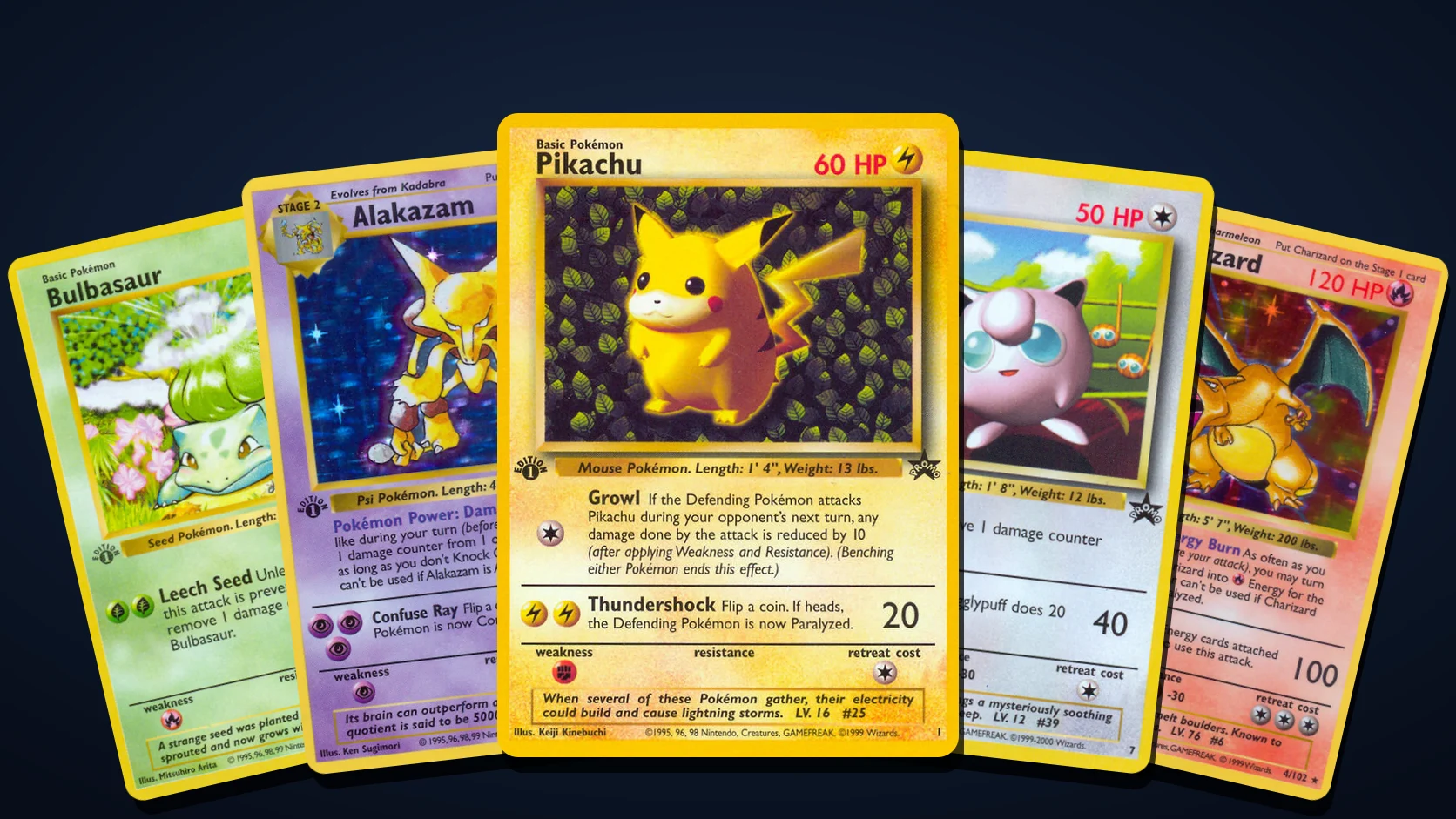
English players got the same 102 cards on 9 January 1999, when Wizards of the Coast released the English Base Set. Its card number 1 is Alakazam (1/102). The first Pikachu card is that 1996 CoroCoro Pikachu, and Bulbasaur, Pokédex number 1, got its first card in the 1996 Japanese Base Set.
"First Pokémon card" can mean five different things, so here is each answer side by side.
First cards ever released
- The answer
- CoroCoro Pikachu and glossy Jigglypuff promos (Japan)
- Date
- 15 October 1996
First set
- The answer
- Japanese Base Set (Expansion Pack), 102 cards
- Date
- 20 October 1996
First English set
- The answer
- Base Set, Wizards of the Coast, 102 cards
- Date
- 9 January 1999
Card number 1
- The answer
- Alakazam, Base Set 1/102
- Date
- 9 January 1999
First numbered English promo
- The answer
- Pikachu, Wizards Black Star Promo #1
- Date
- 16 June 1999 (1st Edition Jungle packs); July 1999 (Pokémon League)
The First Pokémon Card Ever Made: The 1996 CoroCoro Pikachu
The Pokémon Company's corporate history dates the launch of the Trading Card Game in Japan to October 1996. To build interest before the first set, Pokémon partnered with CoroCoro Comic, a monthly manga magazine for children. Its November 1996 issue, on sale 15 October 1996, carried two cards that readers peeled out of the magazine: a Pikachu and a glossy Jigglypuff, both with early 3D art by Keiji Kinebuchi. Bulbapedia calls them the first-ever release of Pokémon TCG cards.
A few details make the original easy to spot and hard to find:
- The Sugimori error. The first Pikachu credits Ken Sugimori as illustrator instead of Kinebuchi. Later reprints fix the credit.
- The leafy background. Collectors call it Ivy Pikachu.
- Almost no clean copies. Most have a small bend along the top edge from the curve of the magazine. Bulbapedia notes it is the most-graded card on PSA's population report without a single PSA 10.
Card designs existed before October 1996. Prototype cards were pictured in CoroCoro's August 1996 issue (on sale in mid-July), but they were never sold. Bandai's Pokémon Carddass vending-machine cards also started in late September 1996, according to Bulbapedia, but those are collectible cards, not part of the Trading Card Game. For English cards, Bulbapedia reports that the first card test-printed was a Base Set Blastoise with the test print code 009/165R, which came to light in 2020.
The First Pokémon Card Set: Base Set (1996 in Japan, 1999 in English)
The first set is Base Set, released in Japan as the first Starter Pack and Expansion Pack (第1弾) and often called Expansion Pack after its boosters. It has 102 cards, all Generation I Pokémon from Pokémon Red and Green. The Japanese release was on 20 October 1996; the English one, published by Wizards of the Coast, on 9 January 1999. The Pokémon Company's history lists January 1999 as the US launch of "Pokémon Card Game: Base Set". Jungle followed as the second set.
The Japanese set has no card numbers. Its cards carry no set number at all, and the earliest print has no rarity symbol either. Collectors call it the No Rarity print and treat it as the Japanese first edition, because it contains errors fixed later. Bulbapedia's example: the No Rarity Venusaur lists itself as Pokédex #68 instead of #3.
What Is Pokémon Card Number 1? Alakazam (1/102)
Base Set card 1/102 is Alakazam, a Stage 2 Psychic holo rare illustrated by Ken Sugimori. It isn't number 1 for any special reason. Bulbapedia explains that the English set is ordered by card type (Pokémon, then Trainers, then Energy), then rarity (holo rares first), then alphabetically by name, so Alakazam simply comes first among the 16 holo rares. Blastoise is 2/102, Chansey 3/102 and Charizard 4/102.
The Japanese set was sorted differently, by type, then rarity, then Pokédex number. Because its cards are unnumbered, there is no Japanese "card number 1".
The First Bulbasaur Card (Pokédex #1)
Bulbasaur is number 1 in the Pokédex, so many people searching for the first Pokémon card mean the first Bulbasaur. Its first card is the Base Set Bulbasaur, illustrated by Mitsuhiro Arita and first released in the Japanese Base Set on 20 October 1996. Bulbapedia's list of the Japanese set starts with it, as the lowest-numbered Grass-type common. In English it is Base Set 44/102, a common.
The First Pikachu Card
The oldest Pikachu card is the 1996 CoroCoro Ivy Pikachu, so the first Pikachu card is also the first Pokémon card. A second Pikachu, illustrated by Mitsuhiro Arita, followed five days later in the Japanese Base Set and became English Base Set 58/102.
Two English versions of 58/102 exist. Bulbapedia estimates that about half of 1st Edition and Shadowless copies have red cheeks, while Unlimited copies all have yellow cheeks, so red-cheek copies are the ones collectors pay more for. A red-cheek Pikachu with a gold "E3" stamp was handed out at Nintendo's booth at E3 from 13 to 15 May 1999.
The First Pokémon Promo Cards
The CoroCoro Pikachu and Jigglypuff were the first promos of all. In English, the first numbered promo is Pikachu, Wizards Black Star Promo #1, the same Ivy Pikachu art with the illustrator corrected to Keiji Kinebuchi. Bulbapedia records two early releases:
- 1st Edition Black Star Pikachu, included in limited quantities in 1st Edition Jungle boosters, released on 16 June 1999. It is identical to the League promo apart from the 1st Edition stamp.
- Black Star Promo Pikachu, its first widespread US release, through the Pokémon League in July 1999.
The English Jigglypuff became Wizards Black Star Promo #7, released with the soundtrack for Pokémon: The First Movie.
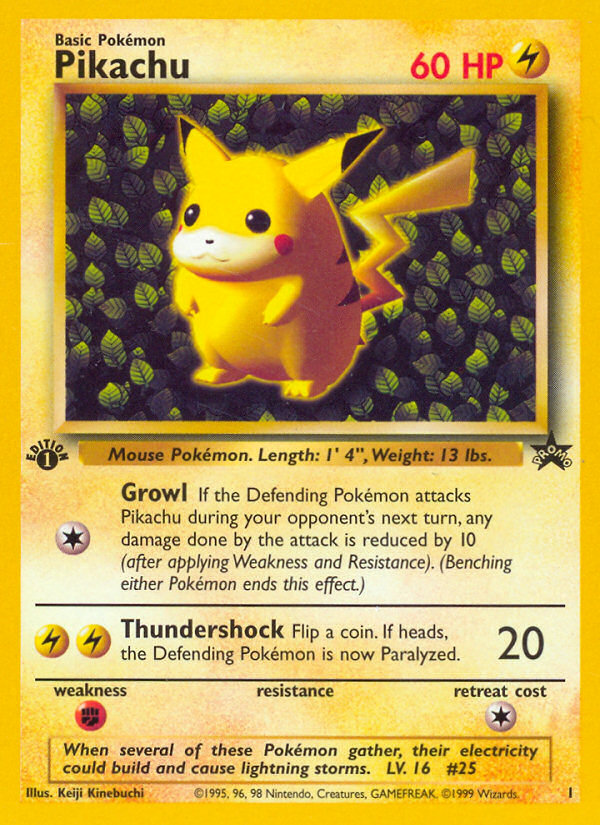 Pikachu, Wizards Black Star Promo #1$42.93 on 18 Nov 2026
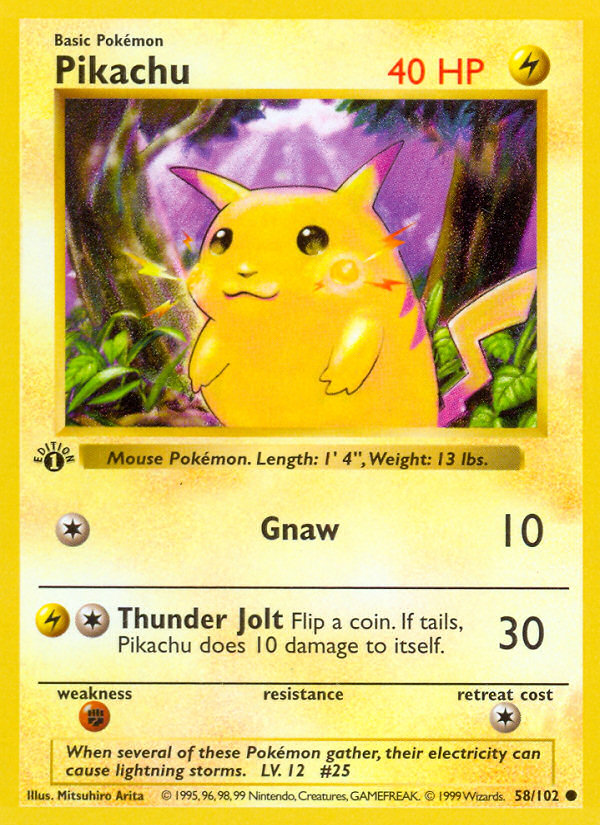 Pikachu, Base Set 58/102Unlimited: $8.03 on 18 Nov 2026
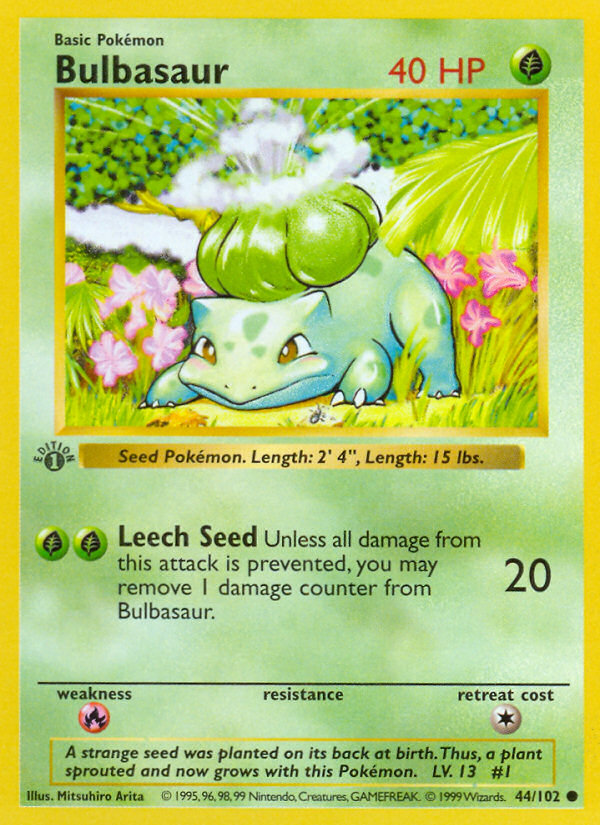 Bulbasaur, Base Set 44/102Unlimited: $4.60 on 18 Nov 2026
1st Edition vs Shadowless vs Unlimited Base Set
The English Base Set was printed four times, and the first two are the valuable ones.
| 1st Edition stamp | Drop shadow on the picture frame | HP and attack text | |
|---|---|---|---|
| 1st Edition (first run) | Yes | No | Thin |
| Shadowless (second run) | No | No | Thin |
| Unlimited (third run) | No | Yes | Thicker |
| Unlimited, ©1999–2000 (fourth run) | No | Yes | Thicker, with a ©1999–2000 copyright line |
Non-English 1st Edition Base Set cards, such as German or French, were not printed in the Shadowless layout: they look like Unlimited cards with a 1st Edition stamp. Our shadowless Pokémon cards guide shows the differences in detail.
Key Cards From the First English Set and What They're Worth
These are TCGplayer market prices for the Unlimited print, ungraded, on 18 November 2026. 1st Edition and Shadowless copies sell for more.
| Card | Number | Illustrator | Unlimited market price (18 Nov 2026) |
|---|---|---|---|
| Alakazam | 1/102 | Ken Sugimori | $76.03 |
| Blastoise | 2/102 | Ken Sugimori | $233.63 |
| Charizard | 4/102 | Mitsuhiro Arita | $1,001.05 |
| Venusaur | 15/102 | Mitsuhiro Arita | $134.94 |
| Bulbasaur | 44/102 | Mitsuhiro Arita | $4.60 |
| Pikachu | 58/102 | Mitsuhiro Arita | $8.03 |
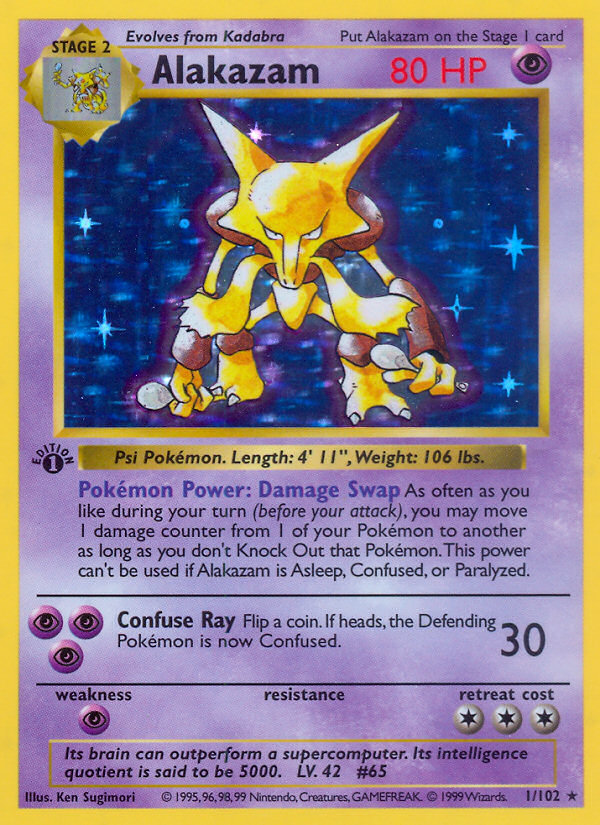 Alakazam, Base Set 1/102Unlimited: $76.03 on 18 Nov 2026
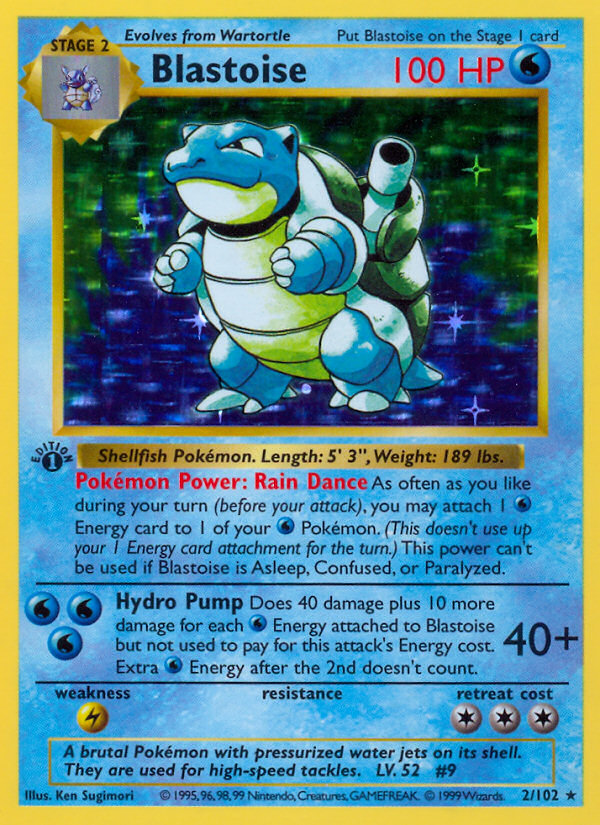 Blastoise, Base Set 2/102Unlimited: $233.63 on 18 Nov 2026
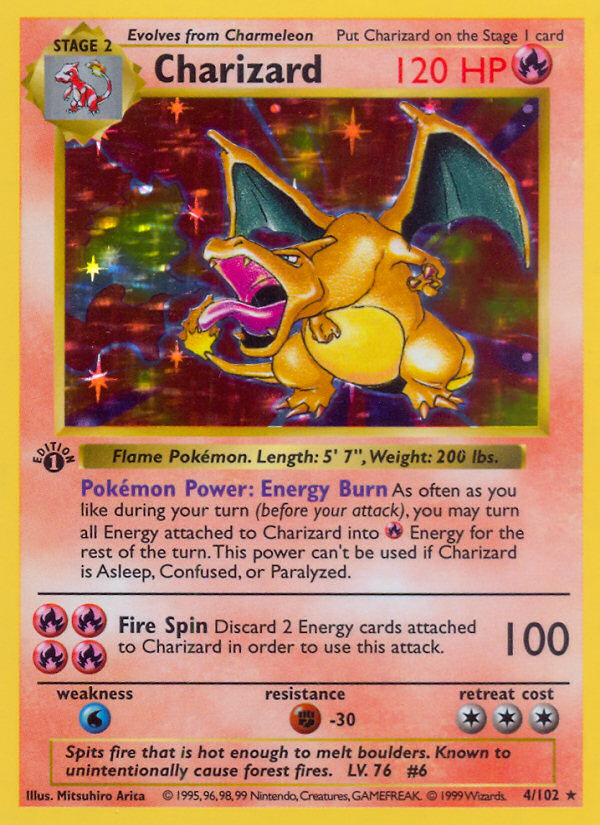 Charizard, Base Set 4/102Unlimited: $1,001.05 on 18 Nov 2026
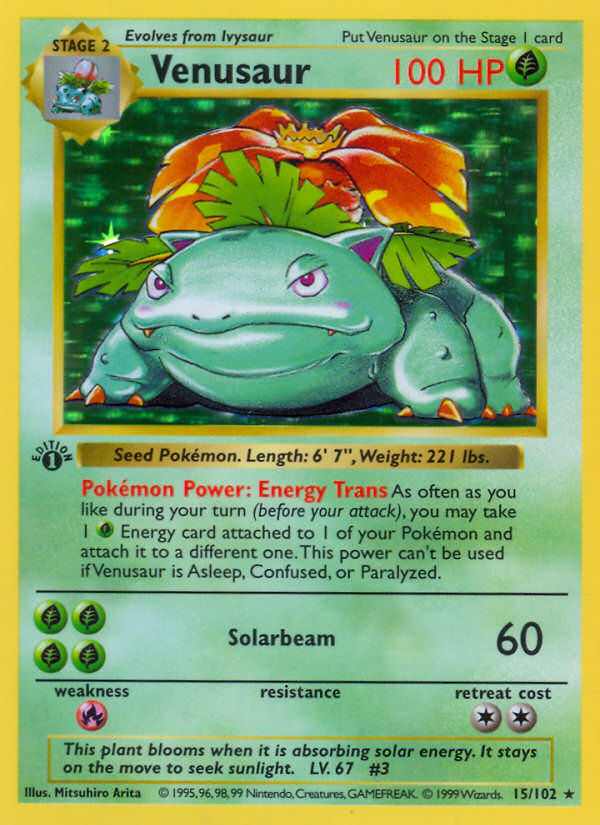 Venusaur, Base Set 15/102Unlimited: $134.94 on 18 Nov 2026
Charizard is the card that sets the market. An ungraded Shadowless Charizard was about $2,170 on TCGplayer on 18 November 2026. Graded first prints are another league: a PSA 10 Japanese No Rarity Charizard sold for $1.7 million in March 2026, Sports Illustrated reported, and a PSA 10 1st Edition English Charizard reportedly sold for $1,385,274 in October 2026, according to a post by Jazwares president Jeremy Padawer reported by Vice. Our Charizard card guide covers every print, and our list of the best Pokémon cards puts Base Set next to the record-holding Pikachu Illustrator.
The cheaper way to own Base Set art: Classic Collection reprints
The Pokémon Company has reprinted some Base Set cards in two Classic Collection subsets: Celebrations: Classic Collection (8 October 2021) and 30th Celebration Classic Collection (16 September 2026). TCGplayer lists both. They're the same art and card numbers at a fraction of the vintage price, but they're reprints, not first prints, and sell as such. TCGplayer market prices on 18 November 2026:
| Reprint | Classic Collection | Market price | Unlimited Base Set original |
|---|---|---|---|
| Charizard 4/102 | Celebrations (2021) | $115.83 | $1,001.05 |
| Charizard 4/102 | 30th Celebration (2026) | $111.07 | $1,001.05 |
| Blastoise 2/102 | Celebrations (2021) | $14.95 | $233.63 |
| Venusaur 15/102 | Celebrations (2021) | $11.23 | $134.94 |
| Pikachu 58/102 | 30th Celebration (2026) | $13.67 | $8.03 |
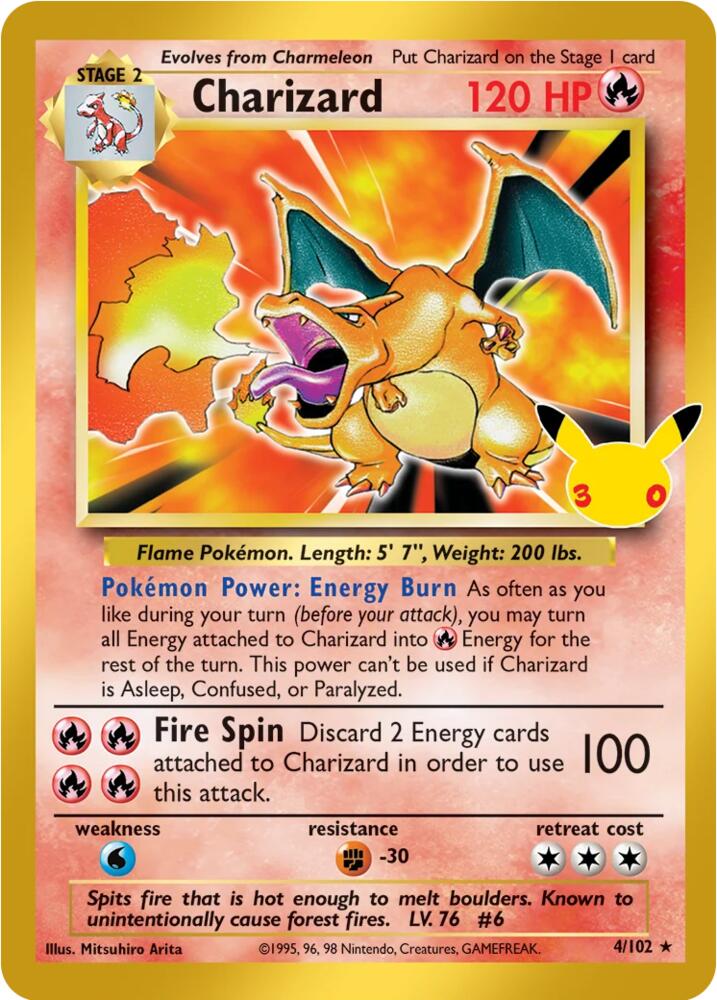 Charizard 4/102, 30th Celebration Classic Collection$111.07, TCGplayer market, 18 Nov 2026
 Charizard 4/102, Celebrations: Classic Collection$115.83, TCGplayer market, 18 Nov 2026
 Blastoise 2/102, Celebrations: Classic Collection$14.95, TCGplayer market, 18 Nov 2026
 Pikachu 58/102, 30th Celebration Classic Collection$13.67, TCGplayer market, 18 Nov 2026
The Pikachu is the odd one: its 2026 reprint costs more than an Unlimited 58/102 original, so for Pikachu the original is the better buy.
Conclusion: Pikachu Came First, Alakazam Is Number 1
The first Pokémon TCG cards ever released were the CoroCoro Pikachu and Jigglypuff on 15 October 1996, five days before the Japanese Base Set. The English Base Set followed on 9 January 1999.
Card number 1 is Alakazam only because of alphabetical order. The first Pikachu is the 1996 Ivy Pikachu, the first Bulbasaur is Base Set 44/102, and for English Base Set cards the 1st Edition and Shadowless prints are the ones worth checking for.
Citations & Resources
- The Pokémon Company: Corporate history (TCG launched in Japan October 1996; Base Set launched in the US January 1999)
- Bulbapedia: Base Set (TCG): release dates, set order, print runs, No Rarity print, Blastoise test print
- Bulbapedia: Pikachu (Wizards Promo 1): the 1996 CoroCoro release and the 1999 English promos
- Bulbapedia: Jigglypuff (Wizards Promo 7)
- Bulbapedia: Pikachu (Base Set 58): red and yellow cheeks, E3 stamp
- Bulbapedia: Bulbasaur (Base Set 44)
- Pokémon TCG API: Base Set Alakazam 1/102 (card data)
- Pokémon TCG API: Wizards Black Star Promo #1 Pikachu
- TCGCSV: TCGplayer market prices for Base Set (updated 18 November 2026)
- Sports Illustrated: World Record Charizard Headlines Top Pokémon Card Sales of March 2026
- Vice: Charizard Pokémon Card Sells for Record-Breaking $1.385 Million (9 October 2026)
Related Guides
- Shadowless Pokémon Cards: how to tell Shadowless from 1st Edition and Unlimited
- Charizard Pokémon Cards: every Charizard ranked by price, and the record sales
- Best Pokémon Cards: the most valuable, the strongest and the best in Standard
- Most Expensive Pokémon Cards: the record sales and the top 50 by price
- How to Tell If a Pokémon Card Is Fake: ten checks ranked by reliability
- Pokémon Card Back: the English back and the original Japanese "Pocket Monsters" back