Quick verdict
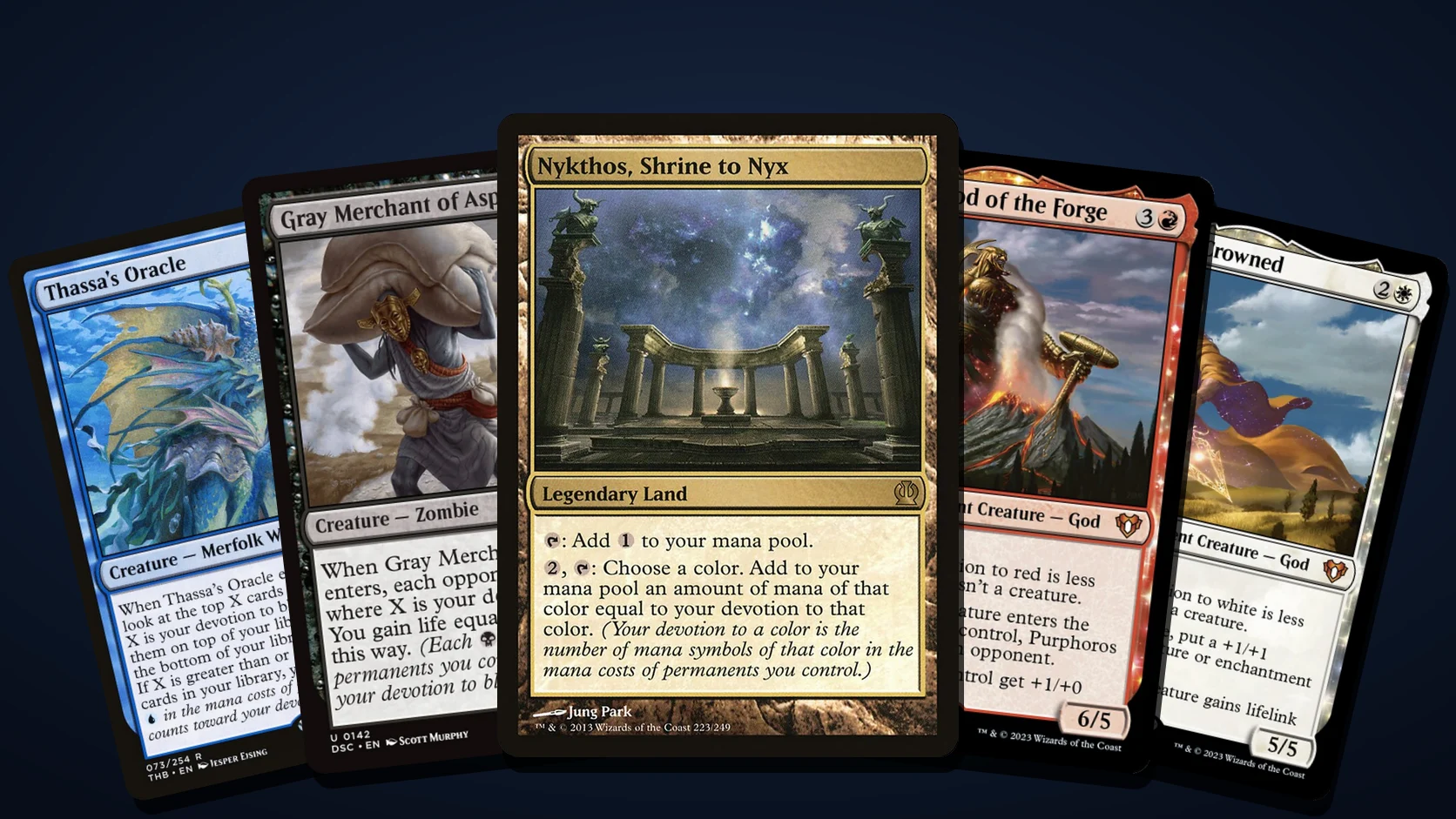
Your devotion to a color is the number of mana symbols of that color in the mana costs of permanents you control. Hybrid and Phyrexian symbols count, generic and X symbols don't, and lands, ordinary tokens and face-down creatures add nothing. Devotion powers the Theros gods, which are indestructible enchantments that only become creatures at five devotion (seven for two-color gods), plus payoffs like Gray Merchant of Asphodel and Nykthos, Shrine to Nyx.
Devotion in MTG is a count, not a keyword: your devotion to a color is the number of mana symbols of that color in the mana costs of permanents you control. Control a {3}{B}{B} creature and a {1}{B} enchantment and your devotion to black is 3. Cards like Gray Merchant of Asphodel, Nykthos, Shrine to Nyx and the Theros gods read that number and get stronger the more heavily you commit to one color.
Devotion was introduced in Theros in September 2013, a set built on Greek myth where the gods grow stronger as mortals worship them. It came back in Theros Beyond Death in January 2020.
How Devotion Works in MTG
The rule is short. Comprehensive Rules 700.5 says a player's devotion to a color "is equal to the number of mana symbols of that color among the mana costs of permanents that player controls." Devotion to two colors counts every symbol that is either color or both.
The Scryfall rulings on the devotion cards fill in the details:
- Only permanents you control count. Cards in your hand, graveyard or on the stack add nothing. An Aura you put on an opponent's creature still counts, because you control the Aura.
- Only the mana cost counts. Mana symbols in rules text don't count, so Purphoros's {2}{R} activation adds nothing.
- Hybrid symbols count for both colors. {U/B} adds 1 to blue and 1 to black. Monocolored hybrid symbols like {2/B} also count for their color.
- Phyrexian symbols count. {B/P} is a black symbol, even if you paid life for it.
- Generic, colorless and X don't count. {1}, {2}, {C} and {X} add nothing to any color.
- It is checked as the effect resolves. A triggered or activated ability counts your devotion when it resolves, and the permanent with the ability counts if it is still on the battlefield.
Gray Merchant of Asphodel
- Devotion it adds
- 2 to black
3BB
Mana cost
Thassa's Oracle
- Devotion it adds
- 2 to blue
UU
Mana cost
Nightveil Specter
- Devotion it adds
- 3 to blue, 3 to black, 3 to blue and black
U/B U/B U/B
Mana cost
Burning-Tree Emissary
- Devotion it adds
- 2 to red, 2 to green, 2 to red and green
R/G R/G
Mana cost
Phenax, God of Deception
- Devotion it adds
- 1 to blue, 1 to black, 2 to blue and black
3UB
Mana cost
Nykthos, Shrine to Nyx
- Devotion it adds
- 0
None (land)
Mana cost
A 1/1 Soldier token
- Devotion it adds
- 0
None
Mana cost
Devotion to two colors
Two-color gods such as Phenax and Athreos check devotion to two colors at once. You count every symbol that is either color, and a hybrid symbol of both colors is counted only once. Three Nightveil Specters give you 9 devotion to blue and black, not 18.
Tokens, face-down creatures and lands
Tokens have no mana cost unless the effect that made them says otherwise (CR 202.1b), so a Soldier token adds nothing. A token that copies a permanent copies its mana cost, though, so a token copy of Gray Merchant adds {B}{B}. Face-down creatures, such as a morph, have no mana cost (CR 708.2a). Lands have no mana cost either, so Nykthos never counts toward itself.
A worked example
You control Erebos, God of the Dead ({3}{B}) and Nightveil Specter ({U/B}{U/B}{U/B}), then cast Gray Merchant ({3}{B}{B}). When its trigger resolves, your devotion to black is 1 + 3 + 2 = 6. Each opponent loses 6 life and you gain the total they lost. In a four-player game that is 18 life. Erebos also became a creature the moment your devotion hit five.
The Theros Gods
The gods are the most recognisable devotion cards. Every one is a legendary enchantment creature with indestructible and a line like Purphoros's: "As long as your devotion to red is less than five, Purphoros isn't a creature." Mono-color gods need five, two-color gods need seven.
What that means in play:
- They are hard to remove. Indestructible stops destroy effects and damage, and while a god isn't a creature, creature removal can't target it. See our indestructible guide for what still works, such as exile.
- Their abilities always work. Purphoros still deals 2 damage to each opponent when another creature you control enters, even while it is only an enchantment.
- They count themselves. A god's own mana symbols are part of your devotion once it is on the battlefield.
- They are creatures everywhere else. In your hand, graveyard and on the stack a god is always a creature card. If it stops being a creature while attacking or blocking, it is removed from combat.
Theros (2013) had five mono-color gods, and Born of the Gods and Journey into Nyx added ten two-color gods. Theros Beyond Death (2020) brought seven more (five mono-color, two two-color), including Heliod, Sun-Crowned, Thassa, Deep-Dwelling and Klothys, God of Destiny.
Best Devotion Cards
Gray Merchant of Asphodel. The most famous devotion card. Each opponent loses life equal to your devotion to black and you gain what they lost. It was a common in Theros, which made it a long-running Pauper staple.
Nykthos, Shrine to Nyx. A legendary land: pay {2} and tap it to add mana of one color equal to your devotion to that color. With five black symbols out, it nets three mana. It is a mana ability, so it can't be responded to.
Nyx Lotus. Nykthos as an artifact from Theros Beyond Death. It enters tapped but needs no extra mana to activate.
Thassa's Oracle. {U}{U} that looks at the top X cards of your library, where X is your devotion to blue, and wins the game if X is at least the number of cards left. With an empty library it wins outright, which is why it is a combo finisher in competitive Commander.
Master of Waves. Makes a 1/0 Elemental token for each point of devotion to blue, and gives them +1/+1. A centrepiece of mono-blue devotion in Theros-era Standard.
Altar of the Pantheon. Adds 1 to your devotion to every color and every pair of colors.
Payoffs for each color. Reverent Hoplite (white tokens), Abhorrent Overlord (black flyers), Fanatic of Mogis (red damage), Karametra's Acolyte (green mana) and Aspect of Hydra (a green pump spell).
Cheapest regular nonfoil printing on Scryfall on 19 November 2026:
Nykthos, Shrine to Nyx
- Printing
- Theros
$48.32
Price (USD)
Purphoros, God of the Forge
- Printing
- Theros
$24.67
Price (USD)
Heliod, Sun-Crowned
- Printing
- Commander Masters
$21.78
Price (USD)
Thassa's Oracle
- Printing
- Mystery Booster 2
$14.62
Price (USD)
Nyx Lotus
- Printing
- Theros Beyond Death
$5.15
Price (USD)
Gray Merchant of Asphodel
- Printing
- Foundations Commander
$0.67
Price (USD)
Best Devotion Commanders
A mono-color Commander deck is the natural home for devotion: 99 cards of one color make five symbols easy and Nykthos absurd. Deck counts are from EDHREC on 19 November 2026.
Purphoros, God of the Forge (red, 4,895 decks). Every other creature that enters under your control deals 2 damage to each opponent, so token makers turn into burn.
Heliod, Sun-Crowned (white, 5,335 decks). Every time you gain life it puts a +1/+1 counter on a creature or enchantment you control, and {1}{W} gives another creature lifelink. Give Walking Ballista lifelink and each ping gains life, which adds a counter back to Ballista: an infinite combo.
Thassa, Deep-Dwelling (blue, 1,453 decks). Blinks one of your other creatures at your end step, which re-triggers enters abilities such as Master of Waves and Thassa's Oracle.
Erebos, Bleak-Hearted (black, 463 decks). Whenever another creature you control dies you may pay 2 life to draw a card, and it pairs with the Gray Merchant plan.
Phenax, God of Deception (blue-black, 9,327 decks, the most of the five). Turns every creature into a mill engine based on its toughness, and Nightveil Specter-style hybrid cards push it to seven.
Rules Corner: Altar of the Pantheon and Purphoros
CR 700.5a has an example worth knowing. Devotion is worked out after copy, control and text-changing effects but before other effects that change permanents. Control Altar of the Pantheon, Purphoros ({3}{R}) and a {R}{R}{R} permanent and your devotion to red is five, so Purphoros is a creature. And if Altar loses its abilities, the rulings say you still keep the bonus.
Where Devotion Fits
Devotion rewards playing deep into one or two colors instead of splashing. For every other mechanic, see our MTG keywords glossary, and for why ordinary tokens add nothing, see MTG tokens explained. Gods are often compared with protection effects; our protection guide covers how the two differ.
Citations & Resources
- Wizards of the Coast: Comprehensive Rules 700.5, 202.1b and 708.2a
- Scryfall: Every card that mentions devotion
- Scryfall: Gray Merchant of Asphodel and its rulings
- Scryfall: Nykthos, Shrine to Nyx
Related Guides
- The Ultimate MTG Keywords Glossary — every keyword and mechanic in one place
- MTG Indestructible Explained — why the Theros gods are so hard to kill
- MTG Protection Explained — another way to dodge removal
- MTG Tokens Explained — why tokens usually add no devotion
- MTG Colors Explained — what each color does, before you commit to one