Quick Verdict
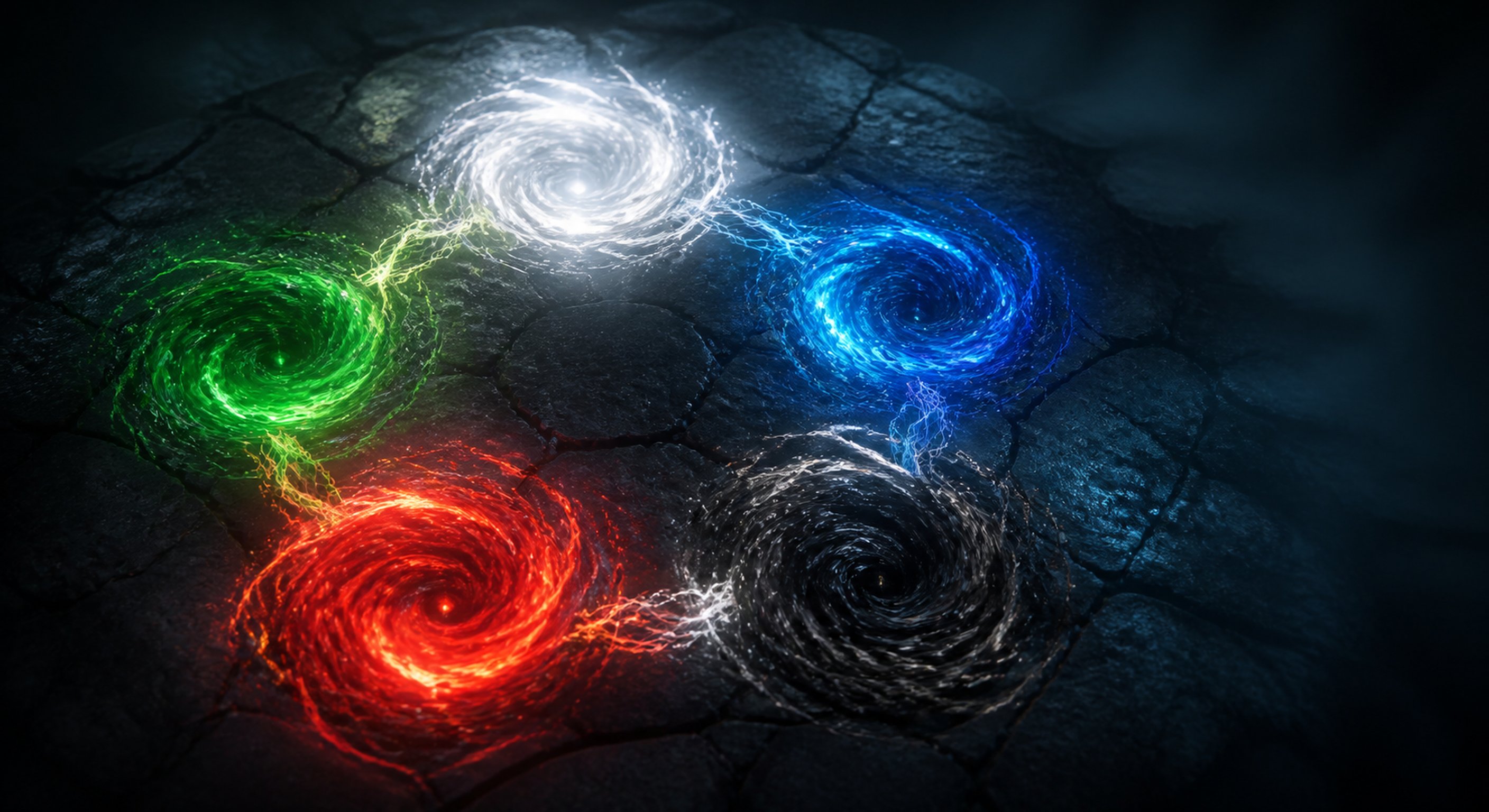
Magic's five colours are a design contract as much as a theme: each colour is defined by what it cannot do as much as what it can, and that restriction is the colour pie. The colours sit on a wheel where each has two allies and two enemies, which is what generates every combination name — the ten Ravnica guilds for pairs, the five Alara shards and five Tarkir wedges for triples, and the Guildpact Nephilim for the four-colour sets.
Most games with factions differentiate them by what they are good at. Magic's colours are defined more sharply by what they are forbidden to do.
Green produces more mana than any other colour and cannot draw cards efficiently. Blue draws more cards than any other colour and cannot destroy a creature outright. Black destroys anything and pays life for the privilege. Those restrictions are the colour pie, and they are the reason a colour feels like something rather than a set of stats.
Understanding it changes how you build decks, because it tells you where your deck's holes are before you find them the hard way — a mono-green deck will have an answer to almost anything on the battlefield and almost nothing to a spell on the stack, and no amount of good green cards will fix that.
Five colours, arranged on a wheel, each with two allies and two enemies. Every combination name in Magic comes from that structure.
The Five Colors
| Colour | Believes in | Does well | Cannot do |
|---|---|---|---|
| White (W) | Order, community, peace through structure | Efficient small creatures, board wipes, lifegain, taxes, removing anything | Draw cards in bulk; produce extra mana |
| Blue (U) | Knowledge, perfection through improvement | Counterspells, card draw, bouncing permanents, flying, copying | Destroy creatures outright; deal direct damage |
| Black (B) | Power, self-interest, no cost too high | Killing creatures, discard, reanimation, tutoring, paying life for anything | Deal with artifacts and enchantments; gain lasting board advantage cheaply |
| Red (R) | Freedom, emotion, acting now | Direct damage, haste, aggression, rituals, destroying artifacts and lands | Play the long game; hold a card advantage; interact with enchantments |
| Green (G) | Nature, growth, accepting things as they are | Large creatures, mana ramp, land search, trample, fighting | Interact with the stack; remove creatures without fighting them |
The "cannot do" column is the useful one. It is the checklist of what a deck in that colour will be missing, and the reason two-colour decks exist at all — you add a colour to cover a hole, not to add more good cards.
Blue is abbreviated U because Black already claimed B. Our guide to MTG symbols covers how these appear on the card and the difference between colourless and generic mana, which is the most common point of confusion in the whole system.
Colourless is not a sixth colour
Colourless is the absence of colour. Artifacts and Eldrazi are typically colourless. Colourless mana (a diamond symbol) is also distinct from generic mana (a number): generic can be paid with any mana at all, colourless specifically cannot be paid with coloured mana.
The Wheel: Allies and Enemies
The five colours sit in a fixed order — White, Blue, Black, Red, Green, and back to White.
Each colour's neighbours are its allies; the two colours opposite are its enemies.
| Colour | Allies | Enemies |
|---|---|---|
| White | Blue, Green | Black, Red |
| Blue | White, Black | Red, Green |
| Black | Blue, Red | Green, White |
| Red | Black, Green | White, Blue |
| Green | Red, White | Blue, Black |
This is not decoration. Allied colours share goals and their cards tend to support each other; enemy colours want opposite things and pairing them creates deliberate tension. Every combination name below is generated by this wheel.
Two Colors: The Ten Guilds
The pair names come from Ravnica, where each two-colour combination is a guild with its own philosophy.
| Guild | Colours | Relationship | Identity |
|---|---|---|---|
| Azorius | White-Blue | Allied | Law and control — rules enforced by force |
| Dimir | Blue-Black | Allied | Secrets and manipulation |
| Rakdos | Black-Red | Allied | Excess and cruelty as entertainment |
| Gruul | Red-Green | Allied | Rage and the wild against civilisation |
| Selesnya | Green-White | Allied | Community and growth as one |
| Orzhov | White-Black | Enemy | Obligation, debt and hierarchy |
| Izzet | Blue-Red | Enemy | Invention for its own sake |
| Golgari | Black-Green | Enemy | Death feeding life; the graveyard as a resource |
| Boros | Red-White | Enemy | Righteous aggression |
| Simic | Green-Blue | Enemy | Evolution through engineering |
These names are used constantly in ordinary conversation — a "Rakdos deck" or "Azorius control" is how players describe colour identity without listing symbols.
Three Colors: Shards and Wedges
Ten three-colour combinations, named from two different sets, and the difference between them is structural rather than cosmetic.
Shards — a colour plus both its allies
From Shards of Alara (2008). Three consecutive colours on the wheel, so every colour in the set is friendly with the others. Shards feel harmonious.
| Shard | Colours | Centre colour | Flavour |
|---|---|---|---|
| Bant | Green-White-Blue | White | Order, chivalry, protection |
| Esper | White-Blue-Black | Blue | Artifice and control |
| Grixis | Blue-Black-Red | Black | Undeath and ruin |
| Jund | Black-Red-Green | Red | Predation and survival |
| Naya | Red-Green-White | Green | Enormous creatures and wild nature |
Wedges — a colour plus both its enemies
From Khans of Tarkir (2014), where each is a clan. A wedge takes one colour and both colours it opposes, so the two outer colours are also enemies of each other. Wedges feel tense by construction.
| Wedge | Colours | Centre colour | Flavour |
|---|---|---|---|
| Abzan | White-Black-Green | White | Endurance, family, the long siege |
| Jeskai | Blue-Red-White | Blue | Cunning, martial discipline |
| Sultai | Black-Green-Blue | Black | Ruthlessness and excess |
| Mardu | Red-White-Black | Red | Speed and relentless aggression |
| Temur | Green-Blue-Red | Green | Savagery and elemental power |
A shard is a colour and its friends. A wedge is a colour and its enemies, forced to cooperate. That difference shows up in how the decks actually play.
Four Colors: The Nephilim
Five four-colour combinations, each defined by the one colour it lacks. The names come from the Nephilim cycle in Guildpact (2006).
| Nephilim name | Colours | Missing | Commander 2016 name |
|---|---|---|---|
| Yore-Tiller | White-Blue-Black-Red | Green | Artifice |
| Glint-Eye | Blue-Black-Red-Green | White | Chaos |
| Dune-Brood | Black-Red-Green-White | Blue | Aggression |
| Ink-Treader | Red-Green-White-Blue | Black | Altruism |
| Witch-Maw | Green-White-Blue-Black | Red | Growth |
Each is four consecutive colours on the wheel, so naming them by the colour they lack is usually clearer — "four-colour, no red" communicates more than "Witch-Maw" to most players. Commander 2016 introduced the alternative names in the right-hand column, and both sets remain in use.
Five Colors: WUBRG
All five, pronounced "wooberg". Every card in the game is castable in principle, and the entire difficulty moves into the manabase — a five-colour deck lives or dies on whether it can produce the right colours on time.
This is why five-colour decks in Commander are so often built around a commander that fixes mana or cheats costs, and why the manabase is usually the most expensive part of the deck by a wide margin.
How Many Colors Should Your Deck Be?
| Colours | Good for | The cost |
|---|---|---|
| One | First decks, budget builds, consistency | You will have a hole your colour cannot cover |
| Two | Most decks in most formats | Slightly less reliable mana; needs some dual lands |
| Three | Commander, and formats with strong fixing | Needs a real manabase — this is where lands get expensive |
| Four to five | Commander with a fixing commander | The manabase becomes the deck's main constraint and cost |
The rule that matters: every colour you add makes your mana less reliable. A deck that cannot cast its spells on time loses to a worse deck that can. Add a colour to fix a specific weakness, not to include more cards you like.
Commander is more forgiving because games are slower and precons ship with a functioning manabase. For the full framework, see how to build an MTG deck, and if you are choosing a first deck at all, how to get into Magic covers the decision that comes before this one.
Conclusion: The Pie Is the Point
It would be easy to read the colour pie as a limitation to work around. It is closer to the opposite — it is the thing that makes deck-building a decision rather than a shopping list. If every colour could answer every problem, choosing colours would just be choosing art.
The practical version: know what your colours cannot do. A mono-green deck has an answer to nearly anything on the battlefield and nearly nothing to a spell on the stack. A mono-blue deck can counter anything it sees coming and struggles with what already resolved. Those gaps are not flaws in your deck — they are the shape of the colours you chose.
And when you do add a second colour, add it for the hole it fills. That is the whole of colour selection, and the twenty-six names above are just a vocabulary for describing the result. If the names are what you came for, MTG color combination names lays out all thirty-one combinations — the twenty-six multicolour ones here plus the five single colours — in one reference table, with the set each name came from.
Citations & Resources
- MTG Wiki: Colors and the color pie
- MTG Wiki: The color pie in detail
- MTG Wiki: The Nephilim cycle and four-colour names
- MTG Wiki: The ten Ravnica guilds
- Wizards of the Coast: Comprehensive Rules — colour (CR 105)
Related Guides
- MTG Color Combination Names — every guild, shard, wedge and Nephilim name in one table
- MTG Symbols Explained — mana symbols, and colourless versus generic
- How to Build an MTG Deck — turning a colour choice into a manabase
- How to Get Into Magic: The Gathering — the decisions that come before colour
- MTG Tribal Decks — where each tribe sits on the colour wheel
- Complete Guide to MTG Formats — how many colours each format can support
- The Ultimate MTG Keywords Glossary — the abilities each colour is allowed to have
Frequently Asked Questions
🔗 Related Resources
More Reviews:
Related Articles
MTG Color Combo Names: Every Guild, Shard and Wedge (2026)
Every MTG color combination name: the ten guilds, five shards, five wedges, the four-color Nephilim names and more. What each combo is called, and why.
How Much Does Magic: The Gathering Actually Cost in 2026?
How much does Magic: The Gathering cost in 2026? Free on Arena, $27–$50 for a Commander deck, and why prices rose in January. Real numbers for every way to play.
How to Get Into Magic: The Gathering (2026 Beginner Guide)
How to get into Magic: The Gathering in 2026: learn free on Arena, pick a format before you buy, then buy exactly one product. The order that saves you money.