
Quick verdict
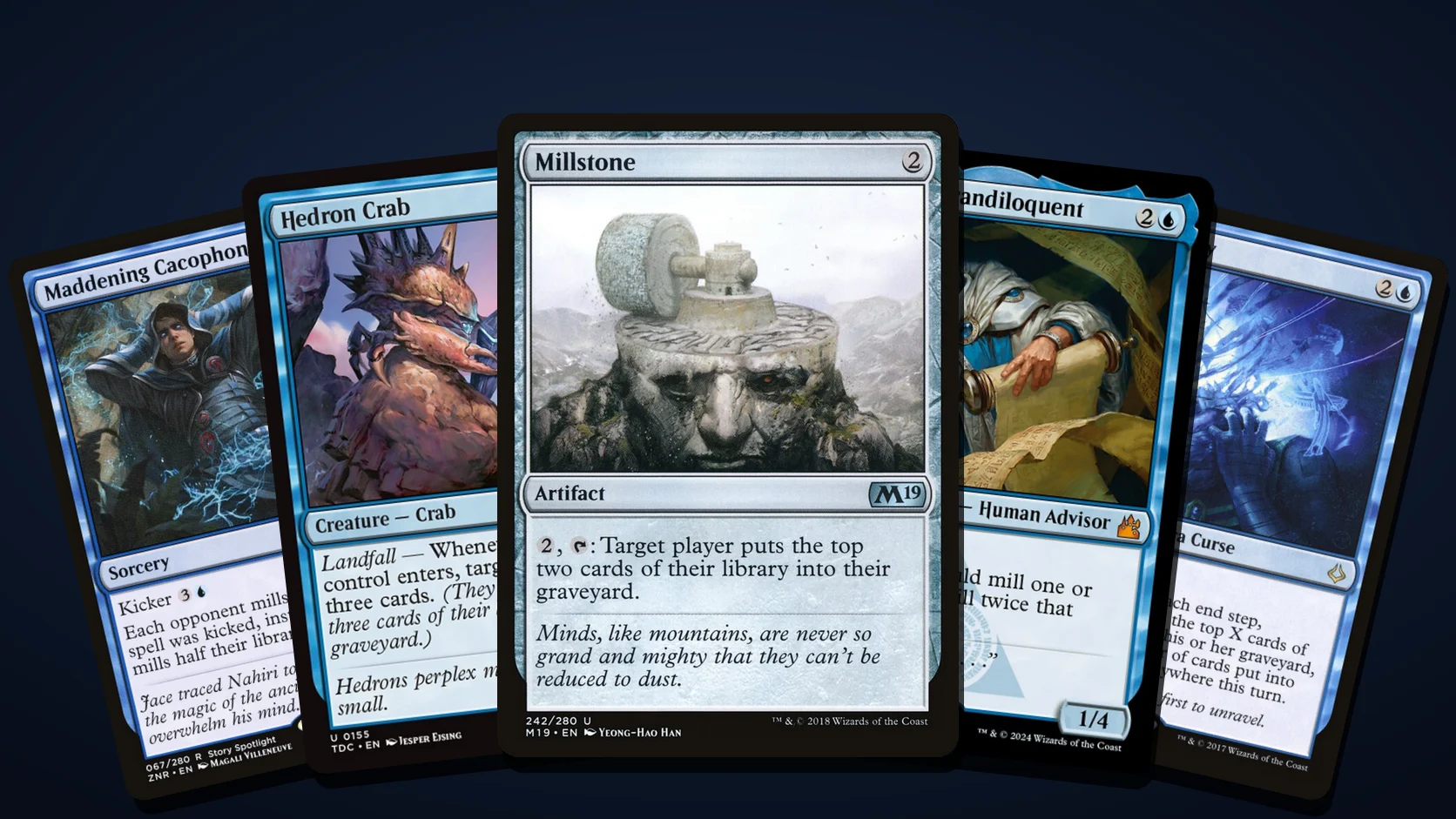
To mill a card in MTG, a player puts the top card of their library into their graveyard. Milling doesn't make anyone lose by itself: a player loses when they have to draw from an empty library. Mill became an official keyword action with Core Set 2021 in 2020, and it is named after Millstone (Antiquities, 1994). It is strong in 60-card formats, weaker in Commander, where three opponents each start with a 99-card library. Eldrazi titans like Ulamog and Kozilek shuffle a milled graveyard back.
Mill in MTG means putting cards from the top of a library into its owner's graveyard. "Target player mills three cards" means that player moves their top three cards straight to the graveyard. A mill deck wins by emptying the opponent's library, because a player who has to draw from an empty library loses the game.
The term comes from Millstone, an artifact from Antiquities (1994). Players said "milling" for decades before it became an official keyword action with Core Set 2021 in 2020.
What Is Mill in MTG? The Rules
Mill is keyword action 701.17 in the Comprehensive Rules (6 November 2026 edition):
For a player to mill a number of cards, that player puts that many cards from the top of their library into their graveyard.
The rest of the rule covers three details:
- You can't mill more than you have. If told to mill more cards than are left, a player mills as many as possible. They can't choose to mill more than they have, and can't pay a cost that mills more than they have.
- Milled cards can be found. An effect that refers to a milled card finds it in the public zone it went to, usually the graveyard.
- Replacement effects can multiply it. If an effect mills one card and then asks about "the milled card", and a replacement effect made it mill more, it checks every milled card.
Before Core Set 2021, cards said "put the top N cards of your library into your graveyard". Wizards issued errata so those cards now say "mill". The rulings on Bruvac the Grandiloquent give a rule of thumb: if a card has you look at or reveal cards before they go to the graveyard, it probably didn't get the errata. That matters, because anything that says "mill" (like Bruvac) only works with cards that use the word.
How Mill Wins the Game: Decking
Milling doesn't make anyone lose. The loss comes from drawing:
- A player who attempts to draw a card from a library with no cards in it loses the next time a player would receive priority (rule 121.4).
- If they have to draw more cards than are left, they draw what's left and then lose the same way (rule 104.3c).
Both are state-based actions. In practice, you mill the opponent's last card and they lose in their next draw step. That gap matters. They get one more turn with what's in their hand, and if they shuffle their graveyard back in during it, the mill is undone. The rulings on Millstone and Altar of Dementia both make the same point: emptying a library isn't a draw, so it doesn't end the game by itself.
Most mill cards are blue, blue-black is the classic mill pairing, and Glimpse the Unthinkable ({U}{B}, target player mills ten cards) is the card most players think of first.
Self-Mill vs Opponent Mill
Milling has two jobs, and many decks only care about one.
Opponent mill tries to empty a library. Ruin Crab, Maddening Cacophony and Bruvac belong here.
Self-mill fills your own graveyard so you can use it. You aren't trying to deck yourself, you're turning your library into a second hand:
- Spells with flashback can be cast from the graveyard right after being milled.
- Reanimation and recursion. Muldrotha, the Gravetide lets you play a land and cast a permanent spell of each permanent type from your graveyard each turn.
- Stitcher's Supplier ({B}) mills three cards when it enters and again when it dies.
- Teval, the Balanced Scale mills three cards whenever it attacks, then can return a land from your graveyard.
Some decks win with self-mill. Laboratory Maniac and Jace, Wielder of Mysteries both say that if you would draw a card with an empty library, you win instead. Thassa's Oracle wins on entering if your devotion to blue is at least the number of cards left in your library. Surveil is a related way to fill the graveyard, but you choose what goes there.
Eldrazi Titans and Shuffle-Back Cards
Three Eldrazi titans punish mill directly. Ulamog, the Infinite Gyre, Kozilek, Butcher of Truth and Emrakul, the Aeons Torn each have this ability:
When [this] is put into a graveyard from anywhere, its owner shuffles their graveyard into their library.
"From anywhere" includes the library. If you mill one, its owner shuffles their whole graveyard back, Eldrazi included. Kozilek and Ulamog are common in Commander, so a mill player has to expect them. They are covered in our annihilator guide, the other keyword these titans share.
Other cards do the same thing on purpose. Gaea's Blessing shuffles your graveyard into your library when it's put into your graveyard from your library, which is exactly what milling does. Elixir of Immortality costs {2} and a tap to gain 5 life and shuffle itself and your graveyard back into your library, at instant speed.
The usual answer is graveyard exile in response, or cards that exile instead of mill. Tasha's Hideous Laughter exiles cards from the top of each opponent's library until they have exiled cards with total mana value 20 or more. It isn't mill, so Bruvac doesn't double it, but exiled Eldrazi don't trigger.
Best Mill Cards
Prices are Scryfall's non-foil prices for the cheapest regular printing (named in brackets) on 19 November 2026. Deck counts are from EDHREC's mill page on the same date.
Maddening Cacophony
- What it does
- Each opponent mills 8; kicked, half their library, rounded up
- Price
- $6.65 (Zendikar Rising)
1U (kicker 3U)
Cost
Bruvac the Grandiloquent
- What it does
- Opponents mill twice as many cards
- Price
- $41.70 (Jumpstart)
2U
Cost
Ruin Crab
- What it does
- Landfall: each opponent mills 3
- Price
- $1.46 (Zendikar Rising)
U
Cost
Hedron Crab
- What it does
- Landfall: target player mills 3
- Price
- $3.71 (Tarkir: Dragonstorm Commander)
U
Cost
Fraying Sanity
- What it does
- Each end step, mills as many as went to their graveyard that turn
- Price
- $0.48 (Fallout)
2U
Cost
Altar of Dementia
- What it does
- Sacrifice a creature: target player mills its power
- Price
- $15.84 (Modern Horizons)
2
Cost
Mindcrank
- What it does
- An opponent who loses life mills that many
- Price
- $10.55 (New Phyrexia)
2
Cost
Mesmeric Orb
- What it does
- Each untapping permanent mills its controller a card
- Price
- $17.05 (Mirrodin)
2
Cost
Psychic Corrosion
- What it does
- Whenever you draw, each opponent mills 2
- Price
- $4.52 (Core Set 2019)
2U
Cost
Glimpse the Unthinkable
- What it does
- Target player mills 10
- Price
- $3.01 (Double Masters 2022)
UB
Cost
Millstone
- What it does
- 2, tap: target player mills 2
- Price
- $0.19 (Core Set 2019)
2
Cost
Maddening Cacophony. Eight cards from every opponent for two mana, or half of every library when kicked. It is in 11,711 mill decks on EDHREC.
Bruvac the Grandiloquent. It doubles every mill effect that makes an opponent mill. Your own self-mill isn't doubled. With Bruvac out, a kicked Cacophony mills half a library, then Bruvac doubles that to the whole library. Two Bruvacs would make opponents mill four times as many, though it's legendary. The cheapest copy right now is the borderless Stardates printing from November 2026, at $15.62.
Ruin Crab and Hedron Crab. One blue mana, three cards per land. Ruin Crab hits every opponent and is in 12,506 mill decks on EDHREC. Hedron Crab targets one player, so it can mill you too.
Fraying Sanity. At each end step, the cursed player mills as many cards as were put into their graveyard that turn, from anywhere. After a big mill it repeats the whole amount: Glimpse the Unthinkable plus Fraying Sanity is at least 20 cards. Two copies on the same player double each other: the second trigger counts the cards the first one milled.
Altar of Dementia. A free sacrifice outlet that mills by power. In Commander it is a finisher for decks with big creatures.
Mindcrank and Mesmeric Orb. The two most-played utility artifacts on EDHREC's mill page (13,197 and 12,167 decks). Mindcrank turns every point of life loss into milled cards. Mesmeric Orb mills everyone, you included, every time a permanent untaps.
Painter's Servant and Grindstone. A two-card combo. Grindstone repeats when the two milled cards share a colour, and Painter's Servant makes every card share one, so it mills a whole library.
Mill Commanders and Mill in Commander
Mill is a hard way to win Commander. A Commander deck is exactly 100 cards, so each opponent starts with 99 in their library and 92 after drawing an opening hand. With three opponents, that's around 276 cards to mill, against 33 for one opponent in a 40-card Limited game.
Commander also punishes mill in two other ways. Most decks have some graveyard use, so milling feeds reanimation and recursion. And the Eldrazi titans and Elixir of Immortality show up often enough to reset a library.
That's why most mill commanders don't rely on mill alone. The top commanders on EDHREC's mill page (19 November 2026):
| Commander | Colours | Decks | How it uses mill |
|---|---|---|---|
| The Wise Mothman | Sultai | 3,735 | +1/+1 counters whenever nonland cards are milled |
| Captain N'ghathrod | Dimir | 2,348 | Horrors mill on damage; steals milled artifacts and creatures |
| Hope Estheim | Azorius | 1,795 | Opponents mill X at your end step, where X is life you gained |
| Teval, the Balanced Scale | Sultai | 1,747 | Self-mill on attack; Zombies when cards leave your graveyard |
| The Mindskinner | Mono-blue | 1,539 | Unblockable; your damage to opponents becomes mill |
| Phenax, God of Deception | Dimir | 1,204 | Your creatures tap to mill by toughness |
| Muldrotha, the Gravetide | Sultai | 1,043 | Self-mill payoff; plays permanents from your graveyard |
| Bruvac the Grandiloquent | Mono-blue | 917 | Doubles how many cards opponents mill |
Captain N'ghathrod and The Mindskinner are the best fit for decking opponents. At your end step, N'ghathrod also puts an artifact or creature card milled from an opponent's library that turn onto the battlefield under your control. The Mindskinner turns every point of damage into mill. Phenax turns high-toughness creatures into Millstones. For the Eldrazi side of the same deck pool, see our best Eldrazi commanders.
Common Misconceptions
"Milling out makes you lose." You lose when you draw from an empty library, not when it empties.
"Every card that puts cards in the graveyard mills." Only cards that say "mill" do, after errata. Mind Funeral and Consuming Aberration reveal cards first and don't say mill, so Bruvac doesn't double them.
"Mill only targets opponents." Hedron Crab, Millstone and Glimpse the Unthinkable target any player, including you.
"Milling an Eldrazi titan gets rid of it." It shuffles back with the rest of the graveyard.
Where Mill Fits
Mill is a keyword action, like scry and surveil, rather than a keyword ability on a creature. For the rest of the terms you'll see on cards, our complete MTG keywords glossary has them all.
Citations & Resources
- Wizards of the Coast: Comprehensive Rules — 701.17 Mill, 104.3c and 121.4
- Scryfall: Every card that mills
- Scryfall: Bruvac the Grandiloquent and its Core Set 2021 rulings
- Scryfall: Millstone, every printing since Antiquities
- EDHREC: Mill commanders and cards
Related Guides
- MTG Flashback Explained — the classic payoff for milling yourself
- MTG Annihilator Explained — the Eldrazi titans that shuffle a milled graveyard back
- What Surveil Means in MTG — filling your graveyard, with a choice
- MTG State-Based Actions — the rule that makes an empty library lose
- Best Eldrazi Commanders — ranked, with prices
- The Ultimate MTG Keywords Glossary — every keyword, with a printable cheat sheet