
Quick verdict
Magic uses the London mulligan (rule 103.5). If you don't like your seven, shuffle them back, draw a new seven, then put one card on the bottom of your library for every mulligan you've taken. Keep whenever you like; you can go all the way down to zero. In multiplayer games, including Commander, and in every Brawl game, your first mulligan is free. Since July 2019 there is no scry after you keep.
MTG mulligan rules are short: if you don't like your opening seven, shuffle them back into your library, draw a new seven, then put one card on the bottom of your library for each mulligan you've taken. This is the London mulligan, rule 103.5 of the Comprehensive Rules, and it has been the only mulligan in every format since July 2019. In multiplayer games, Commander included, and in every Brawl game, your first mulligan is free.
The rest of this guide covers how the process runs at the table, how it changed from the Paris and Vancouver mulligans, Commander, Two-Headed Giant and Arena, the cards that care about your opening hand, and which hands to keep.
How to Mulligan in MTG, Step by Step
Here is the London mulligan as rule 103.5 describes it:
- Everyone draws seven. Your starting hand size is normally seven.
- Declare in turn order. The starting player says whether they'll mulligan, then each other player in turn order does the same.
- Mulligan at the same time. Everyone who decided to mulligan shuffles their hand into their library and draws a new seven.
- Bottom cards. Each of those players puts cards from their new hand on the bottom of their library, one for each mulligan they've taken so far, in any order they like.
- Repeat. Anyone who still isn't happy can mulligan again. Once you keep, that hand is your opening hand and you can't mulligan any more.
You can keep mulliganing until your opening hand would be zero cards. After that you can't take another one.
The important part is the order: you draw a full seven and then choose what to bottom. A six-card hand under the London mulligan is the best six of seven cards, not six random cards. That is why going to six is much less painful than it used to be.
0
- Draw
- 7
- Put on bottom
- 0
- Hand you keep (1v1)
- 7
- Hand you keep (multiplayer / Brawl)
- 7
1
- Draw
- 7
- Put on bottom
- 1 (0 in multiplayer)
- Hand you keep (1v1)
- 6
- Hand you keep (multiplayer / Brawl)
- 7
2
- Draw
- 7
- Put on bottom
- 2 (1 in multiplayer)
- Hand you keep (1v1)
- 5
- Hand you keep (multiplayer / Brawl)
- 6
3
- Draw
- 7
- Put on bottom
- 3 (2 in multiplayer)
- Hand you keep (1v1)
- 4
- Hand you keep (multiplayer / Brawl)
- 5
4
- Draw
- 7
- Put on bottom
- 4 (3 in multiplayer)
- Hand you keep (1v1)
- 3
- Hand you keep (multiplayer / Brawl)
- 4
There is no scry after you keep. That was part of the old Vancouver mulligan, and it went away when the London mulligan arrived.
When the London Mulligan Started, and What It Replaced
Wizards of the Coast announced the London mulligan on 3 June 2019 after testing it at Mythic Championship II in London and on Magic Online. It replaced the old rule in every format, from Standard and Limited to Vintage, so players wouldn't have to learn a different mulligan for each one:
- Magic Online and MTG Arena: 2 July 2019
- Tabletop: Core Set 2020 prereleases, 5 July 2019
- Comprehensive Rules: 12 July 2019
Wizards' own history of the rule runs from the early "no land / all land" mulligan, to the Paris mulligan, to the Vancouver mulligan, to London.
No land / all land
- In use
- Early Magic
- How it worked
- A redraw only for hands with no lands or all lands
Paris
- In use
- 1997 to 2015
- How it worked
- Shuffle your hand away and draw one card fewer each time
Vancouver
- In use
- Battle for Zendikar prereleases (2015) to July 2019
- How it worked
- The Paris mulligan, plus scry 1 if you kept fewer than seven cards
London
- In use
- July 2019 to today
- How it worked
- Always draw seven, then bottom one card per mulligan
The Paris mulligan takes its name from Pro Tour Paris in 1997, and the Vancouver mulligan from Pro Tour Magic Origins in Vancouver in 2015, where it was tested before it became official.
Commander Mulligan Rules: the Free First Mulligan
Rule 103.5c gives a free first mulligan "in a multiplayer game and in any Brawl game." The first mulligan you take doesn't count toward the cards you put on the bottom or toward the number of mulligans you're allowed. Every mulligan after that counts as normal.
In a four-player Commander game that means:
- First mulligan: shuffle, draw seven, bottom nothing.
- Second mulligan: shuffle, draw seven, bottom one.
- Third mulligan: shuffle, draw seven, bottom two.
Two details people get wrong:
- One-on-one Commander doesn't get it. The rules define a multiplayer game as one that begins with more than two players (rule 800.1). A two-player Commander game is not one, so by the rules the first mulligan costs a card.
- Brawl always gets it. Rule 903.12g gives a free first mulligan in any Brawl game, including one-on-one.
The Comprehensive Rules don't add anything else to the Commander mulligan, and Wizards' Commander format page doesn't list a separate mulligan rule. Plenty of casual tables are more generous, such as a free mulligan in a one-on-one game or a redraw for a hand with no lands at all. That is a house rule, so agree on it before the game starts.
Two-Headed Giant and Limited
Two-Headed Giant. A 2HG game starts with four players, so it is a multiplayer game and each player gets the free first mulligan. The process is changed slightly by rule 805.3a: everyone on the starting team declares first, in any order the team likes, then the other team. Teammates may talk about whether to mulligan and which cards to put on the bottom, and you may mulligan even after your teammate has kept.
Limited (draft and sealed). Same London mulligan as Constructed. The only real difference is the deck: 40 cards with 16 or 17 lands, which changes the odds in the table further down.
Mulligans on MTG Arena
Arena has used the London mulligan since 2 July 2019. When you mulligan, Arena shows you the new seven and asks you to choose which cards go to the bottom.
Best-of-One hand smoothing. In Best-of-One queues, Arena weights your opening hand towards the land count your deck usually draws, so zero-land and all-land sevens are much rarer than in paper. Wizards hasn't published the exact algorithm. Best-of-Three games use a normal random draw, so the same deck will see more extreme hands there.
Brawl on Arena. Brawl and Standard Brawl keep the free first mulligan. Competitive Brawl, Arena's ranked version, doesn't have one; Wizards said in June 2026 that it works "like other ranked formats." Our Commander on MTG Arena guide compares the three Brawl queues in full.
Cards That Interact With Mulligans and Opening Hands
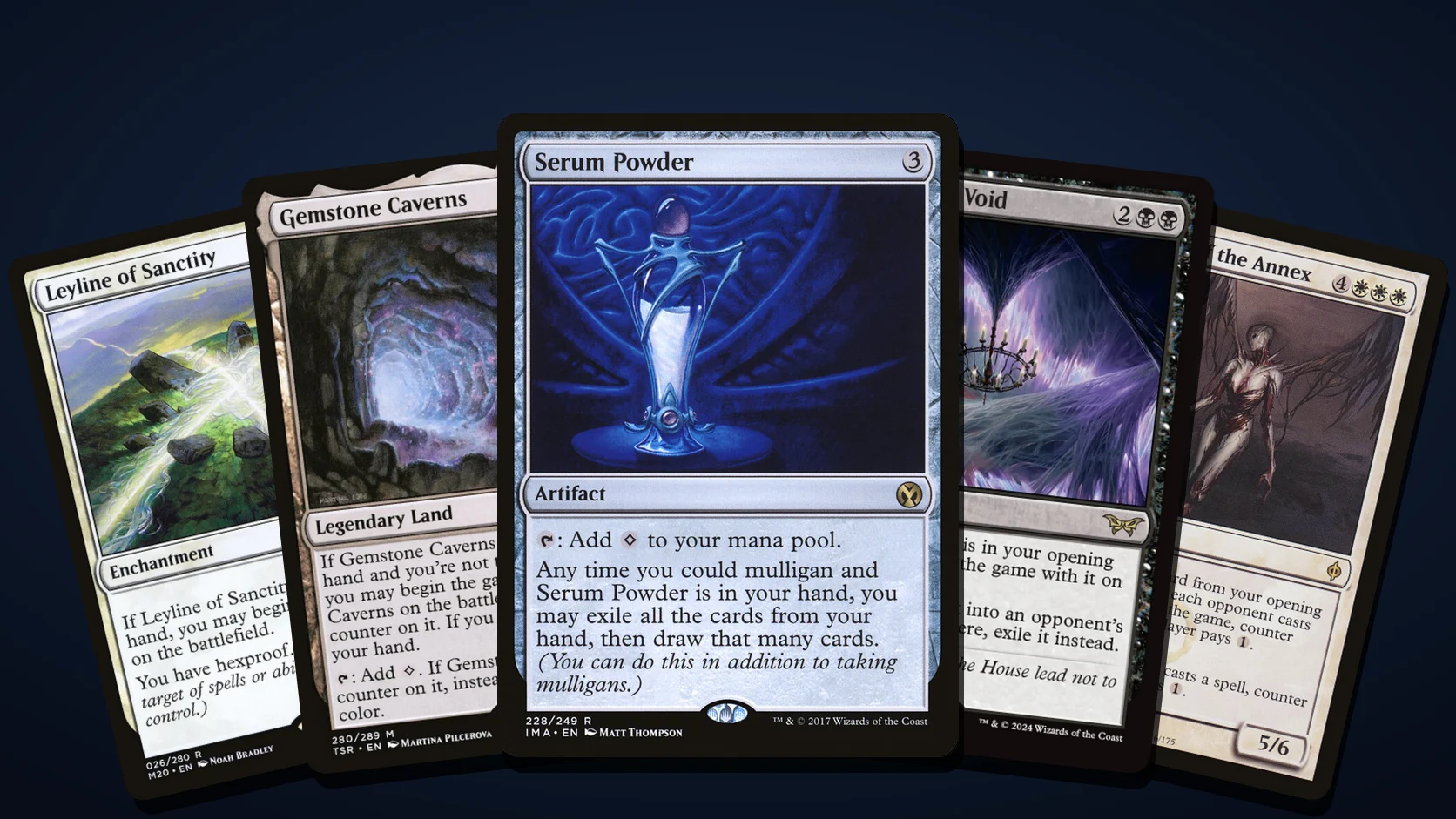
A few cards do something from your opening hand or while you're deciding to mulligan. The rules for them are 103.5b and 103.6.
Serum Powder
- What it does at the start of the game
- Any time you could mulligan, exile your hand and draw that many cards
$2.26 (Iconic Masters)
Price on 19 November 2026 (Scryfall)
Gemstone Caverns
- What it does at the start of the game
- If you're not the starting player, begin the game with it on the battlefield; exile a card from your hand
$60.44 (Time Spiral Remastered)
Price on 19 November 2026 (Scryfall)
Leyline of the Void
- What it does at the start of the game
- Begin the game with it on the battlefield
$0.46 (Duskmourn)
Price on 19 November 2026 (Scryfall)
Leyline of Sanctity
- What it does at the start of the game
- Begin the game with it on the battlefield
$0.50 (Core Set 2020)
Price on 19 November 2026 (Scryfall)
Chancellor of the Annex
- What it does at the start of the game
- Reveal it: each opponent's first spell is countered unless they pay {1}
$3.30 (New Phyrexia)
Price on 19 November 2026 (Scryfall)
Lurrus of the Dream-Den
- What it does at the start of the game
- Revealed as a companion before you shuffle; never part of your hand
$1.55 (Ikoria)
Price on 19 November 2026 (Scryfall)
Prices are for the printing named, from Scryfall, and other printings cost more or less.
Serum Powder
Serum Powder is a three-mana artifact that taps for {C}. Its second ability reads: "Any time you could mulligan and this card is in your hand, you may exile all the cards from your hand, then draw that many cards. (You can do this in addition to taking mulligans.)"
- It isn't a mulligan. Using it doesn't add a card to put on the bottom, and it doesn't stop you from taking a mulligan afterwards.
- The exiled cards are gone. They stay in exile for the rest of the game and are not shuffled back if you mulligan again.
- It shrinks with your hand. Rule 103.5 makes bottoming part of taking each mulligan, so you put cards on the bottom before your next decision. After one mulligan you're holding six. Serum Powder then exiles six and draws six.
- You can do it later in the process. Rule 103.5b lets you use it at any point you would declare a mulligan, even if other players have already declared. After using it, you then declare whether you'll mulligan.
Serum Powder is played in decks that need one specific card in the opening hand, such as a Leyline, or that exile cards as part of their plan.
Gemstone Caverns
Gemstone Caverns only works when you're not the starting player. If it's in your opening hand, you may begin the game with it on the battlefield with a luck counter, and you exile a card from your hand to do so. With the luck counter it taps for one mana of any colour. That means a turn-one extra land on the draw, at the cost of a card.
It is legendary, so two copies on the battlefield at the start of the game don't both stay. The legend rule removes the extra just before the starting player gets priority in the first upkeep, and you can't tap the extra for mana first.
Leylines
Leylines say "If this card is in your opening hand, you may begin the game with it on the battlefield." Leyline of the Void, Leyline of Sanctity and Leyline of Abundance all work this way.
Timing: your opening hand is the hand you have after every player has finished mulliganing. Then the starting player puts all their opening-hand cards onto the battlefield, in any order, followed by each other player in turn order (rule 103.6). Only then does the first turn start.
That's why Leyline decks mulligan harder than most: a seven without a Leyline against the matchup it's meant for can be worth sending back, and the London mulligan makes it easy to keep the Leyline and bottom the worst card.
Leyline Binding is not one of these. It has no opening-hand ability; the name is the only connection.
Chancellors
The New Phyrexia Chancellors are revealed rather than put onto the battlefield. Chancellor of the Annex counters each opponent's first spell of the game unless that player pays {1}, and Chancellor of the Tangle gives you {G} at the start of your first main phase. A revealed card stays revealed until the first turn begins, and each card can only be revealed once (rule 103.6b). In a multiplayer game, Chancellor of the Annex triggers on every opponent's first spell.
Companions
Companions like Lurrus of the Dream-Den are revealed from outside the game before the decks are shuffled (rule 103.2b), so they come before the mulligan and are never in your hand to be shuffled away. A companion works like a guaranteed extra card you can put into your hand for {3} at sorcery speed, which is why companion decks can mulligan more freely. Our companion guide has the full rules. Lurrus itself is banned in Modern.
Which Hands to Keep: Land Count Guide
The easiest test for a seven-card hand is the number of lands. These are the odds of each land count in a random seven, worked out with the hypergeometric distribution for common deck shapes:
Limited: 17 lands in 40
- 0–1 lands
- 10.5%
- 2–5 lands
- 87.8%
- 6–7 lands
- 1.6%
- Average lands in 7
- 3.0
Constructed: 24 lands in 60
- 0–1 lands
- 14.3%
- 2–5 lands
- 84.4%
- 6–7 lands
- 1.4%
- Average lands in 7
- 2.8
Commander: 37 lands in the 99
- 0–1 lands
- 18.6%
- 2–5 lands
- 80.4%
- 6–7 lands
- 1.0%
- Average lands in 7
- 2.6
Simple guidance that holds up in most decks:
- Zero or one land: mulligan. The exception is a very low-curve deck on the draw with plenty of one-drops, and even then it's risky.
- Two lands: keep if your spells are cheap, especially on the draw, where you see an extra card before your second land drop.
- Three or four lands: usually keep, as long as the hand has something to do with them.
- Five lands: keep in slow decks, mulligan in fast ones.
- Six or seven lands: mulligan.
- Check the colours. Two lands that can't cast any of your spells are closer to zero lands.
- Commander: with a free first mulligan in multiplayer, ship a seven that doesn't have three lands or a ramp spell. Games are long and a bad start costs more than a card.
What to bottom. After a mulligan, bottom the cards that make the rest of the hand worse: a sixth land, a second expensive spell, a card that's weak in this matchup. Aim for the land and spell balance you'd want from a good seven.
For deck-building that makes these decisions easier, see our guide to building a Magic deck.
Common Mulligan Mistakes
"I scry after a mulligan." Not since July 2019.
"I draw six on my first mulligan." You draw seven and bottom one. Drawing six was the Paris and Vancouver rule.
"The first mulligan is free in every Commander game." Only in multiplayer games under the rules; one-on-one Commander isn't covered. Brawl always is.
"I put my Leyline in play before my opponent finishes mulliganing." Opening-hand actions happen after every player has kept.
"Serum Powder counts as a mulligan." It doesn't, and the cards it exiles don't come back.
Where This Fits
Mulligans happen before the game starts, so they sit outside the stack and the turn structure. The first check that can end the game after the opening hands is a state-based action. For card selection during the game, see what scry means, and for every keyword in the game, our MTG keywords glossary.
Citations & Resources
- Wizards of the Coast: Comprehensive Rules (effective 6 November 2026), rules 103.5, 103.6, 800.1, 805.3 and 903.12g
- Wizards of the Coast: The London Mulligan (3 June 2019)
- Wizards of the Coast: Introducing Competitive Brawl on MTG Arena
- Scryfall: Serum Powder and its rulings
- Scryfall: Gemstone Caverns and its rulings
- Scryfall: Every card that works from your opening hand
Related Guides
- MTG Formats Explained — which formats use 40, 60 and 100-card decks
- Commander on MTG Arena — Brawl, Standard Brawl and Competitive Brawl compared
- MTG Companion Explained — the card that starts outside your hand
- How to Build a Magic Deck — land counts and curves
- MTG Stack Explained — what happens once the game starts
- The Ultimate MTG Keywords Glossary — every keyword in one place