
Quick verdict
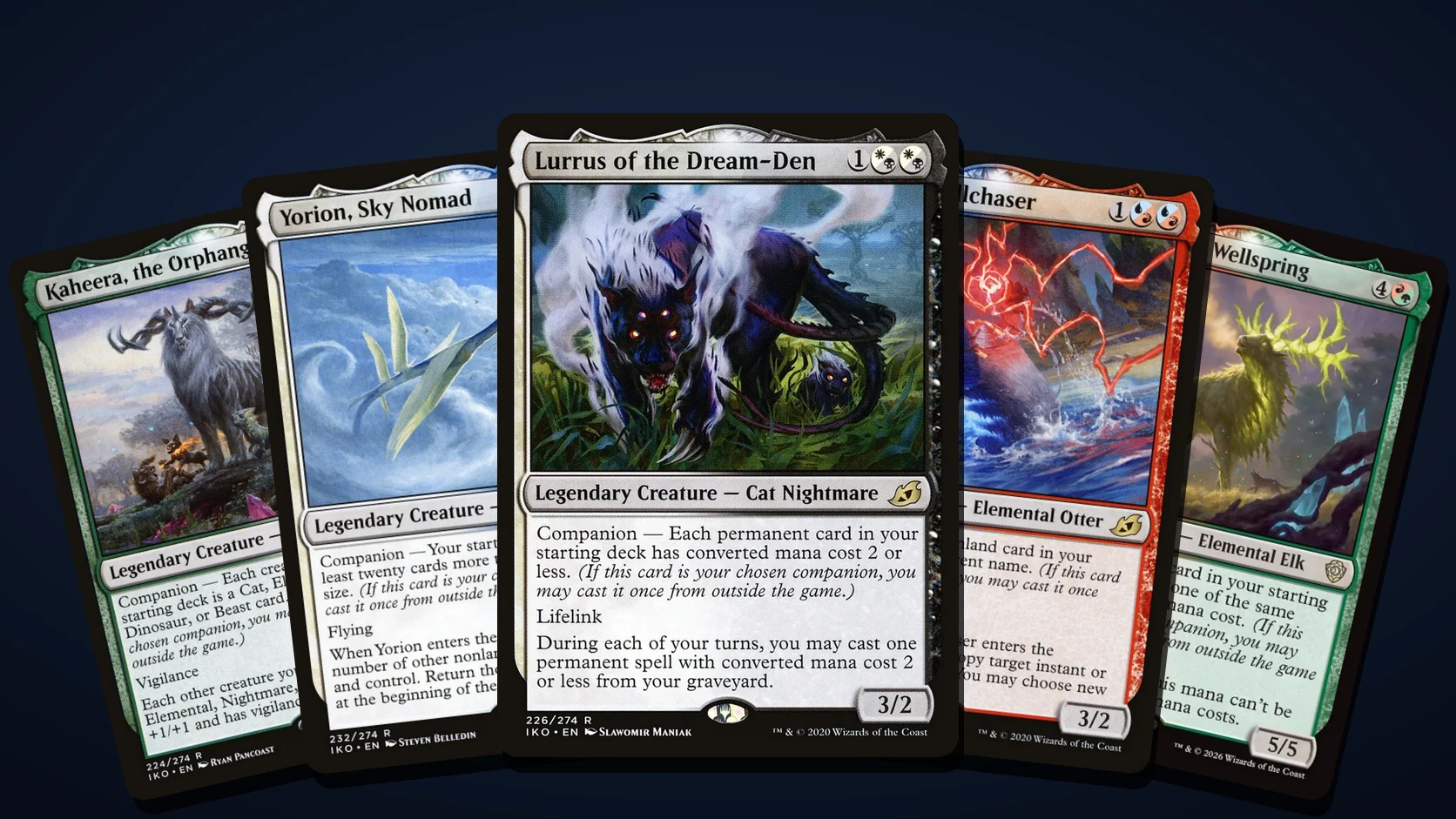
Companion is a deckbuilding keyword from Ikoria (2020). If every card in your starting deck meets a companion's condition, you can reveal that card from outside the game before the game starts. Once per game, during your main phase with an empty stack, you pay 3 generic mana as a special action and put it into your hand, then cast it normally. Before the 1 June 2020 rule change you could cast it straight from outside the game. Only ten companions exist, all from Ikoria. Lurrus, Yorion, Jegantha and Zirda are banned in at least one format, Lutri is banned in Brawl, and in Commander, where your commander counts toward the condition, Lutri is banned only as a companion.
Companion in MTG is a deckbuilding keyword: if every card in your starting deck meets a companion's condition, that card starts the game outside your deck, and once per game you can pay {3} during your main phase to put it into your hand. It is a free extra card in exchange for building around a restriction, such as "every permanent costs 2 or less" or "every card has an even mana value."
Companion came from Ikoria: Lair of Behemoths in April 2020, the same set that introduced mutate. It was so strong that Wizards rewrote the rule about six weeks later, and five of the ten companions are still banned somewhere. No new companion has been printed since.
Companion Rules in MTG
Every companion has the same reminder text on its current Oracle wording, here from Lurrus of the Dream-Den:
Companion — Each permanent card in your starting deck has mana value 2 or less. (If this card is your chosen companion, you may put it into your hand from outside the game for {3} as a sorcery.)
The Comprehensive Rules (702.139) break that down into a few steps.
- Build to the condition. The condition checks your starting deck: the cards you play with after setting your sideboard aside. Your sideboard doesn't have to meet it.
- Reveal before the game. Before you shuffle, you may reveal one card with companion that you own from outside the game, if your deck meets its condition. In a tournament, that card is in your sideboard. The starting player decides first, then the others in turn order, and once you choose not to reveal one you can't change your mind.
- Pay {3} to put it into your hand. Once per game, any time you have priority during your main phase and the stack is empty, you may pay {3} and put it into your hand. This is a special action. It doesn't use the stack, nobody can respond to it, and Phyrexian Revoker can't stop it.
- Then cast it normally. You still pay its mana cost. Once it's in your hand it's a normal card: if it's countered, destroyed or discarded, it goes to your graveyard and stays in the game.
A few details from the rulings matter in practice:
- Only one companion. You can never reveal more than one.
- Its abilities do nothing outside the game. Kaheera's anthem and Zirda's cost reduction only work on the battlefield.
- A companion in your main deck is just a card. Its companion ability does nothing there and puts no restriction on the rest of your deck.
- X is 0. For cards in your deck with {X} in their mana cost, X counts as 0 when you check the condition.
- Sideboarding can turn it off. In games two and three, if you bring in a card that breaks the condition, you can't reveal the companion that game.
Deckbuilding
- When
- Before the event
- What happens
- Your starting deck meets the companion's condition; the companion goes in your sideboard
Reveal
- When
- Before shuffling, in turn order
- What happens
- Reveal one companion from outside the game; it stays revealed
Companion action
- When
- Your main phase, empty stack, once per game
- What happens
- Pay 3 generic mana and put it into your hand; can't be responded to
Cast
- When
- Normal timing
- What happens
- Cast it for its mana cost like any card in your hand
The 2020 Companion Rule Change
Companion did not start out costing {3}. The original Ikoria cards say "you may cast it once from outside the game." That made the companion an eighth card in your opening hand, available whenever you had the mana for it. Within weeks, companion decks were everywhere in competitive play.
On 1 June 2020, Wizards changed the rule rather than ban the cards one by one, citing the play rates of companion decks across all formats. The announcement gave the new version: once per game, any time you could cast a sorcery, you pay 3 generic mana to put your companion from your sideboard into your hand. It took effect in paper on 1 June, on Magic Online on 3 June and on MTG Arena on 4 June. Wizards gave the cards functional errata, so their Oracle text now carries the new reminder text.
The cost is the point. {3} on your turn, at sorcery speed, plus the companion's own mana cost, means playing Lurrus on curve uses most of a turn. Companion went from an automatic extra card to a late-game resource. Some companions still turned out too strong.
All 10 Companions and Their Conditions
There are exactly ten cards with companion, all from Ikoria. Each is a legendary creature with hybrid mana in its cost. Prices are the cheapest non-foil paper printing on Scryfall on 19 November 2026.
Gyruda, Doom of Depths
- Condition (your starting deck)
- Only cards with even mana values
- Price
- $0.46
4 (U/B)(U/B)
Mana cost
Jegantha, the Wellspring
- Condition (your starting deck)
- No card has more than one of the same mana symbol in its mana cost
- Price
- $0.30
4 (R/G)
Mana cost
Kaheera, the Orphanguard
- Condition (your starting deck)
- Each creature card is a Cat, Elemental, Nightmare, Dinosaur or Beast
- Price
- $0.76
1 (G/W)(G/W)
Mana cost
Keruga, the Macrosage
- Condition (your starting deck)
- Only cards with mana value 3 or greater and land cards
- Price
- $0.18
3 (G/U)(G/U)
Mana cost
Lurrus of the Dream-Den
- Condition (your starting deck)
- Each permanent card has mana value 2 or less
- Price
- $1.55
1 (W/B)(W/B)
Mana cost
Lutri, the Spellchaser
- Condition (your starting deck)
- Each nonland card has a different name
- Price
- $0.42
1 (U/R)(U/R)
Mana cost
Obosh, the Preypiercer
- Condition (your starting deck)
- Only cards with odd mana values and land cards
- Price
- $0.26
3 (B/R)(B/R)
Mana cost
Umori, the Collector
- Condition (your starting deck)
- Each nonland card shares a card type
- Price
- $0.32
2 (B/G)(B/G)
Mana cost
Yorion, Sky Nomad
- Condition (your starting deck)
- At least twenty cards more than the minimum deck size
- Price
- $0.30
3 (W/U)(W/U)
Mana cost
Zirda, the Dawnwaker
- Condition (your starting deck)
- Each permanent card has an activated ability
- Price
- $1.19
1 (R/W)(R/W)
Mana cost
What each one does once it's on the battlefield, and the condition details that trip people up:
Gyruda, Doom of Depths. When it enters, each player mills four, and you put a creature card with an even mana value from among them onto the battlefield under your control. Lands have mana value 0, which is even, so they don't break the condition.
Jegantha, the Wellspring. A 5/5 that taps for {W}{U}{B}{R}{G}, which can't pay generic costs. The condition compares exact symbols, so a card costing {X}{X}{R} or two of the same hybrid symbol fails it. In practice it means no card with two of the same coloured pip, which is easy for aggressive decks with cheap spells.
Kaheera, the Orphanguard. Gives your other Cats, Elementals, Nightmares, Dinosaurs and Beasts +1/+1 and vigilance. Only creature cards are checked, so your noncreature spells can be anything, and a creature only needs one of the five types.
Keruga, the Macrosage. Draws a card for each other permanent you control with mana value 3 or more. The condition bans every one- and two-drop, which suits ramp and big-spell decks.
Lurrus of the Dream-Den. Lifelink, and once during each of your turns you may cast a permanent spell with mana value 2 or less from your graveyard. Instants and sorceries in your deck can cost anything. It is the strongest companion and the most banned.
Lutri, the Spellchaser. Flash, and when it enters, if you cast it, copy target instant or sorcery spell you control. In a 60-card deck the condition means no duplicate nonland cards. In Commander it is free, which is why it is banned there as a companion.
Obosh, the Preypiercer. Sources you control with an odd mana value deal double damage. The doubled damage still comes from the original source.
Umori, the Collector. As it enters, choose a card type; spells of that type cost {1} less. Every nonland card must share one card type. Artifact creatures and plain creatures share "creature," but an artifact creature, an artifact and a creature together don't share one type.
Yorion, Sky Nomad. Flying, and when it enters you blink any number of your other nonland permanents until the next end step. The condition is the only one about deck size: at least 80 cards in Constructed, 60 in Limited.
Zirda, the Dawnwaker. Non-mana activated abilities cost {2} less, to a minimum of one mana. Basic lands have intrinsic mana abilities, so they meet the condition.
Lurrus, Yorion, Lutri and the Companion Bans
Companion produced more bans than almost any other mechanic. In date order:
| Date | Change |
|---|---|
| 2 April 2020 | Lutri banned in Commander the day it was previewed, before Ikoria's release |
| 13 April 2020 | Lutri banned in Brawl |
| 18 May 2020 | Lurrus banned in Legacy and Vintage; Zirda banned in Legacy |
| 1 June 2020 | Companion rule change: pay 3 to put it into your hand |
| 15 Feb 2021 | Lurrus unbanned in Vintage |
| 7 Mar 2022 | Lurrus banned in Modern and Pioneer |
| 10 Oct 2022 | Yorion banned in Modern |
| 16 Dec 2024 | Jegantha banned in Modern and Pioneer (and Explorer on Arena) |
| 9 Feb 2026 | Lutri unbanned in Commander, except as a companion |
Lurrus was banned in Legacy and Vintage before the rule change. Vintage normally restricts cards rather than banning them, but Wizards said that restricting Lurrus wouldn't affect its use as a companion, since a companion only ever needs one copy. After the {3} rule, Vintage got Lurrus back in February 2021. Modern and Pioneer banned it in March 2022, even with the higher cost.
Yorion was banned in Modern in October 2022 for a mix of reasons. Wizards cited repetitive triggers and long games with lots of downtime, the physical demands of playing a large deck in paper, and the strong win rate of the Four-Color Omnath decks that ran it as a companion.
Jegantha became the third companion banned in Modern in December 2024, as part of Wizards cutting back Boros Energy.
Lutri's ban was about Commander only. In Commander every deck is singleton, so every blue-red deck met its condition for free. It was banned on 2 April 2020, the day it was previewed, before Ikoria was even released, and on 9 February 2026 the Commander Format Panel created a "banned as a companion" status for it: it can be your commander or one of your 99, but not your companion. Wizards said it doesn't expect any other card on that list.
Current legality from Scryfall on 19 November 2026 (Standard and Pauper: none of the ten are legal). Scryfall lists every companion as legal in Commander, Lutri included, because its legality data can't show a companion-only rule. The Commander column below adds those rules: the Commander ban list bans Lutri only as a companion, and Yorion can never be a Commander companion because its condition needs a deck twenty cards over the minimum, while a Commander deck is exactly 100 cards.
Lurrus
- Pioneer
- Banned
- Modern
- Banned
- Legacy
- Banned
- Vintage
- Legal
- Commander
- Legal
Yorion
- Pioneer
- Legal
- Modern
- Banned
- Legacy
- Legal
- Vintage
- Legal
- Commander
- Legal (can't be a companion)
Jegantha
- Pioneer
- Banned
- Modern
- Banned
- Legacy
- Legal
- Vintage
- Legal
- Commander
- Legal
Zirda
- Pioneer
- Legal
- Modern
- Legal
- Legacy
- Banned
- Vintage
- Legal
- Commander
- Legal
Lutri
- Pioneer
- Legal
- Modern
- Legal
- Legacy
- Legal
- Vintage
- Legal
- Commander
- Legal (banned as a companion)
Gyruda, Kaheera, Keruga, Obosh, Umori
- Pioneer
- Legal
- Modern
- Legal
- Legacy
- Legal
- Vintage
- Legal
- Commander
- Legal
On MTG Arena, Lutri is also banned in Brawl. All ten are legal in Historic and Timeless.
Companions in Commander
Companion works in Commander, with a few extra points:
- The companion is not one of your 100 cards. It sits outside the deck, as a 101st card.
- Your commander counts. The condition checks your deck before your commander is set aside, so the commander has to meet it too. A Lurrus deck needs a commander with mana value 2 or less.
- Colour identity applies. Rule 903.11a bars any card brought into a Commander game from outside it if its colour identity isn't within your commander's, so a blue-red deck can't use Obosh.
- Yorion is impossible. Commander decks are exactly 100 cards, so you can never be twenty over the minimum.
- Lutri is banned only as a companion. It can still lead or sit in the deck.
The companions that see real Commander play are the ones whose conditions a theme deck already meets. Kaheera is the clearest case: on 19 November 2026 EDHREC tagged 2,239 of 11,838 Arahbo, Roar of the World decks as "Kaheera Companion," the commander's most common tag, because a Cat deck already passes the condition (more in our best cat commanders guide). Keruga fits ramp decks with no cheap spells, Umori fits decks built almost entirely from creatures. For the cards that do move a deck up a bracket, see the Game Changers list.
Companion vs Doctor's Companion
Two other things share the name. Doctor's companion is a partner ability from the Doctor Who Commander decks: it lets a legendary creature pair with a Time Lord Doctor as your second commander, in the command zone, and has nothing to do with the Ikoria keyword. Cards with "Companion" in the name, such as Spirited Companion, have no companion ability either.
Common Misconceptions
"You cast the companion from your sideboard." Not since 1 June 2020. You pay {3} to put it into your hand, then cast it.
"The {3} is the companion's cost." It's on top of the card's own mana cost. Lurrus costs you {3} and then {1}{W/B}{W/B}.
"You can respond to the companion action." You can't. It's a special action that doesn't use the stack.
"The companion gets reused if it dies." It goes to your graveyard like any other card, and you can only take the companion action once per game.
"The sideboard has to meet the condition." Only the starting deck does.
"There are newer companions." There aren't. All ten are from 2020, and when Wizards explained the Lutri change in February 2026, it said it expects Lutri to be the only card on the "banned as a companion" list.
Where Companion Fits
Companion is one of the few mechanics that works before the game starts, alongside Commander's partner abilities. If you're building a deck around a condition, our deckbuilding guide covers curves and land counts, the formats guide explains where each companion is legal, and the complete MTG keywords glossary has every other keyword.
Citations & Resources
- Wizards of the Coast: Comprehensive Rules (6 November 2026) — 103.2b, 116.2g, 702.139 Companion and 903.11a
- Wizards of the Coast: June 1, 2020 Banned and Restricted Announcement — the companion rule change
- Wizards of the Coast: May 18, 2020 Banned and Restricted Announcement — Lurrus in Legacy and Vintage, Zirda in Legacy
- Wizards of the Coast: March 7, 2022 Banned and Restricted Announcement — Lurrus in Modern and Pioneer
- Wizards of the Coast: October 10, 2022 Banned and Restricted Announcement — Yorion in Modern
- Wizards of the Coast: December 16, 2024 Banned and Restricted Announcement — Jegantha
- Wizards of the Coast: Commander Banned and Restricted, February 9, 2026 — Lutri banned as a companion
- Scryfall: Every card with companion, with rulings and legality
- EDHREC: Arahbo, Roar of the World and the Kaheera Companion tag
Related Guides
- The Ultimate MTG Keywords Glossary — every keyword, with a printable cheat sheet
- What Is EDH? — Commander rules, the ban list and how a companion fits a 100-card deck
- MTG Game Changers List — the Commander list Lutri was kept off
- Best Cat Commanders — Arahbo and the Kaheera companion deck
- Commander on MTG Arena — Brawl, where Lutri is banned outright
- MTG Stack Explained — why the companion action can't be responded to