
Quick verdict
Mutate is an alternative cost on some creature cards. Pay it and the spell targets a non-Human creature you own; when it resolves, you put the card on top of that creature or underneath it, and the stack becomes one creature. It uses the name, power, toughness and types of the top card and has the abilities of every card in the pile. It doesn't enter the battlefield, so it can attack if the original creature could. If the target is gone, the spell just enters as a normal creature. When the merged creature leaves the battlefield, every card goes with it.
Mutate in MTG lets you cast a creature card for its mutate cost onto a non-Human creature you own. When it resolves, you put it on top of that creature or underneath it, and the two become one creature: it has the name, power, toughness and types of the top card, plus the abilities of every card in the pile. The merged creature isn't new, so it can attack straight away if the original could.
Mutate comes from Ikoria: Lair of Behemoths (2020), the set of giant monsters, and the four mutate cards in the Commander 2020 decks released with it. There are 34 mutate cards in total, and none have been printed since.
How Mutate Works: The Rules
Every mutate card carries the same reminder text. Here it is on Gemrazer:
Mutate {1}{G}{G} (If you cast this spell for its mutate cost, put it over or under target non-Human creature you own. They mutate into the creature on top plus all abilities from under it.)
The Comprehensive Rules (702.140 and 731) break that down into a handful of points.
1. It's an alternative cost. You may pay the mutate cost rather than the mana cost. If you do, the spell becomes a mutating creature spell with a target. Like any alternative cost, you can't combine it with another one, and the card's mana value still comes from its printed mana cost. You don't have to mutate: every mutate card can also be cast normally for its mana cost.
2. The target is a non-Human creature you own. Not one you control: one you own. A creature you've stolen from an opponent isn't a legal target, and neither is any Human, including a changeling, which has every creature type.
3. You choose over or under as it resolves. The card goes on top of the creature or underneath it. With a pile of three or more, it still goes only on the very top or very bottom.
4. The top card sets the characteristics. Name, mana cost, colour, types, power and toughness all come from the topmost card. The abilities come from every card in the pile.
5. It doesn't enter the battlefield. The mutating spell merges with a creature that is already there. The result is the same object it was before, so it hasn't just come under your control, it keeps any counters and Auras, and it stays attacking or blocking if it was.
6. "Whenever this creature mutates" triggers. These abilities trigger when a spell merges with the creature. Enters-the-battlefield abilities don't.
Sea-Dasher Octopus
- Mutate cost
- 1U
- What mutating does
- Flash; draws a card whenever the creature deals combat damage to a player
1UU
Mana cost
Gemrazer
- Mutate cost
- 1GG
- What mutating does
- Reach, trample, destroys an opponent's artifact or enchantment
3G
Mana cost
Migratory Greathorn
- Mutate cost
- 2G
- What mutating does
- Puts a basic land onto the battlefield tapped
3G
Mana cost
Boneyard Lurker
- Mutate cost
- 2(B/G)(B/G)
- What mutating does
- Returns a permanent card from your graveyard to your hand
2BG
Mana cost
Dirge Bat
- Mutate cost
- 4BB
- What mutating does
- Flash, flying, destroys a creature or planeswalker
2BB
Mana cost
Dreamtail Heron
- Mutate cost
- 3U
- What mutating does
- Flying; draws a card when it mutates
4U
Mana cost
Lore Drakkis
- Mutate cost
- (U/R)(U/R)
- What mutating does
- Returns an instant or sorcery from your graveyard to your hand
1UR
Mana cost
Auspicious Starrix
- Mutate cost
- 5G
- What mutating does
- Puts X permanent cards from your library onto the battlefield, X = times mutated
4G
Mana cost
Over or Under: Which to Choose
The choice decides what the creature is. The abilities are the same either way.
- Put it on top when the new card has the better body. Gemrazer on top of a 1-mana Mysterious Egg turns a 0/2 into a 4/4 with reach and trample.
- Put it underneath when you want to keep the creature you already have and just add abilities. Mutating a 2/2 Sea-Dasher Octopus under a 6/6 keeps the 6/6 and adds "draw a card whenever this deals combat damage to a player".
- Keep your commander on top if you want its name and stats. A non-legendary card on top makes the whole creature non-legendary, because supertypes come from the top card too.
A worked example. You control Mysterious Egg (0/2, "Whenever this creature mutates, put a +1/+1 counter on it"). You cast Gemrazer for {1}{G}{G} targeting it and put Gemrazer on top. You now have one 4/4 creature named Gemrazer with reach, trample and both mutate triggers. Gemrazer's trigger destroys an artifact or enchantment, and the Egg's puts a +1/+1 counter on the creature, making it 5/5. If the Egg was on the battlefield since your turn began, the 5/5 can attack this turn.
Mutate and Summoning Sickness
This is the question most players ask first. A mutated creature has summoning sickness only if the creature you mutated onto had it. The merged permanent is the same object as before, and the summoning sickness rule only asks whether that permanent has been under your control continuously since your most recent turn began.
So a creature that has been out since last turn can be mutated in your main phase and attack the same turn, whichever card is on top. Mutate onto a creature you cast this turn and it still can't attack.
Mutate Triggers and Counting Mutations
Because a merged creature has every card's abilities, every "whenever this creature mutates" ability in the pile triggers each time another card mutates onto it. It doesn't matter whether the ability is on the new card or on one that was already there. Stack Cubwarden, then Glowstone Recluse, then Vulpikeet on the same creature and the third mutation triggers all three: two lifelink Cat tokens, two +1/+1 counters and one more counter.
Some cards count the mutations: Porcuparrot deals X damage, Auspicious Starrix puts X permanents onto the battlefield, Insatiable Hemophage drains X. Per the Ikoria release notes, when a "whenever this creature mutates" ability counts mutations, the count includes the mutation that caused it to trigger.
Three support cards reward mutating:
- Pollywog Symbiote makes mutate spells cost {1} less and loots each time you cast one.
- Essence Symbiote puts a +1/+1 counter on a creature and gains you 2 life whenever a creature you control mutates.
- Mysterious Egg and Zagoth Mamba are cheap non-Human bodies with their own mutate triggers, built to sit at the bottom of a pile.
When the Target Becomes Illegal
If the creature you targeted dies, leaves, becomes a Human or otherwise becomes an illegal target before the spell resolves, the spell doesn't fizzle. It stops being a mutating spell and resolves as an ordinary creature spell, entering the battlefield on its own under your control (rule 702.140b).
You keep the card, but it:
- enters the battlefield, so anything that triggers on a creature entering sees it,
- didn't mutate, so its "whenever this creature mutates" ability doesn't trigger,
- has summoning sickness.
That is the main risk of mutate. An opponent who kills the target in response doesn't take your card, but they do take the trigger you paid for and the creature that could attack this turn. Mutating at instant speed with Sea-Dasher Octopus, Pouncing Shoreshark or Dirge Bat, which all have flash, gives them less time to answer.
The mutating spell itself can still be countered like any other creature spell, in which case it goes to your graveyard.
When a Mutated Creature Leaves the Battlefield
A merged creature can't be split apart while it's on the battlefield. When it leaves, one creature leaves, and every card in it goes to the new zone (rule 731.3).
- Dies: one creature dies, and all the cards go to your graveyard, in any order you choose. Its "when this creature dies" abilities trigger once, because it was one creature. If Brokkos, Apex of Forever was in the pile, it lands there too, and its last ability lets you cast it from your graveyard using its mutate cost.
- Bounced: every card returns to your hand. A single bounce spell on a three-card pile costs you three cards' worth of tempo.
- Exiled: every card goes to exile.
- Flickered: if an effect exiles the creature and returns it, it finds every card and returns each one. They come back as separate creatures, no longer merged, and their enters-the-battlefield abilities trigger. Ephemerate-style effects turn a big pile back into several bodies.
Token parts of a pile go to the same zone and then cease to exist, so they never come back.
Mutate and Tokens
You can mutate onto a token, as long as it's a non-Human creature you own. The merged creature is a token only if the top component is a token (rule 731.2d). Put a mutate card on top of a Beast token and the creature is no longer a token; put it underneath and it still is.
Either way, when the pile leaves the battlefield the cards go to their zone normally and the token parts cease to exist.
Copies work as you'd hope. The merged characteristics are copiable, so a clone that copies a mutated creature becomes the top card with every ability in the pile. The copy itself isn't merged with anything.
Mutate in Commander
Mutate does most of its work today in Commander. The rules there add a few points:
A merged creature containing your commander is your commander (rule 903.3c), whether the commander card is on top or underneath. That has three effects:
- Commander damage: combat damage the merged creature deals is damage from that commander. Put a 6/6 mutate card on top of a small commander and every hit from the 6/6 counts toward the 21.
- Going to the command zone: if it dies or is exiled, you may put the commander card into the command zone and the rest of the pile stays in the graveyard or exile. If it would go to your hand or library, you can send the commander to the command zone and the other cards go where they were headed (rule 903.9c).
- Commander tax: casting a mutate commander from the command zone for its mutate cost still adds {2} for each previous cast from the command zone.
Mutating on top of your commander also changes its name, stats and supertypes to the top card's. A non-legendary card on top means the creature is no longer legendary, which matters for the legend rule. It is still your commander.
Best Mutate Commanders
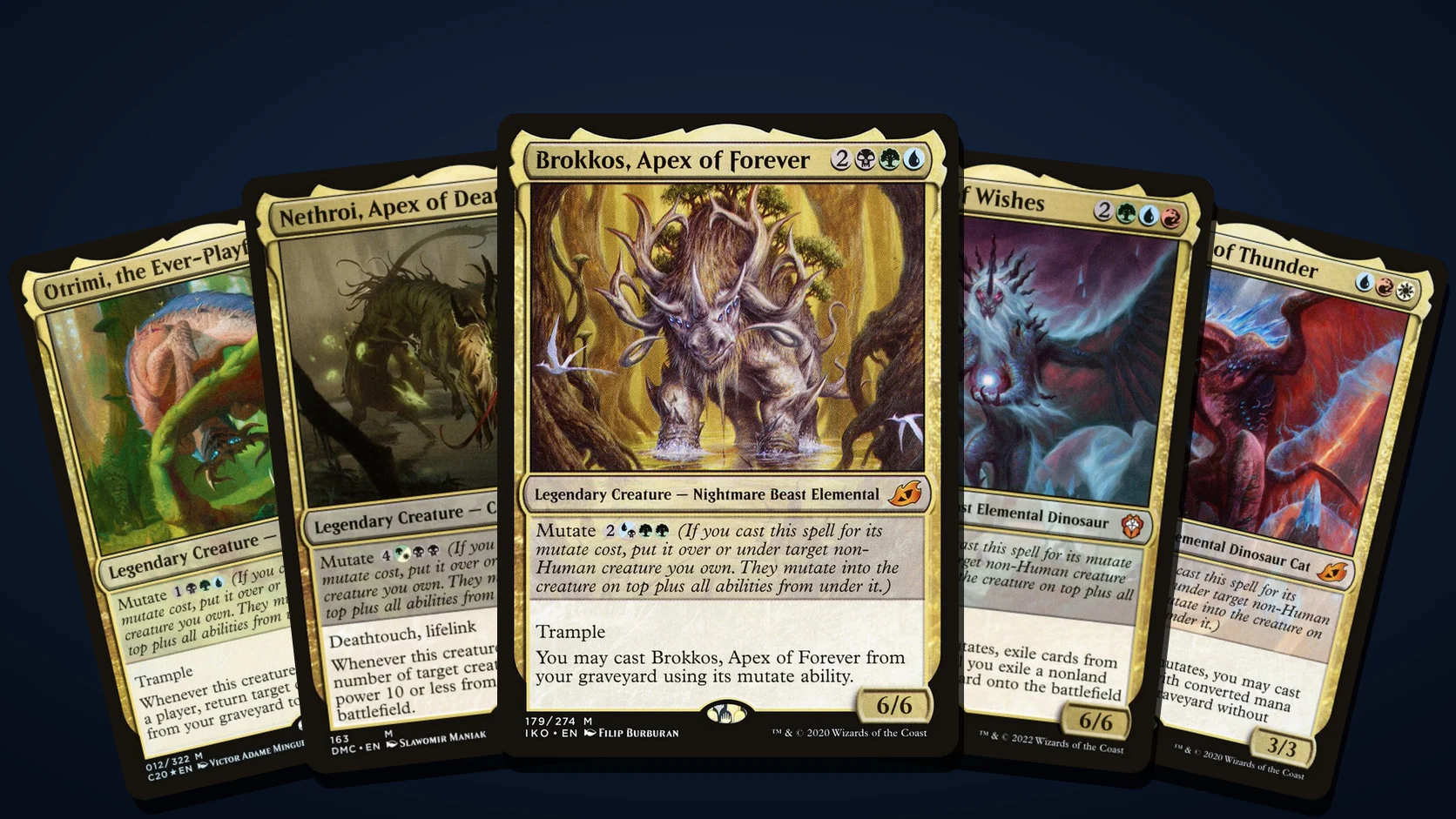
There are six legendary creatures with mutate: the five Apex monsters from Ikoria and Otrimi from Commander 2020. On EDHREC's mutate theme page in November 2026, the mutate commanders rank in this order.
Otrimi, the Ever-Playful
- Colours
- BGU
- What it does
- 6/6 trample; returns a mutate card from your graveyard to hand when it hits a player
- Price (19 Nov 2026)
- $1.24
1BGU
Mutate cost
Illuna, Apex of Wishes
- Colours
- GUR
- What it does
- 6/6 flying, trample; on mutate, digs to the next nonland permanent and puts it onto the battlefield or into your hand
- Price (19 Nov 2026)
- $0.38
3(R/G)UU
Mutate cost
Nethroi, Apex of Death
- Colours
- WBG
- What it does
- 5/5 deathtouch, lifelink; on mutate, reanimates creatures with total power 10 or less
- Price (19 Nov 2026)
- $2.00
4(G/W)BB
Mutate cost
Brokkos, Apex of Forever
- Colours
- BGU
- What it does
- 6/6 trample; can be cast from your graveyard with mutate
- Price (19 Nov 2026)
- $1.50
2(U/B)GG
Mutate cost
Vadrok, Apex of Thunder
- Colours
- URW
- What it does
- 3/3 flying, first strike; on mutate, casts a noncreature card with mana value 3 or less from your graveyard for free
- Price (19 Nov 2026)
- $0.58
1(W/U)RR
Mutate cost
Snapdax, Apex of the Hunt
- Colours
- RWB
- What it does
- 3/5 double strike; on mutate, 4 damage to a creature or planeswalker and you gain 4 life
- Price (19 Nov 2026)
- $0.48
2(B/R)WW
Mutate cost
Prices are Scryfall's listed USD price for the cheapest regular (non-foil, non-promo) printing on 19 November 2026: Commander 2020 for Otrimi, Dominaria United Commander for Illuna, and Ikoria for the rest.
Otrimi, the Ever-Playful is the most popular because it is a mutate engine on its own: every time it connects, a mutate card comes back from the graveyard to your hand, and its mutate cost of {1}{B}{G}{U} is cheaper than its mana cost.
Illuna, Apex of Wishes turns every mutation into a free permanent. Stacking more mutate cards on Illuna means another trigger each time.
Nethroi, Apex of Death is a reanimation commander. Its mutate trigger can return any number of creature cards with total power 10 or less, and a creature with power 0 doesn't count toward the limit.
Brokkos, Apex of Forever is the most resilient. When a pile with Brokkos in it dies, Brokkos goes to the graveyard with everything else, and you can cast it from there with its mutate cost onto your next creature. You have to use the mutate cost when you do; you can't cast it from the graveyard for its normal mana cost.
Vadrok, Apex of Thunder recasts a cheap removal spell, ramp spell or card draw from your graveyard every time it mutates, for free and as the trigger resolves.
Best Mutate Cards
These are among the most-played mutate cards on EDHREC's mutate theme page in November 2026:
- Gemrazer. Three mana to add reach and trample and destroy an artifact or enchantment. The most-played mutate card.
- Migratory Greathorn. Ramp in a creature: a basic land each time it mutates.
- Sea-Dasher Octopus. Two mana, flash, and card draw on combat damage. Mutate it under an unblocked attacker after blockers are declared.
- Dreamtail Heron and Pouncing Shoreshark. Blue mutate cards with a mutate cost of {3}{U}: the Heron draws a card when it mutates, the Shoreshark has flash and bounces an opponent's creature.
- Auspicious Starrix. Gets stronger the more the pile has mutated.
- Boneyard Lurker. Returns any permanent card from your graveyard to your hand.
- Dirge Bat. Instant-speed removal stapled to a flier.
From Commander 2020, Sawtusk Demolisher destroys any noncreature permanent (its controller gets a 3/3 Beast), Souvenir Snatcher steals a noncreature artifact and Mindleecher lets you play the top card of each opponent's library.
Common Misconceptions
"A mutated creature is a new creature." It isn't. It keeps counters, Auras and its place in combat, and it can attack if the original could.
"If the target dies, my mutate spell fizzles." It doesn't. It enters as an ordinary creature.
"Mutating triggers enters-the-battlefield abilities." It doesn't. Only "whenever this creature mutates" abilities trigger.
"Only the new card's mutate trigger goes off." Every mutate trigger in the pile goes off.
"Removal only kills the top card." Removal hits the whole creature, and every card goes with it.
"I can mutate onto my opponent's creature." You can only target a creature you own.
Where Mutate Fits
Mutate shares Ikoria with companion, the other mechanic the set is known for; our MTG companion guide covers how that one works after its 2020 rule change. For the rest of Magic's keywords, see the complete MTG keywords glossary. The stack guide explains why a mutate target can be removed in response, and the tokens guide covers why token parts of a pile vanish.
Citations & Resources
- Wizards of the Coast: Comprehensive Rules — 702.140 Mutate, 731 Merging with Permanents, 903 Commander
- Wizards of the Coast: Ikoria: Lair of Behemoths and Commander (2020 Edition) Release Notes
- Scryfall: Every card with mutate
- EDHREC: Mutate theme
Related Guides
- MTG Companion Explained — Ikoria's other headline mechanic
- The Ultimate MTG Keywords Glossary — every keyword, with a printable cheat sheet
- MTG Stack Explained — responding to a mutate spell
- MTG Tokens Explained — what happens to tokens that leave the battlefield
- MTG Legend Rule Explained — when two legendary creatures share a name
- What Is EDH? — the format where mutate is played most