
The One-Line Answer
EDH stands for Elder Dragon Highlander, the original name of the Commander format in Magic: The Gathering. EDH and Commander are the same thing: same rules, same banned list, two names.
In EDH, each player builds a 100-card deck led by one commander, usually a legendary creature. Every card except basic lands is a single copy, every card has to match the commander's colours, and each player starts at 40 life. Games are usually four players, free-for-all.
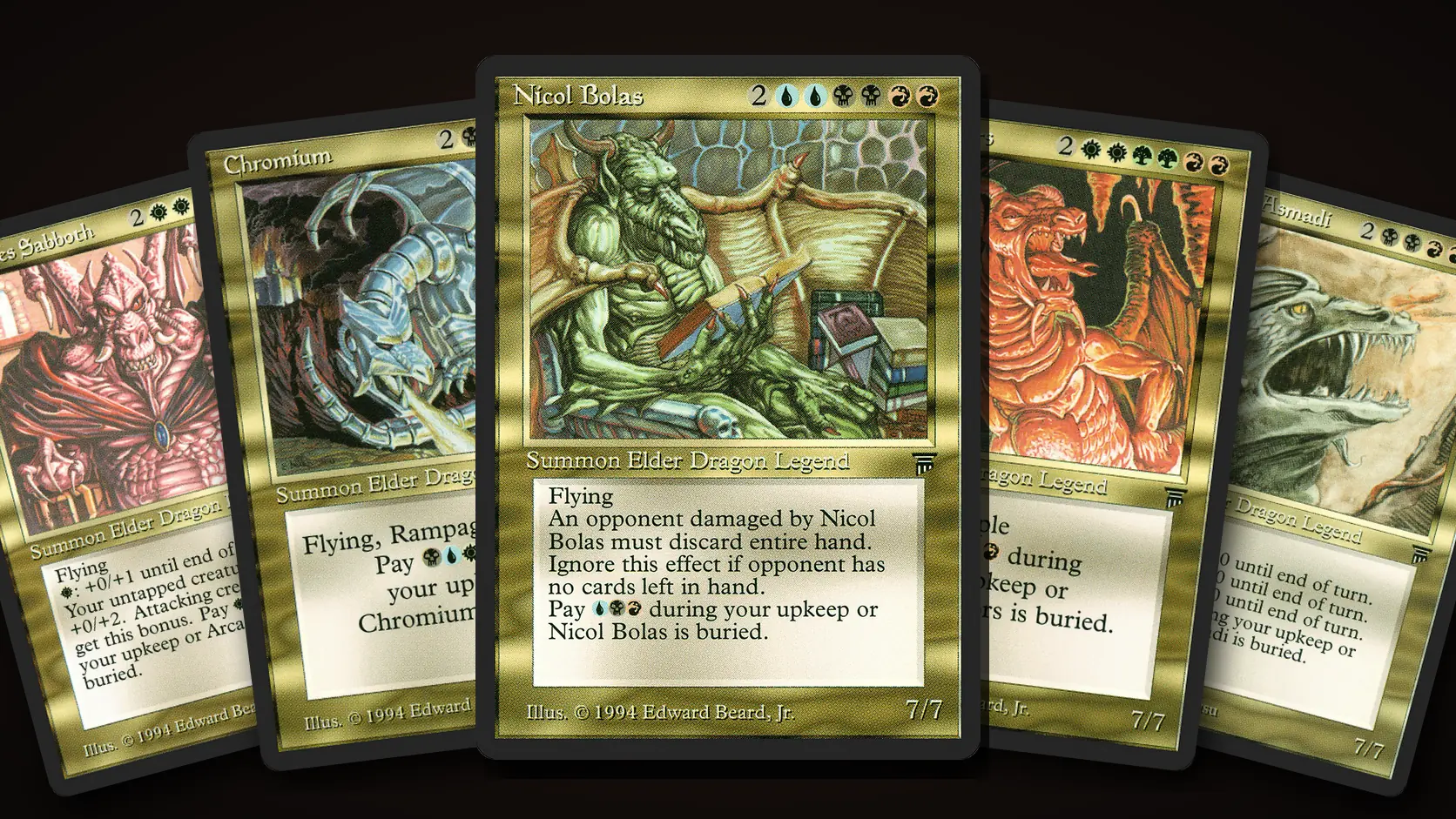
The name comes from where the format started. The first commanders were the five Elder Dragons from the 1994 set Legends, and "Highlander" is the 1986 film whose tagline, "There can be only one", gave the format its one-copy rule.
Short version: say "EDH" or "Commander", and every Magic player will know you mean the same 100-card format.
What Does EDH Stand For?
EDH means Elder Dragon Highlander. The two halves of the name describe the original rules:
- Elder Dragon: in the earliest version, your commander (then called your "General") had to be one of the five Elder Dragons from Legends. Each player claimed one.
- Highlander: a deck may contain only one copy of each card. The word comes from the 1986 film Highlander and its line "There can be only one."
The five Elder Dragons are all legendary 7/7 fliers that cost eight mana across three colours. All five are still legal as commanders today.
Arcades Sabboth
- Colours
- Green, white, blue (Bant)
2GGWWUU
Mana cost
Chromium
- Colours
- White, blue, black (Esper)
2WWUUBB
Mana cost
Nicol Bolas
- Colours
- Blue, black, red (Grixis)
2UUBBRR
Mana cost
Palladia-Mors
- Colours
- Red, green, white (Naya)
2RRGGWW
Mana cost
Vaevictis Asmadi
- Colours
- Black, red, green (Jund)
2BBRRGG
Mana cost
Card data from Scryfall, for the original Legends printings (June 1994).
EDH vs Commander: Is There Any Difference?
No. EDH and Commander are the same format. "EDH" is the fan name the format grew up with. "Commander" is the official name Wizards of the Coast chose when it started printing products for the format, and it's the name on Wizards' rules page, the banned list and every preconstructed deck.
You'll still hear "EDH" all the time, especially in compound terms: cEDH (competitive EDH), EDHREC (the deck statistics site) and "EDH deck". They all mean Commander.
The word "commander" also has a second meaning: the legendary creature that leads your deck. "My commander is Nicol Bolas" and "let's play Commander" use the same word for two different things.
Where EDH Came From: A Short History
EDH started as a house rule among players, not as a Wizards product. The best first-hand account comes from Sheldon Menery, widely credited with spreading the format. Writing for Star City Games in November 2019, he said he first played Adam Staley's variant, "Elder Dragon Highlander", at a friend's apartment in Anchorage, Alaska, in 2002, while stationed at Elmendorf Air Force Base. Other accounts date Staley's first version to the mid or late 1990s.
Jun 1994
Legends is released, with five legendary Elder Dragons: Arcades Sabboth, Chromium, Nicol Bolas, Palladia-Mors and Vaevictis Asmadi.
1996
The Duelist, Wizards' magazine, prints "Elder Dragon Legend Wars", a house-rules format by Jesus M. Lopez built around the Elder Dragons. Adam Staley later said he never read it (Card Kingdom).
1990s–2002
Adam Staley's playgroup in Alaska plays "Elder Dragon Highlander": true singleton, basic lands included, with each player claiming one Elder Dragon as their General.
2002–2005
Sheldon Menery, a Pro Tour judge, learns the format in Anchorage, changes it (basic lands no longer singleton, some cards banned), writes about it around 2004 and takes it to the judges on the Pro Tour.
2006
Gavin Duggan, Sheldon Menery and Duncan McGregor form the Rules Committee. Scott Larabee, Wizards' Pro Tour manager, and Toby Elliott join later.
17 Jun 2011
Wizards releases Commander, five preconstructed decks with 51 new cards. The format now has an official name, Commander, because "Highlander" was the name of a film franchise.
7 Sep 2023
Sheldon Menery, widely called the godfather of Commander, dies after a seven-year fight with cancer.
23 Sep 2024
The Rules Committee bans Dockside Extortionist, Jeweled Lotus, Mana Crypt and Nadu, Winged Wisdom. The backlash includes threats against committee members.
30 Sep 2024
In "On the Future of Commander", Wizards announces that the Rules Committee is giving management of the format to Wizards' game design team.
22 Oct 2024
Wizards announces the Commander Format Panel, a paid advisory group of 17 members led by Wizards' Gavin Verhey, including former Rules Committee members and cEDH players.
11 Feb 2025
Wizards launches the Commander Brackets Beta and the Game Changers list.
The old Rules Committee website, mtgcommander.net, is still online, but its last post of its own is the September 2024 quarterly update. For current rules and bans, go to Wizards' Commander format page.
The Rules of EDH in One Table
These are the core rules from Wizards' Commander page and the Comprehensive Rules, as of 13 November 2026.
| Rule | What it means |
|---|---|
| Deck size | Exactly 100 cards: your commander plus 99 others |
| Singleton | One copy of each card, except basic lands |
| Commander | A legendary creature, a legendary Vehicle or Spacecraft with power and toughness, or a card that says it can be your commander. Two are allowed if both have Partner or a similar ability |
| Colour identity | Every card must use only mana symbols that appear on your commander. Colourless cards are always allowed |
| Starting life | 40 (Standard and most other formats start at 20) |
| Command zone | Your commander starts the game here, not in your deck, and you can cast it from here |
| Commander tax | Two extra mana for each time you've already cast your commander from the command zone this game |
| Returning to the command zone | If your commander would go to your graveyard, hand, library or exile, you can move it back to the command zone instead |
| Commander damage | A player who takes 21 or more combat damage from the same commander over the game loses |
| Banned list | Commander has its own banned list, managed by Wizards. It's separate from the Game Changers list |
| Players | Built for four-player free-for-all; Wizards lists three to five players |
How commander tax works
Say your commander costs four mana. The first cast is four. If it dies and you return it to the command zone, the second cast costs six, the third eight, and so on. The tax counts casts from the command zone only, so a commander that bounces to your hand and gets cast from there doesn't add to it.
How commander damage works
Commander damage is tracked separately for each commander that hits you. Taking 12 from one commander and 10 from another isn't lethal, but 21 from the same commander is, even if you still have life left. Only combat damage counts. Wizards' page notes the count follows the commander even after it changes zones and comes back.
Commander Brackets and Game Changers
Since February 2025, Wizards has used five brackets to describe how powerful a Commander deck is, so a table can agree on the kind of game it wants before shuffling up. The brackets are still labelled beta and are optional.
1
- Name
- Exhibition
- Game Changers allowed
- None
- Expected game length
- At least nine turns
2
- Name
- Core
- Game Changers allowed
- None
- Expected game length
- At least eight turns
3
- Name
- Upgraded
- Game Changers allowed
- Up to three
- Expected game length
- At least six turns
4
- Name
- Optimized
- Game Changers allowed
- Any number
- Expected game length
- At least four turns
5
- Name
- cEDH
- Game Changers allowed
- Any number
- Expected game length
- Any turn
Game Changers are a Wizards-curated list of cards that "easily and dramatically warp Commander games": fast mana like Mana Vault, tutors like Demonic Tutor, and card-advantage engines like Rhystic Study. There are 53 of them as of 13 November 2026, unchanged since 9 February 2026. Sol Ring isn't one.
The brackets also limit two-card infinite combos, mass land denial and extra turns in the lower brackets. Most unmodified precons play at Bracket 2. Our MTG Game Changers list and Commander brackets guide has all 53 cards and every rule for each bracket.
How to Start Playing EDH Cheaply
Buy a preconstructed Commander deck (a precon). It's a complete, legal 100-card deck that you can play out of the box, and it's the cheapest way into the format. Wizards' standard precon has a $49.99 MSRP since January 2026, but many sell for less on TCGplayer.
These four sold for $30 to $49 on TCGplayer on 9 November 2026, and each is a good first deck:
 Keen Engineering (Foundations)About $30 on 9 Nov 2026
 Revival Trance (Final Fantasy)About $30 on 9 Nov 2026
 Wakanda Forever (Marvel)About $35 on 9 Nov 2026
 Multiverse Reforged (Reality Fracture)About $49 on 9 Nov 2026
- Keen Engineering (Sai, Master Thopterist) is a mono-blue artifact deck from the Foundations Commander line, made for players who've never built a Commander deck.
- Revival Trance (Terra, Herald of Hope) is the cheapest Final Fantasy Commander deck, a red-white-black graveyard deck.
- Wakanda Forever (T'Challa) is the best-value of the four Marvel Commander decks.
- Multiverse Reforged (Jace, Multiverse Architect) is our pick as the best all-round precon in our Commander precons guide, which prices every deck since 2023 every week.
If a franchise got you interested, we have deck-by-deck guides for the Star Trek, Fallout, Lord of the Rings, Doctor Who, Warhammer 40,000 and TMNT precons. The 2025 decks are ranked in the best Commander decks of 2025.
Three tips for a cheap start:
- Play the precon as it comes first. You'll learn what the deck wants before you spend anything on it.
- Upgrade slowly with cheap singles. Replace the weakest cards with $1 to $3 singles before you buy anything expensive.
- Check the bracket before you add power. Adding a single Game Changer moves a Bracket 2 precon to Bracket 3, which changes who you should play against.
What Is cEDH?
cEDH is competitive EDH: Commander with the strongest decks the format allows, where everyone at the table is trying to win as quickly and reliably as possible. It uses the same rules and the same banned list as casual Commander. The difference is intent and power.
In Wizards' brackets, cEDH is Bracket 5, described as decks "meticulously designed to battle in the cEDH metagame", and games can end on any turn. cEDH decks play many Game Changers, especially fast mana, efficient tutors and free interaction like Force of Will and Fierce Guardianship. cEDH players were among the first members of the Commander Format Panel in October 2024.
If you're new, start in Brackets 1 to 3. An unmodified precon has little chance against cEDH decks, which can win in the first few turns.
EDH vs Other Magic Formats
Commander (EDH)
- Deck
- 100 cards incl. commander
- Copies
- 1 (except basic lands)
- Starting life
- 40
- Players
- Usually 4
Standard, Modern, Pioneer
- Deck
- 60 cards minimum, sideboard up to 15
- Copies
- Up to 4
- Starting life
- 20
- Players
- 2
Brawl (MTG Arena)
- Deck
- 100 cards incl. commander
- Copies
- 1 (except basic lands)
- Starting life
- 25
- Players
- 2 on Arena
Duel Commander
- Deck
- 100 cards incl. commander
- Copies
- 1 (except basic lands)
- Starting life
- 20
- Players
- 2
Oathbreaker
- Deck
- 60 cards incl. a planeswalker and a signature spell
- Copies
- 1 (except basic lands)
- Starting life
- 20
- Players
- Usually 4
Commander is the multiplayer, high-life, slow-game format. Standard and Modern are two-player formats with four copies of a card and 20 life, built for tournaments. Brawl is Arena's Commander-style format: Wizards' Brawl page lists 100-card decks, 25 life and best-of-one games. Arena has no Commander mode itself; our guide to playing Commander on MTG Arena compares Brawl with the real thing. Duel Commander is a two-player version with its own banned list, run by its own committee, not by Wizards. For how every format compares, see our MTG formats guide.
Common Misconceptions
"EDH and Commander are different formats." They're the same format. EDH is the old name.
"The Rules Committee still runs Commander." It hasn't since 30 September 2024. Wizards of the Coast manages the format and its banned list now.
"Your commander has to be a dragon." Only in the very first version. Today any legendary creature can be your commander, as can legendary Vehicles and Spacecraft with power and toughness and some other cards that say they can.
"Game Changers are banned." They're legal in every Commander deck. They just decide your bracket.
"cEDH is a different format." It's the same format played at Bracket 5.
Conclusion: Same Format, Two Names
EDH is Commander. The name is a fossil from a kitchen-table format built around five dragons from 1994, and it stuck because players liked it.
The rules are simple enough for one table: 100 cards, one of each, your commander's colours, 40 life, 21 commander damage. The brackets tell you what kind of game to expect, and the Game Changers list tells you which bracket you're in.
To start, buy one precon you like the look of for about $30 to $50, play it as it is, and upgrade from there.
Citations & Resources
- Wizards of the Coast: Commander format page, rules and brackets
- Wizards of the Coast: On the Future of Commander, 30 September 2024
- Wizards of the Coast: Introducing the Commander Format Panel, 22 October 2024
- Wizards of the Coast: Commander Brackets Beta Update, 21 October 2025 (bracket descriptions and turn expectations)
- Wizards of the Coast: Commander Brackets Beta Update, 9 February 2026 (Farewell and Biorhythm added)
- Wizards of the Coast: Edge of Eternities update bulletin (legendary Vehicles and Spacecraft as commanders)
- Wizards of the Coast: Commander banned and restricted, 9 February 2026
- Wizards of the Coast: Banned and restricted, 12 October 2026 (no Commander changes)
- Wizards of the Coast: Brawl format page
- Wizards of the Coast: Sheldon Menery, Magic Great, Passes (8 September 2023)
- Star City Games: Sheldon Menery, Godfather of Commander, Passes Away (8 September 2023)
- Star City Games: Sheldon Menery, a brief history of Commander (November 2019)
- Card Kingdom: This day in Magic history, Commander was created (17 June 2011)
- Scryfall: the current Game Changers list
Related Guides
- MTG Game Changers List and Commander Brackets: all 53 Game Changers and what each bracket allows
- MTG Commander Precons: every precon since 2023, priced weekly
- Best MTG Commander Decks of 2025: all 13 precons from 2025, ranked
- MTG Formats Guide: Commander alongside every other format
- MTG Tokens Explained: Treasure, Food, Clue and the other tokens Commander decks make by the dozen
- How Much Does Magic: The Gathering Cost?: what each way of playing costs in 2026