
Quick verdict
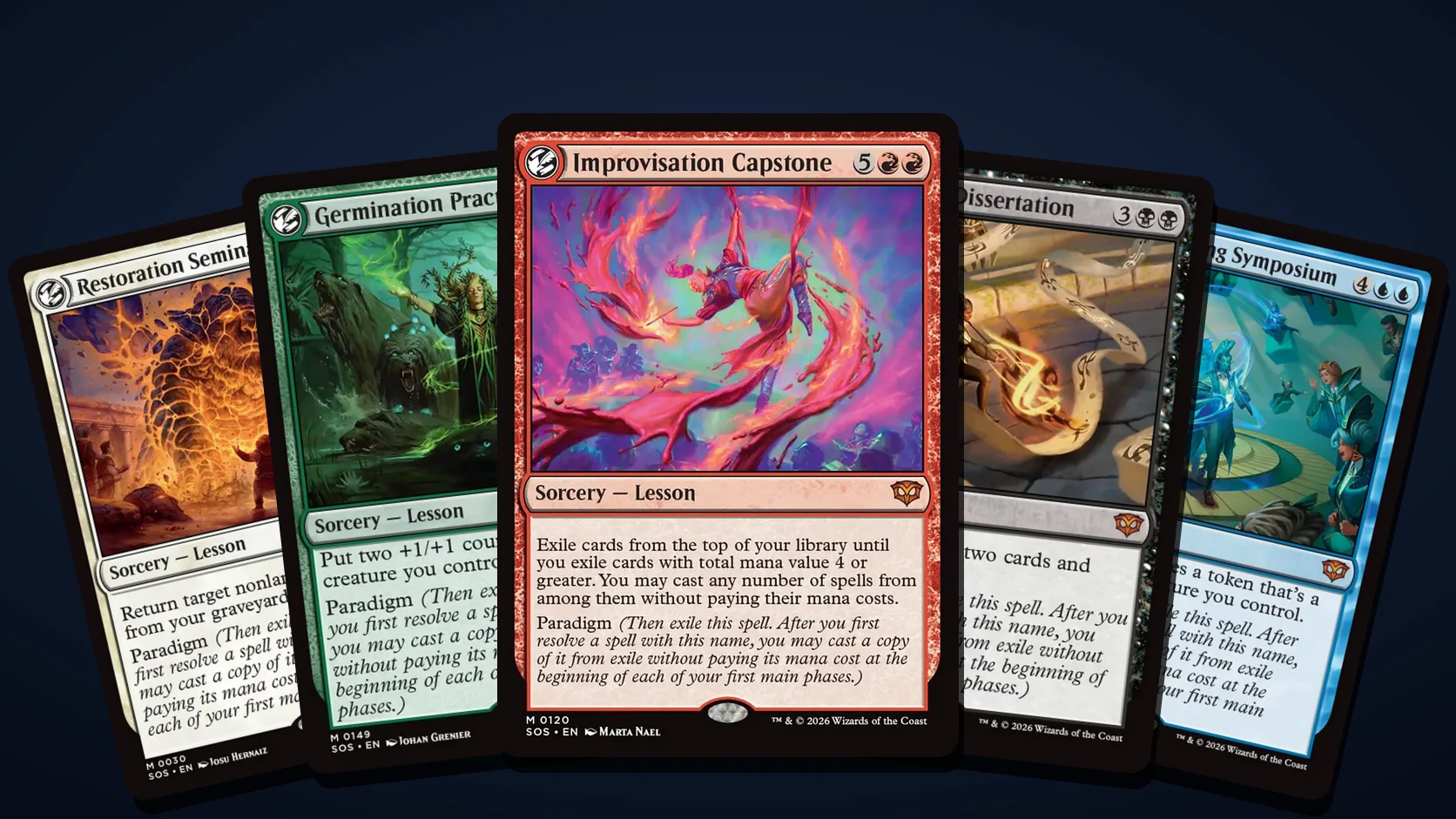
Paradigm is a keyword from Secrets of Strixhaven (24 April 2026) on five mythic rare Lesson sorceries. You cast the card normally. The first time a spell with that name resolves for you, it is exiled and a delayed trigger starts: at the beginning of each of your first main phases for the rest of the game, you may cast a copy of it without paying its mana cost. The copies are optional, don't depend on the exiled card, and keep coming even if one is countered. A second spell with the same name doesn't add a second trigger. Improvisation Capstone is the strongest and most expensive of the five ($10.92 on Scryfall, 19 November 2026).
Paradigm in MTG is a keyword on five sorceries from Secrets of Strixhaven. You cast the card as normal, and it exiles itself as it resolves. If that's the first time a spell with that name has resolved for you this game, then at the beginning of each of your first main phases for the rest of the game, you may cast a copy of it for free. One card becomes a spell you get again every turn.
The set released on 24 April 2026. Wizards' rules manager Matt Tabak described paradigm in the set's mechanics article (31 March 2026) as a keyword that gives a cycle of sorceries "true staying power".
How Paradigm Works in MTG
The reminder text on every paradigm card reads:
Paradigm (Then exile this spell. After you first resolve a spell with this name, you may cast a copy of it from exile without paying its mana cost at the beginning of each of your first main phases.)
The Comprehensive Rules (rule 702.192a, in the 6 November 2026 edition) spell it out. Paradigm is two spell abilities:
- "If this is the first time a spell you control with this spell's name has resolved this game, at the beginning of each of your precombat main phases for the rest of the game, create a copy of this object in exile. You may cast the copy without paying its mana cost."
- "Exile this spell."
"Precombat main phase" is the rules' other name for your first main phase (rule 505.1).
In play, it goes like this:
- Cast it normally. You pay the full mana cost and follow sorcery timing. Paradigm does nothing while the spell is on the stack.
- It resolves. You get the effect, then the card is exiled instead of going to your graveyard.
- The trigger starts. If this was the first spell with that name to resolve for you this game, a delayed triggered ability is set up for the rest of the game.
- Every turn after. At the beginning of your first main phase, the trigger creates a copy of the spell in exile. You may cast it without paying its mana cost. If you don't, the copy ceases to exist.
Paradigm doesn't normally give you a copy on the turn you cast the card. Since paradigm cards are sorceries, you cast them in a main phase, after that turn's trigger point has passed. Your first free copy comes on your next turn.
Paradigm Rules and Rulings
The official rulings for all five cards, published 20 March 2026 and listed on Scryfall, settle the common questions.
The exiled card doesn't matter. "Once a spell with paradigm has resolved, it doesn't matter what happens to the card in exile. Even if the card leaves exile, the delayed triggered ability will still trigger during each of your first main phases, and the copy will still be created." Effects that pull cards out of exile don't turn paradigm off.
Every copy is optional. "When that ability resolves and the copy is created, you can choose not to cast the copy." Skipping one doesn't end the engine: "The delayed triggered ability will still trigger again at the beginning of your first main phase on your next turn regardless."
Countering a copy only stops that copy. Wizards' mechanics article gives this example: "if one of the copies is countered, next turn's triggered ability will still serve you up another."
It has to resolve. No official ruling covers this, but the rules wording settles it. Rule 702.192a counts spells that have resolved, not spells that were cast. If your first paradigm spell is countered (rule 701.6a), or all its targets become illegal so it doesn't resolve (rule 608.2b), it goes to your graveyard and nothing is set up. A later spell with the same name that does resolve becomes the "first time".
One trigger per name. The condition is "the first time a spell you control with this spell's name has resolved this game." A second Germination Practicum still resolves and is exiled, but it doesn't add a second free copy each turn. The copies you cast from the trigger don't stack triggers either. Five different paradigm cards give you five separate triggers.
Free means no alternative costs. Casting "without paying its mana cost" means you can't use an alternative cost, but you can pay additional costs. None of the five paradigm cards has an {X} in its cost, so that question doesn't come up for the copies themselves.
One copy per turn, even with extra combats. Only the first main phase of a turn is a precombat main phase (rule 505.1a). An effect that adds an extra combat and main phase doesn't give you a second copy. An extra turn does, because it has its own first main phase.
Lesson subtype. All five paradigm cards are Sorcery — Lesson. The rulings note that Lesson "has no inherent rules meaning", but older cards can look for it. Learn, from the original 2021 Strixhaven set, lets you take a Lesson card you own from outside the game. Learn doesn't return in Secrets of Strixhaven.
Paradigm Interactions
Cast triggers. You cast the copy, so it is a spell cast for every "whenever you cast" ability: magecraft, prowess, storm counts and the rest. A paradigm card gives a spellslinger deck one free spell a turn.
Copying an opponent's paradigm spell. A copy of a paradigm spell has paradigm. If you copy an opponent's paradigm spell with something like Reverberate and your copy resolves, it's the first time a spell you control with that name has resolved. No official ruling covers this case, but under the wording of rule 702.192a that sets up the free copies for you. Draftsim's paradigm rules guide (29 April 2026) reaches the same conclusion.
Cast during a trigger's resolution. The copy is cast while the delayed trigger is resolving. Rule 608.2g covers casting a spell during resolution: no player gets priority until the trigger finishes, and the copy then goes on the stack and resolves normally.
Cards that stop paradigm. The engine survives counterspells and exile removal, but some cards answer it directly:
- Drannith Magistrate ({1}{W}): "Your opponents can't cast spells from anywhere other than their hands." The copy is cast from exile, so it can't be cast while the Magistrate is out. The first cast from your hand still works.
- Vexing Bauble ({1}): "Whenever a player casts a spell, if no mana was spent to cast it, counter that spell." It counters every free copy, but not the first cast, which you pay for. Its rulings add one exception: if you spend mana on a cost increase or additional cost while casting the copy, Bauble doesn't trigger.
- Cost increases. Effects that make spells cost more still apply when you cast something without paying its mana cost, so you'd have to pay the tax to cast the copy.
Paradigm vs Epic
Paradigm is often compared with epic, a keyword from Saviors of Kamigawa (2005). Draftsim and EDHREC both ran articles on whether paradigm is a fixed version of it. The difference is in the rules text.
When the repeat happens
- Epic (rule 702.50)
- Beginning of each of your upkeeps
- Paradigm (rule 702.192)
- Beginning of each of your first main phases
What you get
- Epic (rule 702.50)
- A copy put on the stack (not cast)
- Paradigm (rule 702.192)
- A copy you may cast for free
Drawback
- Epic (rule 702.50)
- You can't cast spells for the rest of the game
- Paradigm (rule 702.192)
- None
Optional each turn
- Epic (rule 702.50)
- No, the copy is mandatory
- Paradigm (rule 702.192)
- Yes
Triggers cast abilities
- Epic (rule 702.50)
- No
- Paradigm (rule 702.192)
- Yes
Card after resolving
- Epic (rule 702.50)
- Goes to the graveyard
- Paradigm (rule 702.192)
- Exiled
Epic's lockout made its cards a final play. Paradigm cards are expensive at five to seven mana, but you can keep casting your other spells after one resolves.
Every Paradigm Card
There are five, one mythic rare per colour, all in Secrets of Strixhaven. Prices are Scryfall's TCGplayer market prices for the non-foil main-set printing on 19 November 2026. EDHREC deck counts are from the same day and show how many decks on EDHREC include the card, which is 2 to 3% of the decks that could play it.
Improvisation Capstone
- Effect each turn
- Exile from the top until 4+ total mana value, cast any of them free
- Price (19 Nov 2026)
- $10.92
- EDHREC decks
- 76,273
5RR
Cost
Germination Practicum
- Effect each turn
- Two +1/+1 counters on each creature you control
- Price (19 Nov 2026)
- $7.13
- EDHREC decks
- 58,815
3GG
Cost
Decorum Dissertation
- Effect each turn
- Target player draws two cards and loses 2 life
- Price (19 Nov 2026)
- $5.57
- EDHREC decks
- 55,604
3BB
Cost
Restoration Seminar
- Effect each turn
- Return a nonland permanent card from your graveyard to the battlefield
- Price (19 Nov 2026)
- $4.23
- EDHREC decks
- 44,657
5WW
Cost
Echocasting Symposium
- Effect each turn
- Target player creates a token copy of a creature you control
- Price (19 Nov 2026)
- $3.31
- EDHREC decks
- 42,804
4UU
Cost
Each card also has a borderless printing and a stamped promo-pack version. On 19 November 2026 the borderless versions cost $14.77 (Improvisation Capstone), $11.11 (Germination Practicum), $7.25 (Decorum Dissertation), $7.05 (Restoration Seminar) and $4.91 (Echocasting Symposium).
Improvisation Capstone
{5}{R}{R}. "Exile cards from the top of your library until you exile cards with total mana value 4 or greater. You may cast any number of spells from among them without paying their mana costs."
This is the best of the five, and Commander players agree: it's in more EDHREC decks than any other paradigm card. Every turn it hands you at least 4 mana value of free spells. Lands count as 0 and can't be cast, so they're exiled along the way. The rulings add that you cast the spells while Capstone is resolving, so you can't save them for later, and timing restrictions based on card type are ignored. A card with {X} in its cost is cast with X as 0.
Germination Practicum
{3}{G}{G}. "Put two +1/+1 counters on each creature you control." Once is a strong finisher. Every turn, it makes a board of small creatures enormous, and it's a natural fit for the counters decks covered in our proliferate guide.
Decorum Dissertation
{3}{B}{B}. "Target player draws two cards and loses 2 life." Two cards a turn for 2 life is a strong card advantage engine. Because it targets a player, you can also point a copy at an opponent when you need them to lose 2 life more than you need the cards, though they keep the cards.
Restoration Seminar
{5}{W}{W}. "Return target nonland permanent card from your graveyard to the battlefield." It reanimates any nonland permanent, not just creatures, every turn. It needs a target, so the copy can't be cast if your graveyard has no nonland permanent card in it.
Echocasting Symposium
{4}{U}{U}. "Target player creates a token that's a copy of target creature you control." The token copies the creature's printed values, not its counters or Auras, and its enters abilities trigger, so it's best on a creature with a big enters trigger. It needs a creature you control to target.
Paradigm on MTG Arena: Paradigm Shifter
There's one more card that references paradigm. Paradigm Shifter ({1}{U}{R}) is a digital-only mythic from Alchemy: Secrets of Strixhaven (19 May 2026), legal in Alchemy and Historic on Arena. When it enters, it conjures a card of your choice from the Paradigm Spellbook into your hand, and it taps for two mana that can only be spent on instants and sorceries.
Where to Get Paradigm Cards
All five are mythic rares in Secrets of Strixhaven. A Play Booster box costs $143.54 (TCGplayer market price, 18 November 2026) and a Collector Booster box $498.24 (TCGplayer market price, 18 November 2026) on TCGplayer today. Our Secrets of Strixhaven Play Booster EV page tracks what a box's cards are worth. If you only want one paradigm card, buying the single is far cheaper than opening packs for it. For the set's Commander decks, see our Strixhaven Commander decks guide.
Common Misconceptions
"Paradigm gives me a copy the turn I cast it." It doesn't. The trigger is at the beginning of your first main phase, which has already passed by the time a sorcery resolves.
"Two copies of the card mean two free spells a turn." Only the first spell with that name to resolve sets up the trigger.
"If they exile the card from exile, the copies stop." They don't. The trigger doesn't depend on the card.
"Paradigm copies aren't cast." They are, which is why they trigger cast abilities and why Drannith Magistrate and Vexing Bauble stop them.
"Paradigm is just epic." Epic copies at upkeep and stops you casting spells for the rest of the game. Paradigm has no lockout.
Where Paradigm Fits
Paradigm is a keyword about getting a spell again. Others are flashback, which gives one more cast from the graveyard, suspend, which delays a free cast, rebound, which lets you cast the spell free once more at your next upkeep, and cascade, which Improvisation Capstone closely resembles. For how the copy goes on the stack and resolves, see our stack guide. For every other keyword, our complete MTG keywords glossary has them all.
Citations & Resources
- Wizards of the Coast: Comprehensive Rules (6 November 2026), rule 702.192 Paradigm
- Wizards of the Coast: Secrets of Strixhaven Mechanics, Matt Tabak (31 March 2026)
- Scryfall: Every card with paradigm, with rulings
- Draftsim: Paradigm rules interactions (29 April 2026)
- EDHREC: Improvisation Capstone
Related Guides
- The Ultimate MTG Keywords Glossary — every keyword, with a printable cheat sheet
- MTG Flashback Explained — one more cast from the graveyard
- MTG Suspend Explained — another way to cast a spell without paying its mana cost
- What Cascade Means in MTG — the closest relative of Improvisation Capstone
- MTG Stack Explained — how copies and triggers resolve
- Strixhaven Commander Decks — the five Secrets of Strixhaven precons