
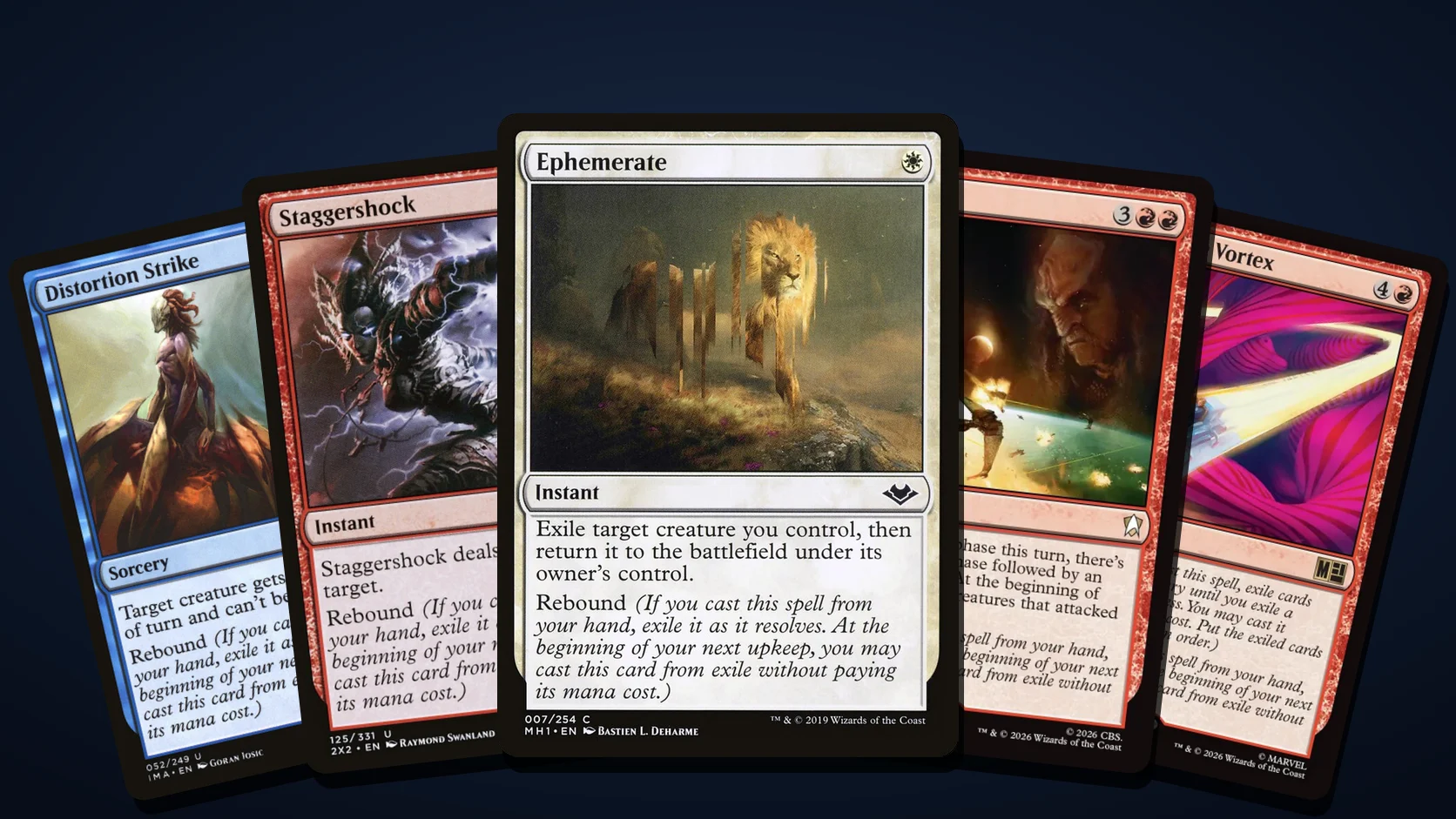
Quick verdict
Rebound lets you cast an instant or sorcery twice for one card. If you cast it from your hand and it resolves, it is exiled instead of going to your graveyard, and at the beginning of your next upkeep you may cast it again from exile without paying its mana cost. It only works when the first cast is from your hand, a countered spell gets no rebound, and the second cast is optional but counts as casting a spell.
Rebound in MTG is a keyword on instants and sorceries that lets you cast the same spell twice. If you cast a rebound spell from your hand and it resolves, it is exiled instead of going to your graveyard. At the beginning of your next upkeep, you may cast it again from exile without paying its mana cost. Then it goes to the graveyard like any other spell.
Rebound first appeared in Rise of the Eldrazi in April 2010. There are 34 tournament-legal paper cards with it, from the original Staggershock to the November 2026 Star Trek Commander reprint of World at War.
Rebound Rules in MTG
The reminder text on Ephemerate gives the whole mechanic in one line:
Rebound (If you cast this spell from your hand, exile it as it resolves. At the beginning of your next upkeep, you may cast this card from exile without paying its mana cost.)
Rule 702.88a of the Comprehensive Rules says rebound is a static ability that works while the spell is on the stack and may create a delayed triggered ability. It means: "If this spell was cast from your hand, instead of putting it into your graveyard as it resolves, exile it and, at the beginning of your next upkeep, you may cast this card from exile without paying its mana cost."
Step by step:
- Cast it from your hand and pay its cost as normal.
- It resolves, and its effect happens. Instead of going to your graveyard, it is exiled.
- At the beginning of your next upkeep, a delayed trigger goes on the stack.
- When that trigger resolves, you may cast the card from exile for free. If you do, it goes to your graveyard afterwards.
It only works from your hand. If you cast a rebound spell from your graveyard, from exile, from your library or from an opponent's hand, rebound does nothing. It does work if you cast it from your hand without paying its mana cost, for example through Maelstrom Archangel.
A countered spell gets no rebound. Rebound replaces the trip to the graveyard as the spell resolves. If the spell is countered, or fails to resolve because all its targets are illegal, it goes to your graveyard and you won't get to cast it next turn.
The second cast is optional. If you don't want to cast it, or can't because there are no legal targets, the card stays in exile for the rest of the game. There is no second chance on a later turn. The same happens if someone counters the rebound trigger itself, with Stifle for example.
Sorcery timing is ignored. You cast the card while the trigger is resolving in your upkeep, so a sorcery like World at War can be cast then. Other restrictions still apply: under Rule of Law, the rebound cast counts as your spell for the turn.
It's a free cast, not a copy. Casting "without paying its mana cost" is an alternative cost (rule 702.88b), so you can't combine it with another one. It goes on the stack as a new spell: you choose new targets and new modes, and opponents can respond or counter it.
Copies don't rebound. A copy of a spell is never cast from your hand, so storm copies or a Twincast copy of Staggershock don't come back.
Cast from hand, resolves
- Do you get the upkeep cast?
- Yes
- Where the card ends up
- Exile, then graveyard after the second cast
Cast from hand, countered
- Do you get the upkeep cast?
- No
- Where the card ends up
- Graveyard
Cast from hand, all targets illegal
- Do you get the upkeep cast?
- No
- Where the card ends up
- Graveyard
Cast from hand for free (Maelstrom Archangel)
- Do you get the upkeep cast?
- Yes
- Where the card ends up
- Exile, then graveyard
Cast via cascade
- Do you get the upkeep cast?
- No
- Where the card ends up
- Graveyard
Cast from graveyard (Sins of the Past)
- Do you get the upkeep cast?
- No
- Where the card ends up
- Exile (Sins of the Past's own text)
A copy of the spell
- Do you get the upkeep cast?
- No
- Where the card ends up
- Copy ceases to exist
You decline the upkeep cast
- Do you get the upkeep cast?
- Declined
- Where the card ends up
- Stays in exile for the rest of the game
Timing: Cast Rebound Spells on Your Opponent's Turn
The second cast always comes at your next upkeep, so when you cast the first one matters.
Cast a rebound instant at the end of an opponent's turn and you get the second cast a few steps later, in your own upkeep. Cast it in your own main phase and you wait a full turn cycle. Ephemerate is the clearest case: hold it until an opponent tries to remove your creature, flicker it in response, and flicker it again for value at your upkeep.
Sorceries such as World at War can only be cast on your turn, so the gap is always one full turn.
Rebound Rulings Worth Knowing
These come from the official Gatherer rulings and Oracle text of the rebound cards.
- Leyline of the Void and similar effects. If another replacement effect would also move the resolving spell, such as an opponent's Leyline of the Void, you choose which one applies. Pick rebound and you still get the upkeep cast.
- Graveyard triggers miss it. A rebound spell that resolves is exiled straight from the stack, so effects that care about cards going to your graveyard don't see it the first time.
- Several rebound spells at once. All of their delayed triggers fire at the beginning of your upkeep, and you put them on the stack in any order you like.
- "Cast from your hand" checks. Transpose creates its Wizard token only "if this spell was cast from your hand". The rebound cast from exile still loots and costs 1 life, but makes no token.
Cascade and Rebound
Two interactions catch people out here. The full cascade rules are in our guide to what cascade means in MTG.
Cascading into a rebound card gives no rebound. Shardless Agent, Ardent Plea and Bloodbraid Elf let you cast the cascaded card from exile, not from your hand. If Shardless Agent hits Ephemerate, you get one flicker and Ephemerate goes to your graveyard. The Gatherer rulings on Staggershock name cascade as an example of a cast that doesn't trigger rebound.
A spell with both keywords cascades twice. Into the Time Vortex ({4}{R}) has nothing but cascade and rebound. Cascade triggers "when you cast this spell", wherever it was cast from. You cast it from your hand and cascade into a spell with mana value 4 or less. At your next upkeep you cast it again from exile, and cascade triggers again. One card, two free spells. If the first cast is countered, the cascade still resolves, but the rebound doesn't happen.
The same principle helps any "whenever you cast" ability. The upkeep cast is a real cast, so it triggers prowess and magecraft and counts toward storm.
Rebound vs Flashback and Suspend
Rebound is one of several keywords that let you get a spell for free or a second time:
- Flashback casts the card again from your graveyard for a separate cost, then exiles it. You choose when, within normal timing.
- Suspend exiles the card with time counters and casts it for free when the last one comes off. It's a delay you choose in place of the normal cast, not a second use.
- Plot also exiles the card from your hand to cast free later, on any later turn you choose but only at sorcery speed. Like suspend, it's one cast, not two.
- Rebound gives you the full spell now and the full spell again next upkeep, for no extra cost. The trade-off is that you don't choose the timing of the second cast.
A Short History of Rebound
Rise of the Eldrazi
- Year
- 2010
- New rebound cards
- 11, including Staggershock, Distortion Strike and World at War
Dragons of Tarkir
- Year
- 2015
- New rebound cards
- 10, as the Ojutai clan mechanic
Modern Horizons
- Year
- 2019
- New rebound cards
- Ephemerate, Trumpeting Herd
Modern Horizons 2
- Year
- 2021
- New rebound cards
- Faithless Salvaging, Blossoming Calm, Terramorph
Forgotten Realms Commander
- Year
- 2021
- New rebound cards
- Fevered Suspicion
Doctor Who
- Year
- 2023
- New rebound cards
- Into the Time Vortex, Quantum Misalignment
Final Fantasy Commander
- Year
- 2025
- New rebound cards
- Transpose
Marvel Super Heroes Commander
- Year
- 2026
- New rebound cards
- Fantastic Elasticity, Flame On!, Invisible Force Field, It's Clobberin' Time!
Many of the older cards have been reprinted in Iconic Masters (2017) and Double Masters 2022. World at War was reprinted in Star Trek Commander on 13 November 2026, and as Battle of Olympus in the God of War Secret Lair. There is also one digital-only card, Unnatural Summons, from Alchemy: Duskmourn, and one playtest card, Jeskai Baller, from Mystery Booster 2: a rare creature with rebound that isn't legal in any format.
No rebound card is legal in Standard. The Rise of the Eldrazi, Dragons of Tarkir, Modern Horizons and MH2 cards are legal in Modern, the Dragons of Tarkir ones are also legal in Pioneer, and all 34 are legal in Commander and Legacy.
Best Rebound Cards
Prices are Scryfall's near-mint USD prices on 19 November 2026, for the printing named.
Ephemerate ({W}). Exile a creature you control and return it, then do it again next upkeep. It saves a creature from removal and gets two extra enters-the-battlefield triggers for one mana. It is a common, so it's legal in Pauper, and it ranks far ahead of every other rebound card on EDHREC. It also saves an evoke creature from its sacrifice trigger, as our evoke guide explains. About $5.18 for the Modern Horizons printing.
Quantum Misalignment ({4}{U}). Create a non-legendary token copy of a creature you control, then another next turn. Two copies of your best creature for five mana is strong in Commander. From $3.08 for the Marvel Super Heroes Commander reprint.
World at War ({3}{R}{R}). An extra combat and main phase, untapping every creature that attacked, and the same again next turn. The Rise of the Eldrazi printing was $12.46; the new Star Trek Commander one starts at $1.51.
Into the Time Vortex ({4}{R}). Two cascades from one card, as explained above. Not legal in Modern.
Fevered Suspicion ({6}{B}{R}). Each opponent exiles cards until they hit a nonland card, and you may cast any of them for free, twice. Strongest at a full Commander table.
Staggershock ({2}{R}). Two damage to any target now and two more next turn. The classic rebound card, and legal in Pauper. $0.23 for the Double Masters 2022 printing.
Transpose ({2}{B}). Loot and lose 1 life twice, plus a 0/1 Wizard that pings each opponent whenever you cast a noncreature spell.
Distortion Strike ({U}). +1/+0 and unblockable for a single blue mana, twice. A common, so it's legal in Pauper.
Rebound in Commander
Rebound is well suited to Commander. Games are long, so a second cast is rarely wasted, and the free cast at upkeep doesn't cost you mana on a turn you want to spend on other things.
Blink decks use Ephemerate with creatures that have big enter triggers. Spellslinger decks get two "whenever you cast" triggers from each rebound card. Our Doctor Who Commander decks guide covers the set that introduced Quantum Misalignment and Into the Time Vortex.
The weakness is graveyard and exile hate. A rebound card is in exile between casts, so it dodges Bojuka Bog, but anything that stops you casting spells from exile or counters triggered abilities will stop the second cast.
Common Misconceptions
"A countered rebound spell still comes back." It doesn't. No resolution, no rebound.
"Rebound works however I cast it." Only a cast from your hand counts. Cascade, flashback and other cast-from-anywhere-else effects give no rebound.
"The upkeep cast isn't really casting." It is. It triggers "whenever you cast" abilities and can be countered.
"I can save it for a later turn." You can't. Cast it at your next upkeep or lose it.
"Rebound copies the spell." It doesn't. You cast the same card a second time, choosing new targets and modes.
Where Rebound Fits
Rebound is one of the cleanest card-advantage keywords in the game: one card, two spells, and the second one is free. For the other keywords you will meet on older cards, our complete MTG keywords glossary has them all, and the stack guide covers how the rebound trigger and the second cast use the stack.
Citations & Resources
- Wizards of the Coast: Comprehensive Rules, 702.88 Rebound and 702.85 Cascade (effective 6 November 2026)
- Scryfall: Every card with rebound
- Scryfall: Staggershock and its rebound rulings
- Scryfall: Into the Time Vortex
Related Guides
- The Ultimate MTG Keywords Glossary — every keyword, with a printable cheat sheet
- What Cascade Means in MTG — why cascading into a rebound card gives no rebound
- MTG Suspend Explained — the other keyword that casts a card from exile for free
- MTG Flashback Explained — a second use from the graveyard instead of exile
- MTG Stack Explained — how the rebound trigger and the free cast use the stack