
Quick verdict
To cast a spell is to put it on the stack and pay its costs (CR 601.2). To play a land is to put it onto the battlefield as a special action that doesn't use the stack (CR 305.1). To play a card means either one: play it as a land or cast it as a spell, whichever fits (CR 601.1a). So a card that says "you may play" an exiled card lets you use lands too, while "you may cast" does not. Free casts such as cascade still count as casting; putting a card onto the battlefield is neither playing nor casting.
In Magic: The Gathering, cast means taking a spell from where it is, putting it on the stack and paying its costs. Play is the wider word: you play a land by putting it onto the battlefield as a special action, and to play a card means to play it as a land or cast it as a spell, whichever fits. So "you may play that card" lets you use a land, while "you may cast that card" doesn't. A land is never cast.
Play vs cast in MTG: the rules
From the Comprehensive Rules effective 6 November 2026:
- CR 601.2: "To cast a spell is to take it from where it is (usually the hand), put it on the stack, and pay its costs, so that it will eventually resolve and have its effect."
- CR 305.1: Playing a land is a special action; it doesn't use the stack. "Since the land doesn't go on the stack, it is never a spell, and players can't respond to it with instants or activated abilities."
- CR 601.1a: "Playing a card" means playing that card as a land or casting that card as a spell, whichever is appropriate.
- CR 305.9: A card that is both a land and another card type can be played only as a land. It can't be cast.
- CR 305.4: Effects that "put" lands onto the battlefield aren't playing a land and don't count as your land for the turn.
The glossary entry for "Play" says the same thing in two lines: to play a land is to put it onto the battlefield as a special action; to play a card is to play it as a land or cast it as a spell.
Side by side
| Playing a land | Casting a spell | |
|---|---|---|
| Uses the stack | No | Yes |
| Can be countered | No | Yes |
| Opponents can respond | No | Yes |
| Limit per turn | One land play (more with effects) | No limit |
| Timing | Your main phase, stack empty | Sorcery speed, or any time for instants and flash |
| Triggers "whenever you cast" | No | Yes |
| Covered by "you may play" | Yes | Yes |
| Covered by "you may cast" | No | Yes |
Why the words changed
From the Sixth Edition rules (1999) until 2009, casting a spell was called "playing" it, and the battlefield was called "in play." The Magic 2010 rules update, announced on 10 June 2009 and effective 11 July 2009, brought back "cast" for spells and "activate" for abilities, and renamed "in play" to the battlefield. Old cards got Oracle errata (CR 601.1). The terminology is why a printed card can say "play" where its Oracle text now says "cast."
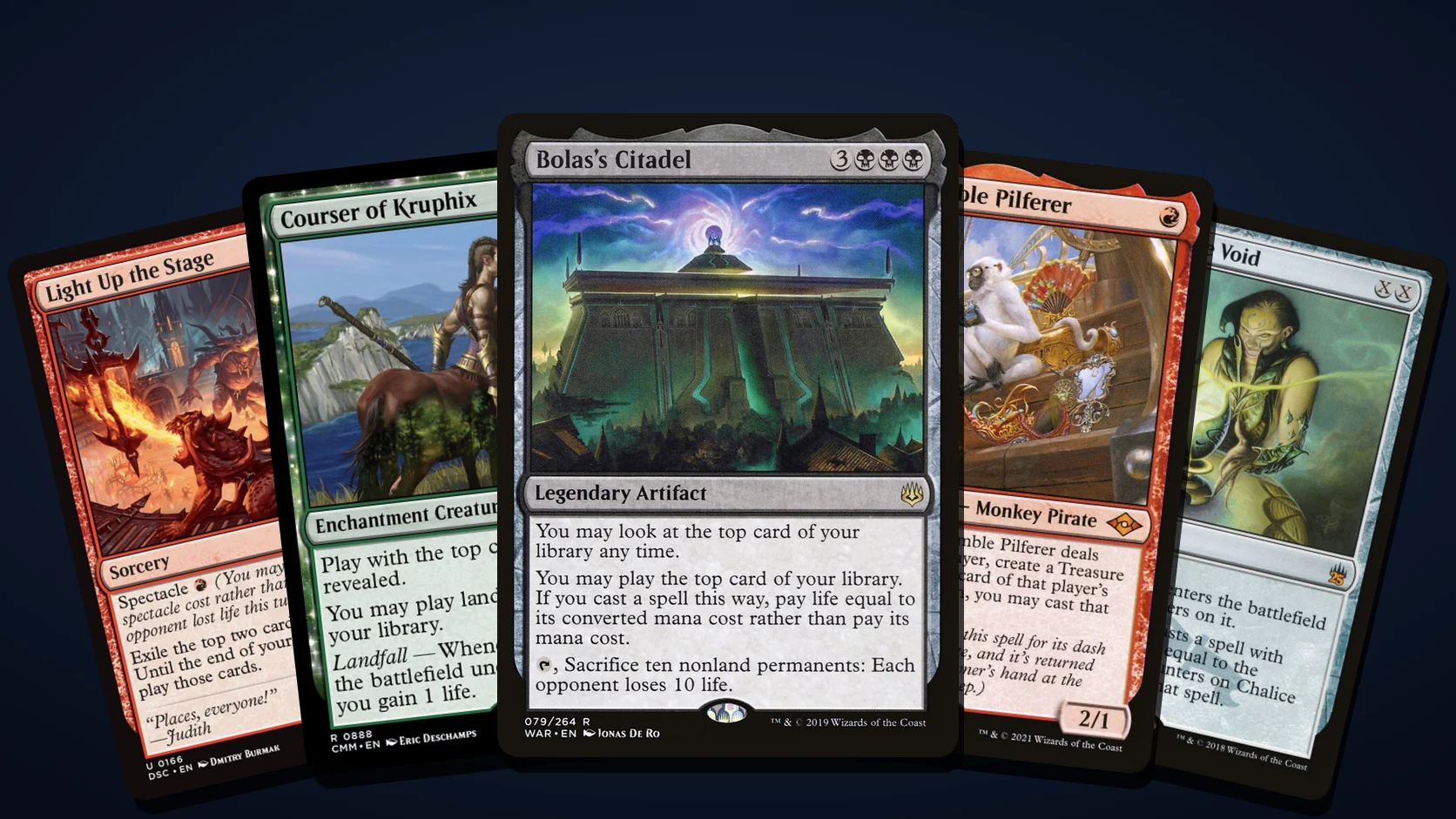
The printed Bolas's Citadel (War of the Spark, 2019) reads "You may play the top card of your library." Its Oracle text now spells it out: "You may play lands and cast spells from the top of your library." Same meaning, just explicit.
Where the difference matters
"Play lands" vs "play lands and cast spells"
Top-of-library cards say exactly which half they allow:
- Courser of Kruphix and Oracle of Mul Daya: "You may play lands from the top of your library." Lands only. A spell on top just sits there.
- Future Sight, Bolas's Citadel and Experimental Frenzy: "You may play lands and cast spells from the top of your library." Both halves.
Lands played from the top still use your land drop. Courser's ruling: "Playing a land from the top of your library counts as your land play for the turn." Oracle of Mul Daya adds a second land play, which is why it pairs so well with its own ability.
The line "Play with the top card of your library revealed" on Courser, Oracle and Future Sight is a third, older use of "play": it just means "the game is played with that card face up." It has nothing to do with playing a land.
"Play" vs "cast" impulse draw
Red card advantage that exiles cards often comes down to one word:
- Light Up the Stage: "Exile the top two cards of your library. Until the end of your next turn, you may play those cards." A land you exile is usable, if you have a land play left.
- Prosper, Tome-Bound: "Until the end of your next turn, you may play that card." Its second ability, "Whenever you play a card from exile, create a Treasure token," triggers on lands played from exile too.
- Ragavan, Nimble Pilferer: "Until end of turn, you may cast that card." Its ruling is blunt: "If you exile a land card, you can't play that card."
Neither word changes timing. A sorcery exiled by Light Up the Stage is still cast in your main phase with the stack empty, and an exiled land can only be played in your main phase.
Effects that stop casting don't stop land plays
Because a land is never cast, "can't cast" effects let lands through:
- Grafdigger's Cage: "Players can't cast spells from graveyards or libraries." Its ruling: "Players can still play lands from graveyards or libraries if an effect allows them to do so." Courser of Kruphix and Crucible of Worlds ("You may play lands from your graveyard") keep working under it.
- Drannith Magistrate stops opponents casting spells from anywhere but their hand. It doesn't stop lands from Crucible.
- Teferi, Time Raveler limits when opponents can cast spells. Land plays already happen at sorcery speed, so nothing changes for them.
Experimental Frenzy goes the other way and names both: "You can't play lands or cast spells from your hand."
"Whenever you cast" triggers ignore lands
Chalice of the Void reads "Whenever a player casts a spell with mana value equal to the number of charge counters on this artifact, counter that spell." A Chalice on zero counters stops Mox and Lotus Petal style spells, but lands have mana value 0 and are still played freely, because playing a land isn't casting. The same goes for Eidolon of the Great Revel ("Whenever a player casts a spell with mana value 3 or less"): a land drop never pings you. Nor does it trigger prowess, which only counts noncreature spells you cast.
Free casts still count as casting
"Without paying its mana cost" changes the cost, not the action. You are still casting:
- Cascade (CR 702.85a): "You may cast that card without paying its mana cost" if its mana value is lower. The spell Bloodbraid Elf cascades into goes on the stack, triggers "whenever you cast" abilities and can be countered. A Chalice on 2 counters a two-mana spell found by cascade. More in our cascade guide.
- Plot (CR 702.170d): a plotted card is cast from exile without paying its mana cost. See plot explained.
- Fires of Invention lets you cast spells for free but also limits you to two spells a turn, and since lands aren't cast they don't count toward that two.
Copies are different. "A copy of a spell isn't cast" (CR 707.10), so storm copies don't trigger cast abilities. Effects that tell you to "cast a copy" are the exception (CR 707.12).
Putting onto the battlefield is neither
Sneak Attack ("put a creature card from your hand onto the battlefield") and Show and Tell ("Each player may put an artifact, creature, enchantment, or land card from their hand onto the battlefield") skip the stack. The creature is never a spell: it can't be countered, and cast triggers don't fire. Enters-the-battlefield triggers do. A land put onto the battlefield this way also isn't your land play (CR 305.4), so you can still play one afterwards.
Modal double-faced cards
A modal double-faced card such as Valakut Awakening // Valakut Stoneforge has a spell face and a land face. You choose: cast the instant face as a spell (CR 712.8b), or play the land face as your land for the turn (CR 712.9). Played as a land, it isn't cast, so "you may cast" effects can't use the land face.
The bottom line
Read the verb. Cast is spells only, on the stack, counterable. Play a land is a special action off the stack. Play a card means either. If a card lets you "play" something, lands are in; if it says "cast," they're out. For the stack itself, read the stack explained.
Sources
- Comprehensive Rules, effective 6 Nov 2026: 116.2a, 305.1-305.9, 601.1-601.2, 702.85a, 702.170d, 707.10, 707.12, 712.8b, 712.9, glossary "Play" and "Cast"
- Wizards of the Coast: Magic 2010 rules changes (10 June 2009)
- Oracle text and rulings for every card named above from Scryfall, checked 19 Nov 2026
Related Guides
- The stack explained: why lands never use it and spells always do
- What cascade means in MTG: the best-known free cast
- Plot explained: plotting is a special action, casting comes later
- What flash means in MTG: changing when you can cast
- The MTG keywords glossary: every keyword in one place