
Quick verdict
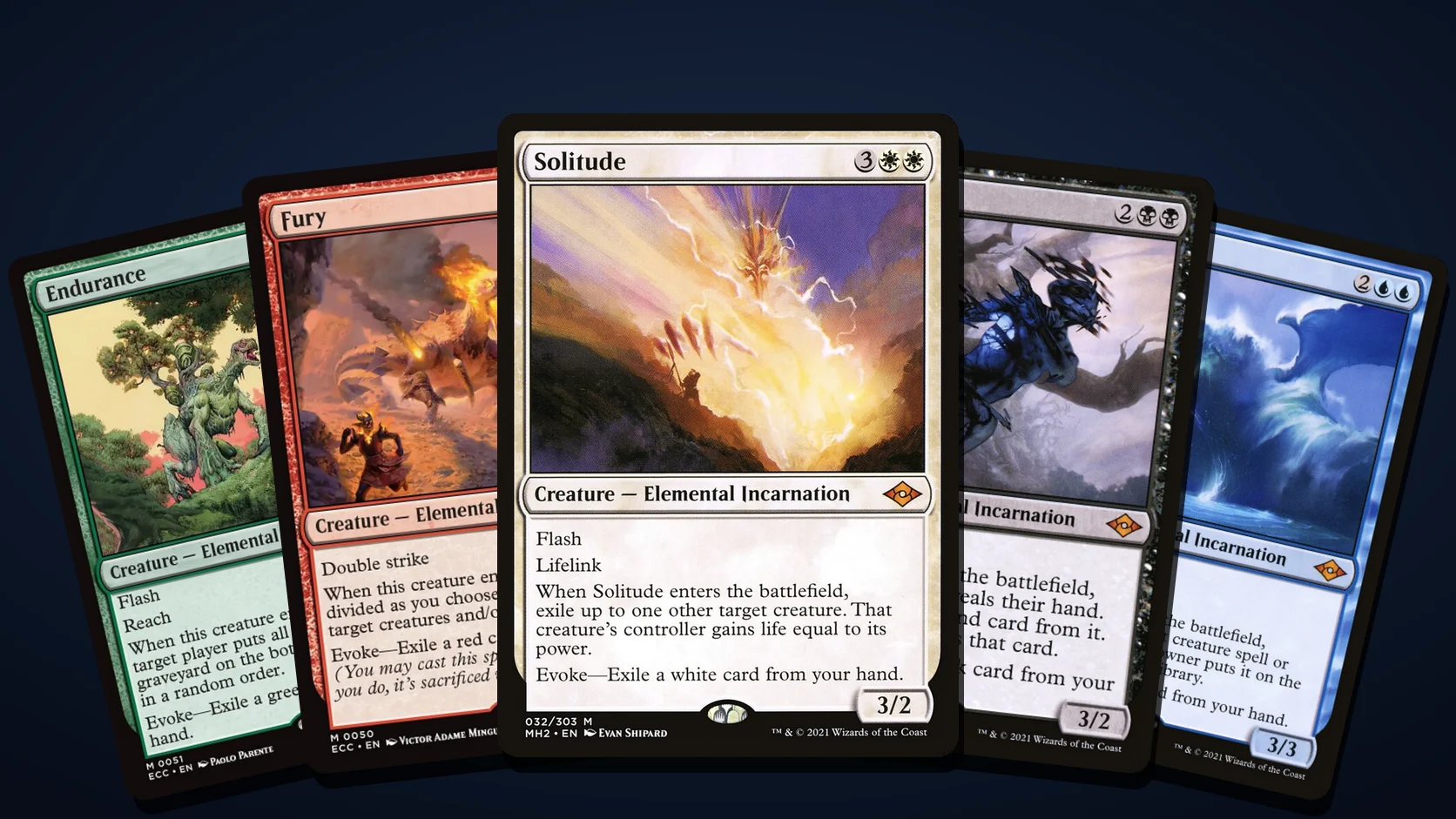
Evoke is an alternative cost on creatures. Pay it instead of the mana cost and the creature enters, its enters ability triggers, and a second trigger sacrifices it. You choose the order of the two triggers, so the effect always happens, and flicker effects, undying or counters for triggered abilities can keep the body too. The Lorwyn elementals made evoke a value mechanic; Modern Horizons 2's pitch elementals, whose evoke cost is exiling a card of their colour, made it free and turned Solitude, Endurance, Subtlety, Fury and Grief into Modern staples.
Evoke in MTG is an alternative cost on creatures: you cast the creature for its evoke cost instead of its mana cost, it enters the battlefield, its enters ability triggers, and it is sacrificed. In practice evoke turns a creature into a cheaper one-shot spell. Mulldrifter becomes a three-mana "draw two", and Solitude becomes a free Swords to Plowshares.
Evoke first appeared on the elementals of Lorwyn in 2007. It became a defining competitive mechanic in 2021, when Modern Horizons 2 printed five elementals whose evoke cost is a card from your hand rather than mana.
Evoke Rules
The Comprehensive Rules (702.74a) define evoke as two abilities:
"Evoke [cost]" means "You may cast this card by paying [cost] rather than paying its mana cost" and "When this permanent enters, if its evoke cost was paid, its controller sacrifices it."
Everything else follows from those two sentences.
It's an alternative cost. You pay the evoke cost instead of the mana cost, so you can't combine it with another alternative cost. If an effect lets you cast the creature "without paying its mana cost", you can't evoke it. Cost increases and reductions apply to the evoke cost the same way they apply to a mana cost.
The enters ability still happens. The creature really does enter the battlefield. Its "when this creature enters" ability and the evoke sacrifice ability trigger at the same time, and you choose the order they go on the stack. The usual play is to let the enters ability resolve first. The Scryfall rulings say you can even cast spells after that ability resolves and before the sacrifice happens.
Leaves-the-battlefield abilities trigger on the sacrifice. Reveillark, Spitebellows and Offalsnout have their effect when they leave the battlefield, so evoking them gives you the effect as soon as they are sacrificed.
Timing doesn't change. A creature without flash can only be evoked when you could cast a sorcery. Solitude, Subtlety and Endurance have flash, which is why they can be evoked during an opponent's turn.
Mana value doesn't change. Mana value comes from the printed mana cost. An evoked Solitude has mana value 5, an evoked Mulldrifter has mana value 5.
It's the choice that counts. Whether the sacrifice triggers depends on whether you chose to pay the evoke cost, not on what you ended up paying after reductions. The trigger says "its controller sacrifices it", so if the creature changes controllers before the trigger resolves, the new controller sacrifices it.
Mulldrifter
- Evoke cost
- 2U
- What evoking it does
- Draw two cards
4U
Mana cost
Shriekmaw
- Evoke cost
- 1B
- What evoking it does
- Destroy a nonartifact, nonblack creature
4B
Mana cost
Ingot Chewer
- Evoke cost
- R
- What evoking it does
- Destroy an artifact
4R
Mana cost
Reveillark
- Evoke cost
- 5W
- What evoking it does
- Return up to two creatures with power 2 or less from your graveyard
4W
Mana cost
Solitude
- Evoke cost
- Exile a white card from your hand
- What evoking it does
- Exile a creature; its controller gains life equal to its power
3WW
Mana cost
Endurance
- Evoke cost
- Exile a green card from your hand
- What evoking it does
- A player puts their graveyard on the bottom of their library
1GG
Mana cost
Subtlety
- Evoke cost
- Exile a blue card from your hand
- What evoking it does
- Put a creature or planeswalker spell on top or bottom of its owner's library
2UU
Mana cost
Grief
- Evoke cost
- Exile a black card from your hand
- What evoking it does
- Look at an opponent's hand and make them discard a nonland card
2BB
Mana cost
Fury
- Evoke cost
- Exile a red card from your hand
- What evoking it does
- 4 damage divided among creatures and planeswalkers
3RR
Mana cost
Keeping the Creature: Flicker, Undying and Stifle
The sacrifice is a triggered ability that uses the stack, so you can respond to it. Three tricks let you keep the creature and sometimes get the enters ability twice.
Flicker it. With the sacrifice trigger on the stack, cast Ephemerate ({W}) on the creature. It is exiled and returns as a new object (rule 400.7), so the sacrifice trigger can't find it and does nothing. The returned creature wasn't cast for its evoke cost, so it stays, and its enters ability triggers again. Ephemerate has rebound, which gives you a third trigger on your next upkeep. Solitude plus Ephemerate is two removal spells and a 3/2 lifelinker for one white mana and a pitched card.
Give it undying. Let the sacrifice resolve with Undying Evil ({B}) on the creature. It dies, returns with a +1/+1 counter, and its enters ability triggers again. A Grief evoked this way takes two cards and stays as a 4/3 menace. Our persist vs undying guide covers how the undying return works.
Counter the trigger. Stifle (Legacy) or Tale's End (Modern) counters the sacrifice trigger, and the creature stays on the battlefield. You spend a whole card just to keep the body, which is usually worse than flicker, but it works.
Reanimation does the same job in a different order: the evoked creature goes to the graveyard, and Reanimate or a similar spell brings it back with another enters trigger. Wizards cited this pattern when it banned Grief in Legacy.
The Lorwyn Elementals
Evoke debuted in Lorwyn (October 2007) and Morningtide (February 2008) on the elemental creature type. The design was flexible cards: an early cheap effect, or a full creature later.
- Mulldrifter. Three mana for two cards, or five mana for two cards and a 2/2 flyer. The highest-ranked evoke card on EDHREC (rank 606 on 19 November 2026), and legal in Pauper.
- Shriekmaw. Two-mana removal for nonblack creatures, or a 3/2 with fear that kills something on the way in.
- Ingot Chewer and Wispmare. One-mana artifact and enchantment removal stapled to a creature. Both are commons and legal in Pauper.
- Cloudthresher. Four mana to deal 2 damage to each flyer and each player at instant speed.
- Reveillark. The rare case where the evoke cost ({5}{W}) is higher than the mana cost ({4}{W}). Evoking it is only useful when you want the leaves-the-battlefield trigger right away.
Later sets added a few more on the same model: Vesperlark in Modern Horizons (2019), Night Incarnate in Commander 2018, Wavesifter, Foundation Breaker and Soul of Migration in Modern Horizons 2, and Nulldrifter in Modern Horizons 3. Nulldrifter draws its two cards when you cast it, so the draw happens even if the spell is countered.
The Modern Horizons 2 Pitch Elementals
Modern Horizons 2 (June 2021) printed five Elemental Incarnations, one per colour, whose evoke cost is "Exile a [colour] card from your hand". They can be cast for no mana at all, which is why players call them pitch elementals: you "pitch" a card instead of paying mana, as with Force of Will.
The card you exile has to be another card. When you cast a spell, the card moves to the stack first (rule 601.2a), so it isn't in your hand to exile. Evoking a pitch elemental costs two cards for one effect, and that card disadvantage is the price of tempo.
Solitude. Free, instant-speed Swords to Plowshares. Hard-cast for five it is a 3/2 flash lifelinker that also exiles a creature. On MTGGoldfish's Modern format staples page on 19 November 2026, Solitude was the third most-played creature, in 17% of decks at 3.9 copies.
Endurance. Free, instant-speed graveyard hate that doesn't exile anything: the target player puts their whole graveyard on the bottom of their library in a random order. Hard-cast for three it is a 3/4 flash reach creature, a fine body on its own. It was in 14% of Modern decks at 2.3 copies on the same page.
Subtlety. A free answer to a creature or planeswalker spell. It puts the spell on top or bottom of its owner's library, the owner's choice. That isn't a counter, so it works on spells that can't be countered, and it only targets spells on the stack, not permanents.
Grief. Free Thoughtseize on turn one, without the life loss. Combined with Ephemerate or Undying Evil it took two cards before the opponent played a land. Wizards banned it in Modern and Legacy on 26 August 2024, calling it one of the least fun parts of competitive Modern.
Fury. Free four damage split among creatures and planeswalkers, and a 3/3 double striker when hard-cast. Wizards banned it in Modern on 4 December 2023, saying it made playing creature decks nearly impossible.
Why the pitch elementals became staples
The pitch elementals do two jobs: early in the game they are free interaction that lets you skip a turn's mana, and late in the game they are creatures you cast normally. A deck never has a dead copy. That flexibility, plus the flicker and undying tricks above, is what made "Evoke" its own archetype and got two of the five banned.
Lorwyn Eclipsed: Hybrid Evoke Elementals
Lorwyn Eclipsed (January 2026) brought evoke back to Standard with five hybrid Elemental Incarnations: Wistfulness, Vibrance, Emptiness, Deceit and Catharsis. Each has two enters abilities, and each checks which colours of mana were spent.
Deceit ({4}{U/B}{U/B}, evoke {U/B}{U/B}) shows how it works:
- If {U}{U} was spent, return up to one other nonland permanent to its owner's hand.
- If {B}{B} was spent, the opponent reveals their hand and discards a nonland card you choose.
The rulings check the total cost paid, not only the hybrid symbols. Evoked for two mana you pick one mode by paying {U}{U} or {B}{B}. Pay one of each and neither ability triggers. Hard-cast with at least two of each colour among the six mana and you get both. A copy of the spell had no mana spent on it, so it gets neither.
Best Evoke Cards
"Price from" is the cheapest regular (non-foil, non-promo) printing on Scryfall on 19 November 2026; for Endurance and Fury that is the Lorwyn Eclipsed Commander reprint. "Where it's played" is based on MTGGoldfish's format staples pages on the same day and EDHREC for Commander.
Solitude
- First printed in
- Modern Horizons 2
- Where it's played
- Modern, Legacy, Commander
$33.96
Price from
Subtlety
- First printed in
- Modern Horizons 2
- Where it's played
- Modern, Commander
$8.20
Price from
Endurance
- First printed in
- Modern Horizons 2
- Where it's played
- Modern, Legacy, Commander
$3.44
Price from
Grief
- First printed in
- Modern Horizons 2
- Where it's played
- Vintage, Commander
$2.28
Price from
Fury
- First printed in
- Modern Horizons 2
- Where it's played
- Vintage, Commander
$0.54
Price from
Mulldrifter
- First printed in
- Lorwyn
- Where it's played
- Commander (Pauper-legal)
$0.28
Price from
Shriekmaw
- First printed in
- Lorwyn
- Where it's played
- Commander
$0.22
Price from
Reveillark
- First printed in
- Morningtide
- Where it's played
- Commander
$0.50
Price from
Ingot Chewer
- First printed in
- Lorwyn
- Where it's played
- Commander (Pauper-legal)
$0.23
Price from
Wistfulness
- First printed in
- Lorwyn Eclipsed
- Where it's played
- Standard-legal
$2.98
Price from
Deceit
- First printed in
- Lorwyn Eclipsed
- Where it's played
- Standard
$3.24
Price from
Nulldrifter
- First printed in
- Modern Horizons 3
- Where it's played
- Commander
$1.34
Price from
Solitude is the one expensive card in the group, because it is still a four-of in Modern. Fury is banned in Modern, and its reprint in the Lorwyn Eclipsed Commander decks sells for well under a dollar.
If you'd rather open them, Modern Horizons 2 and Lorwyn Eclipsed boxes trade at these prices on TCGplayer today:
| Set | Market price | Per pack | Buy |
|---|---|---|---|
| Lorwyn Eclipsed | $105.50 | $3.52 | BuyBuy on TCGplayer |
| Modern Horizons 236 packs | $363.37 | $10.09 | BuyBuy on TCGplayer |
| Lorwyn Eclipsed12 packs | $402.62 | $33.55 | BuyBuy on TCGplayer |
| Modern Horizons 2 | $477.38 | $15.91 | BuyBuy on TCGplayer |
| Modern Horizons 212 packs | $648.20 | $54.02 | BuyBuy on TCGplayer |
Our Modern Horizons 2 draft box tracker shows what the cards in a box are worth against that price.
Evoke in Commander
In Commander evoke cards are value cards. Mulldrifter, Shriekmaw and Solitude are evoked early when you need the effect and hard-cast later for the body. Decks built around enters-the-battlefield effects get the most from them, since every flicker effect turns an evoke creature into a repeatable spell, and an evoked creature dying also feeds "whenever a creature dies" payoffs.
Common Misconceptions
"If I evoke it, I don't get the enters ability." You do. The creature enters, then it's sacrificed.
"The opponent can kill it in response and stop the effect." The enters ability has already triggered. Removing the creature doesn't stop it.
"Evoking lowers its mana value." It doesn't. The printed mana cost decides it.
"I can pitch the elemental to its own evoke cost." You can't. It's already on the stack.
"Evoke gives the creature flash." It doesn't. Only the creatures that already have flash can be evoked at instant speed.
Where Evoke Fits
Evoke is one of several alternative costs in Magic. Flashback works the same way for spells cast from the graveyard, and suspend is another route to casting something without its mana cost. For every other keyword, our MTG keywords glossary has them all.
Citations & Resources
- Wizards of the Coast: Comprehensive Rules, 702.74 Evoke and 118.9 Alternative Costs
- Wizards of the Coast: December 4, 2023 Banned and Restricted Announcement (Fury)
- Wizards of the Coast: August 26, 2024 Banned and Restricted Announcement (Grief)
- Scryfall: Every card with evoke, with rulings
- MTGGoldfish: Modern format staples
Related Guides
- The Ultimate MTG Keywords Glossary — every keyword, with a printable cheat sheet
- MTG Stack Explained — why you can respond to the evoke sacrifice
- MTG Persist vs Undying — the undying return behind Grief and Undying Evil
- MTG Flashback Explained — another alternative cost, for the graveyard
- What Flash Means in MTG — why Solitude and Subtlety can be evoked on your opponent's turn
- MTG Formats Explained — where each evoke card is legal