
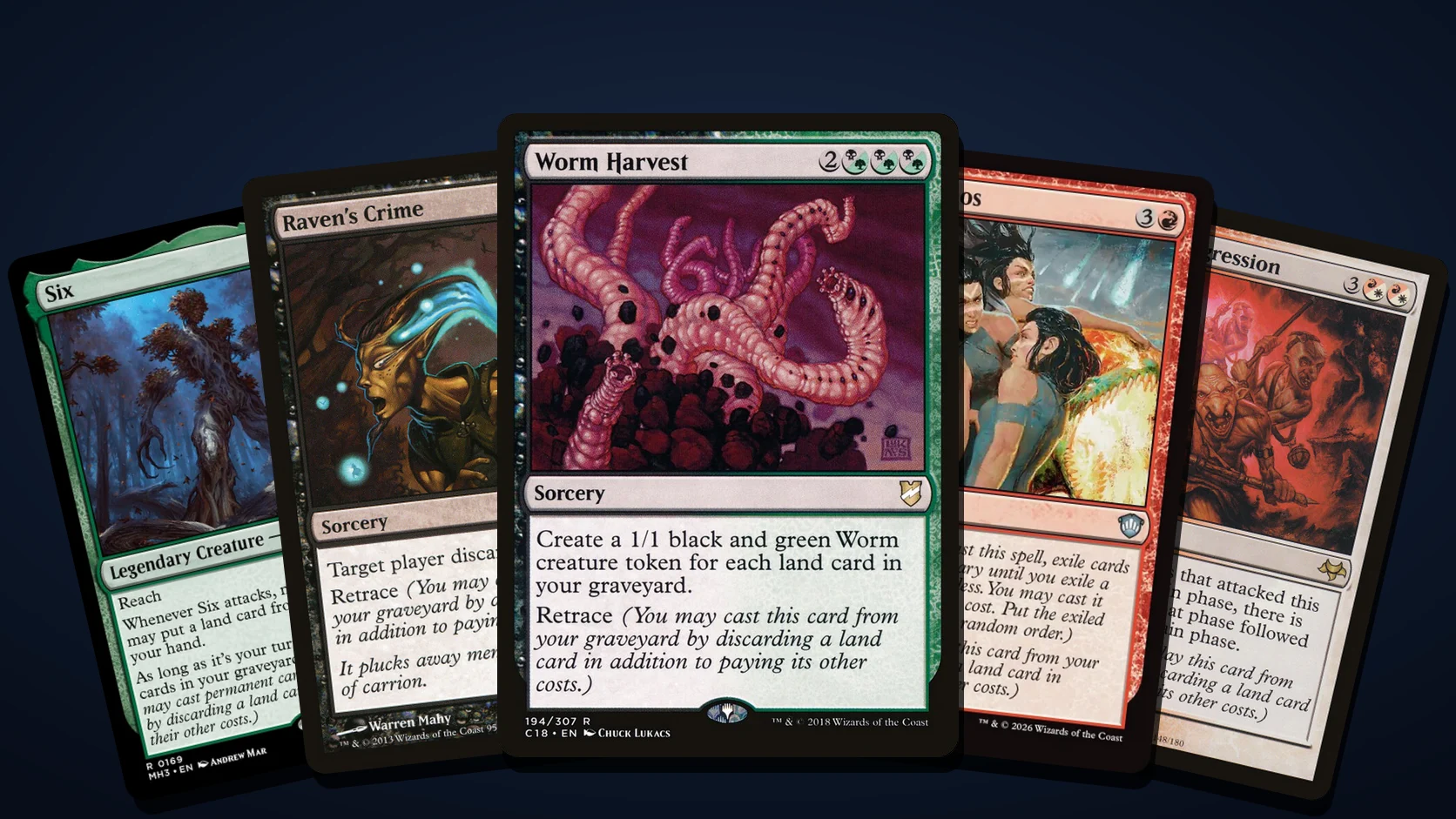
Quick verdict
Retrace lets you cast a card from your graveyard by paying its normal mana cost and discarding a land card as an additional cost. Unlike flashback, the card isn't exiled afterwards: it goes back to your graveyard and you can cast it again as long as you have lands to discard. Because retrace is an additional cost, not an alternative one, it combines with other costs, and normal timing rules still apply.
Retrace in MTG is a keyword that lets you cast a card from your graveyard by discarding a land card in addition to paying its normal mana cost. When the spell resolves, or even if it's countered, it goes back to your graveyard, so you can cast it again as long as you have lands to throw away. It turns late-game extra lands into extra spells.
Retrace first appeared on 12 cards in Eventide in 2008. It has since returned on Commander cards and in both Modern Horizons sets, where Wrenn and Six and Six give retrace to other cards.
Retrace Rules in MTG
The reminder text on every retrace card says it in one line:
Retrace (You may cast this card from your graveyard by discarding a land card in addition to paying its other costs.)
The Comprehensive Rules (702.81a) define it like this: retrace is a static ability that works while the card is in a player's graveyard, and it means "You may cast this card from your graveyard by discarding a land card as an additional cost to cast it." Casting a spell with retrace follows the normal rules for paying additional costs.
What that means in play:
You pay the normal mana cost. Raven's Crime still costs {B} from the graveyard. Waves of Aggression still costs five mana. The land discard is on top of that, not instead of it.
You must discard a land card. It has to be a land card from your hand. A basic, a nonbasic or a fetch land all count. No land in hand, no retrace.
The card comes back. Wizards' rulings say it directly: when a retrace card you cast from your graveyard resolves, fails to resolve or is countered, it's put back into your graveyard, and you may use retrace to cast it again. There is no limit on how many times.
Timing still applies. A retrace card follows the normal timing rules for its card type. Sorceries are main phase, empty stack. Instants such as Oona's Grace and Decaying Time Loop can be retraced whenever you have priority.
It's an additional cost, not an alternative one. Rule 702.81a makes the land discard an additional cost, and any number of additional costs can be applied to a spell (rule 118.8a). Only one alternative cost can be applied to a spell (rule 118.9a), and retrace doesn't take that slot. Read together, those rules mean you can pay kicker, or an alternative cost like evoke, on a spell cast with retrace.
Mana value doesn't change. It always comes from the printed mana cost. Cost reductions and increases apply to the cost you are paying as normal.
You can chain it on your turn. If you retrace a spell on your own turn, you get priority first after it resolves, so you can cast it again before another player can remove it from your graveyard. Casting it moves it straight to the stack, so nobody gets a chance to exile it in between.
Modal double-faced cards. In your hand, a double-faced card has only the characteristics of its front face (rule 712.6a). A card with a spell on the front and a land on the back is not a land card, so you can't discard it for retrace.
Raven's Crime
- Type
- Sorcery
- First printed
- Eventide (2008)
- What each retrace does
- Target player discards a card
B
Cost
Flame Jab
- Type
- Sorcery
- First printed
- Eventide (2008)
- What each retrace does
- 1 damage to any target
R
Cost
Oona's Grace
- Type
- Instant
- First printed
- Eventide (2008)
- What each retrace does
- Target player draws a card
2U
Cost
Worm Harvest
- Type
- Sorcery
- First printed
- Eventide (2008)
- What each retrace does
- A 1/1 Worm for each land card in your graveyard
2 + three B/G hybrid
Cost
Waves of Aggression
- Type
- Sorcery
- First printed
- Eventide (2008)
- What each retrace does
- Untap attackers, extra combat and main phase
3 + two R/W hybrid
Cost
Reality Scramble
- Type
- Sorcery
- First printed
- Commander 2018
- What each retrace does
- Swap a permanent you own for one from your library
2RR
Cost
Throes of Chaos
- Type
- Sorcery
- First printed
- Modern Horizons (2019)
- What each retrace does
- Cascade, every time you cast it
3R
Cost
Decaying Time Loop
- Type
- Instant
- First printed
- Doctor Who (2023)
- What each retrace does
- Discard your hand, draw that many
3R
Cost
Embrace the Unknown
- Type
- Sorcery
- First printed
- Outlaws of Thunder Junction Commander (2024)
- What each retrace does
- Exile the top two, play them until end of next turn
2R
Cost
Formless Genesis
- Type
- Kindred Sorcery
- First printed
- Duskmourn Commander (2024)
- What each retrace does
- An X/X deathtouch changeling, X = lands in your graveyard
2G
Cost
A Retrace Example, Step by Step
You have Worm Harvest in your graveyard, three land cards already in the graveyard, five lands on the battlefield and a Forest in hand. It's your main phase.
- You cast Worm Harvest from your graveyard. As you pay costs, you tap five lands for {2}{B/G}{B/G}{B/G} and discard the Forest.
- Worm Harvest goes on the stack. The Forest is now in your graveyard, so there are four land cards there.
- It resolves and you create four 1/1 Worms. A Worm Harvest ruling confirms the land you discarded for retrace is counted.
- Worm Harvest goes back to your graveyard, ready for the next land you draw.
Retrace vs Flashback
Both let you cast a card from your graveyard, and they are easy to mix up. The difference is in the cost and in what happens after. Our flashback guide covers the other side in full.
What you pay
- Retrace
- Normal mana cost + discard a land card
- Flashback
- The flashback cost instead of the mana cost
Type of cost
- Retrace
- Additional cost
- Flashback
- Alternative cost
After the spell
- Retrace
- Back to the graveyard, reusable
- Flashback
- Exiled, one extra use only
If countered
- Retrace
- Back to the graveyard
- Flashback
- Exiled
Works with other alternative costs
- Retrace
- Yes
- Flashback
- No
Card types
- Retrace
- Any card that has it
- Flashback
- Only if the result is an instant or sorcery
First set
- Retrace
- Eventide (2008)
- Flashback
- Odyssey (2001)
The short version: flashback is one extra use at a fixed price, retrace is unlimited uses at the price of a card from your hand each time. Retrace is weak early, when you need every land you draw, and strong late, when extra lands are dead cards.
Cards That Give Retrace
Three cards hand retrace to other cards. They are the reason the keyword still matters in Constructed and Commander.
Six ({2}{G}, Modern Horizons 3). Reach. Whenever Six attacks, mill three cards and you may put a land card from among them into your hand. During your turn, nonland permanent cards in your graveyard have retrace. That means creatures, artifacts, enchantments and planeswalkers can be cast from your graveyard. A permanent spell cast this way goes to the battlefield when it resolves, and if it dies later it lands back in the graveyard, ready to be retraced again. The land Six finds when it attacks is fuel for the discard.
Wrenn and Six ({R}{G}, Modern Horizons). Its −7 gives you an emblem: "Instant and sorcery cards in your graveyard have retrace." Its +1 returns a land card from your graveyard to your hand, which is exactly what you want to discard next.
Deeproot Historian ({3}{G}, The Lost Caverns of Ixalan Commander). Merfolk and Druid cards in your graveyard have retrace. It's a Merfolk Druid itself, so it can come back too.
Best Retrace Cards
Six. The strongest retrace card by a distance. Every nonland permanent card in your graveyard becomes castable again on your turn, and Six finds the lands to pay for it. There's no specific ruling on evoke, but by the rules an evoke creature in your graveyard can be cast for its evoke cost plus a land on your turn: retrace is an additional cost (702.81a), and evoke works in any zone the card can be cast from (702.74a).
Waves of Aggression. An extra combat and main phase every turn you have a land to discard. The original Eventide printing was $14.99 on Scryfall on 19 November 2026, the highest price of any card with the retrace keyword. The 2026 reprint in Teenage Mutant Ninja Turtles Source Material was $2.40.
Throes of Chaos. Cascade triggers when you cast the spell, so every retrace is another free spell from your library. A Throes ruling notes the card does nothing itself as it resolves; all of its value is the cascade.
Worm Harvest. Grows every turn as your graveyard fills with lands, and the land you discard counts.
Formless Genesis. Three mana for an X/X deathtouch changeling, where X is the number of land cards in your graveyard. Like Worm Harvest, the discard makes the token bigger.
Embrace the Unknown. Two extra cards for three mana that you can repeat. You have until the end of your next turn to play them.
Raven's Crime. One black mana and a land to strip a card from the opponent's hand, every turn. It's legal in Pauper, along with Flame Jab, Oona's Grace, Cenn's Enlistment, Syphon Life and Monstrify.
Decaying Time Loop. An instant-speed wheel of your own hand. The land you discard for retrace leaves your hand first, so you draw one fewer card than you'd expect.
Reality Scramble. Puts a permanent you own on the bottom of your library and puts the next card of a shared card type from your library onto the battlefield. A repeatable way to trade a weak permanent for a random new one.
On Scryfall on 19 November 2026, Wrenn and Six was $7.88 (Double Masters 2022 printing) and Six was $4.43 (regular Modern Horizons 3 printing). Among the retrace cards themselves, only Waves of Aggression's Eventide printing costs more. Most retrace cards cost well under a dollar.
Retrace Synergies: Landfall and Lands in the Graveyard
The cost of retrace is a land card. Decks that already move lands between the hand, graveyard and battlefield turn that cost into a benefit.
Play the land you discarded. Crucible of Worlds, Ramunap Excavator, Conduit of Worlds and Ancient Greenwarden all let you play lands from your graveyard. Discard a land for retrace, then play it as your land drop. If you run landfall cards such as Tireless Tracker, that replayed land still triggers landfall, and Ancient Greenwarden doubles the trigger.
Draw off the discard. The Gitrog Monster draws a card whenever one or more land cards are put into your graveyard from anywhere, so every retrace discard replaces itself. Our frog commanders guide covers it as a commander.
Get the lands back. Life from the Loam returns up to three land cards to your hand, and its dredge can bring it back. Wrenn and Six's +1 does the same one land at a time.
Cash in a full graveyard. Splendid Reclamation, World Shaper's death trigger and Lord Windgrace's −3 put lands from your graveyard onto the battlefield. A retrace deck builds that pile of lands as it goes.
Containment Construct. Whenever you discard a card, you may exile it and play it this turn. A land discarded for retrace can then be played from exile.
Fetch lands and other sacrifice lands also put land cards in the graveyard, which grows Worm Harvest and Formless Genesis. Our dual, fetch and shock lands guide covers how those work.
Retrace in Commander
Retrace suits Commander. Games run long, you draw plenty of lands you don't need, and a card that can be cast every turn is exactly what a long game rewards. Four of the five retrace cards printed after Eventide debuted in Commander products: Reality Scramble in Commander 2018, Decaying Time Loop in the Doctor Who decks, Embrace the Unknown in Outlaws of Thunder Junction Commander and Formless Genesis in Duskmourn Commander.
The weakness is the same as any graveyard plan. Effects that exile your graveyard take the retrace card with them, and a deck running low on lands in hand can't pay the cost.
Common Misconceptions
"Retrace is free." It isn't. You pay the full mana cost plus a card.
"A retrace spell is exiled like flashback." It goes back to the graveyard, even if it's countered.
"I can discard any card." It has to be a land card.
"Retrace ignores timing." It doesn't. Sorceries with retrace are still sorceries.
"I can't use retrace with evoke or kicker." You can. Retrace is an additional cost.
Where Retrace Fits
Retrace is one of several ways to replay cards from the graveyard, alongside flashback, unearth and escape. For every other keyword, our complete MTG keywords glossary has them all, and the cascade guide explains the other half of Throes of Chaos. The stack guide covers why you can retrace a sorcery twice before an opponent gets a chance to exile it.
Citations & Resources
- Wizards of the Coast: Comprehensive Rules — 702.81 Retrace, 118.8 and 118.9 additional and alternative costs, 702.74 evoke, 712.6a double-faced cards
- Wizards of the Coast: Modern Horizons 3 release notes — Six
- Scryfall: Every card with retrace
- Scryfall: Cards that give retrace
- Scryfall: Worm Harvest and its retrace rulings
Related Guides
- MTG Flashback Explained — the one-use version of casting from the graveyard
- The Ultimate MTG Keywords Glossary — every keyword, with a printable cheat sheet
- What Cascade Means in MTG — how Throes of Chaos gets a free spell every cast
- MTG Stack Explained — priority and why a retrace spell can be cast again right away
- Dual, Fetch and Shock Lands Explained — lands that fill your graveyard
- Best Frog Commanders — The Gitrog Monster and the lands-matter frogs