
The Short Answer
To read a Pokémon card, go from top to bottom. The top line shows the stage (Basic, Stage 1 or Stage 2), the name, the HP and the type symbol. The middle holds any Ability and the attacks: the Energy cost on the left, the attack name, the damage on the right and the effect text underneath. The bottom strip shows Weakness, Resistance and Retreat Cost.
The small print at the very bottom is for collectors and judges: the illustrator, the regulation mark (a letter that decides Standard legality), the set code, the collector number and the rarity symbol. A collector number higher than the set total, such as 125/094, means a secret rare, and those are the cards that tend to be worth money.
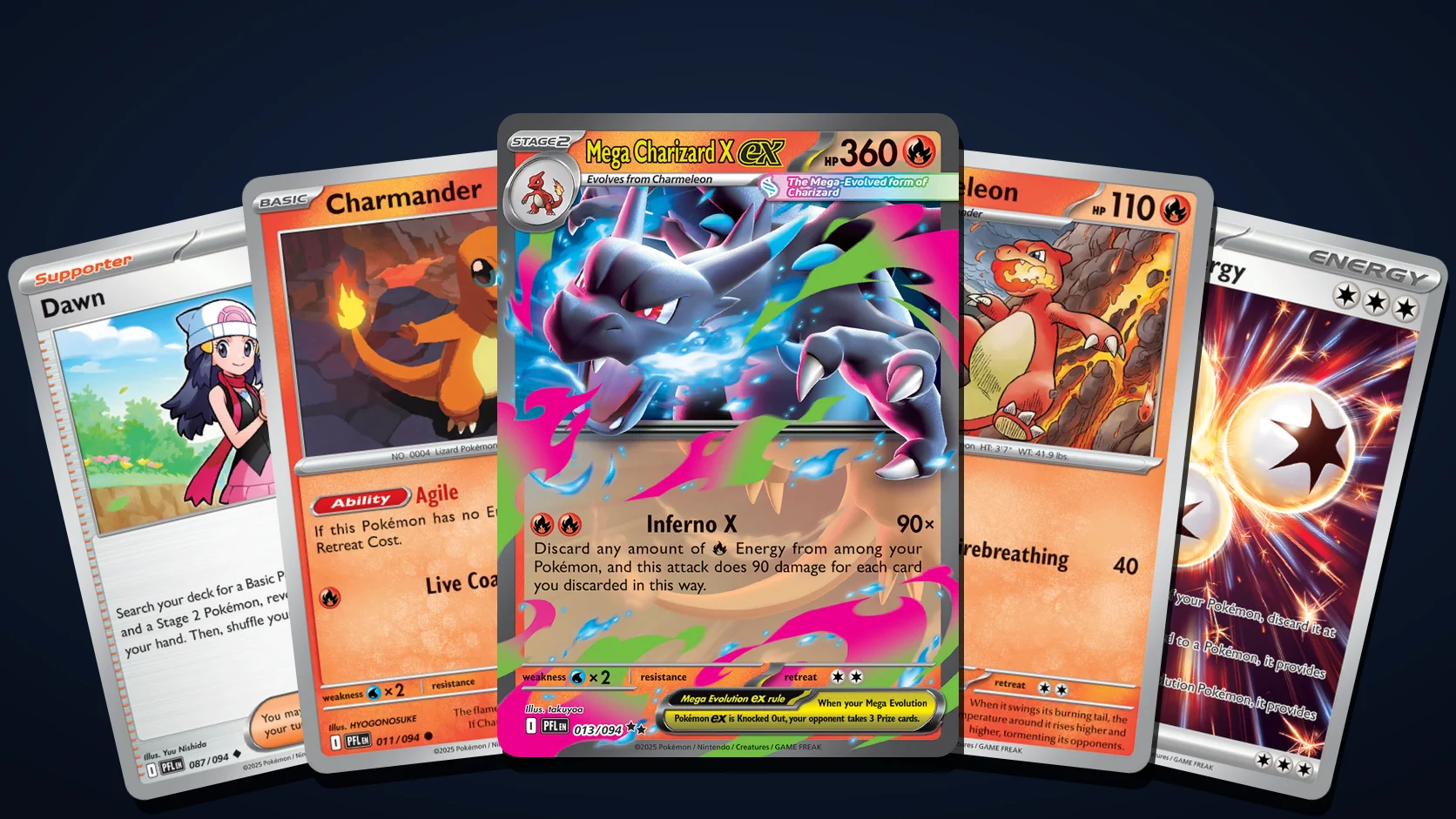
We'll use one real card from Phantasmal Flames (November 2025), the Mega Evolution era's second main set: the regular Mega Charizard X ex, 013/094, with the plain Charmander, 011/094 for the parts an ex card doesn't have.
 Mega Charizard X ex, Phantasmal Flames 013/094Stage 2, HP 360, Mega Evolution ex rule box
 Charmander, Phantasmal Flames 011/094Basic, HP 80, an Ability, a Pokédex line and flavor text
 Dawn, Phantasmal Flames 087/094A Supporter: Trainer cards have no HP, type or attacks
Pokémon Card Parts: The Labelled List
Working down Mega Charizard X ex from the top:
- Stage. The label at the top left says BASIC, STAGE 1 or STAGE 2. Basic Pokémon go straight into play; Stage 1 and Stage 2 Pokémon are played on top of the Pokémon they evolve from. Mega Charizard X ex is a Stage 2.
- Evolves from. Under the name, evolved Pokémon say what they evolve from ("Evolves from Charmeleon") and show a small picture of it in the corner. Basic Pokémon have no such line.
- Name. "Mega Charizard X ex". The ex in the name is part of it and matters for rules; Mega Evolution cards also carry a label such as "The Mega-Evolved form of Charizard".
- HP. Hit Points, top right: 360. Damage is tracked in counters of 10, and the Pokémon is Knocked Out when the damage on it reaches its HP.
- Type symbol. The circle next to the HP. Here it is Fire. Current cards use ten types: Grass, Fire, Water, Lightning, Psychic, Fighting, Darkness, Metal, Dragon and Colorless. The Fairy type was dropped from Sword & Shield (2020) onward, and Fairy Pokémon are now printed as Psychic. Our Energy types guide shows how all 18 video game types map to them, with a 2026 type chart.
- Ability. Some Pokémon have an Ability, marked with a red Ability label above the attacks. Charmander's Agile reads: "If this Pokémon has no Energy attached, it has no Retreat Cost." Abilities are not attacks; most work on their own or when you choose to use them during your turn.
- Attacks. Each attack has an Energy cost on the left (Inferno X costs two Fire Energy), a name, a damage number on the right and an effect underneath. A white star in a cost is Colorless: any type of Energy pays for it. A damage number with × multiplies ("90×" is 90 for each Fire Energy you discard), + means the attack can do more, and no number at all means the attack only has an effect.
- Weakness. Bottom left: Water ×2. Attacks from a Water Pokémon do double damage to this card.
- Resistance. Next to Weakness, usually blank. On current cards it reads −30: Mismagius ex, for example, takes 30 less damage from Fighting Pokémon.
- Retreat Cost. Bottom right: the number of Energy you must discard to move this Pokémon from the Active Spot to the Bench. Two Colorless symbols means discard any two Energy. You can retreat once per turn.
- Rule box. Pokémon ex have a box at the bottom with a rule printed in it (see below).
- Illustrator. "Illus. takuyoa" at the bottom left credits the artist.
- Regulation mark, set code, collector number and rarity. The bottom-left line: I, PFL EN, 013/094 and two black stars. Each gets its own section below.
- Copyright line. "©2025 Pokémon / Nintendo / Creatures / GAME FREAK" along the bottom edge, with the copyright year.
ex, Mega and Tera: What the Rule Box Means
A rule box is the panel at the bottom of a card with a rule in it. On a Pokémon ex the rule gives your opponent extra Prize cards when it's Knocked Out (not every rule box does: an older Radiant Pokémon's only limits you to one per deck), and some cards check for it: The Pokémon Company's Advanced Player's Rulebook defines "a Pokémon with a Rule Box" as one with "Rule" written on the card.
| Card | What the rule box says |
|---|---|
| Pokémon ex | When it is Knocked Out, your opponent takes 2 Prize cards |
| Mega Evolution Pokémon ex | When it is Knocked Out, your opponent takes 3 Prize cards |
| Tera Pokémon ex | 2 Prize cards, plus: while it is on your Bench, it takes no damage from attacks, yours or your opponent's |
Tera cards show the Pokémon covered in crystal, and their type can differ from the Pokémon's usual one. Terapagos ex (Stellar Crown) is the best-known example. Our guide to how the Pokémon TCG is played explains Prize cards and the Bench.
What the Numbers on Pokémon Cards Mean
There are three kinds of number on a Pokémon card, and they're easy to mix up:
- HP (top right): how much damage the Pokémon can take.
- Damage (right of each attack): how much damage the attack does before Weakness and Resistance.
- Collector number (bottom left): where the card sits in its set.
The collector number reads card number / set size. Mega Charizard X ex is 013/094: card 13 of the 94 cards in Phantasmal Flames' main set. Anything numbered higher than the second figure is a secret rare. Phantasmal Flames runs to 130 cards, so 095/094 through 130/094 are its secret cards: Illustration Rares, Ultra Rares, Special Illustration Rares and the gold Mega Hyper Rare. The 199/165 you may have seen is the Special Illustration Rare Charizard ex from Scarlet & Violet 151, a 165-card set.
The Bottom Line: Regulation Mark, Set Code and Rarity
The bottom-left strip of a current card reads, left to right:
| Mark | On Mega Charizard X ex | What it tells you |
|---|---|---|
| Regulation mark | I in a box | Whether the card is legal in Standard |
| Set code | PFL EN | The set (Phantasmal Flames) and the language (English) |
| Collector number | 013/094 | Card number / main set size |
| Rarity symbol | Two black stars | Double Rare |
Regulation mark. Since 10 April 2026, Standard is made of cards with H, I and J marks; G and older are Expanded only. Regulation marks arrived on English cards with Sword & Shield in 2020 (starting at D). Our rotation guide has the full timeline.
Set code. Scarlet & Violet replaced the old expansion symbols with a printed set code and a language code (PFL EN, MEW EN, PRE EN). Cards from Sword & Shield and earlier still show a small set symbol instead.
Rarity symbol. A circle is Common, a diamond Uncommon and a star Rare. More stars, and silver or gold stars, mean rarer cards. We cover every symbol, including the Mega Hyper Rare's gold four-pointed star, in our Pokémon rarity symbols chart.
Trainer and Energy Cards Read Differently
Trainer cards have no HP, type, attacks, Weakness or Retreat. The top line names the kind of Trainer, and the rule for playing it is printed at the bottom. Dawn says "Supporter" at the top left and "You may play only 1 Supporter card during your turn." at the bottom.
| Trainer type | How often you can play it |
|---|---|
| Item | Any number per turn, then discard it |
| Pokémon Tool | Attach to a Pokémon; one Tool per Pokémon |
| Supporter | One per turn, then discard it |
| Stadium | One per turn; it stays in play until another Stadium replaces it |
Energy cards say ENERGY at the top. Basic Energy provides one Energy of its type, and a deck can run any number of them. Special Energy says "Special Energy" at the top and has its own effect; Ignition Energy (Phantasmal Flames) provides three Colorless Energy to an Evolution Pokémon but is discarded at the end of your turn. Like most cards, you're limited to four copies of each Special Energy.
The bottom strip (illustrator, regulation mark, set code, number, rarity) is the same on all three kinds of card.
How to Tell What a Pokémon Card Is Worth
The card itself gives you three clues before you look anything up:
- A number above the set total. 125/094 is worth checking; 013/094 usually isn't.
- The rarity symbol. Gold stars, silver stars and a Mega Hyper Rare's black-outlined gold star mark the hard pulls.
- Full art. Illustration Rares and Special Illustration Rares have art that fills the whole card, and collectors pay the most for them.
The same Pokémon in four printings shows how much those clues matter. TCGplayer market prices on 18 November 2026:
| Mega Charizard X ex | Number | Rarity | Price |
|---|---|---|---|
| Regular | 013/094 | Double Rare | $3.56 |
| Full art | 109/094 | Ultra Rare | $19.05 |
| Full illustration | 125/094 | Special Illustration Rare | $531.36 |
| Gold | 130/094 | Mega Hyper Rare | $181.47 |
- Mega Charizard X ex 013/094 (Double Rare)$3.56 on 18 Nov 2026
 Mega Charizard X ex 109/094 (Ultra Rare)$19.05 on 18 Nov 2026
 Mega Charizard X ex 125/094 (Special Illustration Rare)$531.36 on 18 Nov 2026
 Mega Charizard X ex 130/094 (Mega Hyper Rare)$181.47 on 18 Nov 2026
The rarest printing, the gold 130/094, is not the most valuable one: the art on the 125/094 sells for nearly three times as much. In Scarlet & Violet 151 the gap is wider still: the regular Charizard ex (006/165) was $8.00 and the 199/165 Special Illustration Rare $287.93 on the same day. So read the number and symbol, then look up the exact card number. Condition matters too, and an expensive card is worth checking against our guide to spotting fakes and the real Pokémon card back before you pay.
Conclusion: Top for Play, Bottom for Collecting
The top half of a Pokémon card is for playing: stage, name, HP, type, Ability and attacks, with Weakness, Resistance and Retreat underneath. Once you know where those sit, every Pokémon card from the current era reads the same way. To practise on real cards, the Mega Lucario ex League Battle Deck ($17.70 at TCGplayer market price on 18 November 2026) is the cheapest ready-made deck in our how to play guide.
The bottom line is for collecting and tournaments: the regulation mark says if it's Standard legal, and the collector number and rarity symbol say how rare it is. A number above the set total is the first sign of a valuable card. All Pokémon cards share one size, too: see our Pokémon card size guide for sleeves that fit.
Citations & Resources
- The Pokémon Company: Pokémon Card Game Advanced Player's Rulebook, version 3.4 (retreat, Trainer types, Energy, rule boxes)
- Pokémon.com: Pokémon TCG rules and current rulebook
- Pokémon TCG API: Phantasmal Flames card data (stages, HP, attacks, Weakness, Resistance, regulation marks, rule text)
- TCGplayer: Mega Charizard X ex 013/094 (and 109/094, 125/094, 130/094)
- tcgcsv.com: TCGplayer price data, 18 November 2026
- Bulbapedia: Regulation marks and the Standard format
- Bulbapedia: Fairy (TCG), dropped from Sword & Shield onward
- Bulbapedia: Scarlet & Violet (TCG), set codes replacing expansion symbols
Related Guides
- Pokémon TCG: How to Play: setup, turns, Prize cards and how a game is won
- Pokémon TCG Energy Types: the 10 types, Basic Energy and the 2026 type chart
- Pokémon Rarity Symbols: every rarity symbol, with pull rates and prices
- Pokémon Card Size: exact dimensions, sleeves and toploaders
- How to Tell If a Pokémon Card Is Fake: ten checks ranked by reliability
- Pokémon Card Back: what a real card back looks like
- Charizard Pokémon Cards: every Charizard printing with its current price