
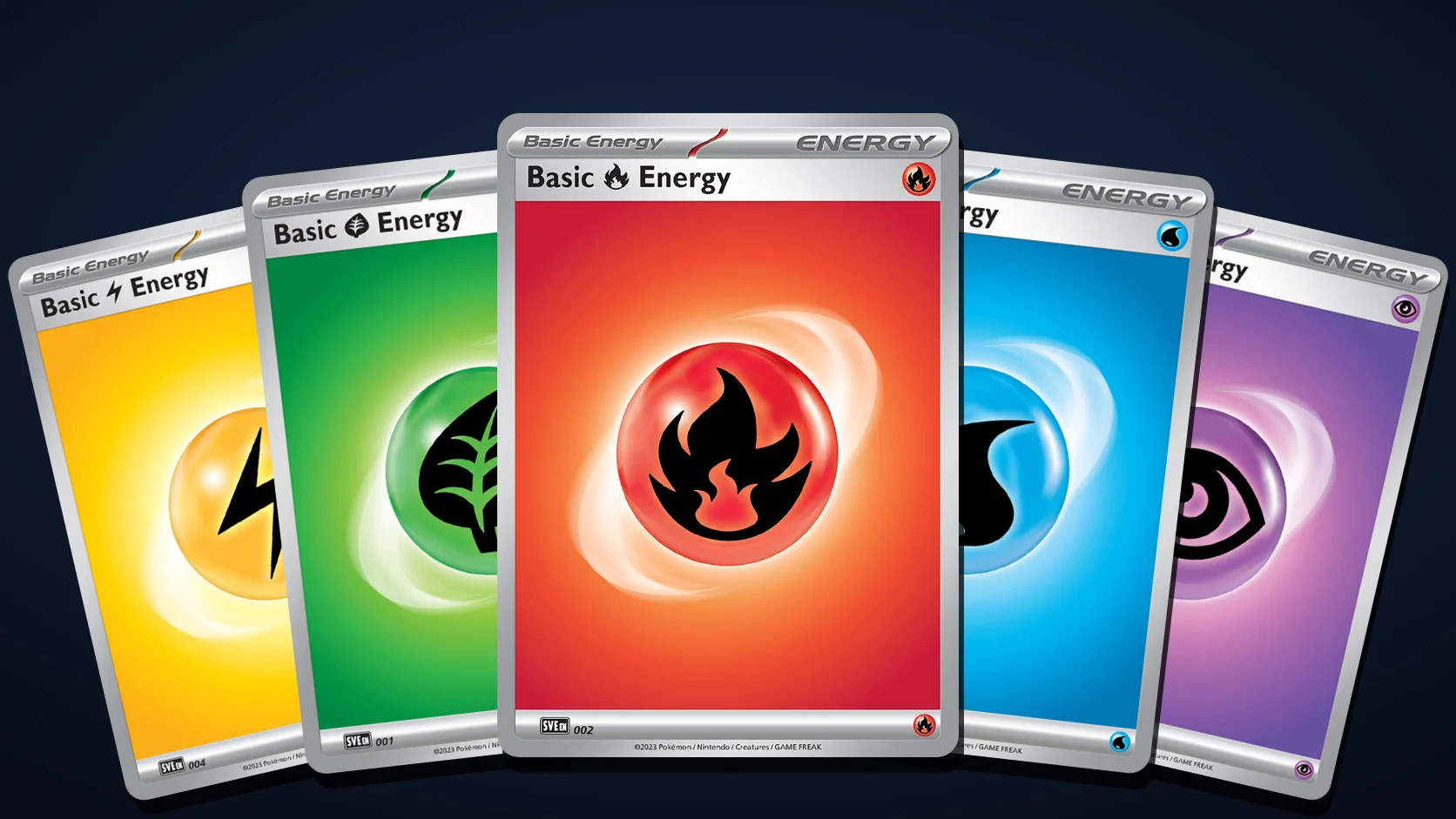
The Short Answer
The Pokémon TCG has 10 types: Grass, Fire, Water, Lightning, Psychic, Fighting, Darkness, Metal, Dragon and Colorless. Eight of them have a Basic Energy card. Dragon and Colorless don't: Dragon Pokémon attack with a mix of other Energy, and a Colorless symbol in a cost can be paid with any Energy. Fairy was a type from the XY era until Sun & Moon; since Sword & Shield (2020), Fairy Pokémon are printed as Psychic.
Weakness doubles damage (×2) and Resistance subtracts 30. Most types have one or two usual Weaknesses, shown in the type chart below, which we built from every Pokémon card in the 2025-26 Mega Evolution sets.
The 10 Pokémon TCG Types and Their Energy
The type is the coloured symbol in the top-right corner of a Pokémon card, next to its HP. Our guide to reading a Pokémon card shows where everything sits.
Grass
- Basic Energy card?
- Yes
- Current example
- Mega Venusaur ex, Mega Heracross ex (Bug)
Fire
- Basic Energy card?
- Yes
- Current example
- Mega Charizard X ex
Water
- Basic Energy card?
- Yes
- Current example
- Kyogre, Mega Abomasnow ex (Ice)
Lightning
- Basic Energy card?
- Yes
- Current example
- Pikachu ex
Psychic
- Basic Energy card?
- Yes
- Current example
- Mega Gardevoir ex, Xerneas
Fighting
- Basic Energy card?
- Yes
- Current example
- Mega Lucario ex, Garganacl
Darkness
- Basic Energy card?
- Yes
- Current example
- Mega Absol ex, Mega Gengar ex
Metal
- Basic Energy card?
- Yes
- Current example
- Kingambit, Mega Mawile ex
Dragon
- Basic Energy card?
- No
- Current example
- Dragapult ex, Mega Dragonite ex
Colorless
- Basic Energy card?
- No (any Energy pays)
- Current example
- Mega Kangaskhan ex
The Advanced Player's Rulebook (version 3.4) lists nine Basic Energy types: the eight above plus Fairy. Fairy Energy was printed between XY (2014) and Burning Shadows (2017). It has no H, I or J regulation mark, so it isn't legal in Standard, but it still works in Expanded, which allows cards from Black & White onward.
 Basic Fire Energy, Scarlet & Violet Energies 002$0.11 on 18 Nov 2026
 Basic Water Energy, Scarlet & Violet Energies 003$0.13 on 18 Nov 2026
 Basic Psychic Energy, Scarlet & Violet Energies 005$0.18 on 18 Nov 2026
 Basic Darkness Energy, Scarlet & Violet Energies 007$0.14 on 18 Nov 2026
 Fairy Energy, XY 140/146Expanded only: no H, I or J print
Dragon arrived in Dragons Exalted (2012) and has never had its own Basic Energy. Dragon attacks cost two or more types instead: Dragapult ex's Phantom Dive is one Fire and one Psychic, Mega Dragonite ex's Ryuno Glide is one Water and two Lightning, and Kommo-o's Blazing Uppercut is Lightning, Fighting and one Colorless.
How the 18 Video Game Types Map to TCG Types
The video games use 18 types. The card game folds them into 10, so several game types share one card type. This table reflects how current cards are printed; older cards don't always follow it.
| Video game type | TCG type in current sets | Examples |
|---|---|---|
| Normal | Colorless | Mega Kangaskhan ex, Miltank, Lopunny |
| Fire | Fire | Mega Charizard X ex |
| Water | Water | Kyogre, Inteleon, Suicune |
| Grass, Bug | Grass | Mega Venusaur ex, Beedrill ex, Mega Heracross ex |
| Electric | Lightning | Pikachu ex |
| Ice | Water (mostly) | Mega Abomasnow ex, Regice ex, Mamoswine |
| Fighting | Fighting | Mega Lucario ex, Hariyama |
| Ground, Rock | Fighting | Sandslash, Onix, Garganacl |
| Poison | Darkness (mostly) | Zubat, Seviper, Toxtricity, Pecharunt |
| Flying | Colorless, or its other type | Fearow, Larry's Staraptor, Talonflame (Fire) |
| Psychic | Psychic | Alakazam, Mega Gardevoir ex |
| Ghost | Psychic or Darkness | Gimmighoul (Psychic), Mega Gengar ex (Darkness) |
| Dragon | Dragon | Dragapult ex, Mega Dragonite ex |
| Dark | Darkness | Mega Absol ex, Sableye |
| Steel | Metal | Kingambit, Gholdengo, Mega Mawile ex |
| Fairy | Psychic (since 2020) | Xerneas, Clefable, Togekiss |
A Pokémon with two game types gets only one card type. Its Weakness often comes from the second type, which is why Flying Pokémon tend to be weak to Lightning whatever their card type is.
Weakness and Resistance: The ×2 and −30 Rule
Weakness and Resistance sit at the bottom left of a Pokémon card. The rulebook applies them in a fixed order when an attack does damage:
- Start with the damage printed on the attack, adjusted by any +, − or × in its own text.
- Apply effects on the attacking Pokémon (for example "+30 damage").
- Weakness: if the attacker's type matches the Defending Pokémon's Weakness, apply the modifier. Every Weakness in current sets is ×2.
- Resistance: if the attacker's type matches the Resistance, apply it. Almost every current Resistance is −30.
- Apply effects on the Defending Pokémon.
Two examples with real cards:
- Mega Lucario ex (Fighting) uses Aura Jab for 130 against Pikachu ex (200 HP, Weakness Fighting ×2). The damage doubles to 260 and Pikachu ex is Knocked Out.
- The same Aura Jab against Kirlia (100 HP, Resistance Fighting −30) does 100, which still Knocks it Out.
Weakness and Resistance only apply to the Active Pokémon. Damage to the Bench and attacks that put damage counters skip both. Our how to play the Pokémon TCG guide covers the full turn and attack sequence.
Pokémon TCG Type Chart: Weakness and Resistance in 2026
There is no official type chart, because every card prints its own Weakness. So we built one from the cards. Method: we pulled every Pokémon card in the eight Mega Evolution-era sets in the Pokémon TCG API on 19 November 2026 (Mega Evolution, Phantasmal Flames, Ascended Heroes, Perfect Order, Chaos Rising, Pitch Black, 30th Celebration and Delta Reign; 1,060 Pokémon cards, every printing counted) and counted the Weakness and Resistance on each type.
Grass
- Cards
- 125
- Usual Weakness
- Fire (100%)
- Other Weakness
- None
- Usual Resistance
- None
Fire
- Cards
- 97
- Usual Weakness
- Water (97%)
- Other Weakness
- Lightning (Talonflame line)
- Usual Resistance
- None
Water
- Cards
- 105
- Usual Weakness
- Lightning (67%)
- Other Weakness
- Metal (33%, Ice Pokémon)
- Usual Resistance
- None
Lightning
- Cards
- 128
- Usual Weakness
- Fighting (96%)
- Other Weakness
- Lightning (Wattrel line)
- Usual Resistance
- None
Psychic
- Cards
- 153
- Usual Weakness
- Darkness (70%)
- Other Weakness
- Metal (30%, Fairy Pokémon)
- Usual Resistance
- Fighting −30 (70%)
Fighting
- Cards
- 101
- Usual Weakness
- Grass (67%, Ground and Rock)
- Other Weakness
- Psychic (33%, Fighting Pokémon)
- Usual Resistance
- None
Darkness
- Cards
- 138
- Usual Weakness
- Grass (58%)
- Other Weakness
- Fighting (30%, Poison); Lightning (12%, Flying)
- Usual Resistance
- None (Fighting −30 on 12%)
Metal
- Cards
- 59
- Usual Weakness
- Fire (95%)
- Other Weakness
- Lightning (Skarmory)
- Usual Resistance
- Grass −30 (92%)
Dragon
- Cards
- 38
- Usual Weakness
- None (100%)
- Other Weakness
- None
- Usual Resistance
- None
Colorless
- Cards
- 116
- Usual Weakness
- Fighting (71%, Normal)
- Other Weakness
- Lightning (29%, Flying)
- Usual Resistance
- None (Fighting −30 on Flying)
Read from the attacker's side, the chart says:
- Fire hits Grass and Metal for double.
- Water hits Fire.
- Lightning hits Water and anything that flies (Colorless and Darkness birds, Talonflame, Skarmory).
- Fighting hits Lightning, Normal-type Colorless Pokémon and Poison-type Darkness Pokémon. It is also the type most often resisted, by Psychic and Flying Pokémon.
- Grass hits Ground and Rock Fighting Pokémon and most Darkness Pokémon.
- Psychic hits Fighting-type Pokémon such as Mega Lucario ex.
- Darkness hits most Psychic Pokémon.
- Metal hits Fairy and Ice Pokémon.
- Dragon hits nothing for double, and nothing hits Dragon for double.
A few cards in older sets and reprints print other values, so always check the card in front of you.
Basic Energy vs Special Energy
Energy is one of the three card types, alongside Pokémon and Trainer cards. The rulebook splits it in two:
- Basic Energy provides one Energy of its type. The four-copy limit doesn't apply, so a deck can run any number. The eight current Basic Energy types are always Standard-legal, whatever set they come from (Fairy Energy is the exception).
- Special Energy says "Special Energy" at the top, has its own effect, and follows the normal limit of four copies per name.
The Mega Evolution sets added a type-specific Special Energy for every Basic type: Growing Grass, Nitro Fire, Bubbly Water, Voltaic Lightning, Telepathic Psychic, Rocky Fighting, Shadowy Darkness and Magnetic Metal. Each provides its own type and gives a bonus to a Pokémon of that type. Voltaic Lightning Energy adds 20 damage to a Lightning Pokémon's attacks, for example, and Bubbly Water Energy makes a Water Pokémon immune to Special Conditions.
 Nitro Fire Energy, Chaos Rising 086/086$0.16 on 18 Nov 2026
 Bubbly Water Energy, Chaos Rising 084/086$0.20 on 18 Nov 2026
 Voltaic Lightning Energy, Pitch Black 084/084$0.22 on 18 Nov 2026
 Ignition Energy, White Flare 086/086$0.27 on 18 Nov 2026
You can attach one Energy card from your hand per turn, to your Active or a Benched Pokémon. Energy stays attached when the Pokémon attacks or evolves, and it's discarded when the Pokémon is Knocked Out. To retreat, you discard Energy equal to the Retreat Cost.
How Colorless Energy Works
A Colorless symbol in a cost can be paid with Energy of any type. Mega Latias ex's Illusory Impulse costs one Fire, one Psychic and one Colorless, so the third Energy can be anything. Mega Kangaskhan ex's Rapid-Fire Combo costs three Colorless, so any three Energy will do. Retreat Costs are always Colorless.
There is no Basic Colorless Energy card. Some Special Energy provides Colorless: Ignition Energy provides one Colorless Energy, or three on an Evolution Pokémon, but it's discarded at the end of your turn. Colorless Energy can only pay Colorless symbols, never a typed one.
Colorless is also a Pokémon type, used for Normal Pokémon and many Flying ones. Colorless Pokémon fit in any deck because their attacks rarely need a specific Energy.
How Many Energy Cards to Run in a Pokémon Deck
A competitive 60-card deck usually runs 7 to 11 Energy. In our Pokémon deck-building guide, three top-16 lists from the Recife Regional (3 October 2026) played 11 (Mega Lucario ex), 8 (Dragapult ex) and 7 (N's Zoroark ex). The Pokémon Company doesn't publish an official number.
Where your deck falls in that range depends on two things:
- Energy recovery and acceleration. Mega Lucario ex's Aura Jab attaches Fighting Energy from the discard pile, and N's Zoroark ex decks recycle Energy too, so they need fewer cards.
- Cost and colours. A deck with one main attacker and one type sits at the low end. A deck that needs two types, like Dragapult ex (Fire and Psychic, plus Darkness for Munkidori), splits its Energy and needs search cards such as Crispin to find the right pair.
For a casual or first deck, our suggestion is to start near 10 to 12 Basic Energy of your main type and cut down once you can see how often you miss an attachment.
Energy is the cheapest part of a deck. The original Scarlet & Violet Energies printings (001 to 008) of the eight Basic Energy cards sold for $0.11 to $0.20 each at TCGplayer market price on 18 November 2026, so 10 to 12 of them cost about $1 to $2.40. The regular printings of the eight type-specific Special Energy cards from the Mega Evolution sets were $0.16 to $0.35 each. If you'd rather not buy cards one at a time, the ready-made 60-card decks in our how to play guide include their Energy.
Conclusion: 10 Types, 8 Energy, ×2 and −30
The Pokémon TCG has 10 types and 8 Basic Energy types in current sets. Dragon and Colorless have no Basic Energy, and Fairy has been folded into Psychic since 2020.
Weakness is ×2 and Resistance is −30 on current cards. The chart is consistent enough to plan around: Fire beats Grass and Metal, Water beats Fire, Fighting beats Lightning, Darkness beats Psychic, and Dragon has no Weakness at all. Run 7 to 11 Energy in a competitive deck, and a few more in your first one.
Citations & Resources
- The Pokémon Company: Pokémon Card Game Advanced Player's Rulebook, version 3.4 (Energy cards, damage calculation, Weakness and Resistance)
- Pokémon TCG API: card data for the Mega Evolution-era sets (types, Weakness, Resistance, attack costs, Special Energy text)
- Pokémon TCG API: every Fairy-type card, last new prints in Cosmic Eclipse (November 2019)
- Pokémon TCG API: Scarlet & Violet Basic Energy cards
Related Guides
- How to Play the Pokémon TCG: setup, turns, attacking and Prize cards
- How to Read a Pokémon Card: type, Weakness, Resistance and Retreat on a real card
- Pokémon TCG Special Conditions: Poisoned, Burned, Asleep, Paralyzed and Confused
- How to Build a Pokémon TCG Deck: the 60-card split and current tournament lists
- Standard vs Expanded: which cards each format allows