
Our picks
 Top pick
Pokémon TCG: Battle Academy 2024
The best way for two new players to learn together: three decks, a game board and guided first games
- Pro: Three 60-card decks led by Pikachu ex, Armarouge ex and Darkrai ex
- Pro: Two tutorial guides, a two-player game board, a rulebook, damage counters and a metallic coin
- Pro: A code card for the online game
- Con: The most expensive starter here, and the decks are built for learning, not tournaments
Price
$68.57TCGplayer market, 18 November 2026

League Battle Deck: Mega Lucario ex
The cheapest ready-to-play deck, built around the Mega Lucario ex used in this guide's examples
- Pro: A 60-card deck with 6 damage-counter dice, a coin-flip die and 2 condition markers
- Pro: Deck box, strategy sheet and a code card to play the same deck online
- Pro: Launched 19 June 2026, per Pokémon's product page
- Con: One deck: a second player needs their own
Price
$17.70TCGplayer market, 18 November 2026

Mega Battle Deck: Mega Diancie ex
A ready-to-play deck that comes with a playmat, so a first game has a board to play on
- Pro: A 60-card deck, damage counters and a large metallic coin
- Pro: A double-sided playmat and strategy sheet, plus a deck box and code card
- Con: The Mega Gengar ex version of the same product sells for $60.17, more than twice as much
Price
$24.68TCGplayer market, 18 November 2026
The Short Answer
To play the Pokémon TCG, each player brings a 60-card deck and tries to take 6 Prize cards by Knocking Out the other player's Pokémon. You start with 7 cards, a Basic Pokémon in the Active Spot, up to 5 more on your Bench and 6 Prize cards face down. On each turn you draw a card, attach one Energy, play Pokémon and Trainer cards, then attack. Attacking ends your turn.
Knock Out a regular Pokémon and you take 1 Prize card. A Pokémon ex gives 2, a Mega Evolution Pokémon ex gives 3. You win when you take your last Prize card, when your opponent has no Pokémon left in play, or when your opponent can't draw a card at the start of their turn.
These are the rules from The Pokémon Company's current rulebook for the Mega Evolution series, checked against the Play! Pokémon tournament handbook. The card examples are real cards from the Mega Evolution set (September 2025).
What You Need to Play
- A 60-card deck each. No more than 4 copies of a card with the same name, except Basic Energy. Only 1 ACE SPEC card per deck.
- Damage counters. Each one stands for 10 damage. Dice work too.
- A coin for coin flips, including deciding who goes first.
- Markers for the Poisoned and Burned Special Conditions, ideally different from your damage counters.
A deck has three kinds of cards. Pokémon fight. Energy powers their attacks and retreats. Trainer cards are split into Items, Pokémon Tools, Supporters and Stadiums. If you don't have a deck yet, a ready-made product such as a Battle Academy or a League Battle Deck is the cheapest way in. Our Pokémon TCG beginner guide compares the starter products, and how to build a Pokémon TCG deck covers the usual 60-card split.
Which starter product to buy
Every product below comes with a complete 60-card deck, damage counters, a coin or coin-flip die, and a code card for Pokémon TCG Live. Contents are from the product listings and Pokémon's product pages; prices are TCGplayer market prices on 18 November 2026.
Battle Academy 2024
- Decks
- 3 (Pikachu ex, Armarouge ex, Darkrai ex)
- Extras in the box
- Game board, 2 tutorial guides, rulebook, 3 deck boxes
- Released
- 21 Jun 2024
$68.57
TCGplayer market
League Battle Deck: Mega Lucario ex
- Decks
- 1
- Extras in the box
- 6 damage-counter dice, 2 condition markers, deck box, strategy sheet
- Released
- 19 Jun 2026
$17.70
TCGplayer market
League Battle Deck: Mega Greninja ex
- Decks
- 1
- Extras in the box
- 6 damage-counter dice, 2 condition markers, deck box, strategy sheet
- Released
- 13 Nov 2026
$31.25
TCGplayer market
Mega Battle Deck: Mega Diancie ex
- Decks
- 1
- Extras in the box
- Double-sided playmat and strategy sheet, metallic coin, deck box
- Released
- 24 Oct 2025
$24.68
TCGplayer market
Mega Battle Deck: Mega Gengar ex
- Decks
- 1
- Extras in the box
- Double-sided playmat and strategy sheet, metallic coin, deck box
- Released
- 24 Oct 2025
$60.17
TCGplayer market
30th Celebration Battle Deck: Umbreon ex
- Decks
- 1
- Extras in the box
- Double-sided playmat and strategy sheet, coin, deck box
- Released
- 30 Oct 2026
$27.10
TCGplayer market
Two new players learning together: the Battle Academy. It's the only product here with three decks and step-by-step tutorial games, so you don't each need to buy a deck. One player on a budget: the Mega Lucario ex League Battle Deck, the cheapest deck in the table and the same Pokémon this guide uses for its examples. Two players who want a deck each to keep: the Mega Lucario ex League Battle Deck and the Mega Diancie ex Mega Battle Deck cost $42.38 together, less than a Battle Academy. Single-deck prices vary a lot by Pokémon: the two Mega Battle Decks come in the same box with the same extras, yet Mega Gengar ex sells for more than twice as much as Mega Diancie ex.
- Battle Academy 2024$68.57, TCGplayer market, 18 Nov 2026
- League Battle Deck: Mega Lucario ex$17.70, TCGplayer market, 18 Nov 2026
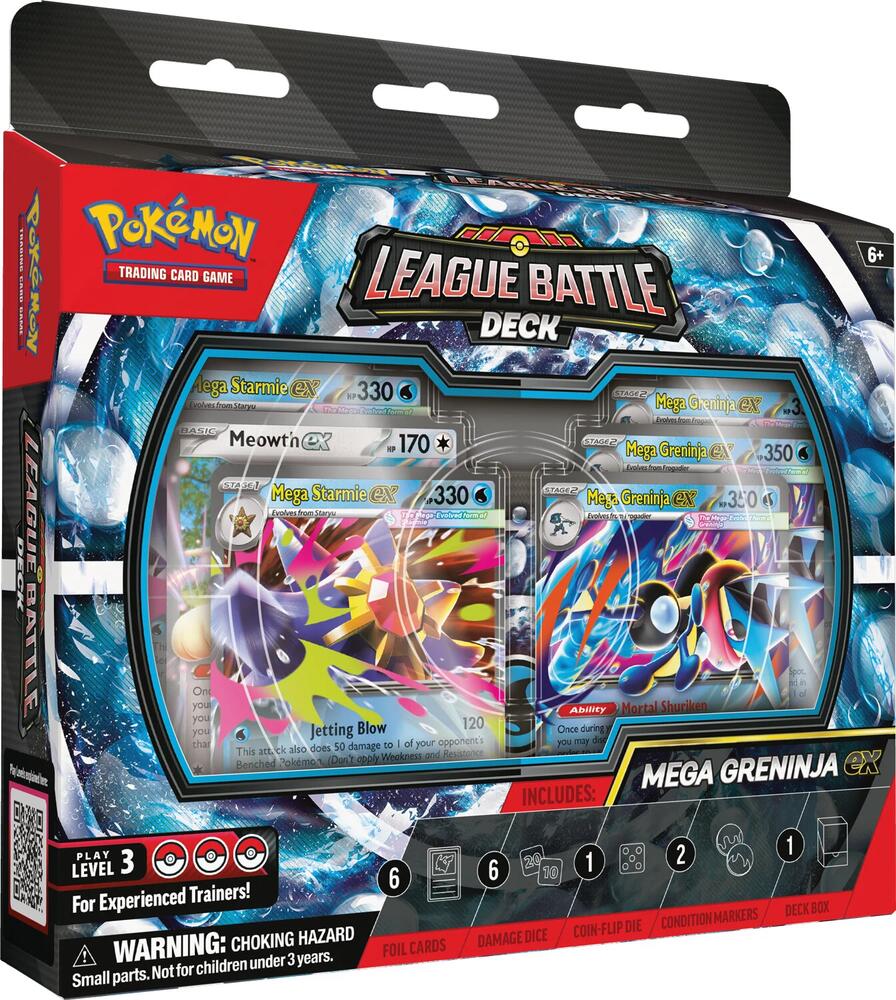 League Battle Deck: Mega Greninja ex$31.25, TCGplayer market, 18 Nov 2026
- Mega Battle Deck: Mega Diancie ex$24.68, TCGplayer market, 18 Nov 2026
Once you own a few decks and want to build your own, the Trainer's Toolkit (2025) adds more than 50 cards, mostly Trainers (3 of them ACE SPEC cards), plus 4 booster packs and 65 sleeves. It sold for $40.51 on 18 November 2026.
How to Set Up a Game of Pokémon
- Shake hands and flip a coin. The winner of the flip chooses who goes first.
- Shuffle your deck and draw 7 cards.
- Choose an Active Pokémon. Put one Basic Pokémon from your hand face down in the Active Spot.
- Fill your Bench (optional). Put up to 5 more Basic Pokémon face down on your Bench.
- Set 6 Prize cards. Take the top 6 cards of your deck and put them face down to the side without looking at them.
- Flip your Pokémon face up and start.
The mulligan rule. If your opening hand has no Basic Pokémon, you show your hand to your opponent, shuffle it back and draw 7 again, repeating until you get one. You wait while your opponent finishes setting up. Once both of you are ready, your opponent may draw 1 card for each extra mulligan you took, and if any of those are Basic Pokémon they can go on the Bench. If both players have no Basic Pokémon, both reveal, reshuffle and start over with no extra cards.
How a Turn Works in the Pokémon TCG
Every turn has three parts: draw, act, attack.
1. Draw a card. Always, including the very first turn of the game.
2. Do any of these, in any order:
Put Basic Pokémon on your Bench
- How often
- As many as you like
- Notes
- Bench holds 5 Pokémon
Evolve your Pokémon
- How often
- As many as you like
- Notes
- Not on a Pokémon's first turn in play, and not on your own first turn
Attach an Energy card
- How often
- Once per turn
- Notes
- To your Active or a Benched Pokémon
Play Item and Pokémon Tool cards
- How often
- As many as you like
- Notes
- One Tool per Pokémon
Play a Supporter card
- How often
- Once per turn
- Notes
- Not allowed for the player going first on turn 1
Play a Stadium card
- How often
- Once per turn
- Notes
- Replaces the Stadium in play; can't play one with the same name
Retreat your Active Pokémon
- How often
- Once per turn
- Notes
- Discard Energy equal to its Retreat Cost
Use Abilities
- How often
- As each card allows
- Notes
- From the Active Spot or the Bench
3. Attack. Your Active Pokémon uses one attack, and your turn ends. You don't have to attack; you can simply end your turn.
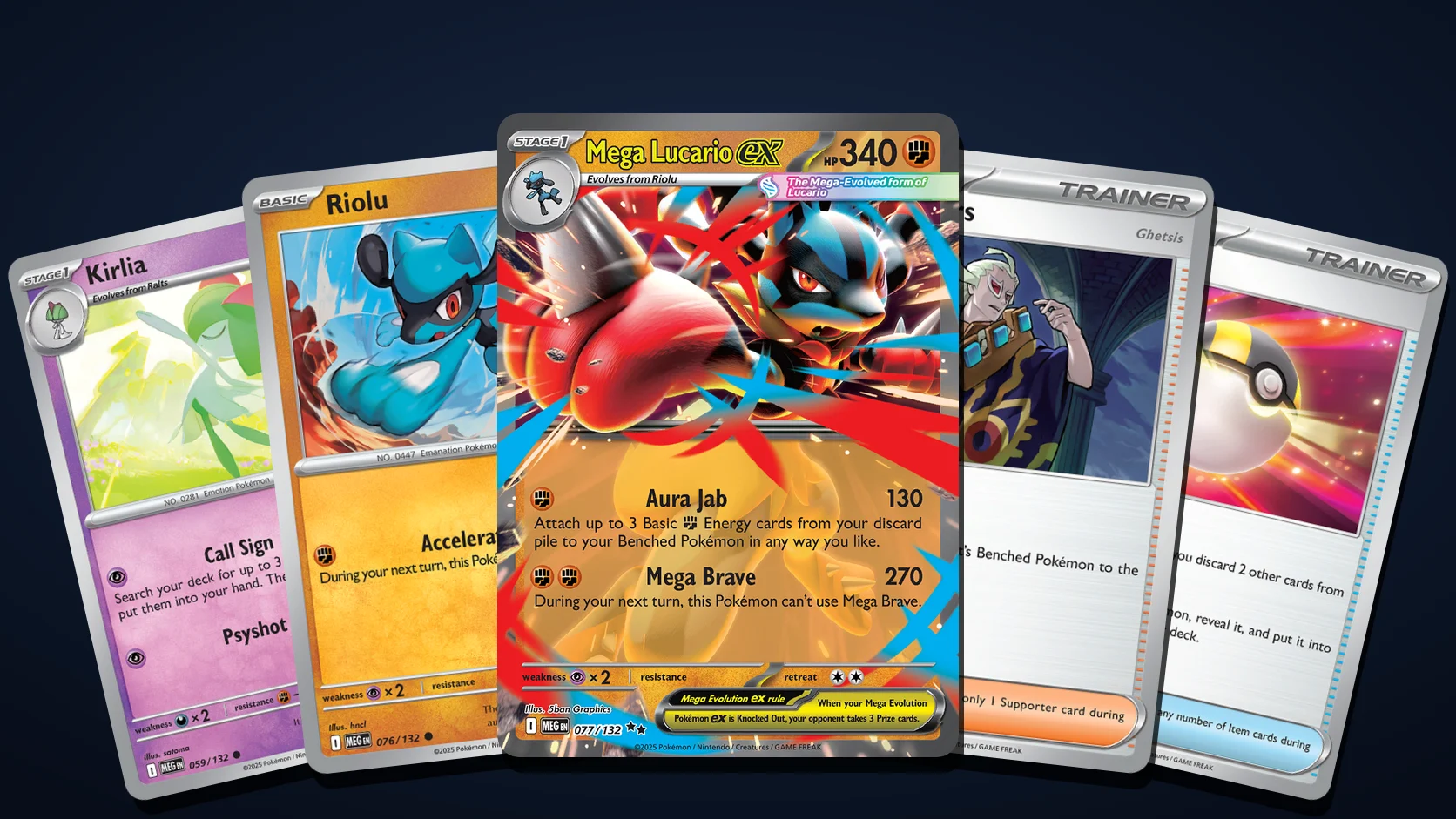
Evolving. A Stage 1 card says "Evolves from" a Basic Pokémon; a Stage 2 evolves from a Stage 1. You play it on top of that Pokémon if the Pokémon was already in play at the start of your turn. Mega Lucario ex, for example, is a Stage 1 that evolves from Riolu. The evolved Pokémon keeps its Energy, Tools and damage counters but loses any Special Conditions and attack effects. It can't use its previous stage's attacks.
Retreating. Discard Energy from your Active Pokémon to pay the Retreat Cost printed at the bottom of the card, then swap it with a Benched Pokémon. Damage counters and attached cards stay with each Pokémon, Special Conditions go away, and the new Active Pokémon can still attack this turn. An Asleep or Paralyzed Pokémon can't retreat.
Abilities aren't attacks. Using one doesn't end your turn, and Benched Pokémon can use them too.
A sample first two turns
Say you go second with Riolu in the Active Spot, a second Riolu on the Bench and a Fighting Energy in hand. Your opponent went first, so they couldn't attack.
- Draw a card.
- Play Ultra Ball (an Item), discarding 2 other cards from your hand as it requires, to search your deck for Mega Lucario ex. You can't evolve yet: it's your first turn.
- Play a Supporter such as Boss's Orders if it helps. Going second, you're allowed one.
- Attach the Fighting Energy to your Active Riolu.
- Attack with Accelerating Stab for 30. Your turn ends.
 Riolu, Mega Evolution 076/132Basic: $0.20 on 18 Nov 2026
 Mega Lucario ex, Mega Evolution 077/132Stage 1, 340 HP: $0.68 on 18 Nov 2026
 Ultra Ball, Mega Evolution 131/132Item: $0.21 on 18 Nov 2026
 Boss's Orders, Mega Evolution 114/132Supporter: $0.38 on 18 Nov 2026
On your next turn, Riolu has been in play since before the turn started, so you can evolve it into Mega Lucario ex, attach a second Energy and attack with Aura Jab. That's the basic rhythm of the game: build up on the Bench, power up one attacker, and take Prize cards faster than your opponent.
How Attacking Works
Check the Energy. An attack's cost is the row of Energy symbols to the left of its name. Your Active Pokémon needs at least that much Energy attached. A Colorless symbol can be paid with any type. Mega Lucario ex's Aura Jab costs one Fighting Energy and does 130 damage; Mega Brave costs two Fighting Energy and does 270.
Work out the damage. Start with the number to the right of the attack, apply any effects on your attacker, then the Defending Pokémon's Weakness, then its Resistance, then any effects on the Defending Pokémon.
Put damage counters on the Defending Pokémon, one for every 10 damage. A Pokémon with damage equal to or more than its HP is Knocked Out.
Attacks that tell you to put damage counters on a Pokémon skip Weakness, Resistance and other damage effects. You just place the counters.
Weakness and Resistance
Weakness and Resistance are in the bottom-left corner of a Pokémon card. On current cards, Weakness doubles the damage (×2) and Resistance subtracts 30 (−30). They only apply to the Active Pokémon, never to the Bench. Our Pokémon type chart lists the usual Weakness and Resistance for each type.
Kirlia's Psyshot (Psychic)
- Defender
- Mega Lucario ex (340 HP, Psychic ×2)
- Base damage
- 30
- Modifier
- Weakness ×2
- Final damage
- 60
Mega Lucario ex's Aura Jab (Fighting)
- Defender
- Kirlia (100 HP, Fighting −30)
- Base damage
- 130
- Modifier
- Resistance −30
- Final damage
- 100: Knocked Out
Riolu's Accelerating Stab (Fighting)
- Defender
- Ralts (70 HP, Fighting −30)
- Base damage
- 30
- Modifier
- Resistance −30
- Final damage
- 0
 Ralts, Mega Evolution 058/13270 HP, Fighting resistance −30
 Kirlia, Mega Evolution 059/132100 HP, Fighting resistance −30
Knock Outs and Prize Cards
When a Pokémon is Knocked Out, its owner puts it and every card attached to it in the discard pile and promotes a Benched Pokémon to the Active Spot. The attacking player takes Prize cards into their hand.
How many depends on the Pokémon. The rule is printed in the card's Rule Box:
Regular Pokémon (no Rule Box)
- Prize cards taken
- 1
- Where you'll see it
- Standard and Expanded
Pokémon ex, including Tera Pokémon ex
- Prize cards taken
- 2
- Where you'll see it
- Standard and Expanded
Mega Evolution Pokémon ex
- Prize cards taken
- 3
- Where you'll see it
- Standard and Expanded
Pokémon V, VSTAR, GX, EX
- Prize cards taken
- 2
- Where you'll see it
- Expanded
Pokémon VMAX, TAG TEAM, V-UNION
- Prize cards taken
- 3
- Where you'll see it
- Expanded
That's the trade-off behind the big cards. Mega Lucario ex has 340 HP and hits for 270, but losing it hands your opponent half their Prize cards in one go. Prize cards can also hold cards you need, since they come off the top of your deck at random.
How to Win a Pokémon Card Game
There are three ways to win:
- Take your last Prize card.
- Your opponent has no Pokémon in play. If their Active Pokémon is Knocked Out and they have nothing on the Bench to replace it, you win.
- Your opponent can't draw. If their deck is empty at the start of their turn, they lose. This is called decking out.
If both players meet a win condition at the same time, a player who wins in two ways beats one who wins in only one. Otherwise, the rulebook now settles a tie with a tiebreaker game; it replaced Sudden Death in February 2026. Play! Pokémon tournaments follow their own handbook for this.
Pokémon Checkup and Special Conditions
Between turns comes Pokémon Checkup. Both players apply Special Conditions in this order: Poisoned, Burned, Asleep, Paralyzed. Then any Pokémon at 0 HP is Knocked Out.
| Special Condition | What it does |
|---|---|
| Poisoned | 1 damage counter at every Pokémon Checkup |
| Burned | 2 damage counters at Checkup, then flip: heads, it recovers |
| Asleep | Can't attack or retreat; flip at Checkup, heads it wakes up |
| Paralyzed | Can't attack or retreat; recovers at the Checkup after its owner's next turn |
| Confused | Flip before attacking: tails, the attack fails and it takes 3 damage counters |
Special Conditions only affect the Active Pokémon. Moving to the Bench or evolving removes all of them. Our Pokémon TCG Special Conditions guide covers how they stack and how to clear each one.
Formats: Standard and Expanded
The rules above are the same in every format. What changes is which cards you can use.
Standard is the main format for tournaments and Pokémon TCG Live. It uses cards with the H, I and J regulation marks, the small letter in the bottom-left corner of each card. The G cards rotated out on 10 April 2026, as our 2026 rotation guide explains. A card from an older set is still legal if a reprint with the same name and text carries a legal mark.
Expanded allows cards from Black & White onward, minus a banned card list. It's a bigger, older card pool with fewer events. Our Standard vs Expanded guide compares the two.
Casual games at home don't need to follow either format. Any 60 cards you and your opponent agree on will do.
Learning Online: Pokémon TCG Live and Pocket
Pokémon TCG Live is the free digital version of the real game. It uses the same rules, 60-card decks and Standard format as tournaments, and its tutorials walk you through a first game. It's the quickest way to learn the rules on this page.
Pokémon TCG Pocket is a separate mobile game with simpler rules: 20-card decks, no Energy cards and 3 points to win. It's fun, but don't learn the card game from it.
Learn the turn order, the first-turn rule and the Prize card counts, and you know enough to play your first real game. Everything else is written on the cards.
The quickest way to learn is to play a game: try the free Pokémon TCG Live, or pick up one of the ready-made decks above. Then keep our guide to reading a Pokémon card open for your first few games.
Once you're playing, our best Pokémon cards list covers the cards worth owning, the Pokémon booster box guide tracks which sets are worth opening, and the Pokémon box opener shows what a box is worth on average. Card sleeves help too: Pokémon card size explains which ones fit.
Citations & Resources
- Pokémon: Pokémon TCG rules page and current web rulebook (last updated November 2026)
- Play! Pokémon: TCG Tournament Handbook, deck rules and legal regulation marks (revised 1 September 2026)
- Play! Pokémon: Tournament rules and resources
- Pokémon Professor Program: Rulebook updates, including tiebreaker games replacing Sudden Death (26 February 2026)
- The Pokémon Company (Asia): Advanced Player's Rulebook, setup, Knock Outs and Pokémon Checkup
- Pokémon TCG API: Mega Evolution set card data (HP, attacks, Weakness, Resistance, Rule Boxes)
Related Guides
- Pokémon TCG Beginner Guide: starter products, Mega Evolution and the 2026 rotation
- Pokémon TCG Special Conditions: Asleep, Burned, Confused, Paralyzed and Poisoned in detail
- How to Build a Pokémon TCG Deck: the 60-card split and deck-building basics
- Pokémon TCG Tier List: the best Standard decks right now, tier by tier
- Pokémon TCG Energy Types: the 10 types, Basic Energy and the 2026 type chart
- Pokémon TCG Rotation 2026: which cards left Standard and what replaced them
- Standard vs Expanded: the two tournament formats compared
- Best Pokémon Cards: the cards worth owning
- Pokémon Booster Box Guide: which sets are worth opening