Quick Verdict
Master every Magic: The Gathering symbol from WUBRG mana to set rarity markers with this comprehensive visual guide for players and collectors.
TOP CARDS

Magic: The Gathering Starter Kit 2024
A two-player starter product that shows the basic symbols in real games
- ✓Two pre-built 60-card decks, ready to play against each other
- ✓Play Guide booklet written for new players

Ultra Pro Mana Symbol Sleeves
Show off your color identity while protecting your deck
- ✓Officially licensed Magic designs
- ✓Standard size, so they fit Magic cards
Magic: The Gathering is more than a card game—it's an entire language written in glyphs, icons, and hieroglyphs that tell you everything from how much a spell costs to whether the card in your hand is worth a dollar or a hundred. Every symbol on a Magic card serves a purpose, whether it's dictating gameplay mechanics, identifying when and where a card was printed, or signaling its rarity to collectors.
For new players, these symbols can feel like an indecipherable code. The curved arrow that means "tap this permanent." The grey circle with a number versus the grey diamond. The gold expansion symbol that makes collectors' eyes light up. For returning players who last played in the 90s, modern cards introduce even more symbols: Energy counters, Phyrexian mana, Acorn stamps, and triangular holofoil markers that didn't exist in the game's early years.
This guide serves as your comprehensive decoder ring for all Magic: The Gathering symbols. Whether you're trying to figure out if you can tap that creature, determine if your childhood collection contains hidden gems, or understand what the snowflake symbol on your Commander deck means, we'll break down every symbol by function and context. By the end, you'll be able to read any Magic card like a native speaker of the game's visual language.
Understanding Magic symbols transforms cards from confusing game pieces into readable strategic tools—let's start with the foundation of the entire game: mana.
The Mana Symbols: WUBRG and Beyond
This section covers how the colours appear on the card. For what each colour actually does — the colour pie, the ally-enemy wheel and all 26 combination names — see our guide to MTG colors.
Every spell in Magic requires mana to cast, and mana symbols form the core alphabet of the game's visual language. These symbols appear in casting costs, activated abilities, and rules text, telling you exactly what resources you need to play your cards.
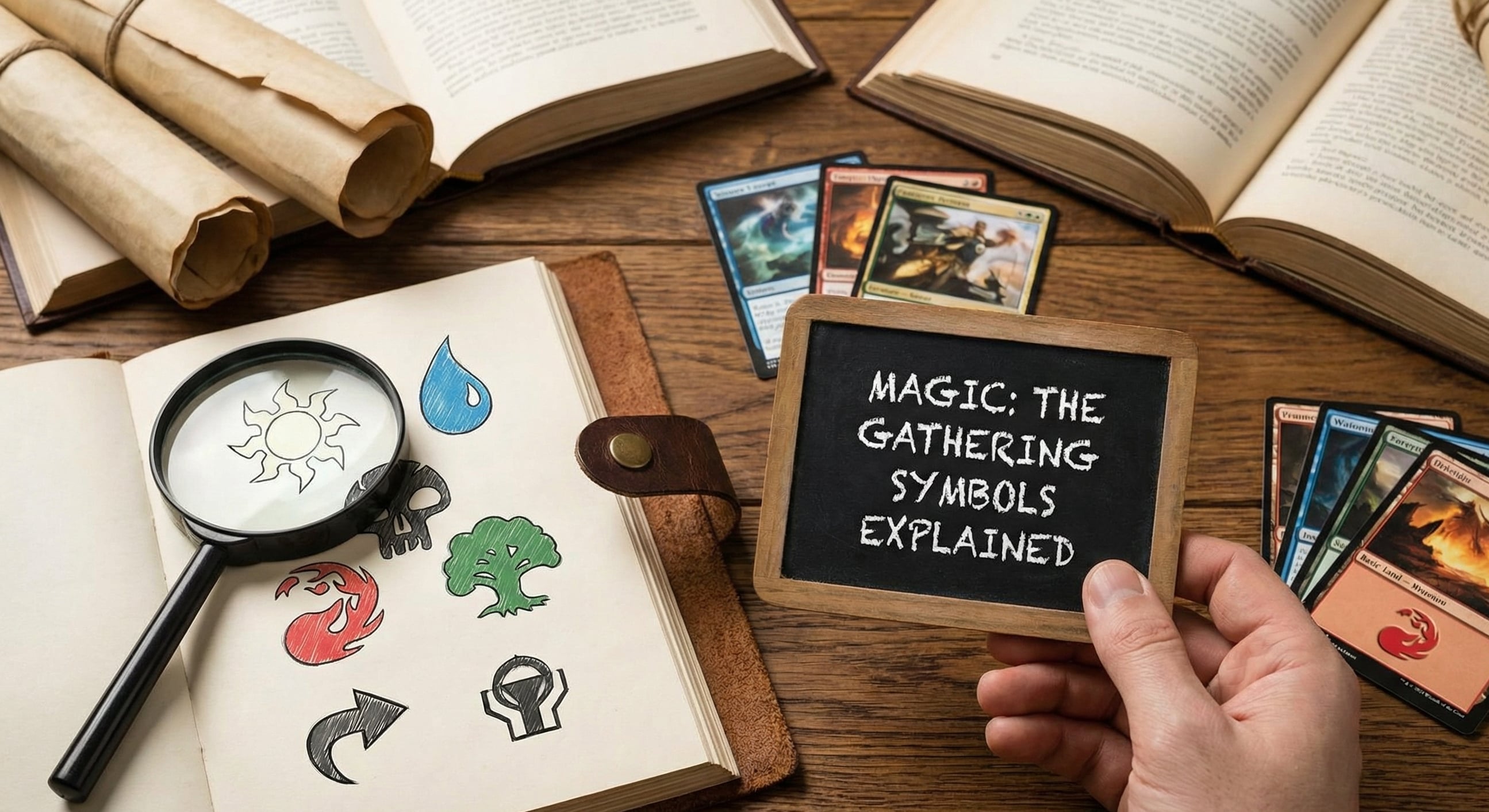
White (W) - Represented by a sun icon on Plains lands, White mana embodies order, protection, healing, and community. White spells often feature life gain, creature tokens, and removal of threats.
Blue (U) - Shown as a water droplet on Island lands, Blue mana represents knowledge, illusion, manipulation, and control. Blue is the color of card draw, counterspells, and returning permanents to hand. (Note: Blue uses "U" to avoid confusion with Black's "B".)
Black (B) - Depicted as a skull on Swamp lands, Black mana symbolizes death, ambition, power at any cost, and necromancy. Black excels at creature destruction, life drain, and recursion from the graveyard.
Red (R) - Shown as a fireball on Mountain lands, Red mana embodies chaos, freedom, emotion, and destruction. Red specializes in direct damage, aggressive creatures, and impulsive card advantage.
Green (G) - Represented by a tree on Forest lands, Green mana represents nature, growth, strength, and instinct. Green features large creatures, mana acceleration, and artifact/enchantment destruction.
These five colors form the foundation, but modern Magic includes several specialized mana symbols that confuse even experienced players.
Generic vs. Colorless Mana: The Critical Distinction
Most Common Symbol Confusion
The difference between Generic mana and Colorless mana is the number one point of confusion for Magic players at every skill level. Getting this wrong can fundamentally change how you build and play your decks.
Generic Mana (Number in Grey Circle): When you see a number inside a grey circle in a casting cost—like the "2" in a spell costing {2}{U}{U}—that's Generic mana. You can pay Generic costs with mana of ANY type: White, Blue, Black, Red, Green, OR Colorless. It's flexible payment that doesn't care about the source.
Colorless Mana (Grey Diamond): The colorless symbol {C}, a diamond shape in a grey circle, represents actual Colorless mana. This symbol appears in two contexts:
-
As a cost (rare): Some cards from Oath of the Gatewatch onward require specifically colorless mana to cast or activate. This cost can ONLY be paid with mana from sources that produce colorless mana, like Wastes, Sol Ring, or other colorless-producing permanents.
-
As production: When a card says "Add
{C}" (the diamond), it's producing colorless mana that can pay for Generic costs OR Colorless-specific costs.

Sol Ring
Perfect example of colorless mana production
Symbol Lesson: Produces {C}{C} (two colorless mana)
Use Case: Pay for any Generic or Colorless costs
Format: Commander staple; restricted in Vintage, banned in Legacy

Thought-Knot Seer
Demonstrates colorless mana requirement
Symbol Lesson: Costs {3}{C} (three generic, one colorless)
Requires: At least one source of colorless mana
Format: Pioneer, Modern, Legacy, Vintage, Commander
Beyond the basics, Magic includes hybrid and alternative mana symbols that offer flexibility in casting costs.
Hybrid and Phyrexian Mana: Flexible Casting Options
Hybrid Mana: A split circle showing two colors means you can pay with EITHER color. A card costing {G/W}{G/W} can be cast with two Green mana, two White mana, or one of each. This allows cards to fit into multiple deck strategies and represents the overlap between color philosophies.
Monocolored Hybrid: Sometimes you'll see a split between a color and a generic number (like {2/G}). This can be paid with either one Green mana OR two generic mana of any type, offering a more expensive but color-flexible option.
Phyrexian Mana: One of the most powerful mechanics in Magic's history, Phyrexian mana shows the Phyrexian symbol on a colored background. These costs can be paid EITHER with one mana of that color OR by paying 2 life. This allows casting spells "for free" if you're willing to sacrifice life points.
Competitive Note
Phyrexian mana cards like Mental Misstep and Gitaxian Probe are banned in Modern and Legacy and restricted in Vintage. Paying life instead of mana let any deck cast them, in any colors, for no mana at all.
Snow Mana: A Supertype, Not a Color
The snowflake symbol {S} represents Snow mana, which is NOT a sixth color but rather a supertype. Snow mana comes from permanents with the "Snow" type (like Snow-Covered Forest or Coldsteel Heart). Some cards require snow mana specifically or reward you for using snow sources, primarily in sets like Ice Age, Coldsnap, and Kaldheim.
Now that we understand mana symbols, let's decode the action symbols that appear in rules text and dictate how you physically interact with cards during gameplay.
Action & Mechanic Symbols: Tap, Untap, and Counters
Magic: The Gathering symbols extend beyond costs into the fundamental actions you take during a game. These symbols appear in rules text and on tokens, representing everything from tapping a creature to tracking energy counters.
The Tap symbol has changed more than most. In Alpha, rules text spelled it out in words: Llanowar Elves read "Tap to add 1 green mana to your mana pool." Revised Edition (1994) replaced the words with a symbol, a tilted letter T. Fourth Edition (1995) switched to the curved arrow used today, which suggests a card turning sideways.
Over the years, the symbol has been refined and stylized, but its meaning remains unchanged: rotate this permanent 90 degrees to use this ability. The tap symbol appears on countless cards and is arguably the most universally recognized Magic symbol after the five mana colors.
The Tap Symbol {T}
The curved arrow pointing to the right represents tapping a permanent—rotating it 90 degrees clockwise to show it's been used. Tapped permanents can't be tapped again until they untap (usually during your next untap step). The tap symbol appears in activation costs for abilities and as a payment requirement.
Common Uses:
- Creature abilities:
{T}: Add one mana of any color - Attack declaration: Attacking creatures become tapped (no symbol needed, it's automatic)
- Artifact abilities: Many artifacts require tapping to activate
Summoning Sickness Reminder
A creature can't attack or use abilities with {T} or {Q} in the cost unless you've controlled it continuously since your most recent turn began. This is called "summoning sickness." It applies only to creatures: a noncreature artifact, like a Sol Ring you just cast, can tap right away.
The Untap Symbol {Q}
Less common but important, the Untap symbol was introduced in the Shadowmoor block. It's a curved arrow in a black circle, and in a cost it means "untap this permanent." Pili-Pala uses it: {2}, {Q}: Add one mana of any color. The permanent must be tapped before you can pay {Q}, and like {T}, a creature can't use it the turn it arrives.
Most modern cards simply write "untap" in the rules text rather than using the symbol, making {Q} one of Magic's rarer action symbols.
Energy Counters {E}
Introduced in Kaladesh and returning in subsequent sets, the Energy symbol looks like a stylized lightning bolt or spark. Energy counters are placed on players (not permanents) and act as a resource you can spend to activate abilities or cast spells with energy costs.
Energy operates parallel to mana—you accumulate energy through certain cards and spend it when other cards call for energy payments. Unlike mana, energy doesn't drain between turns, making it a persistent resource throughout the game.

Aether Hub
Entry point to the energy mechanic
Symbol Lesson: Produces {E} (one energy counter)
Mechanic: Spend energy to add mana of any color
Format: Modern, Pioneer, Commander

Whirler Virtuoso
Converts energy into creature tokens
Symbol Lesson: Costs {E}{E}{E} to activate ability
Payoff: Creates flying artifact creature tokens
Synergy: Rewards energy generation strategies
Other specialized counters use symbols to track game state—poison, experience, and various keyword mechanics all have visual representations.
Poison, Experience, and Other Counter Symbols
Poison Counters: Poison counters have no symbol of their own; cards say "poison counter" in words. They are tracked on players. Infect (Scars of Mirrodin block) and toxic (Phyrexia: All Will Be One) are the main ways to give them. A player with ten or more poison counters loses the game, making poison an alternative win condition.
Experience Counters: Introduced in Commander 2015, experience counters are written out in words rather than shown as a symbol, and they accumulate on players permanently. Commanders like Meren of Clan Nel Toth and Mizzix of the Izmagnus grow stronger throughout the game based on your experience counter total, creating a persistent advancement mechanic.
+1/+1 and -1/-1 Counters: These don't have unique symbols but appear as text in rules. They modify creature power and toughness and are represented physically with dice, tokens, or other markers during gameplay.
Understanding gameplay symbols prepares you to play Magic, but collector symbols tell you what you're playing with—and what it's worth.
Expansion & Rarity Symbols: For Collectors and Historians
The expansion symbol in the middle-right of every modern Magic card serves dual purposes: it identifies which set the card comes from, and its color indicates the card's rarity. For collectors, these symbols are the key to determining a card's age, scarcity, and potential value.
Magic cards didn't always have expansion symbols. Alpha, Beta, and Unlimited had none. You tell them apart by other details: Alpha and Beta have black borders, Unlimited has white borders, and Alpha's corners are more rounded. Arabian Nights introduced the first expansion symbol—a scimitar—in 1993, beginning the tradition of thematic set icons.
Early expansion symbols were always black regardless of rarity, making it impossible to determine at a glance whether you held a common or rare card. The Exodus set in June 1998 introduced colored rarity symbols, revolutionizing how players and collectors evaluated cards.
Core sets took longer. Alpha through Fifth Edition carried no expansion symbol at all — Sixth Edition in April 1999 was the first English-language core set to get one, a Roman numeral VI, already color-coded for rarity. Every core set since has used one, which is why a core set card with no symbol dates from 1997 or earlier.
Today each set gets its own symbol, usually designed to match the set's theme.
How to Read the Expansion Symbol
The expansion symbol encodes two pieces of information in one glyph:
Shape = Set Identity Each Magic set has a unique symbol shape, usually tied to its theme. If you don't recognise a symbol, Scryfall's set list shows every set's icon next to its name.
Color = Rarity The symbol's color indicates how rare the card is within that set:
Common
Black or white symbol (depending on card frame). Most of the cards in a pack are commons.
Uncommon
Silver symbol. A Play Booster has at least three uncommons.
Rare
Gold symbol. Every Play Booster has at least one rare or mythic rare.
Mythic Rare
Orange/red-orange symbol. The rarest of the four main rarities; a mythic sometimes takes the place of a rare.
The Rarities That Are Not Colors
Four tiers cover almost every card, but a few others exist and confuse people who meet them for the first time:
Special (purple). Used for bonus-sheet cards that sit outside the normal rarity structure, such as the Time Shifted cards from Time Spiral. A purple symbol means "this card was not in the normal rarity slots".
Basic lands. Technically their own rarity, and never worth anything unless the printing is unusual.
Promotional printings. Various colors and stamps depending on the promotion. The symbol color on a promo tells you little.
Rarity Is a Print Run, Not a Price
This is the part worth internalising, and it is where the rarity question usually comes from.
Rarity describes how often a card appears in a booster pack. It does not describe how much it is worth. The two correlate loosely and diverge constantly:
- Most rares are worth under a dollar. There are far more bad rares than good ones.
- Some commons are worth real money, because a heavily played common in an eternal format has enormous demand and a fixed supply from an old set.
- A mythic rare from an unpopular set can be cheaper than an uncommon from a popular one.
Treatments are not rarities either. Foil, borderless, extended art, showcase and serialized are finishes and frames applied on top of a card's rarity. A borderless mythic and a normal mythic share a rarity and can differ in price by an order of magnitude. Serialized cards are the extreme case — numbered print runs of a few hundred, which is scarcity that has nothing to do with the symbol color.
If you are trying to work out what a card is worth, the rarity symbol is the weakest signal on the card. Our guide to what MTG cards are worth money covers the markers that actually predict value, and how to value MTG cards covers pricing them properly.
Special Rarity Colors
Purple expansion symbols appear on "Time Shifted" cards from Time Spiral and Time Spiral Remastered. These represent a special rarity tier that reprints older cards with the old card frame.
Pre-Rarity Era Cards: Before Colored Symbols
If you have Magic cards from before 1998 (pre-Exodus), the expansion symbol won't tell you rarity, because it's printed in black. For these cards:
- Core sets before Sixth Edition (Revised, 4th Edition, 5th Edition, etc.) had no expansion symbol at all
- Early expansions used black symbols regardless of rarity
- Rarity determination requires looking the card up, for example on Scryfall
| Set Name | Release Year | Symbol Type | Collector Value |
|---|---|---|---|
| Alpha/Beta | 1993 | No symbol | Black border; Alpha has more rounded corners |
| Arabian Nights | 1993 | Black scimitar (all rarities) | First expansion symbol, highly collectible |
| Revised | 1994 | No symbol (Core Set) | White border; easy to confuse with Unlimited |
| Exodus | 1998 | First color-coded rarity symbols | Symbol color shows rarity from here on |
| Sixth Edition | 1999 | Roman numeral VI, color-coded | First core set with an expansion symbol |
Beyond standard rarity symbols, modern Magic cards include security stamps and special markers that indicate tournament legality and special printings.
Security Stamps and Special Markers
Starting with Magic 2015 (July 2014), rare and mythic rare cards include a small holofoil security stamp at the bottom center of the card to combat counterfeiting. These stamps come in several varieties:
The Oval Stamp: The standard holofoil oval. It appears on rare and mythic rare cards in normal Magic sets, and helps verify that a card is genuine.
The Triangle Stamp: Universes Beyond crossover cards (like Warhammer 40,000, Lord of the Rings, Fallout, and Assassin's Creed) used an inverted triangle instead of the oval. Final Fantasy (June 2025) was the last set to use it. From Marvel's Spider-Man onward, Universes Beyond rares and mythics use the normal oval stamp. Since Final Fantasy, Universes Beyond sets like Spider-Man, Avatar and TMNT have also been Standard-legal, so the stamp style is no guide to legality.
The Acorn Stamp: Replacing the silver border from previous Un-sets, the acorn security stamp appears on cards that are NOT legal in sanctioned tournament play. These cards from sets like Unfinity are designed for casual play and often feature joke mechanics or references that wouldn't work in competitive Magic.
The List Symbol
Some booster packs contain reprints with a small Planeswalker symbol in the bottom left corner. This marks a card from "The List", a curated selection of reprints that has appeared in Set Boosters and, later, some Play Boosters. These cards keep their original set symbol and are legal wherever that card is already legal.
With rarity and set identification mastered, let's examine the symbols that appear on specific card types and in text boxes.
Card Type & Text Box Symbols
Different card types use specific symbols to convey their unique characteristics. These symbols appear in specific locations on cards and indicate values that change during gameplay or are relevant to specific card types.
Power/Toughness (Creatures)
The numbers in the bottom right corner of creature cards represent Power/Toughness. The first number (power) is how much combat damage the creature deals. The second number (toughness) is how much damage it takes to destroy it. These are displayed as X/X and are fundamental to combat calculations.
Some creatures have * or X in place of numbers, indicating the value is defined by an ability in the text box or varies based on game state.
Loyalty (Planeswalkers)
Planeswalker cards display a loyalty number in the bottom right corner inside a shield-like symbol. This number represents the planeswalker's starting loyalty counters. Planeswalker abilities show +X, -X, or -X costs, which modify the loyalty total when activated. When a planeswalker reaches zero loyalty, it's put into the graveyard.

Jace, the Mind Sculptor
Perfect example of loyalty symbol usage
Symbol Lesson: Starts with 3 loyalty counters
Abilities: +2, 0, -1, and -12 loyalty costs
Format: Modern, Legacy, Vintage, Commander

Invasion of Ravnica
Demonstrates defense symbol (Battles)
Symbol Lesson: Defense value shown in bottom right
Mechanic: Siege: when defeated, it's exiled and cast transformed
Format: Pioneer, Modern, Commander (rotated out of Standard)
Defense (Battles)
Introduced in March of the Machine (2023), Battle cards show a defense value in the bottom right corner. A battle enters with that many defense counters, and damage dealt to it removes them. When the last one is gone, the battle is defeated; a Siege like Invasion of Ravnica is then exiled and cast transformed.
Level Up Indicators
Creature cards with the Level Up mechanic (primarily from Rise of the Eldrazi) use arrow symbols to separate different level ranges. These cards physically display different power/toughness values and abilities at different levels, with arrows pointing to text boxes that apply when the creature reaches those levels.
Saga Chapter Symbols
Saga enchantments use Roman numerals (I, II, III, etc.) in the text box to mark chapter abilities. A Saga enters with one lore counter, and you add another as your precombat main phase begins each turn. Each chapter triggers when the lore counters reach its number, and the Saga is sacrificed after its final chapter ability has resolved.
Some symbols appear behind card text rather than as functional elements—these are watermarks, and they serve a different purpose entirely.
Watermarks vs. Functional Symbols
One of the most common points of confusion for players is distinguishing between watermarks and functional symbols. They appear in similar locations but serve entirely different purposes.
Watermarks are faint background images that appear in the text box of cards, usually representing faction affiliation or set identity. Unlike expansion symbols and mana symbols, watermarks have NO gameplay effect and don't determine format legality.
Common Watermark Types:
- Guild Symbols (Ravnica): Each of the ten guilds has a unique watermark showing their allegiance
- Faction Symbols (Mirrodin/Phyrexia): Mirran and Phyrexian watermarks indicated sides during the Mirrodin war
- Clan Symbols (Khans of Tarkir): Each of the five clans has its own watermark
These are purely cosmetic and help establish flavor and worldbuilding. A card with the Azorius watermark and a card without it function identically in gameplay.
Key Differences: Watermarks vs. Set Symbols
Set Symbol (Middle Right):
- Determines which set the card is from
- Color indicates rarity
- Tells you which printing you hold
- Used for collection organization
Watermark (In Text Box):
- Shows faction or character affiliation
- Always decorative, no rules impact
- Doesn't affect format legality
- Purely for flavor and worldbuilding
Rules Exception: Snow Supertype
The one exception where a background element matters is the snow supertype, but this appears as a text line ("Snow Creature" in the type line) rather than just a watermark. The snowflake symbol appears in costs and production, not as a decorative watermark.
Now that we've covered every major symbol category, let's address some special cases and modern innovations that confuse even veteran players.
Advanced Symbol Topics & Modern Innovations
Magic continues to evolve its visual language, introducing new symbols and retiring others. Understanding these edge cases and recent additions helps you navigate the full breadth of Magic's 30+ year history.
Modal Double-Faced Cards (MDFCs)
Cards from Zendikar Rising onward include Modal Double-Faced Cards. They carry a small triangle icon in the top left corner, different from the icons on transforming cards, so you can tell the two kinds apart.
Unlike transform cards, you choose which face to play as you cast the card or play the land. Outside the stack and the battlefield, the card has only its front face's characteristics.
Day/Night Symbols
Innistrad: Midnight Hunt and Crimson Vow introduced the day/night cycle with sun and moon symbols. These appear on double-faced cards and track a game-wide state that affects all day/night cards at once. The game starts as neither day nor night. Once a daybound permanent appears it becomes day, and from then on the game is always either day or night.
Day State
Sun symbol on the front face. If it's day and the previous turn's active player cast no spells that turn, it becomes night.
Night State
Moon symbol on the back face. If it's night and the previous turn's active player cast two or more spells that turn, it becomes day.
Product Reviews: Learning Tools for MTG Symbols
Understanding Magic: The Gathering symbols requires hands-on practice with actual cards. Here are short reviews of the two products listed at the top of this guide:
Review: Magic: The Gathering Starter Kit 2024
Best For: Two new players who want to learn by playing
The Magic: The Gathering Starter Kit 2024 came out alongside Bloomburrow. It contains two pre-built 60-card decks designed to be played against each other, a Play Guide booklet, a deck box and a reference card for each deck, and an MTG Arena code card per deck (in select regions). Each deck includes one mythic rare and four rares.
Why it helps with symbols:
You see the basic symbols in context: mana costs, {T} abilities, power and toughness, and the rarity colors on the expansion symbol. Playing a few games teaches these faster than reading about them.
Limitations:
- Basic symbol coverage: The decks stick to the fundamentals, so you won't meet Phyrexian mana or energy here
- Not for competitive play: These are learning decks, not tournament decks
- Price has risen: It is no longer a cheap entry point. It traded at about $70 on TCGplayer in October 2026. Check what newer beginner products cost before buying
Our Verdict:
A good way for two people to learn the symbols by playing, if you can find it near its original price. At current prices, compare it with newer beginner products first.
Review: Ultra Pro Mana Symbol Sleeves
Best For: Players who want to show their deck's colors while protecting their cards
Ultra Pro makes officially licensed Magic sleeves, including designs built around the mana symbols. They are standard size, so they fit Magic cards.
Why players like them:
Mana-symbol sleeves are a visual statement about your deck's colors, and they help you tell decks apart if you own several.
Practical notes:
- Pack size: Ultra Pro's licensed Magic sleeves usually come in 100-count packs, so one pack covers a 60-card deck plus sideboard, or a 100-card Commander deck
- Not for symbol learning: These sleeves display symbols but don't teach you what they mean
Our Verdict:
A nice accessory if you want themed sleeves. They won't teach you anything about symbols, but they are a fun way to show your colors.
Conclusion: Mastering Magic's Visual Language
Understanding Magic: The Gathering symbols transforms gameplay from frustrating confusion to strategic clarity. Every symbol on a Magic card serves a purpose—from dictating costs to identifying rarity—and mastering this visual language is fundamental to becoming a skilled player.
Key Takeaways:
- Mana symbols form the foundation—WUBRG plus specialized types like Colorless and Phyrexian
- Action symbols control gameplay—Tap, Untap, and counter symbols dictate when you can act
- Rarity symbols show print frequency, not price—Color-coded expansion symbols tell you how often a card was printed
- Watermarks are decorative—Unlike functional symbols, watermarks have no gameplay effect
- Modern innovations continue—New symbols like Day/Night and Battle defense add complexity
Practice Makes Perfect:
The best way to master Magic's symbols is through hands-on experience. Play a few games with beginner decks, reference symbol guides during games, and gradually internalize the visual language that makes Magic cards readable at a glance.
Remember: Every professional player was once a beginner who didn't understand the difference between Generic and Colorless mana. With practice and the right tools, you'll develop the symbol awareness that elevates your gameplay.
Related Guides
- The Ultimate MTG Keywords Glossary — the abilities behind the keyword symbols, with a printable cheat sheet
- What MTG Cards Are Worth Money — using the set and rarity symbols to date and price a card
- The Ultimate Guide to MTG Counters — every counter type the symbols track
- MTG Phases and Turn Structure — when the tap and untap symbols actually matter
- Complete Guide to MTG Formats — what the Universes Beyond triangle stamp means for legality
Frequently Asked Questions
🔗 Related Resources
More Reviews:
Related Articles
.jpg)
MTG The Stack Explained: How Spells and Abilities Resolve (2026)
How does the stack work in Magic: The Gathering? A rules guide to MTG's stack: last-in, first-out resolution, priority, and what does and doesn't use the stack, with Comprehensive Rules citations.
Most Expensive MTG Cards: The Most Valuable Magic Cards (2026)
The most expensive MTG card ever sold is a $3M Alpha Black Lotus. The most expensive and rarest Magic cards in 2026: The One Ring, the 1-of-1s, the Power Nine.
Magic: The Gathering Phases – The Ultimate Guide to Turn Structure & Priority
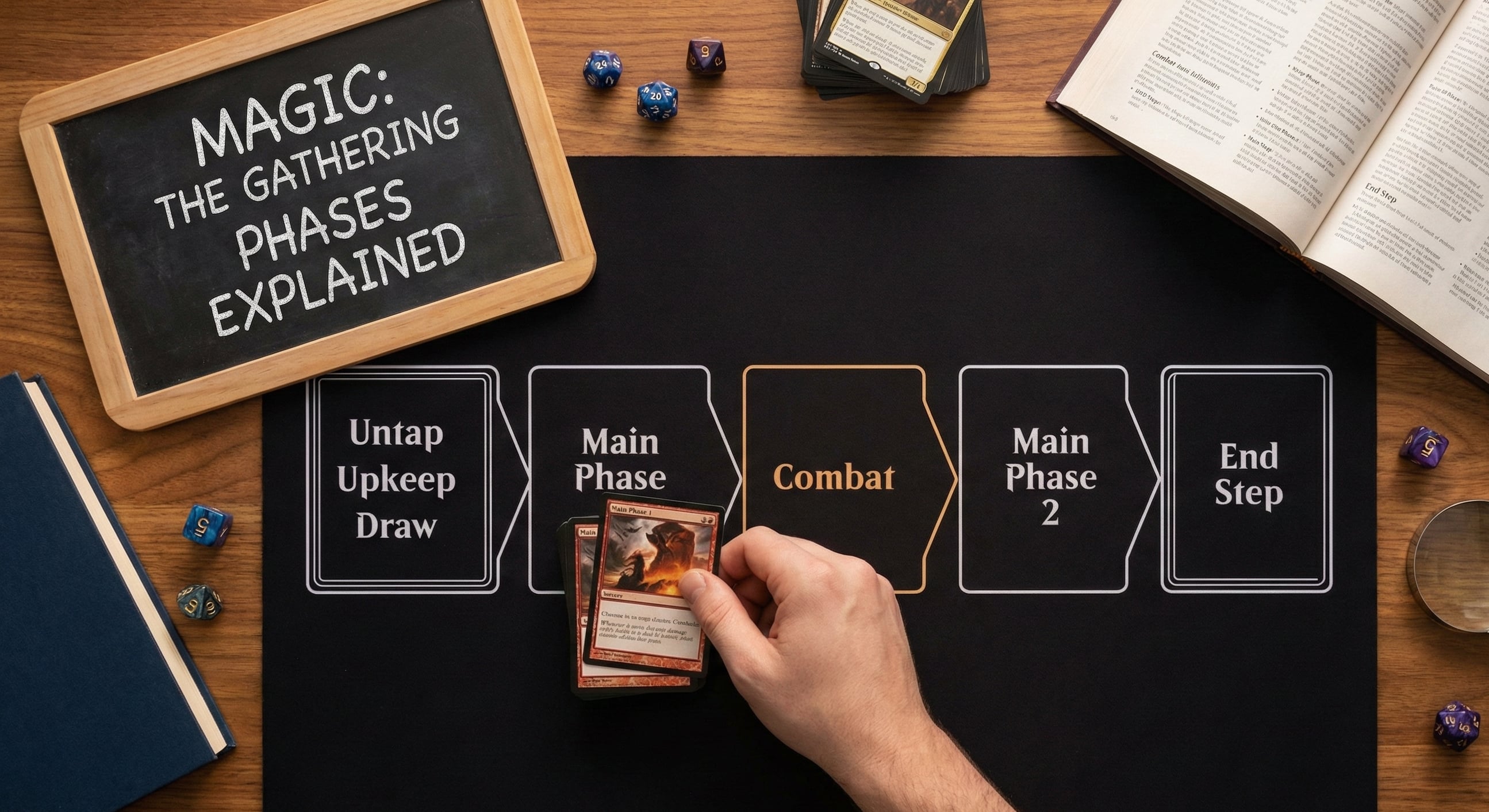
A guide to Magic: The Gathering phases and steps: what happens in each one, when players get priority, how combat damage works under the current rules, and when to cast your spells.