
Quick Verdict
Vigilance has evolved from passive combat utility to a critical economic resource in 2025. Understanding its rules interactions, combat phase mechanics, and strategic applications is essential for competitive play in Foundations and Spider-Man formats.
SEALED PRODUCTS

Bloomburrow Play Booster Box
Best for Vigilance - Rabbit and mouse archetypes packed with vigilance creatures
- ✓Rabbit archetype features vigilance as a core combat keyword
- ✓Creature-focused set rewards attack-and-block strategies

Tarkir: Dragonstorm Play Booster Box
Best for Combat - Dragons with vigilance and flying dominate the skies
- ✓Dragons frequently pair vigilance with flying and trample
- ✓Endure creatures are built to attack and block in the same turn
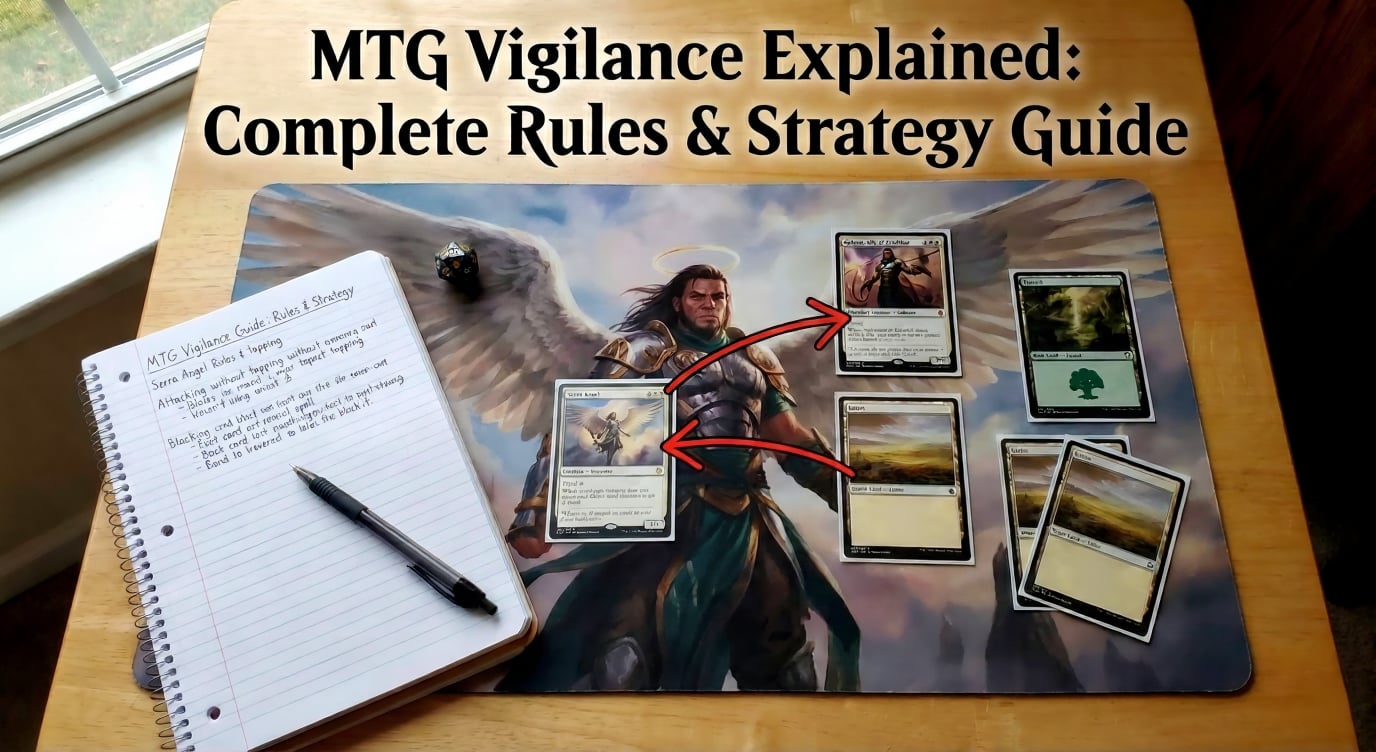
Vigilance in MTG is an evergreen keyword: attacking doesn't cause this creature to tap. So a vigilance creature can attack on your turn and still be untapped to block on your opponent's turn, or to use a {T} ability after combat.
Magic: The Gathering's strategic landscape underwent a seismic shift in 2024-2025 with the release of Foundations and the Spider-Man set. While Vigilance—the ability for creatures to attack without tapping—remains technically unchanged, its tactical application has been radically recontextualized. What was once a passive combat utility has become a critical economic resource, defining formats and reshaping deck-building strategies.
In Foundations, Vigilance anchors the "Damage Assignment Order" rules change and defines baseline creature efficiency. In Marvel's Spider-Man, Vigilance introduces complex ludonarrative tension, creating deliberate anti-synergy with the set's signature Web-slinging mechanic. This guide provides exhaustive analysis of Vigilance's rules, strategic applications, and format-defining interactions.
Whether you're navigating Standard's midrange grind, building Commander decks, or exploring the mechanical tensions of the Spider-Man set, understanding Vigilance's rules framework and strategic implications is essential for competitive success in 2025.
Vigilance Rules in MTG: Comprehensive Rules Analysis
To navigate the 2025 metagame, you must move beyond reminder text and understand the rigid legal framework governing Vigilance. The interaction of static abilities with turn-based actions in the Combat Phase is the bedrock upon which all strategic insights are built.
The Statutory Definition (CR 702.20)
According to the Magic: The Gathering Comprehensive Rules, Vigilance is classified as a static ability that modifies the rules for declaring attackers.
CR 702.20a: Vigilance is a static ability that modifies the rules for the declare attackers step.
CR 702.20b: Attacking doesn't cause creatures with vigilance to tap. (See rule 508, "Declare Attackers Step.")
CR 702.20c: Multiple instances of vigilance on the same creature are redundant.
Critical Distinction: The phrasing "doesn't cause... to tap" is legally distinct from "untaps." A creature with Vigilance that enters the battlefield tapped (due to effects like Thalia, Heretic Cathar) cannot attack, even if it has Vigilance. Vigilance is a preventative measure against the cost of attacking, not a curative measure for the tapped state.
The Tapped State Trap
If a creature enters tapped or becomes tapped before declaring attackers, Vigilance won't help it attack. Vigilance prevents tapping during the attack declaration—it doesn't cure existing tapped status. Always verify your creatures are untapped before the declare attackers step.
The Mechanics of the Declare Attackers Step (CR 508)
The pivotal moment for Vigilance occurs during CR 508.1f, the step where the active player taps chosen attackers. The rule states:
"The active player taps the chosen creatures. Tapping a creature when it's declared as an attacker isn't a cost; attacking simply causes creatures to become tapped."
For a Non-Vigilant Creature:
- Status changes from "Untapped" to "Tapped and Attacking" simultaneously
For a Vigilance Creature:
- Status changes to "Attacking" while the state remains "Untapped"
This bifurcation of state and status is the mechanism that enables the advanced priority plays we'll explore next.
Priority Windows and the "Double Action" Play
One of the most potent yet underutilized interactions involving Vigilance is the ability to utilize tap-activation abilities during the combat phase. This interaction hinges on the specific timing of priority.
The Combat Phase Chronology:
- Beginning of Combat Step (507): Players have priority to cast instants or activate abilities
- Declare Attackers Step (508):
- 508.1: Active player declares attackers. The Vigilance creature is declared
- 508.1f: The Vigilance creature does not tap
- 508.1m: Triggers related to attacking (e.g., "whenever this creature attacks") go on the stack
- Priority Window (508.2): The active player receives priority after attackers are declared but before blockers are declared
Strategic Implication:
At step 508.2, the Vigilance creature is legally an "attacking creature" but is still untapped. The controlling player may now activate an ability with the tap symbol (e.g., tapping Frondland Felidar to tap a potential blocker, or tapping a mana dork like Heronblade Elite to cast a combat trick).
Rule 506.4b: "Tapping or untapping a creature that's already been declared as an attacker or blocker doesn't remove it from combat and doesn't prevent its combat damage."
This rule enables a Vigilance creature to influence the board state twice in a single turn:
- Once by providing combat pressure (attacking)
- Again by utilizing its activated ability (tapping after declaration)
In 2025, this interaction is critical for enabling "Web-slinging" costs in the Spider-Man set, as detailed in Section 4.2.
The Double Action Advantage
After declaring a Vigilance creature as an attacker, you have a priority window to activate its tap ability. This lets you attack for damage AND tap to remove a blocker, generate mana, or activate other abilities—all in the same combat step. This is one of Vigilance's most powerful but underutilized interactions.
Interaction with Exert and Untap Restrictions
Historically seen in the Amonkhet block, the Exert mechanic provides a relevant case study for cost-mitigation via Vigilance.
Exert Definition: "An exerted creature won't untap during your next untap step."
The Vigilance Loophole: If a creature with Vigilance Exerts itself, the penalty is nullified. The creature never tapped to attack; therefore, the restriction on untapping is irrelevant because the creature is already untapped.
While Exert is not a primary mechanic in Foundations, similar "cost-based" attack triggers appear in Marvel's Spider-Man, where Vigilance acts as a stabilizing agent against self-imposed tempo losses.
Foundations (FDN): The Stabilizer Era
Released in November 2024, Magic: The Gathering Foundations (FDN) was designed to establish a perennial Standard environment (legal through at least 2029). The set returns to core design philosophies, using Vigilance to enforce the color identity of White and Green while integrating it with significant rules changes regarding damage assignment.
The Removal of Damage Assignment Order (Rule 509.2)
A critical rules update accompanying Foundations was the removal of "Damage Assignment Order".
Old Rule: If an attacker is blocked by multiple creatures, the attacker must order them (e.g., Blocker A, then Blocker B) and assign lethal damage sequentially.
New Rule (2025): The attacking creature's controller can divide combat damage as they choose among all blocking creatures, without designating an order.
Impact on Vigilance:
This change subtly buffs creatures with Vigilance and high toughness (like Serra Angel or Armasaur Guide). Previously, if a Vigilance creature was double-blocked, the attacker had to commit to an order, allowing the defender to use combat tricks (like Giant Growth) on the first creature in line to save both.
Now, the attacker (the Vigilance player) has total agency to assign damage after tricks are played during the combat damage step calculation. This makes Vigilance creatures more reliable on offense, as they can distribute damage optimally to ensure at least one trade, while still remaining untapped to block on the following turn.
The Archetypes of Vigilance in FDN
Foundations utilizes Vigilance to define the upper echelon of Limited and Standard play.
The Standard-Bearers: Serra Angel and Armasaur Guide
Serra Angel (5 mana total: 3 generic, 2 white, 4/4 Flying, Vigilance):
- A reprint that serves as the "gatekeeper" of the format
- In FDN Limited, Serra Angel creates a state of inequality
- The opponent must keep back blockers to respect the 4/4 body, but the Angel never lowers its own shields
Armasaur Guide (5 mana total: 4 generic, 1 white, 4/4 Vigilance):
- Integrates Vigilance with the +1/+1 counter theme
- Ability: "Whenever you attack with three or more creatures, put a +1/+1 counter on target creature"
- Synergizes with its own Vigilance—it can attack to trigger the ability, grow itself or another threat, and remain untapped to protect the life total
The Apex Predator: Sire of Seven Deaths
The Eldrazi titan Sire of Seven Deaths represents the pinnacle of "Keyword Soup" design in FDN.
Card Profile:
- Mana Cost: 7 (Colorless)
- Stats: 7/7
- Keywords: First strike, Vigilance, Menace, Trample, Reach, Lifelink
- Protection: Ward—Pay 7 life
Analysis:
Vigilance is the force multiplier here. A 7-mana creature without Vigilance is a liability because tapping out to cast it and then tapping it to attack leaves the player defenseless. With Vigilance, Reach, and First Strike, the Sire acts as an impenetrable wall. The Ward (Pay 7 life) ability ensures that spot removal is essentially a "lose the game" action for aggressive decks, solidifying the card as a premier finisher in Control and Ramp strategies.
Sire of Seven Deaths represents the convergence of multiple protection mechanics. Vigilance keeps it untapped to block. Ward (7 life) protects it from removal. First Strike + Reach makes it a combat monster. The combination creates a nearly unstoppable finisher that defines late-game Standard strategies.
Tribal Synergy: Cats and Dinosaurs
Vigilance is woven into the tribal identities of FDN:
Arahbo, the First Fang: While primarily a buffer, Arahbo promotes a "go-wide" Cat strategy where Vigilance (granted by other effects like Kaheera) allows small tokens to chip in for damage without exposing the player to a crack-back.
Dinosaur Tribal: Leverages high-toughness Vigilance creatures to trigger "Enrage" or "Power 4 or greater" mechanics while maintaining defensive superiority.
Saddle and Mounts: The "Untapped" Economy
Foundations and the adjacent Aetherdrift set heavily feature the Saddle mechanic.
Saddle N: Tap any number of other creatures you control with total power N or more: This Mount becomes saddled until end of turn.
The Vigilance Synergy:
Vigilance on the Mount: A Mount with Vigilance, such as Brightfield Glider (1 white mana, 1/1 Vigilance, Saddle 3), is a high-value asset. The player taps other creatures to Saddle the Glider. The Glider attacks (gaining +1/+2 and flying from its Saddle trigger) but remains untapped due to Vigilance. This allows the Glider to serve as an evasive threat and a chump blocker in the same cycle.
Vigilance on the Rider: Vigilance is less useful for the creatures doing the saddling, as Saddle is a Sorcery-speed activation. A creature tapped to Saddle cannot attack, regardless of Vigilance. This creates a hierarchy where Vigilance is premium on Mounts but negligible on Riders.
Table 1: High-Impact Vigilance Cards in Foundations (FDN)
| Card Name | Mana Value | P/T | Keywords | Competitive Role |
|---|---|---|---|---|
| Sire of Seven Deaths | 7 | 7/7 | Vigilance, First Strike, Menace, Trample, Reach, Lifelink, Ward (7 life) | S-Tier. The ultimate stabilizer. Ends aggro games immediately. |
| Serra Angel | 5 (3 generic, 2 white) | 4/4 | Flying, Vigilance | B-Tier (Limited). A solid midrange threat that demands removal. |
| Armasaur Guide | 5 (4 generic, 1 white) | 4/4 | Vigilance, Attack Trigger (+1/+1 counters) | C-Tier. Key synergy piece for Green/White counters archetype. |
| Brightfield Glider | 1 white | 1/1 | Vigilance, Saddle 3 | A-Tier (Aggro). Efficient early drop that scales into a flying threat. |
| Soulstone Sanctuary | Land | 3/3 (when animated) | Vigilance (when animated) | A-Tier. Mana fixing that attacks "for free" (untapped via Vigilance). |
Marvel's Spider-Man (SPM): The Tension Era
The release of Marvel's Spider-Man (SPM) in September 2025 introduced a fascinating mechanical conflict. While Vigilance fits the flavor of "Spider-Sense" (constant awareness), it clashes directly with the set's primary mechanic, creating a puzzle for deck builders.
The "Web-slinging" Anti-Synergy
The signature mechanic of SPM is Web-slinging.
Mechanic Text: "You may cast this spell for [Cost] if you also return a tapped creature you control to its owner's hand."
Function: An alternative cost that rewards tempo plays, allowing players to bounce creatures to re-use ETB effects or save them from removal.
The Conflict:
Standard play patterns involve attacking with a creature (causing it to tap) and then, in the second main phase, using that tapped creature to pay a Web-slinging cost.
The Vigilance Problem: A creature with Vigilance attacks without tapping. Consequently, in the second main phase, it is untapped. It cannot be returned to pay for Web-slinging.
This design creates a scenario where adding a "Vigilance counter" to a creature in a Spider-Man deck might actually be a misplay, as it strands the creature on the battlefield when the player intends to bounce it.
Solving the Puzzle: "Tap Outlets" and Station Mechanics
To reconcile Vigilance with Web-slinging, players must utilize "Tap Outlets"—mechanisms to tap creatures without attacking.
Station Mechanic (Edge of Eternities): The 2025 set Edge of Eternities introduced the "Station" keyword (CR 702.184), which appears on Spacecraft and Planets. It allows a player to "Tap an untapped creature you control" to put charge counters on the Station.
The Synergy: A player can attack with a Vigilance creature (dealing damage), then in the second main phase, tap that creature to activate a Station (gaining value), and then bounce the now-tapped creature to pay a Web-slinging cost. This "tri-layer" synergy turns the Vigilance anti-synergy into a massive value engine.
Convoke & Crew: Similarly, using a Vigilance creature to Crew a vehicle or cast a Convoke spell (tapping it) makes it eligible for Web-slinging return.
The Triple-Value Play
In Spider-Man decks, attack with a Vigilance creature, tap it for Station/Crew/Convoke in your second main phase, then bounce it for Web-slinging. This turns the anti-synergy into a powerful three-step value engine: damage, tap effect, and spell discount.
The Flavor Debate: Vigilance vs. Ward as "Spider-Sense"
A significant design discussion in 2025 centered on the representation of "Spider-Sense," the precognitive ability of Spider-Totems.
Community Stance: Many players argued for Ward (evasion/dodging) or First Strike (reflexes) as the truest representation.
WotC Execution: Wizards utilized a mix:
- Vigilance: Represents "Multitasking" and situational awareness—fighting a villain while saving a bystander (blocking)
- Ward: Represents "Dodging." Used on cards like Skyward Spider (Ward 2) and Spider-Man 2099 (implicit protection via stats)
- Reach: Ubiquitous across the set, representing web-swinging and wall-crawling
Deep Dive: Key Vigilance Cards in SPM
The implementation of Vigilance in SPM focuses on "Hero" cards that are meant to stay on the board, contrasting with the "Villain" cards that often use the Mayhem mechanic (discard/graveyard recursion).
Peter Parker // Amazing Spider-Man
Card Type: Modal Double-Faced Card (MDFC).
Back Face: Amazing Spider-Man (4 generic, 1 green, 1 white, 1 blue total).
Keywords: Vigilance, Reach.
Ability: Grants Web-slinging to other legendary spells.
Analysis: This card is the "Enabler." Because it has Vigilance, Amazing Spider-Man remains on the battlefield to provide the static Web-slinging ability to other cards. He does not bounce himself; he holds the line while the player bounces other creatures (like Black Cat or Mary Jane Watson) to cast spells cheaply. His Vigilance allows him to attack for 4 damage and still block flyers with Reach, perfectly capturing the "Hero" fantasy.
Spider-Man 2099 (Miguel O'Hara)
Mana Cost: 1 blue, 1 red.
Keywords: Double strike, Vigilance.
Mechanic: "From the Future" (Cannot be cast turns 1-3).
Analysis: One of the most efficient combat creatures printed in 2025. Vigilance + Double Strike creates a "No-Win" combat step for the opponent. Attacking into Spider-Man 2099 is suicide due to First Strike damage, and blocking him is equally difficult. He is a pure combat dominance card, detached from the Web-slinging shenanigans.
Ghost-Spider (Gwen Stacy)
Mana Cost: 5 total (2 generic, 1 blue, 1 red, 1 white).
Keywords: Flying, Vigilance, Haste.
Ability: Synergies with casting from exile.
Analysis: A "French Vanilla" powerhouse. Haste and Vigilance allow her to swing for a 4-point life swing immediately upon resolution while staying back to protect the player's life total or Planeswalkers. In Commander, she is a premier Voltron commander because she applies pressure without leaving the player open to the other three opponents.
Silk, Web Weaver
Mana Cost: 4 total (2 generic, 1 green, 1 white).
Keywords: Web-slinging (2 generic, 1 green, 1 white total).
Analysis: Silk is interesting because she has Web-slinging as a casting cost but does not natively have Vigilance. This makes her "fuel" for other Web-slinging cards if she attacks, or she can be cast cheaply by bouncing a tapped dork. She supports the "Go-Wide" Spider archetype.
Table 2: High-Impact Vigilance Cards in Marvel's Spider-Man (SPM)
| Card Name | Mana Value | P/T | Keywords | Competitive Relevance |
|---|---|---|---|---|
| Amazing Spider-Man (Back) | N/A (Transformed) | 4/4 | Vigilance, Reach, Grants Web-slinging | High. The centerpiece of the Blue/Green/White Spider-Man deck. |
| Spider-Man 2099 | 1 blue, 1 red | 2/3 | Double Strike, Vigilance | High. A combat monster. Hard to remove in combat. |
| Ghost-Spider | 5 total (2 generic, 1 blue, 1 red, 1 white) | 4/4 | Flying, Vigilance, Haste | High (Commander). Immediate impact, high mobility. |
| Skyward Spider | 4 total (2 generic, 1 blue, 1 white) | 2/2 | Vigilance, Ward 2 | Medium (Common). Gains Flying if modified. A nuisance in Pauper. |
The Ward Interaction: Vigilance + Protection
While Vigilance protects the player's life total, Ward protects the Vigilance creature itself. In 2025, Ward has fully replaced Hexproof as the standard for creature protection, leading to complex stack interactions.
Ward Definition and Stack Mechanics
Rule 702.21a: Ward is a triggered ability. "Whenever this permanent becomes the target of a spell or ability an opponent controls, counter that spell or ability unless that player pays [cost]."
The Uncounterable Interaction:
A crucial ruling in the 2025 meta involves "Can't be countered" spells (e.g., Abrupt Decay variants in the Source Material bonus sheet). If an opponent casts an uncounterable spell targeting a Ward creature:
- Ward triggers
- The opponent can choose not to pay the cost
- The Ward ability attempts to counter the spell but fails
- The spell resolves
Insight: Ward is not a "prevention" effect; it is a "counter" effect. This makes Vigilance creatures with Ward (like Skyward Spider or Sire of Seven Deaths) vulnerable to uncounterable removal, a key weakness in their armor.
The Uncounterable Weakness
Vigilance + Ward creatures like Sire of Seven Deaths are vulnerable to uncounterable removal. Cards like Abrupt Decay bypass Ward entirely, as the counter attempt fails. Always have a backup plan for protecting your key Vigilance threats.
Redirecting Spells
If a player redirects a spell (e.g., using Bolt Bend) to target a creature with Ward:
- The creature "becomes the target"
- Ward triggers
- The controller of the spell (the opponent) must pay the Ward cost or have their spell countered
This interaction is vital in Commander, where redirecting removal to a "Warded" Vigilance threat can force an opponent to tap out or lose their spell entirely.
Strategic Implications in the 2025 Meta
Standard Format: The Midrange Grind
In Standard (FDN + SPM + Aetherdrift), Vigilance is the defining keyword of the Green/White and Blue/Green/White Midrange decks.
The "Sticky" Strategy:
Decks utilize creatures like Sire of Seven Deaths and Spider-Man 2099. These creatures require no mana investment to block, allowing the player to keep mana open for interaction (Counterspells or Protection).
Damage Race:
With the removal of Damage Assignment Order, Vigilance creatures with high toughness (4+) are incredibly difficult to attack into. They can absorb small creatures without risk, forcing the opponent to overcommit to the board, which leaves them vulnerable to board wipes.
Commander: The Multiplayer Multiplier
Vigilance scales exponentially with the number of opponents.
- 1v1: You block one player
- Commander: You have three opponents. An attack without Vigilance leaves you open to three crack-backs
Cosmic Spider-Man Deck:
The "Spider-Kindred" Commander deck (likely led by Peter Parker // Amazing Spider-Man or Shelob, Child of Ungoliant) utilizes Vigilance to overcome the tribe's historical weakness (low aggression).
Synergy: Shelob gives Spiders Deathtouch and Ward 2. Adding Vigilance (via Amazing Spider-Man or Brave the Sands) creates a board of creatures that kill anything they block, dodge spot removal, and attack every turn.
In Commander, Vigilance isn't just good—it's essential. Attacking without Vigilance exposes you to three opponents' retaliation. Vigilance creatures provide constant defensive value while maintaining offensive pressure, making them premium in multiplayer formats.
Limited: Pick-Two Draft (SPM)
Marvel's Spider-Man utilizes a unique "Pick-Two" draft format due to its smaller card pool (approximately 193 cards).
Vigilance Valuation: In this format, Vigilance is a double-edged sword.
Pros:
- Dominates the combat step
- Provides defensive value in aggressive formats
Cons:
- Non-combo with Web-slinging
- Can strand creatures when you want to bounce them
Verdict: Draft Vigilance cards like Spider-Man 2099 as "Bombs" (finishers), but prioritize cheap, non-Vigilance creatures (like Radioactive Spider) as "Draft Chaff" to fuel your Web-slinging costs.
Conclusion
The year 2025 demonstrates that Vigilance is far more than a simple keyword; it is a lens through which the contrasting design philosophies of Magic are revealed. In Foundations, Vigilance is a tool of Stability—it enforces the color pie, simplifies combat math for the attacker (while complicating it for the defender under the new damage assignment rules), and anchors the format's power level.
In Marvel's Spider-Man, Vigilance is a tool of Tension—it creates deliberate friction with Web-slinging that forces players to innovate with "Tap Outlets" like Stations and Vehicles.
For the competitive player, the lesson is clear: Context is King. A Vigilance creature in an FDN deck is a pure asset. A Vigilance creature in an SPM deck is a resource puzzle that requires careful solving.
By mastering the interactions of Rule 702.20 with the priority windows of combat and the stack mechanics of Ward, players can leverage this "untapped economy" to dominate the battlefield in 2025. Whether you're grinding Standard, building Commander decks, or exploring Limited formats, Vigilance remains one of Magic's most strategically rich keywords—and understanding its nuances is the key to competitive success.
Related Guides
- The Ultimate MTG Keywords Glossary — every other evergreen keyword, with a printable cheat sheet
- What Reach Is in MTG — the other defensive combat keyword
- What Lifelink Means in MTG — the keyword vigilance pairs with most often
- The Ultimate Guide to MTG Counters — granting vigilance with keyword counters
- The Stack Explained — why attack triggers resolve when they do
- First Strike and Double Strike Explained - the two-step combat damage structure
Frequently Asked Questions
🔗 Related Resources
More Reviews:
Related Articles
MTG Ward: What Ward Does, Ward Rules and How to Beat It
What does ward do in MTG? It counters an opponent's spell or ability that targets it unless they pay the ward cost. Full ward rules and how to beat it.
MTG Counters: Every Type Explained, From +1/+1 to Rad (2026)
Every MTG counter type explained: +1/+1 and -1/-1, keyword, shield, finality and rad counters, plus the CR 122 rules and the Doubling Season ruling.
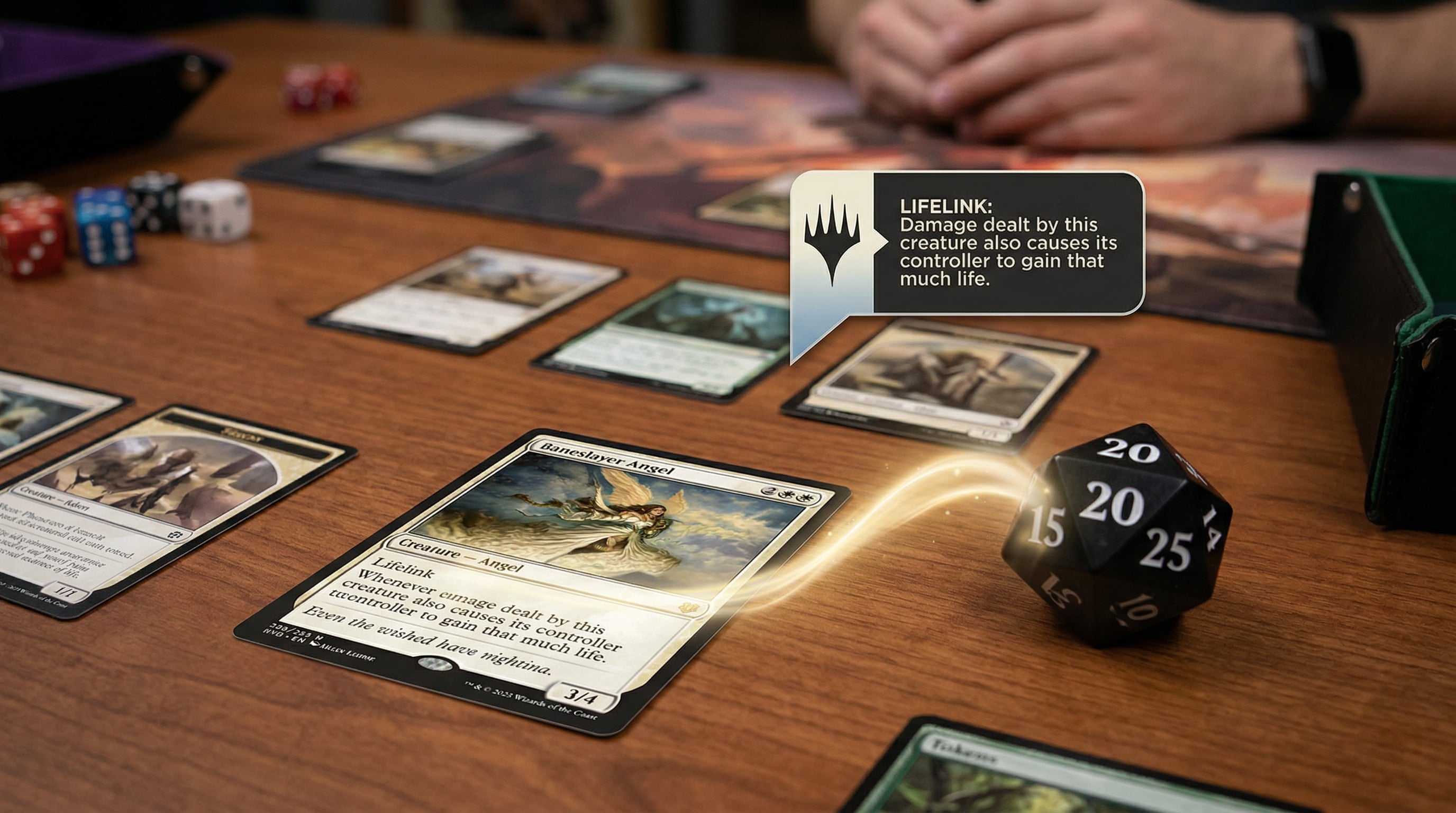
Lifelink MTG: What Does Lifelink Mean in Magic? (2026)
Lifelink in MTG: damage dealt by the source also gains its controller that much life, in combat or out. Full lifelink rules, common myths and the best cards.