
Quick verdict
A creature with defender can't attack. That is the whole rule. It can still block, tap for mana or other abilities, and be used to pay costs. Effects that say a creature 'can attack as though it didn't have defender' switch the restriction off, and Arcades, the Strategist, High Alert and Assault Formation go further by making those creatures deal combat damage equal to their toughness.
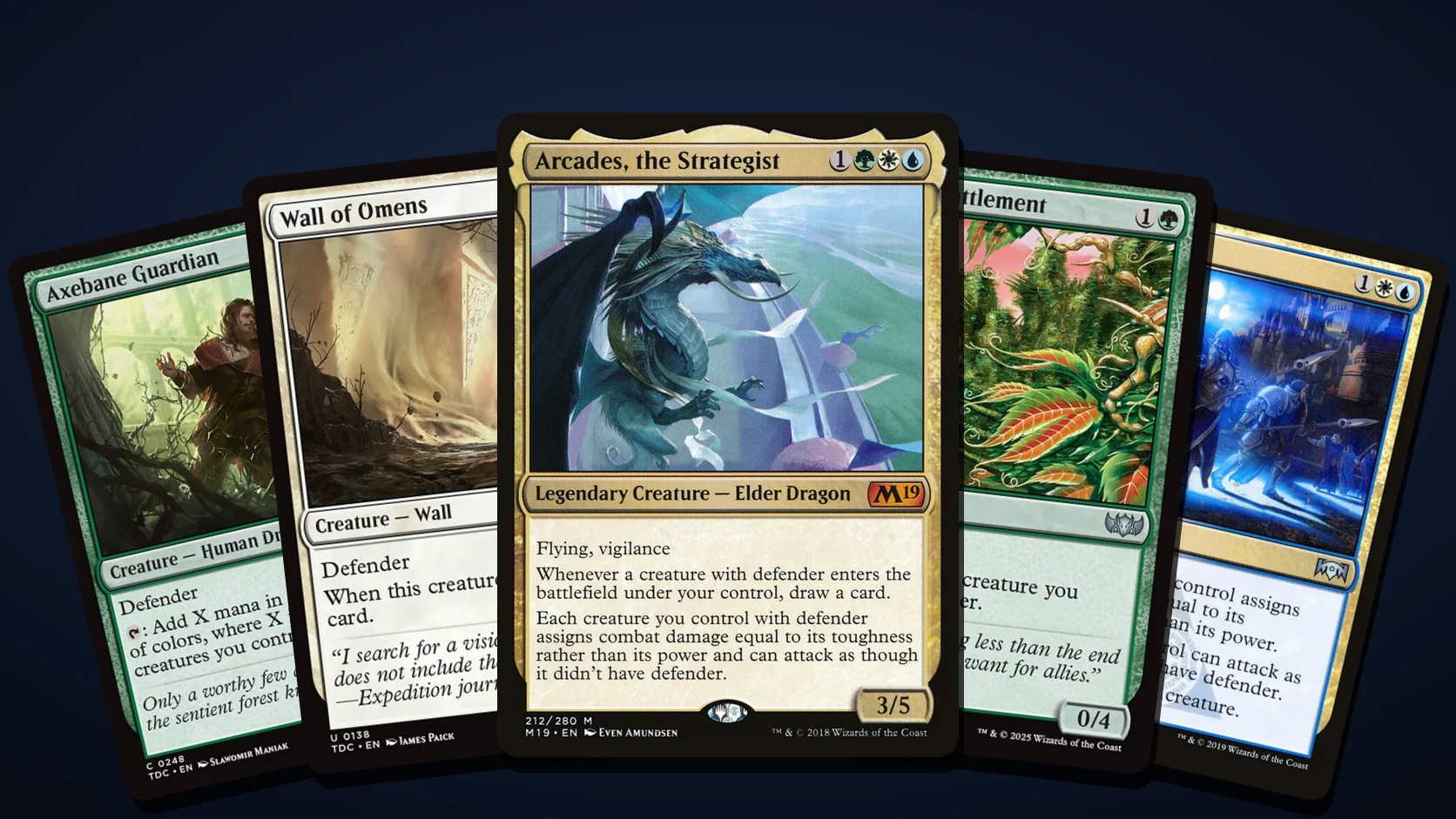
Defender in MTG means a creature can't attack. That is all it does. A creature with defender still blocks, still taps for mana or other abilities, and can still be sacrificed, targeted or copied like any other creature. You'll find it on cheap creatures with big toughness, such as Wall of Omens (0/4 for two mana), whose job is to block and buy time.
There are more than 300 cards with the keyword, and a small group of cards that let defenders attack anyway, usually dealing damage equal to their toughness. That group is what turns a pile of Walls into a Commander deck.
What Defender Does: The Rules
Rule 702.3 of the Comprehensive Rules is three lines long:
- Defender is a static ability.
- A creature with defender can't attack.
- Multiple instances of defender on the same creature are redundant.
The reminder text on cards such as Wall of Stone says the same thing: Defender (This creature can't attack.)
Everything else follows from what defender doesn't say:
- It can block. Defender doesn't touch blocking at all.
- It can tap. Axebane Guardian ({T}: add X mana, where X is the number of creatures you control with defender) and Overgrown Battlement ({T}: add {G} for each creature you control with defender) are mana creatures. Summoning sickness still applies to their {T} abilities on the turn they enter, the same as any creature.
- No tap, no wait. Wall of Roots makes mana by putting a -0/-1 counter on itself, not by tapping, so you can use it the turn it enters, on an opponent's turn, or after it has blocked.
- It has nothing to do with vigilance. Vigilance stops a creature tapping when it attacks; defender stops the attack. Weathered Sentinels has defender, reach, vigilance and trample, and only the last two matter once it is allowed to attack.
How to Attack With Defender
There are two ways round the rule.
"Can attack as though it didn't have defender." This is the usual wording. The creature keeps defender but ignores it. High Alert, Arcades, the Strategist and Felothar the Steadfast do this for all your defenders all the time. Assault Formation does it one creature at a time for {G}, and Wakestone Gargoyle does it for all of them for {1}{W}.
Losing defender. A few creatures switch it off themselves. Grozoth and Tidewater Minion both have "{4}: This creature loses defender until end of turn." Ageless Sentinels loses defender for good the first time it blocks.
Three details catch people out:
- Summoning sickness still applies. Letting a creature attack doesn't give it haste. A Wall you cast this turn can't attack under High Alert. Walking Bulwark's ability gives haste as well, and Crashing Drawbridge taps to give your creatures haste. Our haste guide covers the summoning sickness rule.
- Once it attacks, it stays attacking. If Arcades leaves the battlefield after a defender has attacked, that creature remains an attacking creature. It just goes back to assigning damage equal to its power.
- Toughness damage isn't power. Arcades, Doran, High Alert, Assault Formation and Felothar only change how much combat damage a creature assigns. Fight effects, Rabid Bite and anything else that checks power use the real number, so a 0/8 Wall still fights for 0.
Walls and Defender: A Short History
Defender didn't exist as a keyword until Champions of Kamigawa in October 2004. Before that, "can't attack" was an unwritten rule built into the Wall creature type. Old cards such as Rolling Stones and Animate Wall existed only to let Walls attack.
With Champions of Kamigawa, the rules removed that restriction from the Wall type and created defender as a keyword. Older Walls received Oracle errata to have defender, and Wall became a creature type with no rules meaning. The same set also turned Legend from a creature type into the legendary supertype.
The change split the two ideas apart. Most Walls have defender, but not every defender is a Wall: Axebane Guardian is a Human Druid and Sylvan Caryatid is a Plant. And a Wall doesn't automatically have defender. Mistform Wall only has it "as long as it's a Wall", and a changeling is every creature type, Wall included, without ever gaining defender.
Best Defender Payoffs
Arcades, the Strategist
- What it does for defenders
- Draw a card when one enters; they attack and deal damage equal to toughness
1GWU
Cost
Felothar the Steadfast
- What it does for defenders
- All your creatures attack through defender and deal toughness damage
1WBG
Cost
High Alert
- What it does for defenders
- Same as Felothar, as an enchantment, plus an untap ability
1WU
Cost
Assault Formation
- What it does for defenders
- Toughness damage; G: one defender can attack this turn
1G
Cost
Doran, the Siege Tower
- What it does for defenders
- Every creature deals toughness damage, but defenders still can't attack
WBG
Cost
Axebane Guardian
- What it does for defenders
- Taps for one mana per defender you control
2G
Cost
Overgrown Battlement
- What it does for defenders
- Taps for G per defender you control
1G
Cost
Stalwart Shield-Bearers
- What it does for defenders
- Other defenders get +0/+2
1W
Cost
Wall of Roots
- What it does for defenders
- Mana without tapping, once each turn
1G
Cost
Arcades, the Strategist is the best of them: a 3/5 flying, vigilant Elder Dragon that turns every Wall into a cantrip and an attacker. Its Core Set 2019 printing sold for $3.54 on Scryfall on 19 November 2026.
Doran, the Siege Tower is the original toughness card, $7.01 for its Double Masters 2022 printing on the same date. Read it carefully: it affects every creature on the battlefield, yours and your opponents', and it does nothing to let defenders attack. It's a combat-damage card, not a defender card.
Assault Formation and High Alert are the cheap backups that let a defender deck keep working when Arcades is removed.
Arcades, the Strategist in Commander
Arcades is the defender commander. On 19 November 2026 EDHREC lists about 23,500 Arcades decks and ranks it 44th among commanders. These are the cards its decks run most, leaving out lands, Sol Ring and Arcane Signet:
| Card | Share of Arcades decks |
|---|---|
| Overgrown Battlement | 94% |
| Wall of Denial | 92% |
| Axebane Guardian | 91% |
| Tetsuko Umezawa, Fugitive | 83% |
| Wall of Blossoms | 82% |
| Wall of Omens | 82% |
| High Alert | 81% |
| Stalwart Shield-Bearers | 80% |
| The Pride of Hull Clade | 77% |
| Sunscape Familiar | 75% |
| Crashing Drawbridge | 74% |
Tetsuko Umezawa is the trick. Its ability makes creatures with power or toughness 1 or less unblockable, and nearly every Wall has 0 power. Under Arcades, a 0/8 Wall of Denial attacks for 8 and can't be blocked.
The deck's weakness is the same as any one-commander engine: lose Arcades and the Walls go back to blocking. That is why High Alert, Assault Formation and Wakestone Gargoyle appear as backups.
Felothar the Steadfast is the other option, with about 21,900 EDHREC decks. It is the face commander of the Abzan Armor precon from Tarkir: Dragonstorm, which we rank in our best Commander decks list. It trades Arcades's card draw for black, and its own ability sacrifices another creature to draw cards equal to that creature's toughness, then discard cards equal to its power, which for a 0-power Wall is nothing.
Common Misconceptions
"Defender means it can't tap." It can. Defender only stops attacking, so a creature with defender can still tap to crew a Vehicle.
"Walls can't attack because they're Walls." Not since 2004. It's the defender keyword that stops them.
"High Alert lets a Wall attack the turn it comes down." Not without haste.
"Toughness damage means the creature's power changes." It doesn't. Only combat damage changes.
For every other keyword on the battlefield, see our MTG keywords glossary. If you are building Walls as a creature-type deck, the tribal decks hub covers how typal Commander decks are put together.
Citations & Resources
- Wizards of the Coast: Comprehensive Rules, rule 702.3 Defender and the Wall glossary entry
- Scryfall: Every card with defender
- Scryfall: Cards that let defenders attack
- EDHREC: Arcades, the Strategist
- EDHREC: Felothar the Steadfast
Related Guides
- The Ultimate MTG Keywords Glossary — every keyword in one place
- What Haste Means in MTG — the other half of attacking with a fresh Wall
- MTG Vigilance Guide — the keyword most often confused with defender
- Hexproof vs Shroud — why Wall of Denial is so hard to remove
- MTG Changeling Explained — a Wall without defender
- What Is EDH? — the format Arcades decks live in