
Quick verdict
Flicker and blink are community slang for the same thing: exiling a permanent and returning it to the battlefield. Neither word is a rules term or keyword; the Comprehensive Rules just say 'exile, then return'. Some players use one word for an immediate return and the other for a return at the end step, but there is no agreed split, and both namesake cards, Flicker and Momentary Blink, return the permanent immediately. Either way, the permanent comes back as a new object (CR 400.7): its enters abilities trigger again, and counters, Auras, damage and targets are gone.
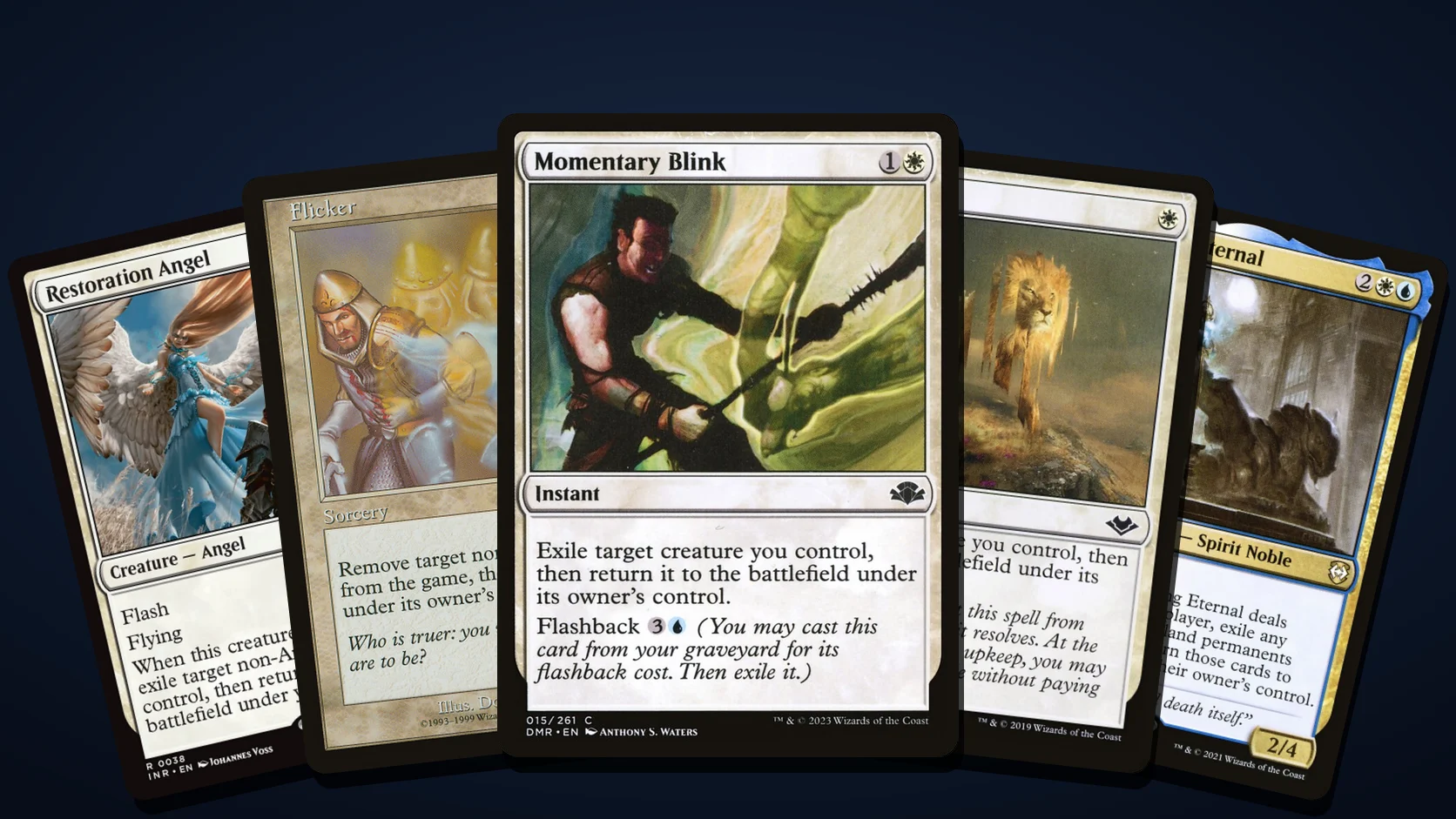
Flicker and blink mean the same thing in MTG: exile a permanent, then return it to the battlefield. Neither word is a keyword or a rules term. The Comprehensive Rules never use either one; the cards just say "exile target creature you control, then return it to the battlefield." The words come from two cards, Flicker (Urza's Destiny, 1999) and Momentary Blink (Time Spiral, 2006), and most players use them interchangeably.
You will sometimes see players draw a line: one word for a permanent that comes back immediately, the other for one that comes back at the next end step. There is no agreement on which word is which, and both namesake cards return the permanent immediately, so the card names don't settle it. When the timing matters, say "returns immediately" or "returns at end step." Wizards prints it both ways, and the rules below cover both.
What Flicker Does: The Rules
Both cards return the permanent in the same breath:
- Flicker ({1}{W}, sorcery): "Exile target nontoken permanent, then return it to the battlefield under its owner's control."
- Momentary Blink ({1}{W}, instant): "Exile target creature you control, then return it to the battlefield under its owner's control." It also has flashback {3}{U}.
The rule that makes flicker work is CR 400.7: "An object that moves from one zone to another becomes a new object with no memory of, or relation to, its previous existence." The creature that comes back is, for the game, a different creature. That one rule explains almost everything below.
Flicker vs Blink: Immediate vs Delayed Return
| Immediate return (Momentary Blink, Ephemerate, Cloudshift) | Delayed return (Flickerwisp, Eerie Interlude, Yorion) | |
|---|---|---|
| When it comes back | As the spell or ability resolves | At the beginning of the next end step |
| New object (CR 400.7) | Yes | Yes |
| Enters abilities trigger again | Yes | Yes, at the end step |
| Counters, damage, Auras | Gone; Auras go to the graveyard, Equipment stays unattached | Same |
| Summoning sickness (CR 302.6) | Can't attack or tap this turn without haste | Same, but it's usually already the end step |
| Tokens (CR 111.7, 111.8) | Cease to exist, never return | Same |
| Whose control | Card says: owner's or yours | Usually owner's |
| Transformed double-faced card | Returns front face up (CR 712.11) | Same |
| Your commander | No chance to go to the command zone | Owner may send it to the command zone instead (CR 903.9a) |
| Gone during the turn | No | Yes, so it misses the rest of the turn |
Some details worth knowing:
- Targets fizzle. If an opponent targets your creature with removal and you flicker it in response, the spell's target is gone and it does nothing. The Flicker rulings spell this out.
- "Dies" triggers don't happen. The card goes to exile, not the graveyard. "Leaves the battlefield" triggers do.
- It leaves combat. A creature that leaves the battlefield is removed from combat (CR 506.4), so flickering a blocker after blocks means the attacker stays blocked and deals no damage to it.
- Double-faced cards reset. A flipped Delver of Secrets comes back as Delver, not Insectile Aberration (CR 712.11, and the Eerie Interlude rulings).
Why Flicker Matters
Enters value. Every flicker re-triggers "when this enters" abilities. Flickering Mulldrifter draws two more cards, flickering Thraben Inspector makes another Clue. The best trick is with evoke: flicker an evoked creature with its sacrifice trigger on the stack and it returns as a new object that isn't sacrificed. Ephemerate has rebound, so it does it twice.
Saving a creature. An instant-speed flicker beats targeted removal. It doesn't beat a board wipe, which kills the returned creature too.
Resetting control. If an opponent steals your creature with Control Magic, Flicker (which can target any nontoken permanent) or Flickerwisp returns it "under its owner's control," back to you, and the Aura falls off. The wording runs both ways: Cloudshift, Restoration Angel and Conjurer's Closet return the card "under your control," and the rulings confirm you keep it indefinitely. Borrow a creature with Act of Treason, flicker it with Cloudshift, and it's yours.
Beating "until" effects. Flicker your own Brutal Cathar and the creature it exiled comes back to its owner (CR 610.3), while the new Cathar exiles a fresh target. That only works during the day: Brutal Cathar has daybound, so at night it returns as Moonrage Brute and exiles nothing. Flicker an unearthed creature and it stays, because the new object isn't tied to unearth's end-step exile.
Flicker vs Phasing
Phasing looks similar but works the opposite way. A phased-out permanent doesn't change zones (CR 702.26d): no enters or leaves triggers, and counters, Auras and tokens all stay. Phasing protects what's on the permanent; flicker wipes it clean.
Best Flicker and Blink Cards
Deck counts are from EDHREC's Blink theme on 19 November 2026 (38,470 decks), as a share of the Blink decks that can play the card's colours.
| Card | Cost | What it flickers | Return | In Blink decks |
|---|---|---|---|---|
| Ephemerate | {W} instant, rebound | Creature you control | Immediately, then again next upkeep | 64% |
| Soulherder | {1}{W}{U} creature | Another creature you control, each end step | Immediately | 54% |
| Cloudshift | {W} instant | Creature you control | Immediately, under your control | 49% |
| Ghostly Flicker | {2}{U} instant | Two artifacts, creatures and/or lands you control | Immediately | 48% |
| Teleportation Circle | {3}{W} enchantment | Artifact or creature you control, each end step | Immediately | 41% |
| Displacer Kitten | {3}{U} creature | Nonland permanent you control, each noncreature spell | Immediately | 38% |
| Eerie Interlude | {2}{W} instant | Any number of your creatures | Next end step | 37% |
| Conjurer's Closet | {5} artifact | Creature you control, each end step | Immediately, under your control | 35% |
| Restoration Angel | {3}{W} flash creature | Non-Angel creature you control | Immediately, under your control | 32% |
Panharmonicon (38%) isn't a flicker card, but it doubles every artifact and creature enters trigger, so it's the most common payoff. Felidar Guardian and Charming Prince are cheap creatures that flicker another of your permanents when they enter, and Yorion, Sky Nomad flickers any number of your nonland permanents at the next end step. Flickerwisp and Thassa, Deep-Dwelling round out the list.
Best Blink Commanders
The top commanders on EDHREC's Blink theme on 19 November 2026:
- Brago, King Eternal (1,785 decks), {2}{W}{U}: when it deals combat damage to a player, flicker any number of your nonland permanents. Mana rocks untap, creatures re-trigger, and Brago can flicker itself.
- Niko, Light of Hope (1,287 decks), {2}{W}{U}: {2}, {T} exiles a nonlegendary creature you control until the next end step, and its Shard tokens copy it meanwhile.
- Atraxa, Grand Unifier (1,040 decks): not a flicker card, but a seven-mana enters trigger worth repeating.
- Pantlaza, Sun-Favored (812 decks): Dinosaurs entering trigger discover, once each turn.
- Aminatou, the Fateshifter (748 decks), {W}{U}{B} planeswalker: its −1 flickers another permanent you own.
- Abdel Adrian, Gorion's Ward (714 decks): exiles your permanents for Soldier tokens; flicker Abdel and they come back to re-trigger.
Roon of the Hidden Realm (436 decks) is the Bant option that can also flicker an opponent's creature until the end step.
The Bottom Line
Flicker and blink are the same move: exile a permanent and bring it back as a new object. Pay attention to the card's wording instead of the slang: when it returns, and under whose control.
Sources
- Comprehensive Rules, effective 6 Nov 2026: 111.7, 111.8, 122.2, 302.6, 400.7, 506.4, 610.3, 702.26d, 704.3, 712.11, 903.9a
- EDHREC: Blink theme, checked 19 Nov 2026
- Oracle text, first printings and rulings for every card named above from Scryfall, checked 19 Nov 2026
Related Guides
- MTG evoke explained: the classic flicker target
- MTG rebound explained: why Ephemerate flickers twice
- MTG phasing explained: the opposite of a flicker
- MTG unearth explained: flicker makes an unearthed creature stay
- MTG tokens explained: why a flickered token is gone for good
- The MTG keywords glossary: every keyword in one place