
Quick verdict
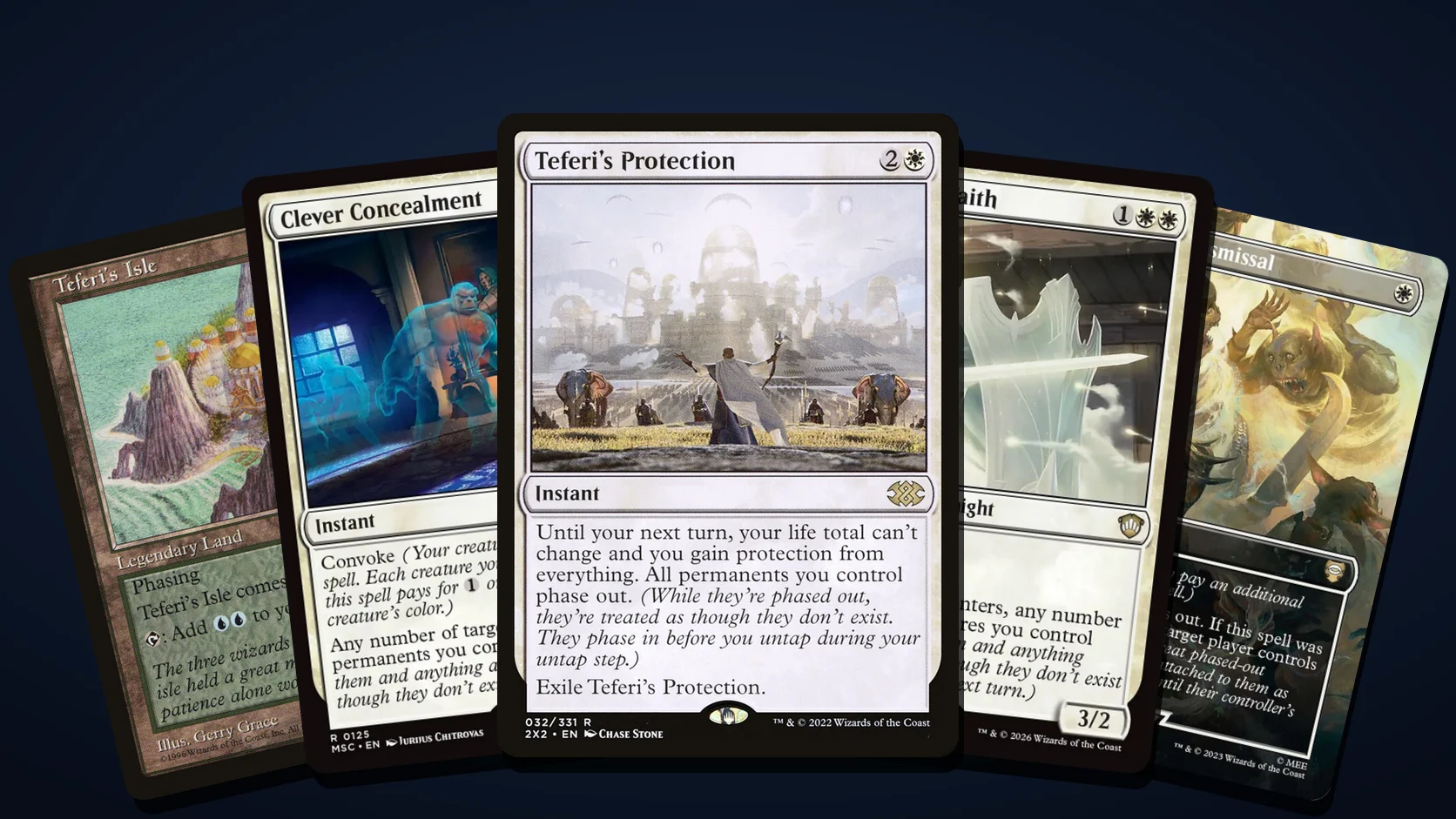
A permanent that phases out is treated as though it doesn't exist until it phases back in, which normally happens during its controller's next untap step, just before they untap. It never leaves the battlefield, so nothing triggers on the way out or back, tokens survive, counters stay, and Auras and Equipment phase out with it. That makes phasing the cleanest protection in Commander: Teferi's Protection, Clever Concealment and Galadriel's Dismissal dodge board wipes with no card disadvantage.
Phasing in MTG means a permanent is treated as though it doesn't exist. When a permanent phases out, it can't be targeted, can't attack or block, isn't hit by board wipes, and its abilities stop working. It never actually leaves the battlefield, and it phases back in during its controller's next untap step, right before they untap.
That one rule is why phasing has become a Commander staple. Teferi's Protection, Clever Concealment and Galadriel's Dismissal let you sit out a board wipe or a lethal attack and come back on your own turn with everything intact: tokens, counters, Auras and Equipment included.
What Phase Out Means in MTG
The Comprehensive Rules define the status in rule 702.26b:
If a permanent phases out, its status changes to "phased out." Except for rules and effects that specifically mention phased-out permanents, a phased-out permanent is treated as though it does not exist. It can't affect or be affected by anything else in the game.
The rules give two examples. If you control three creatures and one is phased out, a spell that draws a card for each creature you control draws you two. If you cast "Destroy all creatures," the phased-out creature is not destroyed.
Phased in and phased out is a status, like tapped and untapped or face up and face down (rule 110.5). Older versions of the rules treated "phased out" as a zone. Today it is only a status, so phasing never counts as a permanent changing zones.
The modern reminder text puts it simply:
Treat it and anything attached to it as though they don't exist until its controller's next turn.
Older printings say "it phases in before you untap during your next untap step." Both describe the same thing.
Phasing Rules in MTG
When it phases in. At the start of each untap step, before anything untaps, every phased-out permanent that the active player controlled when it phased out phases in (rule 502.1). Creatures that phase in can attack that turn and pay {T} costs, because they never left the battlefield.
No triggers. Phasing doesn't change a permanent's zone or controller. "Leaves the battlefield" abilities don't trigger when it phases out, and "enters" abilities don't trigger when it phases in (rule 702.26d).
Tokens survive. Tokens continue to exist on the battlefield while phased out and come back like any other permanent.
Counters stay. A creature that phases out with three +1/+1 counters phases in with three +1/+1 counters.
Attached permanents go with it. Auras, Equipment and Fortifications attached to a permanent that phases out phase out at the same time. This is called phasing out indirectly. They don't phase in on their own; they phase in with the permanent they're attached to, still attached (rule 702.26g).
Phasing removes a creature from combat. An attacking or blocking creature that phases out stops being an attacker or blocker (rule 506.4). Phasing out a blocker doesn't make the attacker unblocked; it is still blocked and deals no damage unless it has trample (rule 509.1h).
It fizzles spells aimed at it. A spell or ability targeting a permanent that phases out has an illegal target. If that was its only target, it doesn't resolve.
Choices are remembered. Anything chosen for a permanent as it entered, such as a creature type or a colour, is still chosen when it phases in.
"Until" effects work differently. Some cards phase a permanent out until a specific event, as Oubliette does. That permanent doesn't phase in during the untap step; it phases in when the event happens (rule 610.4).
Skipping your untap step delays it. If an effect makes a player skip their untap step, phasing simply doesn't happen that turn (rule 702.26m).
It's not on the stack. Phasing during the untap step is a turn-based action that doesn't use the stack (rule 502.1), and no player receives priority during the untap step (rule 502.4), so there is no window to respond to permanents phasing back in.
+1/+1 and other counters
- While phased out
- Stay on it
- When it phases in
- Still there
Auras and Equipment
- While phased out
- Phase out with it (indirectly)
- When it phases in
- Phase in still attached
Token status
- While phased out
- Token still exists
- When it phases in
- Phases in normally
Enters / leaves abilities
- While phased out
- Don't trigger
- When it phases in
- Don't trigger
Combat status
- While phased out
- Removed from combat
- When it phases in
- Not attacking or blocking
Pump from a resolved spell
- While phased out
- Not affected by new effects
- When it phases in
- Effects that ended while it was out are gone
Choices made as it entered
- While phased out
- Kept
- When it phases in
- Remembered
Edge Cases and Rulings
Banishing Light stays put. If your Banishing Light phases out, the exiled card does not come back. One-shot effects waiting "until this leaves the battlefield" don't happen when a permanent phases out, because it hasn't left.
"For as long as" effects end. Continuous effects with a "for as long as" duration ignore phased-out objects (rule 702.26f). Mind Flayer gains control of a creature "for as long as you control this creature." If Mind Flayer phases out, you no longer control it as far as the game can see, so the control effect ends and the stolen creature goes back for good.
New effects skip phased-out permanents. If a spell or ability gives "creatures you control get +2/+2 until end of turn" while one of your creatures is phased out, that creature isn't included when it phases in (rule 702.26e).
Stolen permanents. If you gain control of an opponent's creature and it phases out, it phases in during your untap step, because you controlled it when it phased out. If the control effect ends before then, it phases in under its owner's control as your next untap step begins.
Directly phased Auras. An Aura or Equipment that phases out on its own, not along with what it's attached to, phases back in attached to the same object if that object is still in the same zone. If not, it phases in unattached, and an unattached Aura is put into the graveyard as a state-based action.
Your commander. A commander that phases out stays on the battlefield, so there is no trip to the command zone and no extra commander tax.
Multiplayer. If a player leaves the game, phased-out permanents they own leave with them (rule 702.26k). Permanents that phased out under the control of a player who left phase in during the next untap step after that player's next turn would have begun (rule 702.26n).
Phasing vs Phase Out: The Keyword and the Effect
There are two ways the word shows up on cards.
The phasing keyword is a static ability. A permanent with phasing phases out during each of its controller's untap steps and phases back in during the next one, so it is around every other turn. Teferi's Isle taps for {U}{U} but only exists half the time. This is the original 1996 version and is almost never printed today.
"Phases out" as an effect is what modern cards use. Teferi's Protection, Clever Concealment and Teferi, Master of Time don't have the phasing keyword; they make a permanent phase out once, and it phases back in on its controller's next untap step.
Both use the same rules for what being phased out means.
Where Phasing Came From
Phasing debuted in Mirage, released in October 1996, on cards such as Teferi's Isle, Teferi's Imp, Taniwha, Merfolk Raiders and Sandbar Crocodile. Teferi's name has stayed on the mechanic ever since. Visions and Weatherlight added Teferi's Realm, Rainbow Efreet, Ertai's Familiar and Teferi's Veil.
The rules have been modernised since. Phased out used to be a zone, and tokens that phased out never came back. When Teferi's Protection arrived in Commander 2017 (August 2017), its rulings noted that a phased-out token "will phase in as your next untap step begins. This is a change from previous rules." From then on, phasing became a protection tool rather than an oddity.
Core Set 2021 added Teferi, Master of Time, Adventures in the Forgotten Realms added Guardian of Faith, Blink Dog and Divine Smite, and phasing has turned up in Commander products regularly since.
Best Phasing Cards
Prices are the cheapest non-foil printing on TCGplayer via Scryfall on 19 November 2026, leaving out promos and the just-released Stardates printing of Talon Gates of Madara.
Teferi's Protection
- What it phases out
- All your permanents, plus protection from everything
- Price (19 Nov 2026)
- $37.99
2W instant
Cost
Clever Concealment
- What it phases out
- Any number of your nonland permanents
- Price (19 Nov 2026)
- $3.97
2WW instant, convoke
Cost
Galadriel's Dismissal
- What it phases out
- One creature, or kicked, every creature a player controls
- Price (19 Nov 2026)
- $26.67
W instant, kicker 2W
Cost
Guardian of Faith
- What it phases out
- Any number of your other creatures
- Price (19 Nov 2026)
- $0.65
1WW creature, flash
Cost
Teferi, Master of Time
- What it phases out
- A creature you don't control, at instant speed
- Price (19 Nov 2026)
- $8.63
2UU planeswalker
Cost
Slip Out the Back
- What it phases out
- One creature, with a +1/+1 counter
- Price (19 Nov 2026)
- $2.74
U instant
Cost
March of Swirling Mist
- What it phases out
- Up to X creatures
- Price (19 Nov 2026)
- $4.46
XU instant
Cost
Ripples of Potential
- What it phases out
- Your permanents that got a counter from proliferate
- Price (19 Nov 2026)
- $5.43
1U instant
Cost
Change of Plans
- What it phases out
- Any of X creatures you make connive
- Price (19 Nov 2026)
- $12.51
X1U instant
Cost
Talon Gates of Madara
- What it phases out
- Up to one creature when it enters
- Price (19 Nov 2026)
- $31.47
Land
Cost
Teferi's Protection ({2}{W}). Until your next turn your life total can't change, you gain protection from everything, and all permanents you control phase out. Then it exiles itself. It is the most-played phasing card in Commander by a distance and turns a lost game into a skipped turn cycle. Perch Protection is the Bloomburrow Commander version: six mana, four 2/2 flying Birds, and the full Teferi effect if you promise an opponent an extra turn as a gift.
Clever Concealment ({2}{W}{W}). Any number of target nonland permanents you control phase out. Convoke means you can tap the creatures you're about to save to pay for it, which often makes it free in a go-wide deck. Lands stay behind, which is usually fine since board wipes rarely hit them.
Galadriel's Dismissal ({W}). One mana to save a creature from removal, or, kicked for {2}{W} more, every creature a target player controls phases out. Target yourself to dodge a wrath, or target an opponent to remove all their blockers before a lethal attack.
Guardian of Faith ({1}{W}{W}). A 3/2 with flash and vigilance that phases out any number of your other creatures when it enters. It saves your board and leaves a body behind that eats the wrath. It is also the cheapest card on this list.
Teferi, Master of Time ({2}{U}{U}). You can activate his loyalty abilities on any player's turn at instant speed, and his −3 phases out a creature you don't control. Used on an attacker during an opponent's turn, it removes that creature until its controller's next turn.
Slip Out the Back ({U}). One blue mana: a +1/+1 counter and a phase out. The cheapest single-creature save in blue.
March of Swirling Mist ({X}{U}). Up to X creatures phase out, and you can exile blue cards from your hand to reduce the cost. Works on both sides: save your creatures or remove blockers.
Ripples of Potential ({1}{U}). Proliferate, then phase out any of your permanents that got a counter. Superfriends and +1/+1 counter decks get a counter on everything and protection in one card. See our proliferate guide for why that first half matters.
Oubliette ({1}{B}{B}). Phasing as removal: target creature phases out until Oubliette leaves the battlefield. The creature never dies or leaves the battlefield, so death and leaves-the-battlefield triggers never happen.
Robe of Stars and Haystack give you a repeatable phase out on a creature, and Talon Gates of Madara puts a phase-out on a land you can drop from your hand at instant speed for {4}.
Phasing in Commander
Phasing does three jobs in Commander.
Board wipe insurance. This is the main one. A wrath that destroys or exiles creatures simply doesn't see your phased-out board. Unlike Flawless Maneuver or Heroic Intervention, which give indestructible (and hexproof, for Heroic Intervention) until end of turn, phasing also beats exile effects, -X/-X effects and "sacrifice" effects, because there is nothing there to exile, shrink or sacrifice.
Spot protection. Slip Out the Back, Galadriel's Dismissal and Clever Concealment answer targeted removal the same way hexproof would, by making the spell lose its target. The difference is that your creature also can't attack or block until your next turn.
Temporary removal. Phasing out an opponent's creature or whole board is a tempo play. Their creatures come back on their next untap step, so use it when it wins the game: remove blockers for a lethal swing, or take an attacker out of combat.
The cost. Phased-out creatures can't block during the opponents' turns, and phased-out mana rocks can't produce mana. Teferi's Protection phases out your lands too. You are trading a turn cycle of defence and mana for keeping your board.
Phasing vs Protection, Hexproof and Indestructible
Phased out
- Stops targeted removal
- Yes
- Stops board wipes
- Yes
- Stops exile
- Yes
- Can still attack or block
- No
Hexproof
- Stops targeted removal
- From opponents
- Stops board wipes
- No
- Stops exile
- Only targeted
- Can still attack or block
- Yes
Protection from a colour
- Stops targeted removal
- That colour
- Stops board wipes
- No
- Stops exile
- Only targeted
- Can still attack or block
- Yes
Indestructible
- Stops targeted removal
- Destroy only
- Stops board wipes
- Destroy only
- Stops exile
- No
- Can still attack or block
- Yes
Protection and hexproof make a permanent harder to touch. Indestructible stops destruction. Phasing is the only one that removes the permanent from the game's view entirely, which is why it is the strongest defence and also the one that costs you the most tempo.
Common Misconceptions
"Phasing out is the same as blinking." Blinking exiles a permanent and returns it, so it re-enters as a new object and triggers enter abilities. Phasing does none of that.
"A phased-out token dies." Not since 2017. It phases back in like anything else.
"My phased-out creatures come back at end of turn." They come back during their controller's next untap step, not at the end of the current turn.
"Teferi's Protection phases me out." Players never phase out. You get protection from everything and a fixed life total, but you are still in the game and can still be made to discard by effects that don't target you.
"Phasing is the same as the phases of the turn." Unrelated. For beginning, main, combat and ending phases, see MTG turn phases.
Citations & Resources
- Wizards of the Coast: Comprehensive Rules, 702.26 Phasing, 502.1 and 610.4
- Scryfall: Teferi's Protection and its phasing rulings
- Scryfall: Every card that phases, by EDHREC popularity
- Scryfall: Oubliette and "until" phasing
Related Guides
- The Ultimate MTG Keywords Glossary — every keyword, with a printable cheat sheet
- MTG Protection Explained — the DEBT rule and how protection differs from phasing
- Hexproof vs Shroud — the targeted-only defences
- MTG Indestructible — what it stops and what still kills it
- MTG Stack Explained — when you can respond to a phasing spell
- MTG State-Based Actions — what happens to an Aura that phases in unattached