
Quick verdict
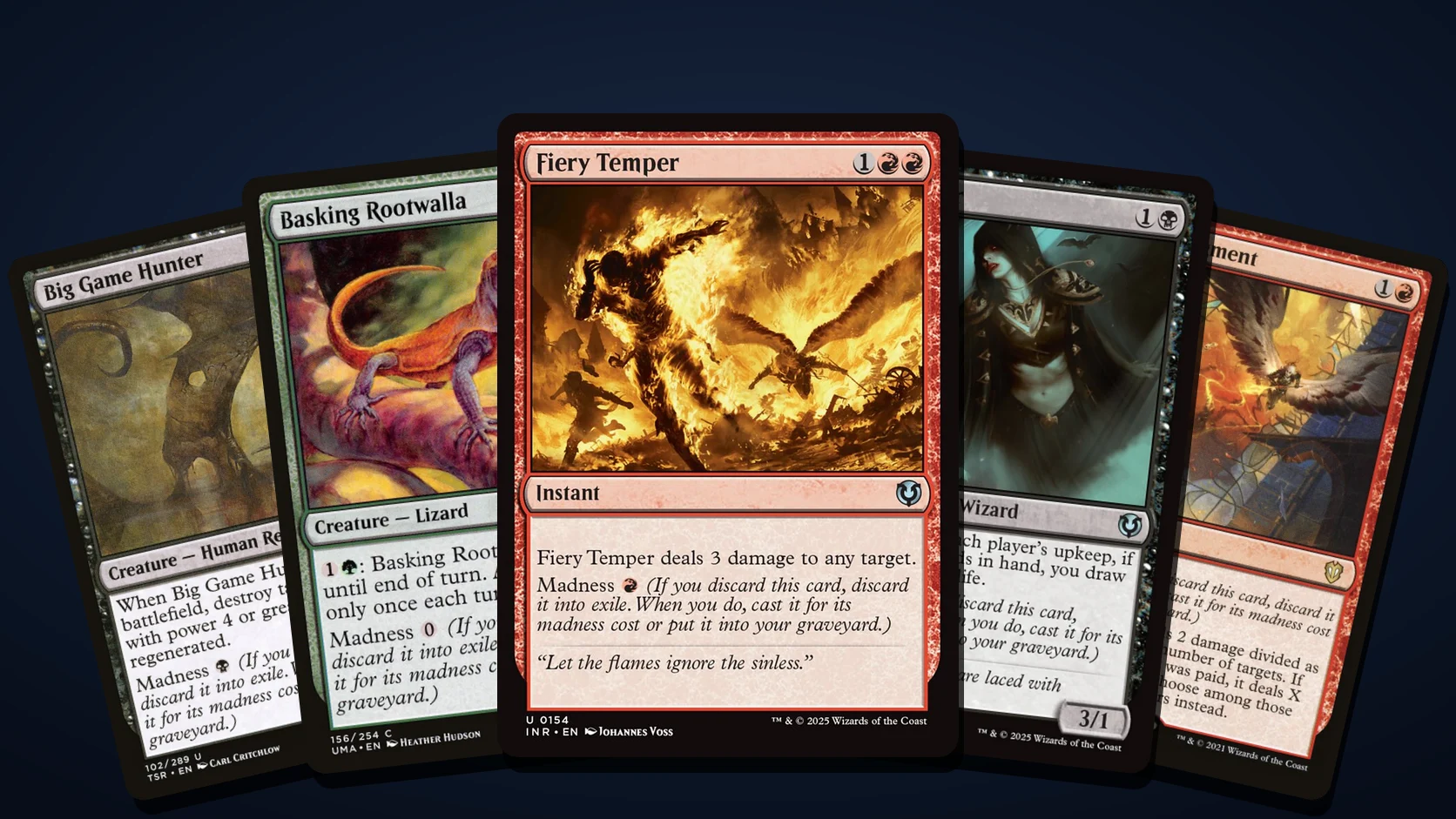
Madness turns a discard into a cast. When you discard a card with madness, it goes to exile instead of the graveyard, and a trigger lets you cast it for its madness cost or put it into the graveyard. You cast it while that trigger resolves, so even sorceries and creatures can be cast on your opponent's turn. The madness cost is an alternative cost, the mana value doesn't change, and it works however the card was discarded: a spell, an ability, a cost like Wild Mongrel's, or the cleanup step.
Madness in MTG is a keyword that lets you cast a card when you discard it. A discarded madness card goes to exile instead of your graveyard, and a trigger lets you cast it right away for its madness cost, usually much cheaper than its mana cost. If you don't cast it, it goes to the graveyard. Because you cast it while that trigger resolves, even a sorcery or a creature can be cast on your opponent's turn.
Madness was introduced in Torment in February 2002. It turns discarding, normally a cost, into card advantage: Fiery Temper is a three-mana burn spell, but discard it to Wild Mongrel and it's 3 damage for a single red mana.
How Madness Works
The reminder text on Fiery Temper sums it up:
Madness {R} (If you discard this card, discard it into exile. When you do, cast it for its madness cost or put it into your graveyard.)
The Comprehensive Rules (702.35a) define madness as two abilities. "Madness [cost]" means:
- "If a player would discard this card, that player discards it, but exiles it instead of putting it into their graveyard."
- "When this card is exiled this way, its owner may cast it by paying [cost] rather than paying its mana cost. If that player doesn't, they put this card into their graveyard."
In play, it goes like this:
- Something makes you discard the madness card.
- It's discarded into exile, and the madness ability triggers.
- The trigger goes on the stack. Players can respond to it.
- When it resolves, you either cast the card for its madness cost or put it into your graveyard.
The spell you cast is a normal spell. It can be countered or copied, and when it resolves a permanent goes onto the battlefield and an instant or sorcery goes to your graveyard.
Madness Rules and Rulings
Timing doesn't apply. You cast the card while the trigger is resolving (608.2g), and the madness rulings confirm this ignores the timing rules for its card type. A sorcery with madness discarded during your opponent's turn can still be cast, and so can a creature. This is the part of madness that surprises people most.
It's an alternative cost. The madness cost is paid instead of the mana cost (702.35b), so you can't combine it with another alternative cost, though additional costs such as kicker can still be added. To work out the total, start with the madness cost, add increases, then apply reductions.
Mana value doesn't change. Fiery Temper is still mana value 3 when you pay {R} for it. If the madness cost has X, as on Avacyn's Judgment (madness {X}{R}), you choose X as you cast it.
Any discard works. It doesn't matter why you discard the card: a cost, a spell or ability telling you to, or the hand-size discard in your cleanup step. The card still counts as discarded, so a cost paid by discarding it is paid and "whenever you discard" abilities trigger.
You can't discard on a whim. You need an effect that lets or makes you discard. With no outlet, a madness card is just an expensive card in your hand.
Only from your hand. Cards are only discarded from your hand. Milling a madness card, or putting it into the graveyard from anywhere else, does nothing.
Discard as a cost resolves first. If you discard a madness card to pay for a spell or activated ability, the madness trigger and the spell it becomes resolve before the thing you paid for. Discard Fiery Temper to Lightning Axe and you can deal 3 damage before the Axe deals its 5.
Discarding mid-resolution waits. If you discard during a spell's resolution, as with Faithless Looting, the card goes to exile at once. The madness trigger goes on the stack after the spell has finished resolving.
One chance only. If you decline, the card goes to your graveyard and stays there. Unlike flashback, madness offers no second window later.
History: Torment to Modern Horizons
Torment (2002). Madness debuted in the Odyssey block's second set, built around the discard outlets of Odyssey. Fiery Temper, Basking Rootwalla, Arrogant Wurm and Circular Logic are all Torment cards, and Wild Mongrel from Odyssey was the engine that made them work.
Time Spiral block (2006-2007). The nostalgia block revisited it: Fiery Temper came back as a timeshifted card, and new madness cards included Big Game Hunter (Planar Chaos) and Gibbering Descent (Future Sight).
Shadows over Innistrad and Eldritch Moon (2016). Madness returned in blue, black and red, with 26 new madness cards across the two sets. Asylum Visitor and Avacyn's Judgment come from Shadows over Innistrad, and Fiery Temper was reprinted there.
Modern Horizons 2 (2021). Seven new madness cards, including Necrogoyf, Blazing Rootwalla and Terminal Agony. The first Modern Horizons had none.
Modern Horizons 3 (2024). Emrakul, the World Anew has madness for six colorless mana, a way to get a 12-mana Eldrazi into play by discarding it.
Commander 2019 built a preconstructed madness deck around Anje Falkenrath, and Innistrad Remastered (2025) reprinted nine, including Fiery Temper and Asylum Visitor.
Best Madness Cards
Fiery Temper
- Madness cost
- R
- First set
- Torment
- Price (19 Nov 2026)
- $0.21 (Shadows over Innistrad)
1RR
Mana cost
Basking Rootwalla
- Madness cost
- 0
- First set
- Torment
- Price (19 Nov 2026)
- $0.23 (Ultimate Masters)
G
Mana cost
Circular Logic
- Madness cost
- U
- First set
- Torment
- Price (19 Nov 2026)
- $0.29 (Dominaria Remastered)
2U
Mana cost
Big Game Hunter
- Madness cost
- B
- First set
- Planar Chaos
- Price (19 Nov 2026)
- $0.34 (Time Spiral Remastered)
1BB
Mana cost
Asylum Visitor
- Madness cost
- 1B
- First set
- Shadows over Innistrad
- Price (19 Nov 2026)
- $0.25 (Shadows over Innistrad)
1B
Mana cost
Avacyn's Judgment
- Madness cost
- XR
- First set
- Shadows over Innistrad
- Price (19 Nov 2026)
- $0.22 (Crimson Vow Commander)
1R
Mana cost
Terminal Agony
- Madness cost
- BR
- First set
- Modern Horizons 2
- Price (19 Nov 2026)
- $0.27 (Modern Horizons 2)
2BR
Mana cost
Emrakul, the World Anew
- Madness cost
- Pay six colorless
- First set
- Modern Horizons 3
- Price (19 Nov 2026)
- $7.48 (Modern Horizons 3)
12
Mana cost
Prices are Scryfall's TCGplayer market price for the cheapest regular non-foil printing of each card (named in brackets) on 19 November 2026.
Fiery Temper. The classic. Three damage to any target for {R}, at instant speed, whenever you discard it.
Basking Rootwalla. Madness {0}: a free 1/1 that pumps to 3/3 once a turn. Blazing Rootwalla from Modern Horizons 2 is its red twin.
Circular Logic. A counterspell for {U} that gets stronger as your graveyard fills, which is exactly what a discard deck does.
Big Game Hunter. One black mana to destroy a creature with power 4 or greater, and you keep a 1/1.
Asylum Visitor. A 3/1 for two that draws you cards when any player starts their upkeep with an empty hand. It's fine cast normally and better when discarded.
Avacyn's Judgment. Two damage divided for two mana, or X damage divided when its madness cost is paid.
Emrakul, the World Anew. When you cast it, you gain control of all creatures target player controls, and that cast trigger works when you cast it with madness.
Discard Outlets: How to Trigger Madness
Madness decks need ways to discard on their own terms. The best ones:
- Wild Mongrel. Discard a card to give it +1/+1 and change its color until end of turn. Free, repeatable and at instant speed, the original madness enabler.
- Faithless Looting. Draw two, discard two for {R}, with flashback to do it again.
- Bazaar of Baghdad. Tap: draw two, discard three. Banned in Legacy, but a Vintage graveyard engine.
- Lightning Axe. Discard a card (or pay {5}) as an additional cost to deal 5 damage to a creature, and the madness card resolves first.
- Anje Falkenrath. The madness commander: tap and discard a card to draw a card, and Anje untaps whenever you discard a card with madness.
- Your cleanup step. End your turn with eight or more cards and the hand-size discard triggers madness too. The phases of a turn guide covers when that happens.
Madness vs Flashback and Evoke
All three are alternative costs, and none changes the card's mana value. Flashback casts an instant or sorcery from your graveyard and then exiles it; madness casts any card type from exile at the moment you discard it. Evoke casts a creature cheaply and sacrifices it; madness gives you the whole card at a discount. Retrace is the reverse deal, discarding a land to recast a spell from your graveyard.
For every other keyword on these cards, see our MTG keywords glossary.
Citations & Resources
- Wizards of the Coast: Comprehensive Rules — 702.35 Madness
- Scryfall: Every card with madness
- Scryfall: Fiery Temper and its madness rulings
- Scryfall: Emrakul, the World Anew
Related Guides
- The Ultimate MTG Keywords Glossary — every keyword, with a printable cheat sheet
- MTG Flashback Explained — the other Odyssey block graveyard mechanic
- MTG Evoke Explained — another alternative cost, on creatures
- MTG Retrace Explained — discard a land to recast a spell
- MTG Stack Explained — how the madness trigger uses the stack
- Magic: The Gathering Phases — the cleanup step where hand-size discards happen