
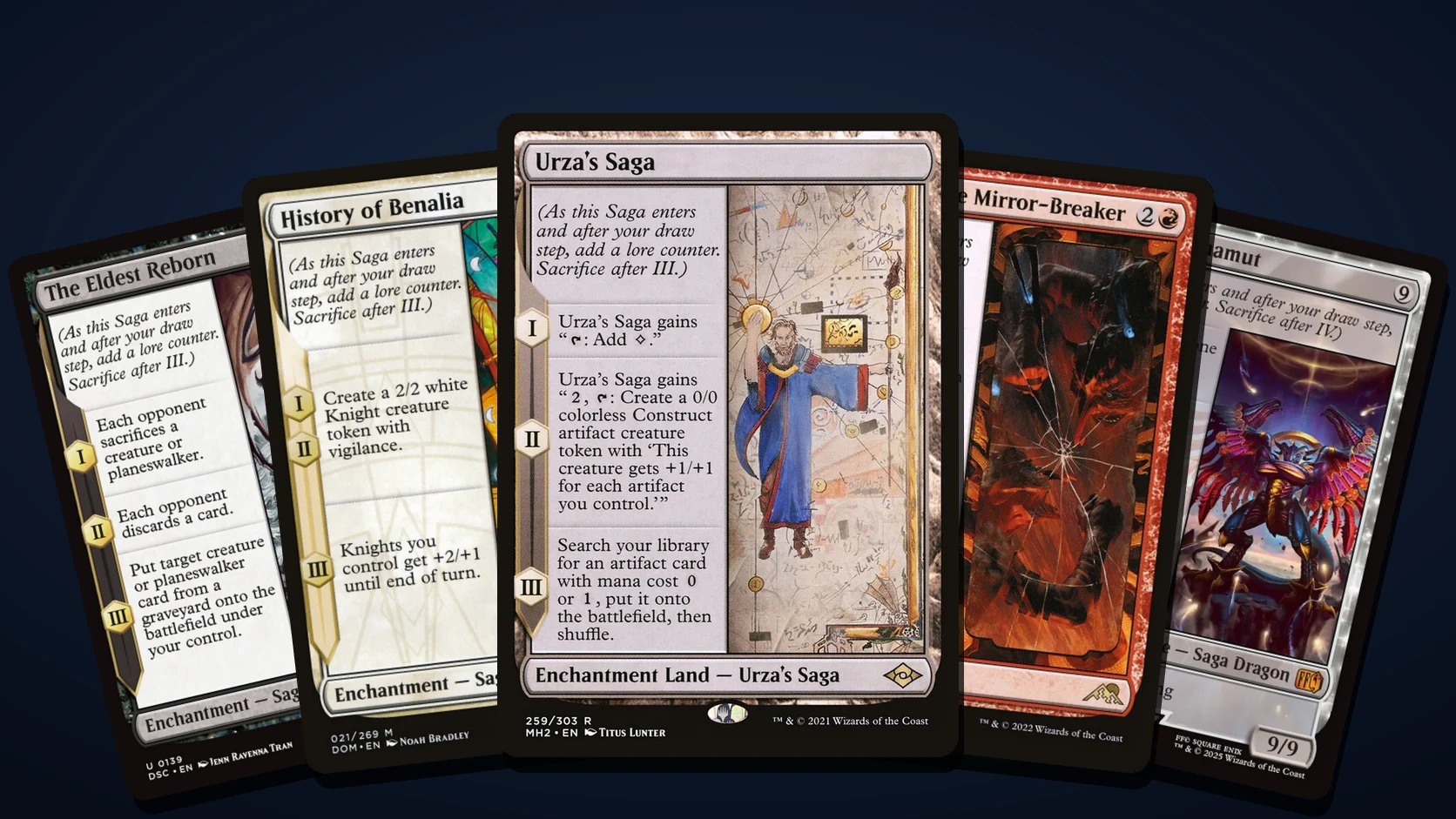
Quick verdict
A Saga is an enchantment that tells a story over several turns. It enters with one lore counter, gets another as your precombat main phase begins (right after your draw step), and each counter triggers the matching chapter ability. Once it has as many lore counters as its last chapter and no chapter ability from it is still on the stack, you sacrifice it. Anything that adds lore counters, such as proliferate, moves it to the next chapter early.
Saga rules in MTG come down to one loop: a Saga is an enchantment that enters with a lore counter, gets another lore counter as your precombat main phase begins (right after your draw step), and each new counter triggers the matching chapter ability. When it has as many lore counters as its last chapter number and that last chapter ability has left the stack, you sacrifice it. A three-chapter Saga gives you three effects over three of your turns, then goes to the graveyard.
Sagas debuted in Dominaria on 27 April 2018. Each one is a short story from the history of the plane it comes from, which is why the art runs down the right side of the card and the chapters are numbered I, II, III.
How Sagas Work in MTG: the Rules
The reminder text on History of Benalia covers the whole mechanic in one line:
(As this Saga enters and after your draw step, add a lore counter. Sacrifice after III.) I, II — Create a 2/2 white Knight creature token with vigilance. III — Knights you control get +2/+1 until end of turn.
The Comprehensive Rules (section 715, "Saga Cards") spell it out:
- Saga is an enchantment subtype. Sagas are cast at sorcery speed like any other enchantment unless something says otherwise.
- Each chapter symbol is a triggered ability. "{rN} — [Effect]" means "When one or more lore counters are put onto this Saga, if the number of lore counters on it was less than N and became at least N, [effect]." A chapter ability uses the stack and can be responded to.
- It enters with a lore counter. Every Saga without read ahead has the intrinsic ability "This Saga enters with a lore counter on it." That counter triggers chapter I as soon as the Saga lands.
- It gets one counter per turn. As your precombat main phase begins, you put a lore counter on each Saga you control that has a chapter ability. This is a turn-based action: it doesn't use the stack and can't be responded to.
- It is sacrificed after its last chapter. If the number of lore counters on a Saga is greater than or equal to its final chapter number, and it isn't the source of a chapter ability that has triggered but not yet left the stack, its controller sacrifices it. This is a state-based action.
Because the counter comes at the start of your main phase rather than your upkeep, the chapter ability resolves after you've drawn for the turn and before combat. That's why History of Benalia's chapter III pump lands in time for your attack.
A Saga turn by turn
Here is History of Benalia cast on turn 3:
Turn 3: you cast it
- Lore counters
- 1
- What happens
- Chapter I triggers: one 2/2 vigilant Knight
Turn 4: precombat main phase
- Lore counters
- 2
- What happens
- Chapter II triggers: a second Knight
Turn 5: precombat main phase
- Lore counters
- 3
- What happens
- Chapter III triggers: your Knights get +2/+1 this turn
Turn 5: after chapter III leaves the stack
- Lore counters
- 3
- What happens
- You sacrifice History of Benalia
Three mana bought two 2/2 creatures and a pump turn. That is the basic value pattern of almost every Saga: a small effect now, more effects later, no extra cards spent.
Chapter rules worth knowing
These come straight from the official Saga rulings that Wizards prints with every Saga set:
- Each chapter triggers once per pass. A chapter doesn't trigger if the Saga already had at least that many lore counters. The third lore counter triggers chapter III, but not I and II again.
- Chapters that trigger together go on the stack in any order you like. If any need targets, you choose them all as the abilities go on the stack, before any resolve.
- A triggered chapter is independent of the Saga. Once a chapter ability is on the stack, it resolves normally even if the Saga loses counters or leaves the battlefield.
- Removing counters lets chapters happen again. Taking lore counters off doesn't trigger anything, but when the Saga gets counters back, the chapters it passes through trigger again.
- You keep the Saga until the last chapter is off the stack. This is why The Akroan War works: you keep the creature you stole with chapter I while chapter III resolves, and only give it back once the Saga is sacrificed.
- The sacrifice is not optional. Indestructible doesn't help, because sacrificing isn't destroying.
Ways to Add Lore Counters Faster
Anything that puts a lore counter on a Saga triggers the next chapter. The counter doesn't have to come from the main-phase turn-based action.
Proliferate. Proliferate gives each chosen permanent one more counter of each kind it already has, so a Saga with lore counters moves forward one chapter. It's the most common way to speed Sagas up. Our proliferate guide covers every card that does it.
Direct lore counter cards. Keldon Warcaller (from Dominaria itself) puts a lore counter on target Saga you control whenever it attacks. Storyweave can put two lore counters on a Saga at instant speed. Satsuki, the Living Lore taps to put a lore counter on each Saga you control, at sorcery speed.
Doubling Season. Doubling Season doubles counters that an effect puts on a permanent. Rule 715.3a makes "enters with a lore counter" a replacement effect, so a Saga entering under Doubling Season gets two lore counters and chapters I and II both trigger. The main-phase counter is a turn-based action, not an effect, so it is not doubled. Our MTG counters guide explains why older answers to this question are out of date.
One limit applies to all of these: adding a lore counter to a Saga that is already at its final chapter triggers nothing. Proliferating a Saga while its chapter III is on the stack doesn't give you chapter III twice.
Read Ahead: Choosing Where the Story Starts
Dominaria United (2022) added read ahead. The reminder text on The Weatherseed Treaty:
Read ahead (Choose a chapter and start with that many lore counters. Add one after your draw step. Skipped chapters don't trigger. Sacrifice after III.)
The rule (702.155) works like this:
- As the Saga enters, you choose a number between one and its final chapter number, and it enters with that many lore counters.
- Chapter abilities can't trigger on the turn it entered unless the Saga has exactly the number of lore counters in that chapter's symbol. So if you choose III, only chapter III triggers. Chapters I and II are skipped for good.
- Neither choosing the number nor placing the counters uses the stack.
The Cruelty of Gix shows why that matters. Early in a game you start at I to strip a creature from your opponent's hand. Late in a game you start at III and reanimate the best creature in any graveyard right away.
Barbara Wright, from the Doctor Who Commander decks, gives every Saga you control read ahead, so you can skip straight to the chapter you need on any of them.
Transforming Sagas and Saga Creatures
Not every Saga simply goes to the graveyard.
Transforming Sagas (Kamigawa: Neon Dynasty, 2022). The Neon Dynasty Sagas are double-faced cards. Their chapter III reads "Exile this Saga, then return it to the battlefield transformed under your control." Fable of the Mirror-Breaker becomes Reflection of Kiki-Jiki, and The Kami War becomes O-Kagachi Made Manifest. The back face is an enchantment creature, not a Saga, so it stays. Because the card exiles itself during chapter III, it's never sacrificed, so "whenever you sacrifice an enchantment" abilities don't trigger.
Sagas on the back face. In March of the Machine (2023), the Praetors Elesh Norn, Jin-Gitaxias, Sheoldred, Urabrask and Vorinclex each transform into a Saga, and Huatli, Poet of Unity does the same in The Lost Caverns of Ixalan.
Saga creatures (Final Fantasy, 2025). The Final Fantasy Summon cards are Enchantment Creature — Saga. Summon: Bahamut is a 9/9 flying Saga Dragon with four chapters; Summon: Knights of Round has five. They follow every Saga rule, so they are sacrificed after their final chapter, and they're also creatures that can attack, block and be killed in between. Abilities printed below the type line, such as Bahamut's flying, aren't chapter abilities and apply whatever the lore count. Summon: Knights of Round has indestructible, which doesn't stop the sacrifice after chapter V.
Edge Cases and Rulings
Sagas that lose their chapter abilities. Since the June 2025 rules change that came with Final Fantasy, a Saga with no chapter abilities isn't sacrificed and no longer gets a lore counter each main phase. The best-known case is Urza's Saga under Blood Moon. Blood Moon makes it a Mountain and strips its chapter abilities. Under the old rules it was sacrificed at once; now it stays on the battlefield as a land that taps for red.
Urza's Saga is a land. It can only be played as your land drop, never cast. It keeps the abilities it gains from chapters I and II for as long as it stays, and chapter III finds only a card with an actual mana cost of {0} or {1}, not mana value 0 or 1. You couldn't find a card that costs {U} or {X}.
Sagas are historic. The Comprehensive Rules define historic as legendary, artifact or Saga. The Hobbit's storied keyword (2026) also counts Sagas, alongside artifacts and legendaries.
Mana value of transforming Sagas. A transforming Saga's mana value is always the mana value of its front face, whichever face is up.
Responding to chapters. A chapter ability on the stack can be countered by abilities like Stifle. Its effect is gone, but the Saga is still sacrificed once its final chapter ability has left the stack. For how triggered abilities and responses resolve, see our guide to the stack.
Best Sagas in MTG
Our picks, ordered by how much Commander plays them; Urza's Saga and Fable of the Mirror-Breaker are Constructed staples too. The EDHREC rank is the figure Scryfall lists for each card on 19 November 2026 (lower means more Commander decks play it).
Urza's Saga
- First printed
- Modern Horizons 2 (2021)
- Chapters
- III
- Why it's good
- A land that becomes a token maker and tutors a 0- or 1-cost artifact
- EDHREC rank
- 116
Summon: Bahamut
- First printed
- Final Fantasy (2025)
- Chapters
- IV
- Why it's good
- Two removal chapters, draw two, then a huge finisher on a 9/9 flyer
- EDHREC rank
- 1,173
Binding the Old Gods
- First printed
- Kaldheim (2021)
- Chapters
- III
- Why it's good
- Destroys an opponent's nonland permanent and ramps a Forest
- EDHREC rank
- 1,396
Fable of the Mirror-Breaker
- First printed
- Kamigawa: Neon Dynasty (2022)
- Chapters
- III (transforms)
- Why it's good
- A Treasure-making Goblin, a loot, then Reflection of Kiki-Jiki
- EDHREC rank
- 1,753
There and Back Again
- First printed
- The Lord of the Rings (2023)
- Chapters
- III
- Why it's good
- Ends with Smaug, a 6/6 flying, hasty Dragon
- EDHREC rank
- 2,048
The Eldest Reborn
- First printed
- Dominaria (2018)
- Chapters
- III
- Why it's good
- Edict, discard, then reanimate the best creature in any graveyard
- EDHREC rank
- 2,062
Elspeth Conquers Death
- First printed
- Theros Beyond Death (2020)
- Chapters
- III
- Why it's good
- Exiles a big threat, taxes spells, returns a creature
- EDHREC rank
- 3,159
The Cruelty of Gix
- First printed
- Dominaria United (2022)
- Chapters
- III (read ahead)
- Why it's good
- Discard, a tutor or a reanimation: you pick
- EDHREC rank
- 4,273
Kiora Bests the Sea God
- First printed
- Theros Beyond Death (2020)
- Chapters
- III
- Why it's good
- An 8/8 hexproof Kraken, then steal their best permanent
- EDHREC rank
- 4,720
Urza's Saga. The most played Saga in the game. As a land it costs you nothing to deploy, makes Construct tokens that grow with your artifacts, and finds a card like Sol Ring or a key 0-cost artifact on chapter III. It's a staple of Modern and Legacy artifact decks and, per Scryfall's legality data, restricted in Vintage.
Fable of the Mirror-Breaker. A Goblin that makes Treasure, a two-card loot, and then Reflection of Kiki-Jiki, which copies your creatures. It was one of the defining cards of Standard during its time there and remains a Pioneer and Modern card.
History of Benalia. The first great Saga. Two 2/2 vigilant Knights for three mana was a premium rate in 2018 Standard, and the chapter III pump makes it an aggressive finisher.
The Eldest Reborn. Five mana for an edict, a discard and the best creature or planeswalker in any graveyard. In Commander every opponent sacrifices and discards.
Summon: Bahamut. Nine mana is a lot, but it destroys two nonland permanents, draws two, and then deals damage equal to the total mana value of your other permanents to each opponent.
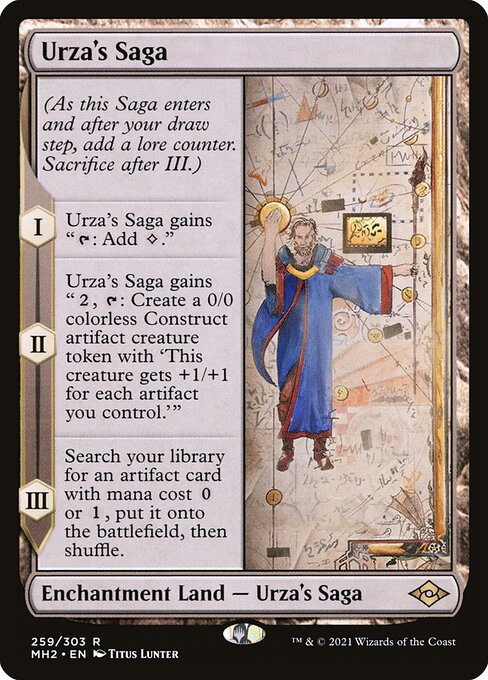 Urza's Saga$39.30 on 19 Nov 2026
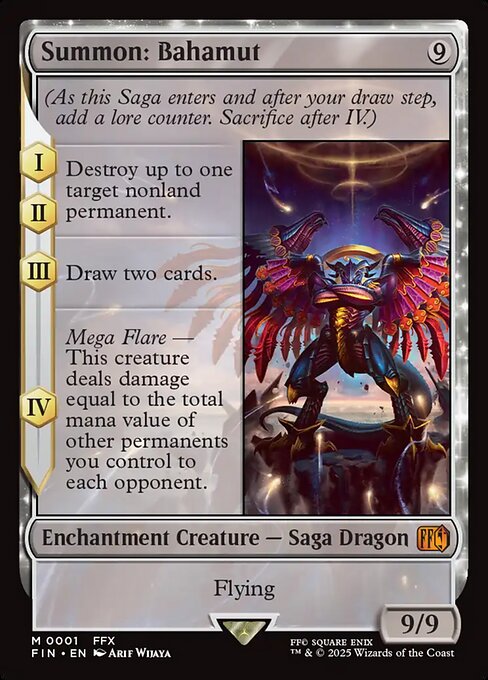 Summon: Bahamut$26.75 on 19 Nov 2026
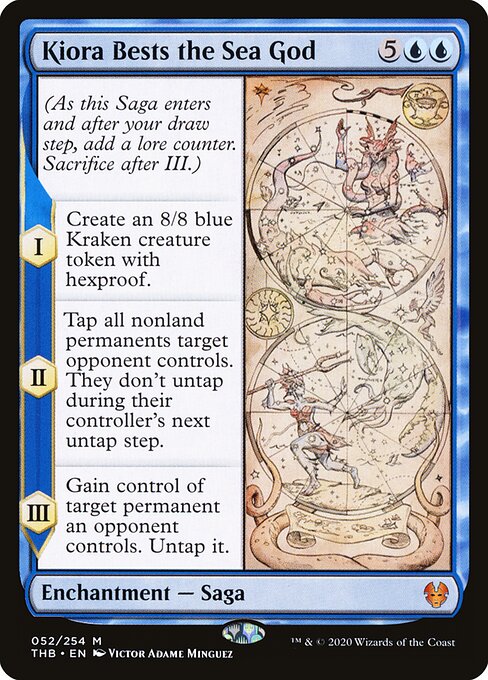 Kiora Bests the Sea God$7.97 on 19 Nov 2026
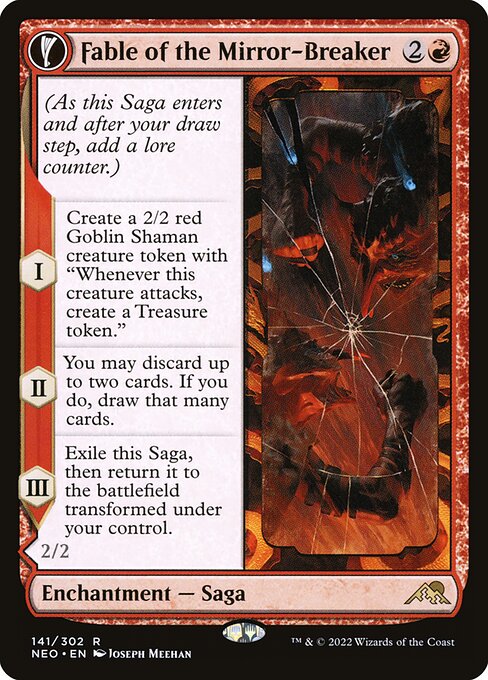 Fable of the Mirror-Breaker$6.21 on 19 Nov 2026
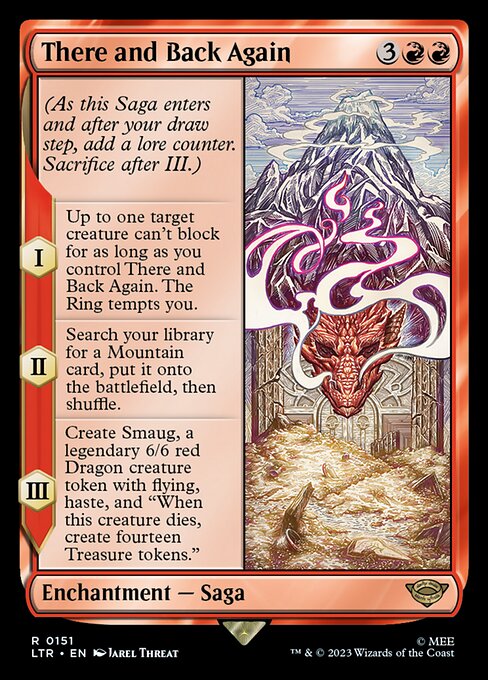 There and Back Again$6.03 on 19 Nov 2026
Prices are Scryfall's TCGplayer market prices for the printings shown, on 19 November 2026. Most Sagas cost under a dollar; History of Benalia was $0.95 and The Eldest Reborn $0.37 on the same day.
Saga Payoffs and Commanders
A Saga deck needs cards that reward the story ending, restart it, or push it along.
Tom Bombadil (The Lord of the Rings). Five colours. Whenever the final chapter ability of a Saga you control resolves, you reveal cards from the top of your library until you hit a Saga and put it onto the battlefield, once each turn. With four or more lore counters among your Sagas he has hexproof and indestructible. One ruling to know: if Tom has 4 damage on him and the Saga holding your fourth lore counter is sacrificed, he's destroyed before his trigger can find a new Saga.
Satsuki, the Living Lore (Neon Dynasty). Green-white. Taps to put a lore counter on each Saga you control, and when she dies she returns a Saga to your hand.
Sigurd, Jarl of Ravensthorpe (Assassin's Creed). Red-green-white. After he attacks, pay {1} to add or remove a lore counter on a Saga, and whenever you put a lore counter on a Saga you control, another creature gets a +1/+1 counter.
Narci, Fable Singer (Commander Masters). White-black-green. Draws a card whenever you sacrifice an enchantment, and when a Saga's final chapter resolves, each opponent loses life equal to that Saga's mana value and you gain that much.
Garnet, Princess of Alexandria (Final Fantasy). Green-white. When she attacks, remove lore counters from your Sagas to grow her, which also lets those chapters trigger again later.
Dathon, His Heart Open (Star Trek, November 2026). Green-blue-red. Draws a card whenever you cast an enchantment spell and deals 2 damage to each opponent if it's a Saga. Its {2} ability adds another counter of a kind already on an enchantment you control, which works on lore counters.
Support cards. Historian's Boon makes a 4/4 flying Angel whenever a Saga's final chapter triggers. Barbara Wright gives your Sagas read ahead. Search for Glory can tutor a Saga card.
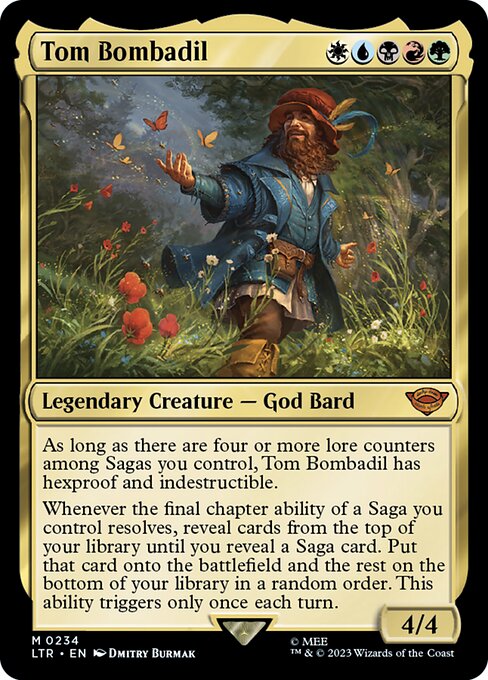 Tom Bombadil$2.71 on 19 Nov 2026
 Historian's Boon$2.36 on 19 Nov 2026
 Sigurd, Jarl of Ravensthorpe$0.35 on 19 Nov 2026
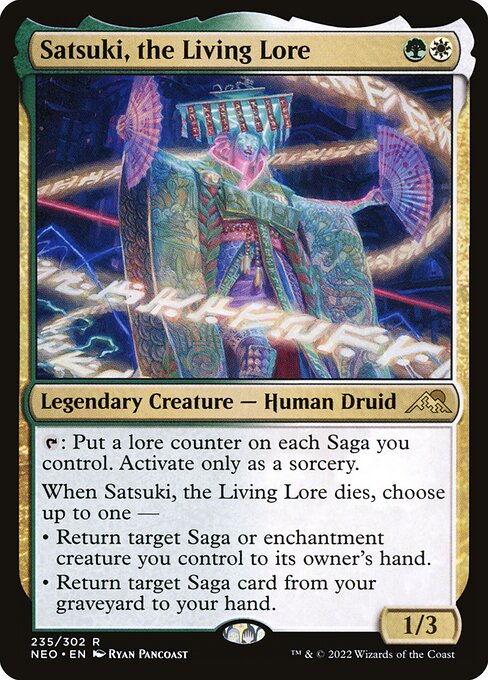 Satsuki, the Living Lore$0.34 on 19 Nov 2026
For more on Tom Bombadil's set, see our Lord of the Rings MTG guide; for the Summon Sagas, see the Final Fantasy Commander decks.
A Short History of Sagas
Dominaria
- Year
- 2018
- What it added
- The first Sagas, all with three chapters, and the historic mechanic that counts them
Theros Beyond Death
- Year
- 2020
- What it added
- Sagas retelling Theros myths, such as Elspeth Conquers Death
Kaldheim
- Year
- 2021
- What it added
- Norse-saga stories, including Binding the Old Gods
Modern Horizons 2
- Year
- 2021
- What it added
- Urza's Saga, the first Saga that is also a land
Kamigawa: Neon Dynasty
- Year
- 2022
- What it added
- Double-faced Sagas that exile and return transformed into creatures
Dominaria United
- Year
- 2022
- What it added
- Read ahead
March of the Machine
- Year
- 2023
- What it added
- Praetors that transform into Sagas
Final Fantasy
- Year
- 2025
- What it added
- Saga creatures (the Summons) and the rule that a Saga with no chapter abilities isn't sacrificed
The Hobbit
- Year
- 2026
- What it added
- Storied, a keyword that counts Sagas
On 19 November 2026 Scryfall lists more than 240 cards with the Saga type, counting the double-faced cards with a Saga on one face.
Common Misconceptions
"The lore counter goes on in my upkeep." It goes on as your precombat main phase begins, after your draw step.
"I can respond to the main-phase lore counter." You can't; it's a turn-based action. You can respond to the chapter ability it triggers.
"Proliferate on the last chapter replays it." It doesn't. Adding counters past the final chapter triggers nothing.
"Indestructible Sagas stay." They don't. Sagas are sacrificed, and indestructible only stops destruction.
"Read ahead triggers every chapter up to the one I chose." Only the chosen chapter triggers that turn. The skipped ones never happen.
Where Sagas Fit
Sagas are one of several counter-driven card types, alongside planeswalkers and their loyalty counters. For the turn structure behind the main-phase counter, see our phases and steps guide, and for every other keyword on modern cards, the complete MTG keywords glossary.
Citations & Resources
- Wizards of the Coast: Comprehensive Rules (effective 6 November 2026), rule 715 "Saga Cards" and rule 702.155 "Read Ahead"
- Scryfall: Every Saga card
- Scryfall: Every card with read ahead
- Scryfall: Summon: Bahamut and the 2025 Saga rules change
- Scryfall: Tom Bombadil and its rulings
Related Guides
- MTG Proliferate Explained — the most common way to move a Saga forward
- MTG Counters Guide — lore counters, Doubling Season and every other counter type
- MTG State-Based Actions — the check that sacrifices a finished Saga
- MTG Stack Explained — how chapter abilities trigger and resolve
- The Ultimate MTG Keywords Glossary — read ahead, storied and every other keyword