
Quick Verdict
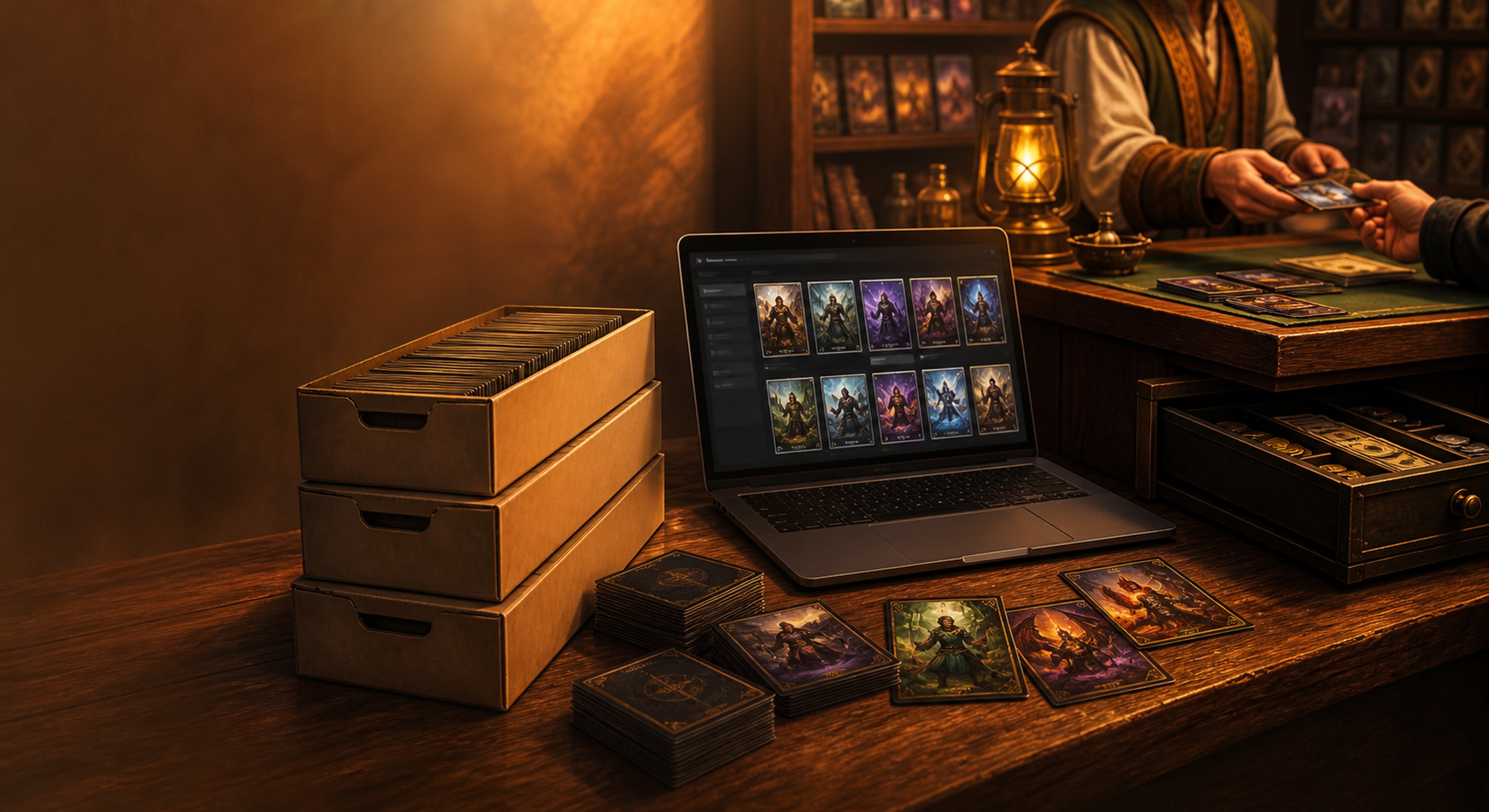
There is no single best place to sell Magic cards — there is a best place for each tier of your collection. Bulk and low-value commons should go to a buylist or a local store because listing them costs more in labour than they return. Cards between roughly $5 and $150 net the most on TCGplayer or Mana Pool. High-end singles, graded cards and sealed product belong on eBay, where the buyer pool is widest. Splitting a collection across all three usually beats sending the whole thing to one place.
Nobody actually wants to know where to sell Magic cards. What they want to know is how much money is in the box in the closet, and how much of their weekend it will cost to get it out.
Those two numbers move in opposite directions. Every venue that pays more asks more of you — photographs, listings, packing, customer messages, disputes. Every venue that is easy pays less. The whole skill of selling a collection is knowing which tier of card is worth which kind of effort, and refusing to spend an evening listing cards that were never going to clear five dollars.
This guide prices out every realistic venue with its 2026 fee structure, then gives you the sorting rule that decides where each card goes.
The short version: buylist the bulk, list the middle on TCGplayer or Mana Pool, and put the high end on eBay. Almost every collection should be split across at least two venues.
Net Proceeds, Not Market Price
The single most expensive mistake sellers make is reading a market price and treating it as money they own.
Market price is a buyer's number. It is what someone pays to acquire the card from an established seller with feedback, inventory and fast shipping. You are entering that market from the other side, and three things stand between the listed price and your bank account:
The fee. Between about 8% and 15% depending on the venue, and on eBay it is charged on shipping and sales tax as well as on the card.
The spread. To sell reasonably quickly you list below the current lowest comparable listing, not at market. On a thin card that gap is a few percent; on a heavily-stocked staple it can be 15%.
Your time. Photographing, listing, packing and shipping a card is roughly five to ten minutes of work whether the card is worth $2 or $200.
That last one is the real decision-maker, and it is why this guide is organised by card value rather than by venue. A 12% fee on a $200 card is $24 well spent. The same ten minutes spent on a $2 card earns you about $1.40 for the effort.
The arithmetic that decides everything
Ten minutes of work on a $2 card is roughly $8.40 an hour before shipping supplies. Ten minutes on a $60 card is around $315 an hour. This single ratio determines where every card in your collection should go — not which website has the nicest interface.
Sort First: The Three Buckets
Before choosing a venue, split the collection. This takes an evening and it is the highest-value hour of the entire process, because it is what stops you from listing worthless cards and buylisting valuable ones.
Bucket 1 — Bulk (under about $1). Commons, uncommons, and the enormous mass of draft chaff. This is most of the physical volume of nearly every collection and almost none of its value. It is never worth listing individually. Its only job is to be sold in one transaction to someone who takes it unsorted.
Bucket 2 — Playables (roughly $1 to $150). Commander staples, Standard and Modern playables, decent rares, mid-range foils. This is where the actual money in a typical collection lives, and it is the bucket most worth listing individually rather than buylisting.
Bucket 3 — High end (roughly $150 and up). Reserved List cards, Power Nine, serialized cards, graded slabs, sealed product, and anything from Alpha, Beta or Unlimited. Small in number, large in value, and worth handling individually with tracked, insured shipping.
If you do not know which bucket a card falls into, price it before you sort it. Our guide to valuing Magic: The Gathering cards covers the scanning apps that price a binder in minutes, and the most valuable MTG cards of 2026 is a useful check that nothing expensive is about to leave in a bulk box by accident.
The mistake that actually costs money
Every experienced seller has a story about a card that left in bulk. Scan before you sort, not after. A single missed Reserved List card can be worth more than the entire rest of the box, and once a bulk lot is sold it is gone with no recourse.
The Venues, With Their 2026 Numbers
Buylists — Card Kingdom, Star City Games
You send cards to a store; the store pays a published price per card. No listing, no photographs, no buyers to answer, no disputes. You are paid once the shipment is graded.
The price is the trade-off: buylists generally pay 40–60% of retail, because the store has to hold the card, list it, and carry the risk that the price moves against them.
Card Kingdom's 30% store credit bonus is the most useful lever here, and it is applied to the whole order rather than card by card. A $100 cash offer becomes $130 in credit. If you are an active player who buys singles anyway, that bonus closes most of the gap between buylisting and listing yourself — with none of the labour. If you are selling because you are leaving the game, it is worth nothing.
Buylists
Pros
- ✓Fastest route from cards to money — usually paid within days of arrival
- ✓One transaction regardless of how many cards are involved
- ✓No fees, no listings, no buyer disputes, no shipping individual orders
- ✓Card Kingdom's 30% store credit bonus is genuine and applies to the whole order
- ✓Prices are published in advance, so you know the offer before you ship
Cons
- ✗40–60% of retail is a large discount on good cards
- ✗Buylist prices can change while your package is in transit
- ✗Condition grading is done by the buyer and is not negotiable
- ✗Most buylists have minimum order values
- ✗Store credit is worthless if you are exiting the game
Use for: bulk, large volumes of low-value playables, and any situation where speed matters more than maximum return.
Card Conduit — The Middle Path for Big Collections
Card Conduit occupies a genuinely useful niche: you ship an unsorted collection, they sort it, grade it, and route each card to the best available offer among their buylist partners, charging around 5% of the payout. You get an itemised report of what everything sold for.
This is the correct answer to the specific problem of "I have twelve long boxes and no idea what is in them." The alternative is either weeks of your own sorting or accepting a single lowball offer on the lot. Five percent to skip that is cheap.
It is the wrong answer for a small, already-sorted stack of good cards. If you can list twenty cards in an evening, do that instead.
Use for: large, unsorted, unpriced collections — especially inherited ones or a decade-old accumulation.
TCGplayer — The Default for the Middle Bucket
TCGplayer is where most Magic singles change hands in North America, and for cards in the $5–$150 range it is usually the highest net return available without the effort of eBay.
The marketplace fees changed on 10 February 2026, and the Direct fees changed again on 18 June 2026. As of October 2026 they look like this:
| Seller type | Commission | Transaction fee | Effective rate |
|---|---|---|---|
| Marketplace (Level 1–4) | 10.75% | 2.5% + $0.30 | ~13.25% + $0.30 |
| Pro / Sync seller | 9.25% | 2.5% + $0.30 | ~11.75% + $0.30, plus subscription |
| Direct seller (since 18 June 2026) | 8.95% | 2.5% (no $0.30) | ~11.45% + $1.12 per card above $2.49; flat 50% on cards $2.49 and under |
Two details that are easy to miss. First, commission is capped at $75 per item — on a $2,000 card that cap turns a nominal 10.75% into an effective 3.75%, which makes TCGplayer surprisingly competitive at the very top end. Second, the Pro and Direct tiers carry costs of their own, so they only pay off above a meaningful volume. The Direct fee is especially harsh on cheap cards: a $1 card sold through Direct returns 50 cents, and Direct will not take listings under $0.40. A casual seller clearing out a collection should assume the standard rate.
TCGplayer
Pros
- ✓The largest dedicated buyer pool for Magic singles in North America
- ✓Buyers arrive already knowing condition language and market pricing
- ✓Commission capped at $75 per item, which helps enormously on high-end cards
- ✓Cards sell without promotion — buyers come to the listing
- ✓Bulk listing tools make large uploads manageable
Cons
- ✗Effective fees near 13.25% + $0.30 for standard sellers after February 2026
- ✗Price competition is visible and brutal — you are one row in a sorted list
- ✗You ship every order yourself unless you are enrolled in Direct
- ✗Condition disputes are resolved against sellers more often than not
- ✗Slow for anything unusual enough not to have an established market
Use for: the $5–$150 bucket. This is TCGplayer's home ground.
Mana Pool — Cheaper Fees, Smaller Audience
Mana Pool charges a 5% marketplace fee on the merchandise price (not on shipping), plus 2.9% + $0.30 credit card processing on the order. That is roughly 8% all-in against TCGplayer's 13.25% — a real difference of over five points on every sale.
The catch is traffic. TCGplayer has the buyers; Mana Pool has the better rate. In practice the sensible approach is to list on both and pull the listing when one sells, accepting the small risk of a double sale.
Use for: the same $5–$150 bucket as TCGplayer, listed in parallel. The fee saving is real and worth capturing when it lands there first.
eBay — The High End and Everything Unusual
eBay's fee for Collectible Card Games is 13.25% on the first $7,500 of an item's price and 2.35% above that, plus a per-order fee of $0.30 on orders of $10 or less and $0.40 above.
The crucial detail: that percentage applies to the entire transaction — the card, the shipping the buyer paid, and sales tax. On a $40 card with $5 shipping and $3 tax, you are paying 13.25% of $48, not of $40. Sellers routinely under-budget for this. International sales add another 1.65%.
So why use it? Because eBay has the widest buyer pool of anywhere, and for certain cards that is decisive:
- Graded slabs, where buyers compare across the whole market rather than within one game's ecosystem
- Sealed product — booster boxes, collector boxes, sealed decks — where TCGplayer's single-card framing works against you
- Vintage and Reserved List cards, where the pool of serious buyers is global
- Genuinely unusual items — misprints, foreign-language rarities, artist proofs, signed cards — that a fixed catalogue cannot represent
Where eBay quietly wins
Above $7,500 on a single item, eBay's rate drops to 2.35% on the excess. For a card in the five-figure range that is dramatically cheaper than any percentage-based alternative, and it is the main reason genuinely high-end Magic still trades there.
eBay
Pros
- ✓The widest buyer pool of any venue, by a wide margin
- ✓2.35% rate above $7,500 makes it the cheapest option for very expensive singles
- ✓Auction format finds the true price on cards with no established market
- ✓Handles graded, sealed, foreign and misprinted items that fixed catalogues cannot
- ✓Top Rated Seller Plus earns a 10% discount on the final value fee percentage
Cons
- ✗13.25% is charged on shipping and sales tax as well as the card
- ✗Buyer protection is strongly buyer-favoured in disputes
- ✗Listings need photographs and written descriptions — slow per card
- ✗Attracts more bad-faith buyers than TCGplayer or Mana Pool
- ✗1.65% additional fee on international sales
Use for: anything above roughly $150, everything graded, all sealed product, and anything that does not fit a standard catalogue entry.
Your Local Game Store
Cash today, no shipping, no fees, no packaging, no disputes. The rate is usually below the major online buylists because the store carries more risk and less inventory turnover — but on bulk, where shipping weight is the dominant cost of every other option, a local store is frequently the best real outcome.
Bulk is heavy. Shipping three long boxes to an online buylist can cost more than the cards are worth. Carrying them to a store costs a drive.
Use for: bulk, fast liquidation, and any situation where postage on the shipment would eat the payout.
Player-to-Player — Facebook Groups, Discord, r/mtgmarket
The highest possible return, because there is no marketplace fee at all. You keep essentially the full sale price minus payment processing.
You also absorb every risk that a marketplace would otherwise absorb: no escrow, no dispute resolution, no seller protection beyond what PayPal Goods and Services provides. Established groups mitigate this with reputation systems and active moderation, and they work — but they work because participants follow the rules rigidly.
Non-negotiable rules for private sales
- Take payment via PayPal Goods and Services, never Friends and Family — F&F has no dispute mechanism, and a buyer who insists on it is telling you something
- Photograph every card, front and back, immediately before packing
- Photograph the sealed, addressed package before it goes to the post office
- Check the buyer's post history and reputation thread before agreeing to anything
- Ship tracked above $20 and signature-confirmed above $250, without exception
- Never ship first to an account with no history, whatever the reason offered
Use for: cards you can price confidently, sold to a community you are already part of.
Worked Examples: What You Actually Keep
Fees are abstract until they are applied to a specific card. Three realistic cases, using the 2026 rates above.
| Venue | $4 card | $60 card | $400 card |
|---|---|---|---|
| Buylist at 50% | $2.00 | $30.00 | $200.00 |
| Card Kingdom credit (50% + 30% bonus) | $2.60 credit | $39.00 credit | $260.00 credit |
| TCGplayer standard (~13.25% + $0.30) | $3.17 | $51.75 | $346.70 |
| Mana Pool (~7.9% + $0.30) | $3.38 | $54.96 | $368.10 |
| eBay (13.25% + order fee, card only) | $3.17 | $51.65 | $346.60 |
| Player-to-player (PayPal G&S, 2.99% + $0.49) | $3.39 | $57.72 | $387.55 |
Read the rows, then read the effort. On the $4 card the entire spread between the worst and best option is $1.39 — less than the value of the ten minutes it takes to list it. On a $4 card, the buylist wins on any honest accounting of your time.
On the $400 card the spread is $187.55, which is worth a photograph and a trip to the post office. And note that the eBay figures above are optimistic: applying 13.25% to shipping and sales tax as well would push the $60 case closer to $50.
The fee percentage barely matters at the bottom of a collection and matters enormously at the top. Sort by value, then choose the venue — never the reverse.
What Bulk Is Really Worth
Unsorted commons and uncommons trade at roughly $2–$5 per thousand cards. A shoebox holds about 1,500. Three long boxes hold around 9,000 and are worth somewhere between $18 and $45.
This number surprises people, and it is worth stating plainly because it prevents a specific and very common waste of a weekend: sorting bulk by hand hoping to find value. The cards that would make that worthwhile — the ones worth $1 or more — are exactly the ones a scanning app finds in a single pass, which is why the sorting step above comes before any decision about venue.
Sell bulk to whoever takes it unsorted with the least shipping cost. Usually that is a local store. Its value is the shelf space it frees, not the money it returns.
Shipping: The Part That Costs People Money
More sales go wrong in packing than in pricing.
Under $20. Penny sleeve, toploader, team bag to seal the toploader, plain white envelope. Cheap, standard, and universally accepted at this price point. The risk of loss is real but small enough to be worth carrying.
$20 to $250. Bubble mailer with tracking. Untracked mail leaves you with no defence at all against an item-not-received claim, and at this value the postage difference is trivial against the exposure.
Above $250. Add signature confirmation. Most marketplace and payment-processor seller protections require a signature above roughly this threshold — without it, protection you assumed you had may simply not apply.
Always. Photograph the cards before they go in, and photograph the sealed package with the address label visible. This costs fifteen seconds and is the only evidence you will have if a dispute is opened.
Bend protection is not optional
A card shipped in a sleeve inside an envelope with no rigid backing will arrive creased often enough to matter. A toploader costs a few cents. A condition dispute costs the sale, the return postage, and the card's grade.
If you are buying supplies for a large sale, the same protection standards apply to the cards you are keeping — our guides to the best MTG sleeves for 2026 and the best deck boxes cover the storage side.
Grading: Almost Always No
Grading costs roughly $20–$75 per card plus shipping in both directions, and takes weeks. It pays only where a high grade multiplies the price rather than adding to it — Alpha and Beta staples, Power Nine, serialized cards, pristine early foils, and vintage cards in genuinely exceptional condition.
For a modern rare, grading reliably costs more than it adds. A card that grades a 9 instead of a 10 can be worth less than the same card raw, once the fee is counted. If you are asking whether a card is worth grading, the answer is almost certainly no.
The Decision Table
| What you have | Where it goes | Why |
|---|---|---|
| Bulk commons and uncommons | Local game store, or a bulk buyer | Shipping weight exceeds the value; only worth one transaction |
| Large unsorted collection, unknown contents | Card Conduit | ~5% to skip weeks of sorting and price research |
| Many cards in the $1–$5 range | Buylist, credit if you still play | Listing time exceeds the fee difference |
| Playables from $5 to $150 | TCGplayer and Mana Pool in parallel | Best net return per hour of effort |
| Singles above $150 | eBay, or TCGplayer for the $75 fee cap | Widest buyer pool; the fee cap helps at the top |
| Graded slabs and sealed product | eBay | Buyers cross-shop categories rather than one game's catalogue |
| Anything above $7,500 | eBay | 2.35% above the threshold beats every alternative |
| Cards you can price confidently | Facebook or Discord community | No marketplace fee, but you carry all the risk |
| You need cash this week | Local store or buylist | Speed has a price and this is it |
Conclusion: Split the Collection
The instinct when selling a collection is to find the single best venue and send everything there. That instinct is wrong, and it is expensive in both directions — it either wastes hours listing cards worth two dollars, or hands a Reserved List card to a buylist at half price.
Sort once, into three buckets. Bulk goes in one transaction to whoever is closest. The middle goes on TCGplayer and Mana Pool, where the fees are survivable and the buyers already know what they are looking at. The top goes on eBay, photographed properly and shipped with a signature.
Done that way, a collection that a single buylist would value at $1,200 routinely returns $1,800 or more — for about one extra evening of work concentrated entirely on the cards where that evening actually pays.
Citations & Resources
- TCGplayer: Official seller fee schedule
- TCGplayer: February 2026 marketplace fee changes
- eBay: Selling fees by category
- Mana Pool: Marketplace fees for sellers
- Card Conduit: Buylisting service and fee structure
- Card Kingdom: MTG singles buylist
Related Guides
- How to Value Magic: The Gathering Cards — price a collection before you sell it
- Most Valuable Magic: The Gathering Cards 2026 — make sure nothing expensive leaves in a bulk box
- Best MTG Sleeves 2026 — protection standards for cards you keep
- Best MTG Deck Boxes — storage for the collection after the sale
Frequently Asked Questions
🔗 Related Resources
More Reviews:
Related Articles
What MTG Cards Are Worth Money? How to Spot Valuable Ones
Which Magic: The Gathering cards are worth money? The era markers, Reserved List cards and treatments that find the valuable ones in a box of old cards fast.

Black Lotus MTG: Every Printing, Price and How to Spot a Fake
Black Lotus in MTG: a zero-mana artifact that adds three mana once. Why it's banned almost everywhere, every printing, what each is worth in 2026, and fakes.

How Much Does Magic: The Gathering Actually Cost in 2026?
How much does Magic: The Gathering cost in 2026? Free on Arena, $27–$50 for a Commander deck, and why prices rose in January. Real numbers for every way to play.