
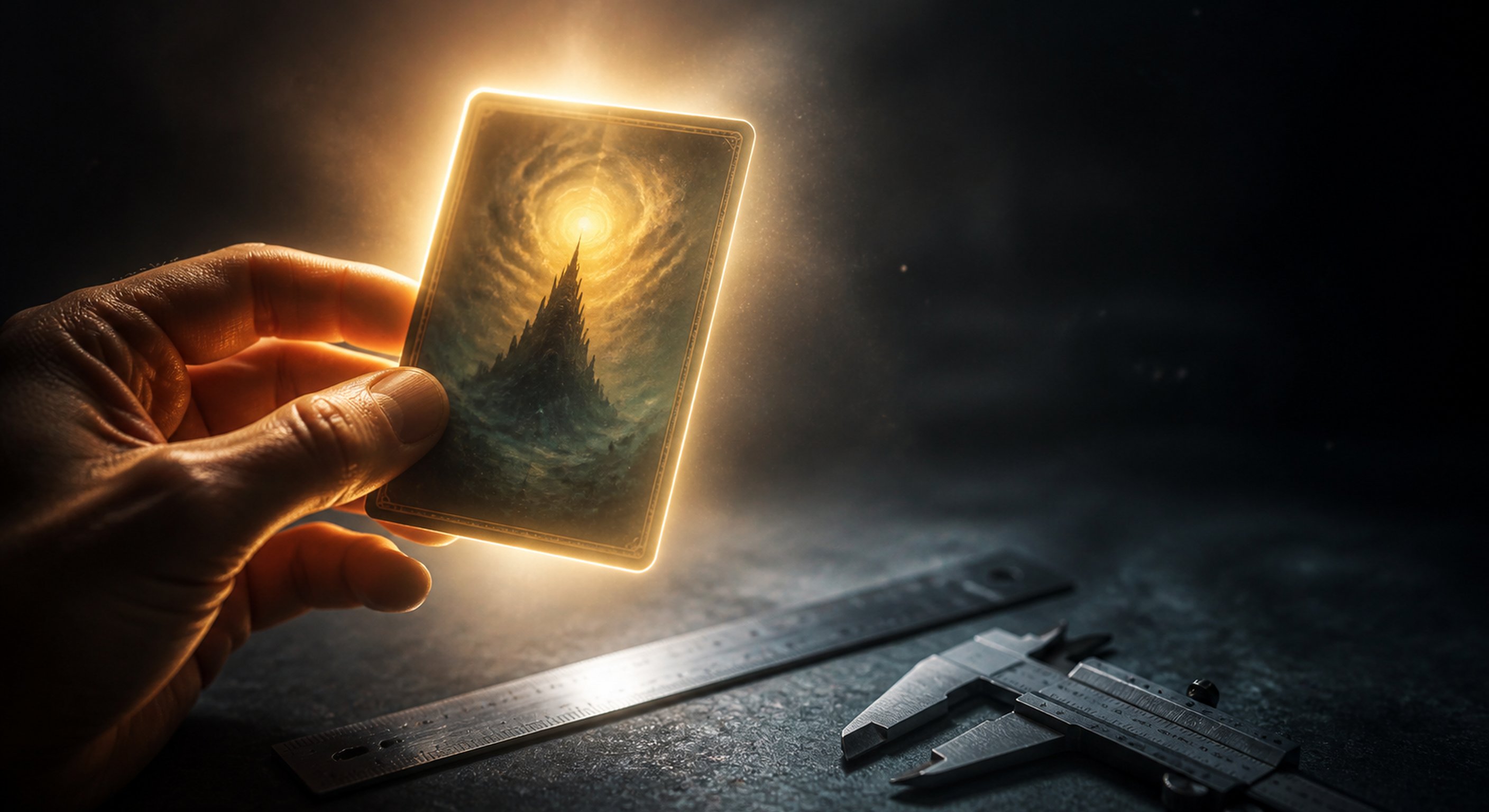
Quick Verdict
A Magic card is 63 × 88 mm (2.49 × 3.48 inches), roughly 0.30–0.32 mm thick and about 1.8 grams. Standard sleeves are 66 × 91 mm and perfect-fit inner sleeves are 64 × 89 mm. The back is identical on every tournament-legal card — the wordmark, a ring of five coloured pips, and the Deckmaster label — and the card's internal blue core layer is what makes the light test a reliable authentication check.
MTG card size is 63 × 88 millimetres, or 2.49 × 3.48 inches, the standard trading card size shared with Pokémon and most other TCGs. A Magic card is about 0.3 mm thick and weighs roughly 1.8 grams. Those card dimensions haven't changed since 1993, and they decide which sleeves, binders and deck boxes fit.
Card size sounds like the least interesting fact about Magic, and it is the one that quietly determines what you can buy, how you store a collection, how you ship it, and whether a card you are looking at is genuine.
Sixty-three by eighty-eight millimetres. Every sleeve, binder, deck box, toploader and storage product in the hobby is built around those two numbers, and they have not changed since 1993.
The back matters more than the front for a surprising number of purposes — it is the reason hidden information works, the reason a proxy is never tournament legal, and, together with the card's internal construction, the fastest way to tell a real card from a fake.
63 × 88 mm, about 0.3 mm thick, about 1.8 grams. Everything else follows from that.
MTG Card Dimensions: The Numbers
| Measurement | Metric | Imperial |
|---|---|---|
| Width | 63 mm | 2.49 in |
| Height | 88 mm | 3.48 in |
| Thickness | 0.30–0.32 mm | ~0.012 in |
| Weight | 1.7–1.8 g | ~0.06 oz |
| Standard sleeve | 66 × 91 mm | 2.6 × 3.6 in |
| Perfect-fit inner sleeve | 64 × 89 mm | 2.5 × 3.5 in |
This is the standard trading card size, shared with Pokémon and most other modern TCGs. That is why sleeves, binders and deck boxes work across games — a product advertised for Pokémon fits Magic cards exactly.
Cards printed after roughly 2015 run slightly heavier, which is a small detail with an outsized use in authentication. See below.
What the Size Means in Practice
Sleeves. Standard 66 × 91 mm sleeves fit with a small margin. Perfect-fit inners at 64 × 89 mm sit tight against the card and are designed to go inside a standard outer sleeve — that combination is what "double sleeving" means. Our guide to the best MTG sleeves covers which to use for what.
Deck boxes. This is where thickness stops being trivial. A card is about 0.3 mm; a sleeve adds meaningfully more, and double sleeving roughly doubles that addition. A 100-card Commander deck that fits a box comfortably unsleeved may not fit at all double-sleeved, which is why box capacity is quoted as "100+ double-sleeved" rather than just a card count. Our deck box guide works through the maths.
Binders and pages. Nine-pocket pages are the standard, sized for this exact card. A sleeved card in a binder page is a tighter fit than an unsleeved one, and forcing it is a common cause of corner damage.
Shipping. Card dimensions determine the whole shipping kit: penny sleeves, toploaders and team bags are all built to 63 × 88 mm. See where to sell MTG cards for the packing standards buyers expect at each price point.
The Card Back
Every tournament-legal Magic card has an identical back:
- The Magic: The Gathering wordmark across the top
- A ring of five coloured pips in the centre, representing white, blue, black, red and green
- The Deckmaster label at the bottom
The uniformity is not decoration — it is a rule of the game made physical. Magic depends on hidden information: your library must be unknowable and your hand must be unreadable. If backs varied by set, rarity or card, that would collapse immediately.
Why a different back means not legal
Any card whose back differs cannot be played in a sanctioned event, whatever is printed on the front. This covers:
- Collectors' Edition and International Collectors' Edition (1993), which also have square corners
- The 30th Anniversary Edition (2022), which carries a deliberately distinct back
- Every printed proxy, regardless of how good the front looks
Casual playgroups frequently allow proxies by agreement. That is a house rule and it has no bearing on legality.
The Blue Core
A Magic card is not a single piece of card. It is two layers of paper bonded together with a dark blue-grey adhesive core.
That core is the reason the light test works. Hold a genuine card up to a strong lamp and the core blocks most of the light, producing a characteristic opacity. Most counterfeits use single-layer stock or a different construction and let noticeably more light through — often the first thing you notice before any detail of the printing.
Combined with the size and weight figures above, that gives three fast physical checks that need no expertise:
| Test | What you do | What a fake shows |
|---|---|---|
| Light test | Hold against a strong lamp | Noticeably more light passes through |
| Weight test | Jeweller's scale, compare to a known card | Rebacked cards run heavy from adhesive |
| Corner check | Look at the cut | Square corners mean Collectors' Edition, not Beta |
| Rosette check | 10x loupe on the printed dots | Blurred, chaotic dots instead of a sharp pattern |
These are screening tests, not proof. For anything valuable, professional grading is the answer — our Black Lotus guide covers authentication in full, including why rebacked Collectors' Edition cards are the most convincing fakes in the hobby.
The front of a Magic card tells you what it does. The back and the core tell you whether it is real.
Corners, and the Cards That Are Not Standard
Alpha corners. Alpha cards, from 1993, were cut with a visibly larger corner radius than everything printed since. Placed next to a Beta card of the same name the difference is unmistakable, and it is worth roughly an order of magnitude in price — which is why it is the first thing to check on any black-bordered 1993 card. Overall dimensions are essentially unchanged; it is the rounding that differs.
Square corners. Collectors' Edition and International Collectors' Edition were cut square. A square-cornered card is never a Beta card, whatever the back suggests. A CE card with rounded corners has been trimmed, which destroys its value entirely.
Oversized cards. These exist as display pieces and have appeared in some Commander and planeswalker products, and Vanguard cards in the late 1990s were larger. None are tournament legal.
Everything else is standard size. Tokens, emblems, double-faced cards, and every foil treatment are all 63 × 88 mm. A foil is the same size as a non-foil — foils curl, which is a warping problem rather than a sizing one, and one more reason to sleeve them.
Common Questions
"Are Magic and Pokémon cards the same size?" Yes. Both are standard trading card size, so sleeves and storage are interchangeable.
"Do foils have different dimensions?" No. They warp, they do not resize.
"Is a proxy the right size enough?" No. Size is the easiest specification to match and the least important — back design, core construction and print quality all fail.
"Do older cards differ in size?" Only in corner cut, not meaningfully in dimensions.
Conclusion: The Boring Number That Decides Everything
Sixty-three by eighty-eight millimetres is the least interesting fact in Magic and one of the most load-bearing. Every accessory you will ever buy is built to it, every storage decision is a consequence of it, and the thickness figure is the one that decides whether your deck actually closes its box.
The back is the more interesting half. It is uniform because the game requires it to be, and that requirement is what makes proxies unplayable in sanctioned events and what makes the blue core worth knowing about — the light test exists because of how the card is physically built.
Learn the three screening checks. Light, weight, corners. They take ten seconds, they need no equipment beyond a lamp, and they will catch the overwhelming majority of fakes before you ever need an expert.
Citations & Resources
- Wizards of the Coast: Comprehensive Rules — card legality and authenticity
- Wizards of the Coast: Buyer Beware — identifying counterfeit cards
- MTG Wiki: Card anatomy and physical specifications
- MTG Wiki: The Magic card back
- CGC: Counterfeit alert — rebacked cards
Related Guides
- Best MTG Sleeves 2026 — standard, perfect fit and double sleeving
- Best MTG Deck Boxes — why sleeved thickness decides capacity
- Magic: The Gathering Black Lotus — authentication in full depth
- What MTG Cards Are Worth Money — using corners and borders to date a card
- Where to Sell MTG Cards — packing standards by price point
- MTG Symbols Explained — reading the front of the card
Frequently Asked Questions
🔗 Related Resources
Explore More:
More Reviews:
Related Articles

MTG Star Trek: Release Date, Products and What to Preorder
MTG Star Trek releases 13 November 2026. Every product, its MSRP, what it costs to preorder on TCGplayer today, and which ones are worth buying early.
Flashback MTG: What It Means, Rules and Best Cards (2026)
Flashback in MTG lets you cast an instant or sorcery from your graveyard for its flashback cost, then exile it. Full flashback rules and the best cards.

The Ring Tempts You MTG: Rules, 4 Levels, Best Cards (2026)
The Ring tempts you in MTG gives you an emblem and a Ring-bearer that gets stronger each time. All four levels, the rules, and the best Ring cards.