
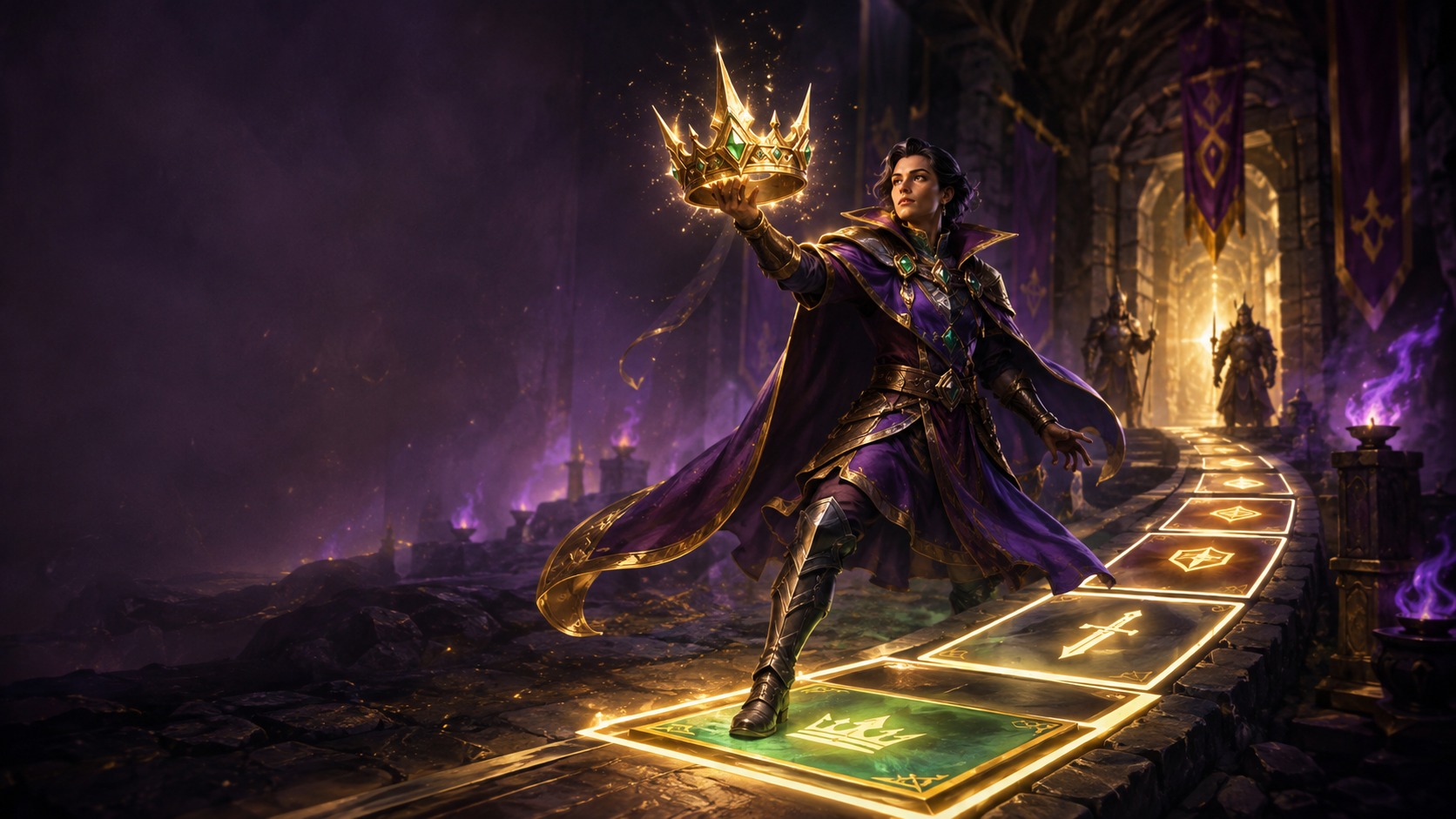
Quick verdict
Monarch and the initiative are designations, not permanents — one player holds each, and both change hands when a creature deals combat damage to the holder. The monarch draws an extra card at their end step. The player with the initiative ventures deeper into the Undercity dungeon each upkeep. Both were built to stop multiplayer games stalling by making the holder worth attacking, and the initiative proved so strong it was banned in Legacy and Pauper.
Monarch in MTG is a designation: the monarch draws an extra card at the beginning of their end step, and any player who deals combat damage to the monarch becomes the monarch. The initiative in MTG works the same way, but instead of drawing, the player who takes it ventures into the Undercity dungeon. Here are the full rules for both, and why one of them was banned in two formats.
Multiplayer Magic has a structural flaw that took Wizards twenty years to address directly: nobody wants to attack first.
Committing creatures to an attack taps them, exposes you to the two players you did not attack, and usually costs you more than it gains. So four-player games stall. Everybody builds a board, nobody swings, and the game is decided by whoever assembles a combo behind the wall.
Monarch and the initiative are both solutions to that, and they use the same trick. Give one player an ongoing benefit. Make that benefit transfer to whoever hits them in combat. Now there is always a reason to attack somebody, and it is always the same somebody.
The mechanics are structurally twins. The difference is how much they hand out — and that difference is why one is a beloved Commander staple and the other is banned in two formats.
The rule for both: one holder at a time, and combat damage to the holder takes it.
Monarch in MTG: The Rules
The monarch is a designation, not a permanent or a card. It cannot be destroyed, exiled or countered, because there is nothing to interact with.
The benefit: the monarch draws an additional card at the beginning of their end step.
The transfer: whenever a creature deals combat damage to the monarch, that creature's controller becomes the monarch.
The constraints: there is only ever one monarch. Some cards simply say "you become the monarch", which takes it from whoever had it, with no combat required.
| Question | Answer |
|---|---|
| Can a 1/1 token steal the monarchy? | Yes — any creature, any amount of combat damage |
| Does a burn spell to the monarch steal it? | No. Combat damage only |
| Does an ability that pings the monarch steal it? | No. Combat damage only |
| Can there be two monarchs? | Never |
| Can the monarchy be removed from the game? | Not by normal means — it is a designation, not a permanent |
| Does trample damage to the monarch count? | Yes — it is still combat damage dealt by a creature |
The monarch is why one-power fliers are good
Because any amount of combat damage transfers the designation, the ideal monarch-stealing creature is not big — it is unblockable. A 1/1 flier does exactly as good a job as a 9/9, for a fraction of the mana. In Commander pods where the monarchy is live, cheap evasive creatures gain a whole extra role.
Monarch cards worth knowing
Palace Jailer — four mana, become the monarch, and exile an opponent's creature until an opponent becomes the monarch. Hold the crown and the creature never returns. It is removal, card advantage and a target painted on you, all at once.
Queen Marchesa — a three-colour commander that makes you the monarch on entry and gives you a deathtouch blocker each turn to help you keep it.
The Court cycle from Commander Legends — Court of Grace, Court of Cunning, Court of Ambition, Court of Ire and Court of Bounty — enchantments that make you the monarch and then do something extra, with a bigger effect while you stay monarch.
Regal Behemoth and Forth Eorlingas! — later designs that fold the monarchy into a body or a token swarm.
The Initiative in MTG: The Rules
The initiative works identically at the transfer layer and is far more generous at the benefit layer.
The benefit: when you take the initiative, and at the beginning of your upkeep while you have it, you venture into the Undercity — a specific dungeon of nine rooms, each with its own effect, escalating along branching paths towards the Throne of the Dead Three.
The transfer: whenever a creature deals combat damage to the player who has the initiative, that creature's controller takes the initiative.
The critical difference: the monarch gives you one card and then does the same thing again next turn. The initiative gives you a different, larger effect every turn, and your progress through the dungeon is remembered. Taking the initiative back later resumes where you were.
| Monarch | The Initiative | |
|---|---|---|
| Benefit | Draw a card at your end step | Venture into the Undercity each upkeep |
| Benefit changes over time | No — always one card | Yes — deeper rooms are stronger |
| Progress remembered | Nothing to remember | Yes — you resume where you left off |
| How it transfers | Combat damage to the holder | Combat damage to the holder |
| Introduced | Conspiracy: Take the Crown, 2016 | Battle for Baldur's Gate, 2022 |
| Banned anywhere | No | Yes — Legacy and Pauper |
The monarch offers the table a card to fight over. The initiative offers them a snowball that has already started rolling.
Why the Initiative Broke Two Formats
The initiative was designed for a multiplayer Commander product. It escaped into competitive formats where the maths worked very differently.
In a duel, the designation only has one place to go. There is no political layer, no three opponents splitting the job of taking it back — just you and one opponent, and if that opponent cannot attack profitably, the initiative never leaves.
White Plume Adventurer is a three-mana 3/3 that takes the initiative immediately. In Legacy, that meant a turn-one or turn-two play that started compounding dungeon value while presenting a body that had to be attacked through. Decks were built entirely around protecting the initiative holder. It is banned in Legacy.
The same thing happened one rarity down. Aarakocra Sneak, Stirring Bard, Underdark Explorer and Vicious Battlerager — four commons — are all banned in Pauper, a format where an unanswerable engine on a cheap creature is even harder to fight.
The monarch, by contrast, is banned nowhere. One extra card per turn is strong; it is not a compounding engine.
The design lesson
Both mechanics rely on opponents being able to attack the holder. That assumption holds in a four-player Commander pod, where three players can gang up. It falls apart in a duel against a deck built to hold the ground. The initiative is a case study in a multiplayer mechanic behaving completely differently once it leaves multiplayer.
Playing Them Well
Do not take the monarchy while you are visibly winning. You are asking three opponents for a reason to attack you, and they already had one. Monarch is best when you are behind, or when you have the blockers to keep it.
Keeping it is worth more than taking it. A single turn as monarch is one card. Four turns is four cards and a game-winning advantage. Deathtouch blockers, cheap removal and a wide board matter more than the card that grants the designation.
Attack the monarch, not the leader. In a four-player game, the monarch is usually the correct attack target regardless of who is ahead on board, because you gain a permanent resource rather than just dealing damage.
Any creature works. Do not save your big attack for the monarch. Send the 1/1 flier and keep the rest home.
Watch for Palace Jailer specifically. If a Jailer has exiled your creature, taking the monarchy back returns it. That is often worth more than the card draw.
In Commander
Both mechanics are Commander-native and both improve the format for the reason they were designed: they give a stalled board a reason to move.
The monarch is the better-behaved of the two. It provides a modest, comprehensible incentive, it rotates naturally around the table, and it rewards decks that can defend without being oppressive.
The initiative is stronger and more polarising. In a pod where nobody can attack the holder, it snowballs the way it did in Legacy. Many playgroups treat it as a soft power level marker — an initiative deck in a casual pod is usually a step above the rest of the table.
The mechanic they pair best with is goad, from the same original set. Goad forces creatures to attack somebody else; monarch gives them somebody worth attacking. Together they solve the stall problem from both directions.
The most-played monarch cards in Commander
Ranked by how many Commander decks play them (EDHREC data, via Scryfall). Prices are for the cheapest printing on Scryfall in October 2026.
- Court of Grace — about $1.33
- Court of Garenbrig — about $14
- Regal Behemoth — about $0.58
- Court of Ambition — about $6.49
History
Both mechanics come from products designed explicitly for multiplayer.
Monarch debuted in Conspiracy: Take the Crown in August 2016, alongside goad — a set entirely built for free-for-all play. It was reprinted into Commander products almost immediately and has appeared steadily since, including a Palace Jailer reprint in Marvel Super Heroes Commander in 2026.
The initiative debuted in Commander Legends: Battle for Baldur's Gate in June 2022, as part of that set's Dungeons & Dragons venture mechanics. Around 24 cards reference taking it, essentially all from that one set.
The trajectory since is instructive. The monarch became a permanent part of the Commander toolkit. The initiative was printed once, broke two competitive formats, and has not returned.
Common Misconceptions
"Any damage to the monarch steals it." Combat damage from a creature only.
"The monarch is a permanent I can destroy." It is a designation. There is nothing to target.
"Two players can be the monarch." Never.
"The initiative restarts the dungeon each time." Your progress is remembered; you resume where you were.
"Monarch is banned in Commander." It is banned nowhere. The initiative is the one with bans.
"I need a big creature to take the crown." A 1/1 does the job identically.
Conclusion: A Benefit With a Bullseye
Monarch and the initiative are the same design idea executed at two very different power levels. Give one player something good. Make everyone else able to take it by attacking. The result is a multiplayer game that moves, which is exactly what both were built to produce.
The skill in both is knowing when you want the target on your back. The card, or the dungeon room, is only worth what you keep — and a player who takes the crown with no way to defend it has handed the table a free reason to point everything at them.
And the initiative's ban history is worth remembering as a general lesson. A mechanic balanced by three opponents being able to punish you is not balanced at all once there is only one.
Citations & Resources
- Wizards of the Coast: Comprehensive Rules — monarch, the initiative and designations
- Wizards of the Coast: Banned and Restricted list — White Plume Adventurer in Legacy
- Scryfall: Every card that makes you the monarch
- Scryfall: Every card with the initiative
- Scryfall: Conspiracy: Take the Crown — where the monarch debuted
Related Guides
- The Ultimate MTG Keywords Glossary — every keyword, with a printable cheat sheet
- MTG Goad Explained — the other Conspiracy: Take the Crown mechanic, solving the same stall problem
- MTG Myriad Explained — another Commander-first combat mechanic
- MTG Formats Explained — why Legacy and Pauper ban lists differ
- MTG Phases and Turn Structure — when the end step draw and the upkeep venture happen
- Venture Into the Dungeon in MTG — the three dungeons you choose from, against the Undercity the initiative forces on you
- What Deathtouch Means in MTG — the cheapest way to defend a crown
- Best MTG Commander Decks — where Queen Marchesa and the Court cycle live
Frequently Asked Questions
🔗 Related Resources
More Reviews:
Related Articles
Discover MTG: Rules, Best Cards and Discover vs Cascade (2026)
Discover in MTG exiles until it hits a nonland card of mana value N or less; cast it free or keep it. Full discover rules, and discover vs cascade.
Proliferate MTG: What It Means, Rules and Best Cards (2026)
Proliferate in MTG adds one more of each counter already on the permanents and players you choose. It doesn't target. Full proliferate rules and best cards.

MTG Protection: What Protection Does and the DEBT Rule (2026)
Protection in MTG stops a creature being Damaged, Enchanted, Blocked or Targeted by the named quality. Full protection rules (DEBT) and every edge case.