
Quick verdict
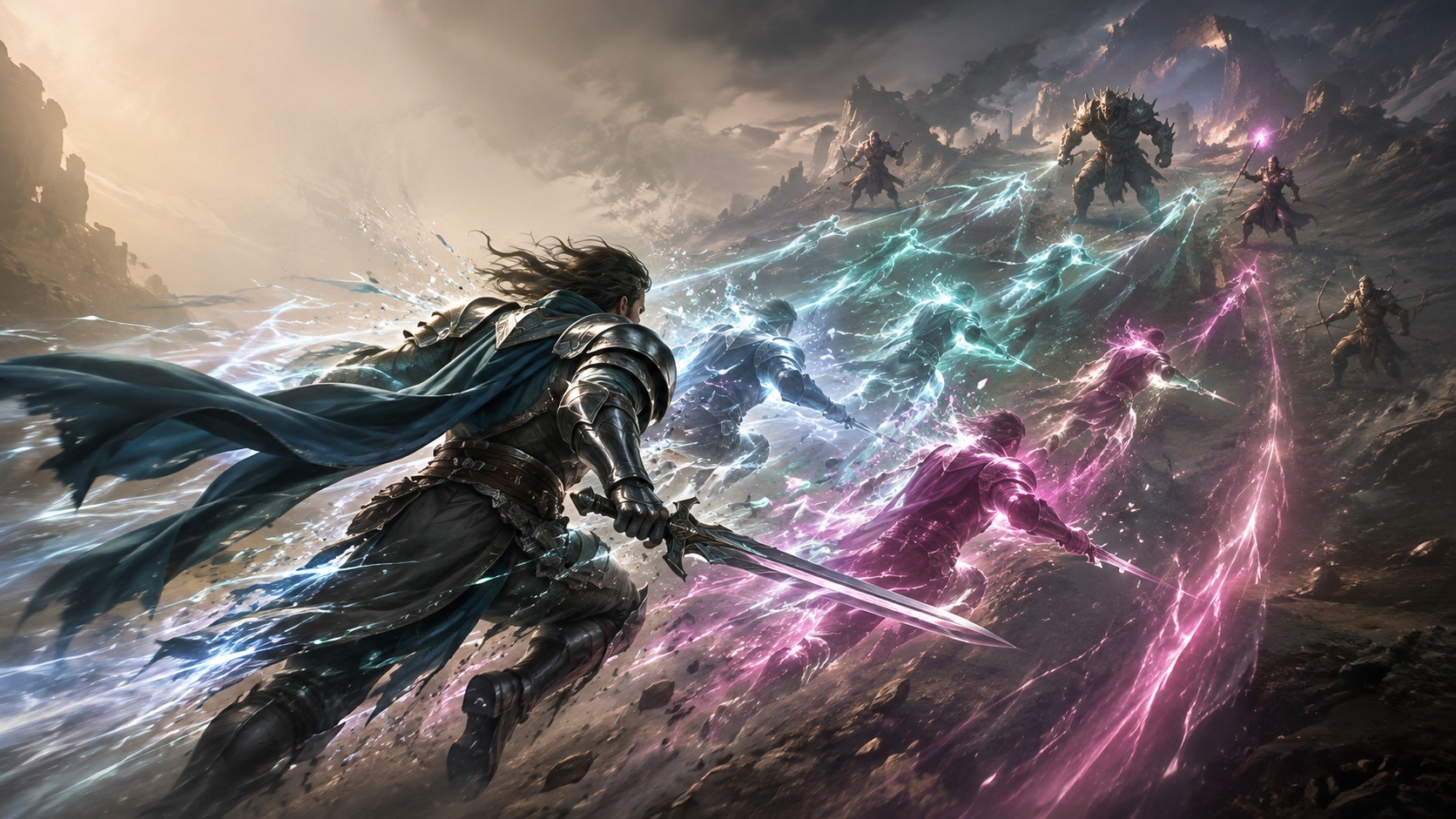
Myriad triggers when the creature attacks: for each opponent other than the defending player, you may create a tapped, attacking token copy pointed at them. The tokens are exiled at end of combat, which sounds like a drawback and is actually the mechanic's engine — every token still entered the battlefield, so every enters-the-battlefield trigger on the creature fires once per opponent.
Myriad in MTG is a triggered ability: whenever the creature attacks, for each opponent other than the defending player, you may create a token copy of it that's tapped and attacking that player or a planeswalker they control. The tokens are exiled at end of combat. In a four-player Commander game, one attack becomes three.
Magic has plenty of keywords that are better in multiplayer. Myriad is the only one that is literally blank without it.
Read the trigger: for each opponent other than defending player, you may create a token copy attacking that player. In a two-player game, the set of opponents other than the one you are attacking is empty. Nothing happens. The keyword is text on a card doing nothing at all.
That is not a flaw, it is a targeting decision. Myriad was printed in a Commander product, for Commander, and it has essentially stayed there for a decade.
And the part that looks like the drawback — the tokens are exiled at end of combat — turns out to be the reason the mechanic is dangerous rather than fair.
The rule: on attack, copy the creature at every other opponent, tapped and attacking. Exile the copies at end of combat.
Myriad Rules in MTG
Myriad is a triggered ability on the creature. The reminder text:
Whenever this creature attacks, for each opponent other than defending player, you may create a token copy that's tapped and attacking that player or a planeswalker they control. Exile the tokens at end of combat.
Four clauses that decide how it plays:
"Whenever this creature attacks." Declaring it as an attacker is enough. It does not need to connect, and it does not need to survive.
"For each opponent other than defending player." One copy per remaining opponent. Three opponents in a four-player game means one attacker becomes three.
"You may." Per opponent, individually. You can make some copies and not others.
"Exile the tokens at end of combat." After combat damage. The tokens are around for the whole fight.
| Players in game | Copies created | Total attackers |
|---|---|---|
| 2 (a duel) | 0 | 1 — myriad does nothing |
| 3 | 1 | 2 |
| 4 (standard Commander) | 2 | 3 |
| 5 | 3 | 4 |
| 6 | 4 | 5 |
The copies do not myriad again
The tokens are created already attacking rather than being declared as attackers, so their own myriad ability never triggers. This is deliberate — without it, myriad would loop infinitely on the first attack. It is also why myriad is powerful but not degenerate on its own.
Why the Exile Clause Is the Engine
Read casually, "exile the tokens at end of combat" is a downside. You get three attackers, then you get none.
But the tokens were still created. They still entered the battlefield. And nothing undoes that.
So a creature with myriad and an enters-the-battlefield ability fires that ability once per opponent, every single attack, forever. The board never grows, so nothing ever looks unfair. The triggers do all the work.
Myriad does not build a board. It builds a trigger count, and then hides the evidence at end of combat.
This is the entire reason Blade of Selves — an Equipment that simply grants myriad, with equip four — is a Commander staple. It is not there to make copies of a good attacker. It is there to be strapped onto a creature whose enters-the-battlefield trigger you want to happen three times a turn.
| Creature ability type | How myriad interacts | Value |
|---|---|---|
| Enters the battlefield | Fires once per token, every attack | Enormous — the main combo |
| Attack trigger | Tokens enter attacking, so it fires | High |
| Dies trigger | Only if a token is killed in combat | Situational — exile is not dying |
| Lifelink | All copies deal damage simultaneously | High |
| Deathtouch | Every copy threatens any blocker | High — taxes every opponent |
| Myriad itself | Tokens do not re-trigger | None — deliberately closed |
Note the "dies" row. Exile is not death. A token that survives combat is exiled and triggers nothing. A token that gets blocked and killed does trigger death abilities — which occasionally makes attacking into a blocker the correct play.
The Politics of Attacking Everyone
Myriad has a strategic cost that does not appear anywhere in its rules text: it attacks the entire table at once.
You choose one player to attack. Myriad points a copy at everybody else. Three opponents who were previously neutral now all took damage from you in the same combat, and in a format where the biggest threat gets removed by consensus, that is a real price.
The "you may" clause is your release valve, and it is underused. You are allowed to copy at only the opponent you actually want to pressure, keep the deal you made with the player on your left, and avoid waking up a third player who was busy fighting someone else.
When to decline a copy
Decline the copy when the opponent has an untapped blocker that eats your creature for free and you gain nothing from the trigger, when you have a working political arrangement with that player, or when that player is at low life and you do not want to be the one who makes them a desperate, nothing-to-lose opponent. Declining costs you damage you were never going to convert anyway.
The Cards Worth Knowing
Blade of Selves — the Equipment that grants myriad. The single most important card in the mechanic, because it puts myriad on the creature you choose.
Herald of the Host — a five-mana Angel with flying, vigilance and myriad. Vigilance matters here: attacking with a myriad creature normally taps it, and vigilance keeps your original back as a blocker while the copies do the work.
Battle Angels of Tyr — myriad plus a stack of triggers keyed to opponents having more of things than you, which in a four-player game is close to always.
The Master, Multiplied — a Doctor Who legend built entirely around the enters-the-battlefield interaction.
Scion of Calamity, Chittering Dispatcher, Wizards of Thay, Elturel Survivors — the modern crop, mostly from Commander Legends: Battle for Baldur's Gate and later Commander decks.
Roughly 23 cards carry the keyword, and almost every one of them was printed in a Commander product.
In Commander
Myriad is a Commander mechanic in the most literal sense — it was designed there, it is printed there, and it does not function anywhere else.
The three things it rewards:
Enters-the-battlefield value creatures. Anything that draws, ramps, drains or makes tokens on entry becomes three of those per attack with Blade of Selves attached.
Vigilance and evasion. The original creature taps to attack; vigilance means it does not. Evasion matters because the copies attack into three separate untapped boards.
Sacrifice outlets. If a token is going to be exiled at end of combat anyway, sacrificing it first converts it into whatever your outlet produces. This is the cleanest way to get value out of the exile clause instead of losing to it.
History
Myriad debuted in Commander 2015 and has stayed there. Later appearances came in Commander Legends: Battle for Baldur's Gate (2022), The Lost Caverns of Ixalan Commander (2023), Modern Horizons 3 Commander (2024) and Tarkir: Dragonstorm Commander (2025).
The design lineage is clear: myriad is a cleaner version of older "attacks each opponent" effects, packaged so the board does not spiral. Compare it to goad, another Commander-first mechanic from the same era that manipulates multiplayer combat from the opposite direction — myriad makes you attack everyone, goad makes everyone else attack each other.
Common Misconceptions
"Myriad works in a duel." It does absolutely nothing in two-player Magic.
"The tokens stay if they survive." They are exiled at end of combat regardless.
"Myriad tokens trigger myriad." They do not. The loop is closed by design.
"Exiled tokens trigger death abilities." Exile is not death. Only tokens killed in combat do.
"I have to make all the copies." Every copy is a separate optional choice.
"Myriad is about damage." In practice it is about enters-the-battlefield triggers. The damage is the smaller half.
Conclusion: Count the Triggers, Not the Attackers
Myriad looks like a combat mechanic and plays like a value engine. Three attackers instead of one is the visible half; three enters-the-battlefield triggers instead of one, every single turn, with no permanent board growth to draw attention, is the half that wins games.
That reframing changes how you build. Do not look for the biggest creature to give myriad to. Look for the creature whose entry trigger you would happily pay four mana to repeat three times a turn, and equip that one.
And remember that every attack is a table-wide declaration. The keyword offers you an opt-out on every copy, and the players who use myriad well are the ones who take it.
Citations & Resources
- Wizards of the Coast: Comprehensive Rules — myriad and triggered abilities
- Scryfall: Every card with myriad
- Scryfall: Blade of Selves — the Equipment that grants myriad
- Commander Format: official rules and multiplayer structure
Related Guides
- The Ultimate MTG Keywords Glossary — every keyword, with a printable cheat sheet
- MTG Goad Explained — the other Commander-first combat manipulator
- What Deathtouch Means in MTG — why every myriad copy becomes unblockable in practice
- What Lifelink Means in MTG — simultaneous damage across all copies
- MTG Vigilance Explained — why vigilance is the best partner for myriad
- MTG Phases and Turn Structure — what the end of combat step actually does
- Best MTG Commander Decks — where Blade of Selves earns its slot
Frequently Asked Questions
🔗 Related Resources
More Reviews:
Related Articles

MTG Protection: What Protection Does and the DEBT Rule (2026)
Protection in MTG stops a creature being Damaged, Enchanted, Blocked or Targeted by the named quality. Full protection rules (DEBT) and every edge case.
Regenerate MTG: What Regenerate Means and How It Works
Regenerate in MTG replaces the next destruction this turn: tap it, remove its damage, take it out of combat. Full regenerate rules, and why it was retired.
Goad MTG: What Goad Means, Rules and Best Goad Cards (2026)
Goad in MTG forces a creature to attack each combat until your next turn, and to attack someone other than you. Full goad rules, politics and best cards.