Quick verdict
Magic has 31 possible colour combinations and almost all of them have a nickname drawn from a specific set. Two-colour pairs use the Ravnica guild names, three-colour allied sets use the Alara shard names, three-colour enemy sets use the Khans of Tarkir clan names, and four-colour sets use the Guildpact Nephilim names. This is the complete reference table, plus why the colours are always listed in WUBRG order.
PLAY THE CLANS
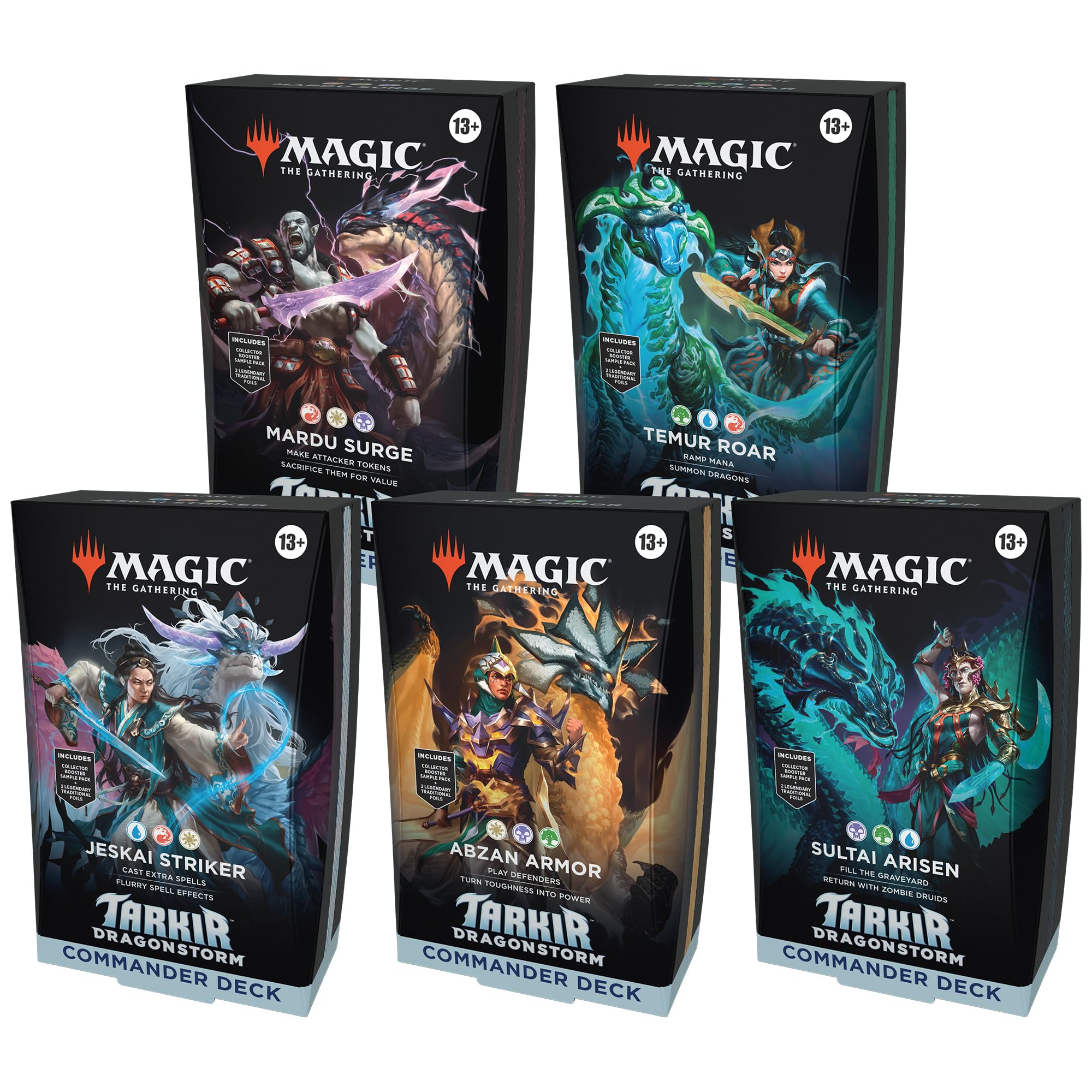

Tarkir: Dragonstorm Play Booster Box
The return to Tarkir, the plane the five wedge names come from
- ✓Abzan, Jeskai, Sultai, Mardu and Temur clans all in one set
- ✓Standard-legal 2025 set
MTG color combination names are the nicknames players use for each mix of colors: two-color pairs are named after the ten Ravnica guilds (Azorius, Dimir, Rakdos...), three-color allied combos after the Alara shards (Bant, Esper, Grixis, Jund, Naya), and three-color enemy combos after the Tarkir wedges (Abzan, Jeskai, Sultai, Mardu, Temur). Here is every color combo name in one place.
Magic never sat you down and explained that Jund means black-red-green. It just started saying it, in tournament coverage and deck lists and every conversation about Commander, and expected you to keep up.
The names are not rules text. Not one of them appears in the Comprehensive Rules. They are flavour names from specific sets that stuck so hard they replaced the actual colour descriptions in everyday use, and they now cover almost every one of Magic's 31 colour combinations.
The system is more organised than it first appears. Two-colour pairs come from Ravnica. Three-colour allied sets come from Alara. Three-colour enemy sets come from Tarkir. Four-colour sets come from a strange five-card cycle in Guildpact that most players have never actually cast.
Here is all of it in one place.
Thirty-one combinations: 5 mono, 10 pairs, 10 triples, 5 quads, 1 five-colour.
The WUBRG Order
Before the names, the order — because everything else depends on it.
Magic always lists colours as White, blUe, Black, Red, Green. Blue takes U because white already claimed W.
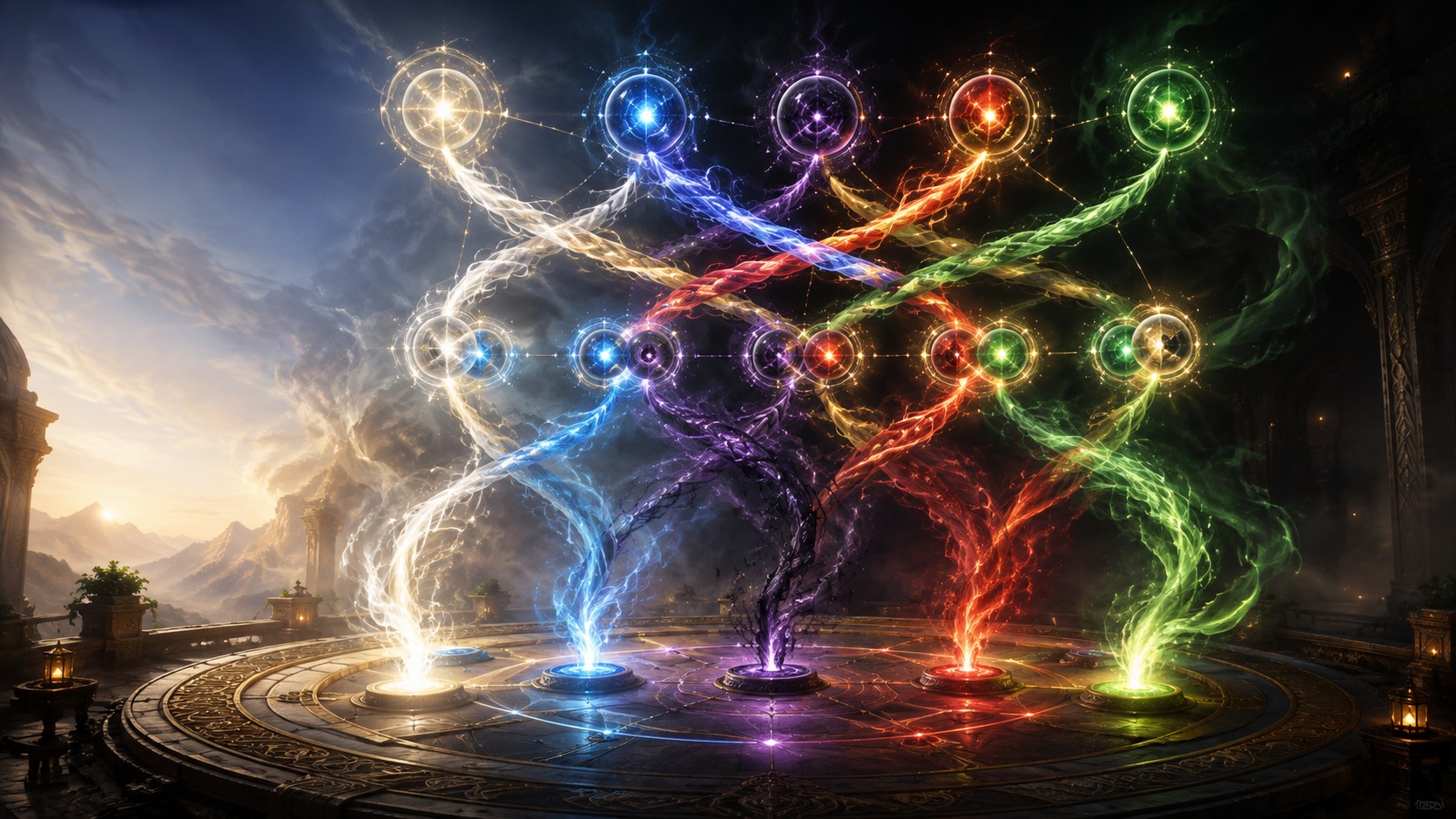
That order is the colour wheel read clockwise, and it is not arbitrary. Arrange the five colours in a pentagon in WUBRG order and two relationships fall out automatically:
Each colour is adjacent to its two allies. White sits beside blue and green.
Each colour is opposite its two enemies. White sits across from black and red.
Every naming system below is built on that geometry. Our MTG colors guide covers what each colour actually does philosophically and mechanically.
Two Colours: The Ten Ravnica Guilds
The most-used names in Magic, from the plane built around exactly ten two-colour factions.
| Guild | Colours | Pair type | Identity |
|---|---|---|---|
| Azorius | White-Blue (WU) | Allied | Law, control, taxes |
| Dimir | Blue-Black (UB) | Allied | Secrets, mill, information |
| Rakdos | Black-Red (BR) | Allied | Excess, sacrifice, damage |
| Gruul | Red-Green (RG) | Allied | Rage, big creatures, aggression |
| Selesnya | Green-White (GW) | Allied | Community, tokens, going wide |
| Orzhov | White-Black (WB) | Enemy | Debt, drain, lifegain |
| Izzet | Blue-Red (UR) | Enemy | Invention, spells, prowess |
| Golgari | Black-Green (BG) | Enemy | Decay, graveyard, counters |
| Boros | Red-White (RW) | Enemy | Order through force, aggro |
| Simic | Green-Blue (GU) | Enemy | Evolution, ramp, +1/+1 counters |
The mnemonic that actually works
The five allied guilds are the ones whose colours sit next to each other on the wheel: Azorius, Dimir, Rakdos, Gruul, Selesnya — go around the pentagon in WUBRG order and you have them in sequence. The five enemy guilds skip a colour each time: Orzhov, Izzet, Golgari, Boros, Simic. If you can recite the first five in order, the second five are just the pentagram drawn inside the same pentagon.
Three Colours: Shards and Wedges
Ten three-colour combinations, split into two groups of five by a single structural difference.
A shard is a colour plus both of its allies. A wedge is a colour plus both of its enemies.
The Five Shards (Alara, 2008)
| Shard | Colours | Centre colour | Identity |
|---|---|---|---|
| Bant | Green-White-Blue (GWU) | White | Order, exalted, protection |
| Esper | White-Blue-Black (WUB) | Blue | Artifice, control, artifacts |
| Grixis | Blue-Black-Red (UBR) | Black | Undeath, removal, value |
| Jund | Black-Red-Green (BRG) | Red | Survival, sacrifice, midrange |
| Naya | Red-Green-White (RGW) | Green | Wilderness, huge creatures |
The Five Wedges (Khans of Tarkir, 2014)
| Wedge | Colours | Centre colour | Clan colour | Identity |
|---|---|---|---|---|
| Abzan | White-Black-Green (WBG) | Black | White | Endurance, counters, resilience |
| Jeskai | Blue-Red-White (URW) | Red | Blue | Cunning, prowess, spells |
| Sultai | Black-Green-Blue (BGU) | Green | Black | Ruthlessness, graveyard, ramp |
| Mardu | Red-White-Black (RWB) | White | Red | Speed, aggression, tokens |
| Temur | Green-Blue-Red (GUR) | Blue | Green | Savagery, big spells, ferocious |
The shards got names in 2008. The wedges waited until 2014. That six-year gap is the clearest evidence of how much longer allied colour pairs were favoured in Magic's design.
Before Khans of Tarkir, wedges genuinely had no names. Players used clumsy descriptions or borrowed the name of a Commander 2013 general. The clan names landed so completely that they are now the only terms anyone uses.
Four Colours: The Nephilim
The odd one out. Four-colour names come from a five-card cycle of creatures in Guildpact (2006) — a set otherwise entirely about two-colour guilds. The Nephilim are not a faction, they have no story significance, and most were never good cards. Their names became the standard anyway, purely because nothing else was available.
| Name | Colours | Missing colour | Plain-English version |
|---|---|---|---|
| Yore-Tiller | White-Blue-Black-Red | Green | Sans green / no green |
| Glint-Eye | Blue-Black-Red-Green | White | Sans white / no white |
| Dune-Brood | Black-Red-Green-White | Blue | Sans blue / no blue |
| Ink-Treader | Red-Green-White-Blue | Black | Sans black / no black |
| Witch-Maw | Green-White-Blue-Black | Red | Sans red / no red |
Nobody actually says Yore-Tiller
In practice most players describe four-colour decks by what they are missing — "no green", "sans white" — because it is instantly parseable and the Nephilim names are not. Commander players more often reach for the four-colour legends instead: Atraxa is sans red, Breya is sans green, Kynaios and Tiro is sans black, Yidris is sans white, and Saskia is sans blue. Naming a four-colour deck after its commander is now more common than either alternative.
Five Colours and Mono-Colour
Five colours has no flavour name. Players say five-colour, WUBRG, Rainbow, or occasionally Domain after the mechanic that counts basic land types. Every set that has explored all five colours at once has treated it as a special case rather than a faction, so no name ever stuck.
Single colours are simply mono-white, mono-blue, mono-black, mono-red and mono-green. Mono-coloured decks trade the flexibility of a second colour for a consistent mana base and access to colour-specific payoffs — which in Commander is a real trade, not a downgrade.
Why This Vocabulary Persists
Two practical reasons, beyond habit.
It is shorter. "Jund" is one syllable. "Black-red-green" is four, and you have to think about the order.
It carries strategic meaning. Saying a deck is Esper communicates more than its colours — it implies control, artifacts and a particular way of winning. Saying "white-blue-black" communicates only the mana base. That extra layer is why the names survived long past the sets that produced them.
For Commander specifically, the names double as colour identity shorthand, which determines what you can legally include in a deck. A Golgari commander means every card in the deck must be black, green, colourless, or some combination — and the guild name is the fastest way to say that.
Common Misconceptions
"Shards and wedges are the same thing." Shards are a colour plus its allies. Wedges are a colour plus its enemies.
"The guild names are rules terms." None of these names appear in the Comprehensive Rules. They are entirely community and flavour vocabulary.
"WUBRG is alphabetical or arbitrary." It is the colour wheel read clockwise, which is what makes allies adjacent and enemies opposite.
"Every combination has an official name." Five-colour never got one, and the four-colour Nephilim names are barely used.
"Blue is U because of ultramarine." Blue is U because white had already taken W. That is the whole reason.
"Colour identity is the same as colour." They are different. A card's colour comes from its mana cost; its colour identity includes mana symbols in its rules text, which is what Commander deckbuilding uses.
Conclusion: Learn the Ten, Infer the Rest
If you memorise nothing else, memorise the ten guilds. They are the combinations that come up most often, they cover every two-colour deck you will ever build, and once you know which five are allied and which five are enemy, the three-colour groups organise themselves around the same wheel.
The shards and wedges follow from one question: is this colour with its friends, or with its enemies? Answer that and you already know whether you are looking for an Alara name or a Tarkir one.
And do not lose sleep over four-colour. Almost nobody says Ink-Treader out loud. Say what colour you are missing, or name the commander, and everyone at the table will know exactly what you mean.
Citations & Resources
- Wizards of the Coast: Comprehensive Rules — colour and colour identity
- Scryfall: Ravnica: City of Guilds — the origin of the guild names
- Scryfall: Shards of Alara — the origin of the shard names
- Scryfall: Khans of Tarkir — the origin of the wedge names
- Scryfall: The Nephilim cycle — the four-colour names
Related Guides
- MTG Dual, Fetch and Shock Lands — the lands that make each colour pair castable
- MTG Colors Explained — what each colour actually does, mechanically and philosophically
- The Ultimate MTG Keywords Glossary — every keyword, with a printable cheat sheet
- MTG Symbols Explained — the mana symbols behind every colour combination
- MTG Formats Explained — where colour identity rules actually bind
- How to Build an MTG Deck — choosing a colour pair for a first deck
- Best MTG Commander Decks — decks organised by colour identity
- What Surveil Means in MTG — the Dimir mechanic, and the ten guild-pair surveil lands
Frequently Asked Questions
🔗 Related Resources
More Reviews:
Related Articles
Discover MTG: Rules, Best Cards and Discover vs Cascade (2026)
Discover in MTG exiles until it hits a nonland card of mana value N or less; cast it free or keep it. Full discover rules, and discover vs cascade.
Monarch and Initiative MTG: Full Rules Explained (2026)
Monarch and the initiative in MTG reward whoever holds them and pass on combat damage. Full monarch rules, initiative rules, and why initiative got banned.
Proliferate MTG: What It Means, Rules and Best Cards (2026)
Proliferate in MTG adds one more of each counter already on the permanents and players you choose. It doesn't target. Full proliferate rules and best cards.