
Quick Verdict
Magic is not hard to learn — it is hard to buy. The rules take an afternoon and MTG Arena teaches them free. What ruins the first month is buying the wrong product before deciding which format you want to play, because a Commander deck and a Standard starter kit are almost unrelated purchases. Learn free on Arena, decide between Commander and 1v1, then buy exactly one thing. A prerelease is the best first paper event there is.
THE THREE PRODUCTS WORTH BUYING FIRST
.jpg)
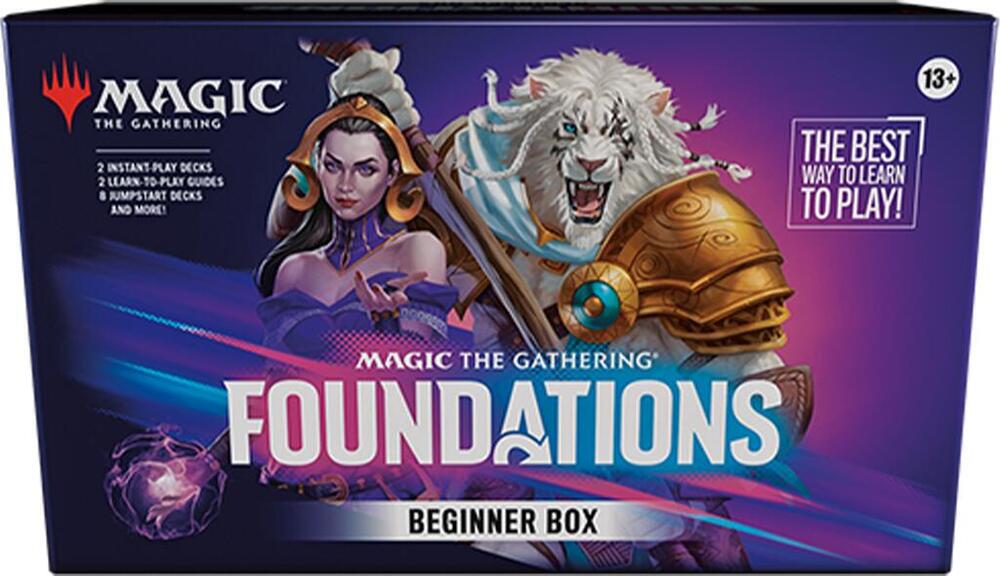
Magic: The Gathering Foundations Beginner Box
Best for two complete beginners learning together - the scripted booklet teaches the rules without a teacher
- ✓Two pre-shuffled 20-card decks (Cats and Vampires)
- ✓Playmat and a step-by-step booklet
Almost nobody bounces off Magic because the rules were too hard. They bounce off because they spent forty dollars on the wrong product, opened it, and found they still could not play a game.
Magic's rules take an afternoon. Its catalogue is thirty years deep, sold in a dozen product shapes that look interchangeable and are not, split across formats that require entirely different purchases. A booster box, a Commander precon and a starter kit sit on the same shelf at similar prices and lead to three unrelated experiences.
So this guide is ordered by decision, not by product. Learn the game free. Decide what you want to play. Then buy one thing, once.
The order is the whole trick: learn first, choose format second, buy third. Reversing any two of those is what costs people money.
Is Magic Hard to Learn?
The honest answer has two halves, and conflating them is why the question gets answered badly.
The rules are not hard. Play a land, cast spells with the mana it makes, attack, pass the turn. There are maybe six concepts you need on day one, and a digital client will enforce every one of them for you while you learn. An afternoon is genuinely enough.
The card pool is hard, permanently. There are tens of thousands of cards, and no way to know what an unfamiliar one does except to read it. You will lose games in your first months to cards you had never seen, and that is not a sign you learned something wrong.
The good news is that the second problem shrinks on its own. You never face the whole card pool — only the few hundred cards that see play in your format. After a few weeks of one format, most of what your opponents play is familiar.
The realistic timeline
Rules: an afternoon. Playing competently at a kitchen table: a few weeks. Playing genuinely well: years, because the ceiling is in card evaluation and sequencing rather than rules knowledge. Expect to lose early games to unfamiliar cards — that is the normal experience, not a failure of preparation.
Step 1: Learn It Free on Arena
MTG Arena is free on PC, Mac, Android and iOS, and no purchase is required to reach the full game. Before spending anything on cardboard, do this:
- Finish the tutorial. An in-game assistant called Sparky walks you through a first game and explains each step as it happens.
- Complete the five Color Challenges. Each teaches one colour's play pattern — how white, blue, black, red and green actually want to win. This is the part that makes card choices make sense later, and our guide to MTG colors covers the same ground in more depth.
- Play twenty games. Free, against real opponents, with the client handling all the bookkeeping.
Arena is the best teaching tool Magic has ever had because it removes every source of friction at once: it highlights which cards you can legally play, does combat maths instantly, and never lets you forget a trigger.
That is also its one weakness. When you move to paper you suddenly have to shuffle, track life totals, remember your own triggers and communicate with a person across the table. Arena teaches the rules; it does not teach the table.
For the underlying structure Arena is silently managing for you, our guides to MTG phases and turn structure and the stack are worth reading once you have played a few games and started wondering why things resolve in the order they do.
Step 2: Choose Your Format Before You Buy Anything
This is the step people skip, and it is the one that determines whether the money you spend is useful.
Commander is four players, 100-card singleton decks, one legendary creature as your commander, forty life. Games run an hour or more and are social rather than cutthroat. It is by a wide margin the most-played format, which means it is the easiest to find a game for.
Standard and other 1v1 formats are 60-card decks, twenty life, and games of fifteen to twenty minutes. Cheaper per deck, faster to learn, more focused — but you need a specific opponent.
| If… | Play | Because |
|---|---|---|
| Your friends already play something | Whatever they play | Having opponents beats every other consideration, without exception |
| Nobody around you plays | Commander | Most-played format, so the easiest to find a table for at any store |
| You want cheap and fast | Standard or 1v1 | 60-card decks cost less and games take fifteen minutes |
| You mainly want to play online | Arena | Free, instant matchmaking, no collection required to start |
The reason this matters so much: a Commander deck and a Standard deck share almost nothing. Different card counts, different card pools, different power levels, different prices. A Commander precon is useless for Standard and vice versa. Choosing after buying means one of those purchases was wasted.
Buy for the format your friends already play. A cheaper deck for a game nobody around you plays is the most expensive deck you can own.
Step 3: Buy Exactly One Thing
One product. Not a starter kit and a precon and some boosters.
| Product | Roughly | What it gives you | Buy it if |
|---|---|---|---|
| MTG Arena | Free | The full game, digitally, with the rules enforced | You are not sure you want paper yet |
| Foundations Beginner Box | Entry price | Two pre-shuffled 20-card decks (Cats and Vampires), a playmat and a scripted booklet | You are teaching yourself and a friend from zero, together |
| Starter Kit | ~$20 | Two ready 1v1 decks plus Arena codes | You want paper 1v1 with one specific opponent |
| Commander precon | $20–$45 | One complete, playable 100-card deck | Your group plays Commander — skip the beginner products entirely |
If you've decided on paper, these are the current versions of the three rows above. Pick the one that matches how you'll play, not all three.
The three products worth buying first
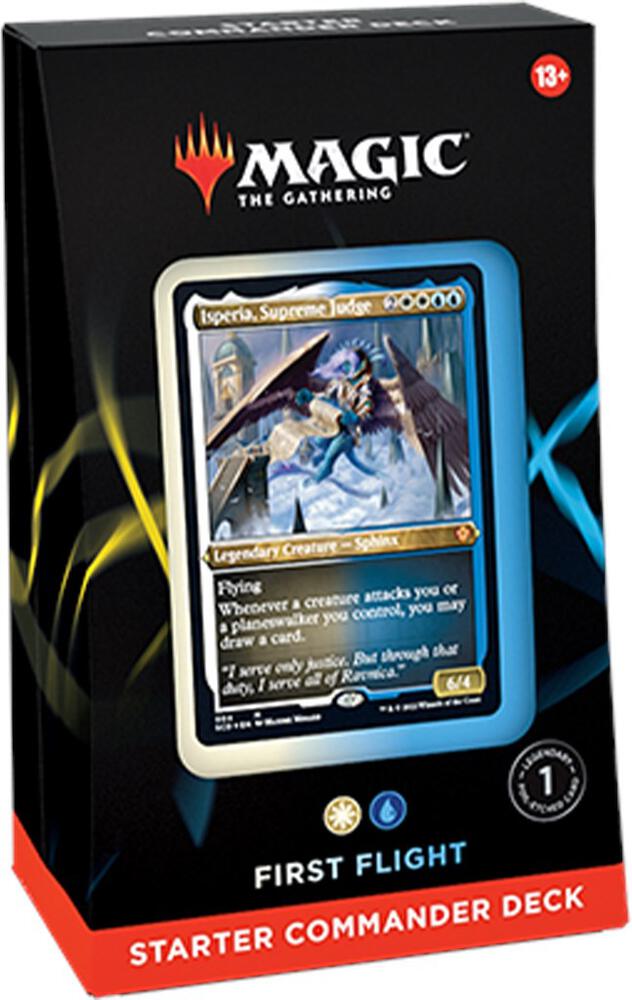
Starter Commander Deck: First Flight
built by Wizards for players new to the format
- Complete 100-card deck, ready to play
- Isperia, Supreme Judge: white-blue flyers, simple to pilot
- Designed as an entry point, not a power-level chase
Final Fantasy Starter Kit
two ready decks in one box
- Two 60-card decks: Cloud vs Sephiroth
- Includes MTG Arena codes
- Play the same night you buy it
Magic: The Gathering Foundations Beginner Box
scripted first games for two players
- Two pre-shuffled 20-card decks (Cats and Vampires)
- Playmat and a step-by-step booklet
- Teaches the rules without a teacher
If your friends play Commander, buy a precon and go straight to a real game. The beginner products teach a 1v1 game you are not going to play, and a precon is a complete deck the moment you open it.
Our guide to the best MTG starter decks compares the entry products in detail, the Foundations guide covers which Foundations product suits which player, and the best Commander precons covers the precon route.
What not to buy first
A booster box. A large payment for random cards that will not assemble into a deck. It is a product for people who already play and want to draft or open product with friends.
Singles. These only make sense once you own a deck and know which card you are improving.
Sleeves, a deck box and dice, before you own a deck. Buy protection for a deck you have decided to keep — our sleeves and deck box guides are for month two, not day one.
A Secret Lair or anything with a licence on it. Crossover products are collectibles priced for fans of the franchise. Some are not even legal in the format you picked — see every Universes Beyond set and where it is legal.
Step 4: Go to a Prerelease
Once you can play a game, the best first paper event is not Friday Night Magic — it is a prerelease.
A prerelease runs the weekend before a new set launches. Entry is roughly $25–$35 and gets you a kit with six booster packs from the unreleased set, a foil promo rare and a spindown life counter. You open the packs, build a deck from what you got, and play. You keep everything.
Why this is the ideal first event:
Nobody has a good deck. Everyone builds from random packs on the spot, so no one arrives with an expensive optimised list. Experienced players hold a small deckbuilding edge, and sealed variance flattens it more than in any other format. This is the most level playing field Magic offers.
Nobody knows the cards either. The set is not out yet. For one weekend, the card-pool problem that makes Magic hard for beginners applies to everybody in the room equally.
The value is real. Six packs plus a promo for around $30 is roughly what the packs alone cost at retail.
Most stores run several events across the weekend. Saturday afternoon is the busiest, Sunday is usually the most casual and the friendliest for a first attempt, and Friday night events often include an extra pack to compensate for a shorter three-round structure. Kits also include an Arena code for a free sealed event online.
The next one
Prereleases happen roughly every couple of months, tied to the set schedule. Reality Fracture prereleases run the weekend of 25–27 September 2026 — about four weeks out from now, which is comfortable time to learn the game first. See our complete guide to MTG formats for where each set sits in the release calendar.
After that, Friday Night Magic is the weekly version of the same thing — lower stakes, regular crowd, and the standard way people find an ongoing group.
A Realistic First Month
| When | Do | Spend |
|---|---|---|
| Day 1 | Install Arena, finish the tutorial and five Color Challenges | $0 |
| Week 1 | Play 20 Arena games. Decide: Commander or 1v1? | $0 |
| Week 2 | Buy one product for the format you chose | $20–$45 |
| Week 3 | Play it. Learn what the deck wants to do before changing anything | $0 |
| Week 4 | Sleeve the deck if you are keeping it. Book a prerelease | ~$10 + entry |
Week 3 is the step people skip. A precon is built to work as printed, and swapping cards before you understand the deck's plan reliably makes it worse. Play it ten times first — then read our guide to building an MTG deck and start changing things on purpose.
Conclusion: Sequence Beats Spending
Magic has a reputation for being expensive and complicated. It is neither, at the start. It is free to learn and a complete first deck costs less than a night out. What it is, is badly signposted — the products do not explain which format they are for, and the format decision is invisible until after you have already bought something.
So do it in the order that removes the risk. Learn on Arena, where the rules are enforced and the cost is zero. Pick the format your friends actually play. Buy one complete product for that format, and nothing else. Play it enough to understand it before you change it.
Then find a prerelease. It is the one event where being new costs you almost nothing, and it is where most people stop being someone learning Magic and start being someone who plays it.
Citations & Resources
- Wizards of the Coast: Prerelease events — official page
- Wizards of the Coast: MTG Arena — free download
- Wizards of the Coast: Comprehensive Rules
- Commander Format: Official rules and banned list
- Scryfall: Card database for looking up anything unfamiliar
Related Guides
- Magic: The Gathering Foundations Guide — which Foundations product suits which player
- Best MTG Starter Decks — the entry products compared
- Best MTG Commander Decks 2025 — the precon route
- How to Build an MTG Deck — for week four, once you understand your deck
- Complete Guide to MTG Formats — every format and what it costs to play
- How Much Does Magic Actually Cost? — real 2026 numbers for every way to play
- MTG Phases and Turn Structure — the structure Arena manages for you
- The Ultimate MTG Keywords Glossary — with a printable cheat sheet for the table
- Is Magic: The Gathering Dying? - what the 2026 revenue and player numbers actually say
Frequently Asked Questions
🔗 Related Resources
More Reviews:
Related Articles

How Much Does Magic: The Gathering Actually Cost in 2026?
How much does Magic: The Gathering cost in 2026? Free on Arena, $27–$50 for a Commander deck, and why prices rose in January. Real numbers for every way to play.

MTG Star Trek: Release Date, Products and What to Preorder
MTG Star Trek releases 13 November 2026. Every product, its MSRP, what it costs to preorder on TCGplayer today, and which ones are worth buying early.
MTG Dual Lands, Fetch Lands and Shock Lands Explained (2026)
MTG dual lands, fetch lands and shock lands explained: what each cycle does, why fetches find duals and shocks, 2026 prices, and the budget land cycles.