

Quick verdict
To explore, reveal the top card of your library. If it is a land, put it into your hand. If it is not, put a +1/+1 counter on the creature and then choose whether to leave the card on top or bin it. Explore is the rare mechanic that never whiffs — every outcome gives you something — and its real skill is the second choice, which most players make on autopilot.
WHERE TO GET EXPLORE CARDS
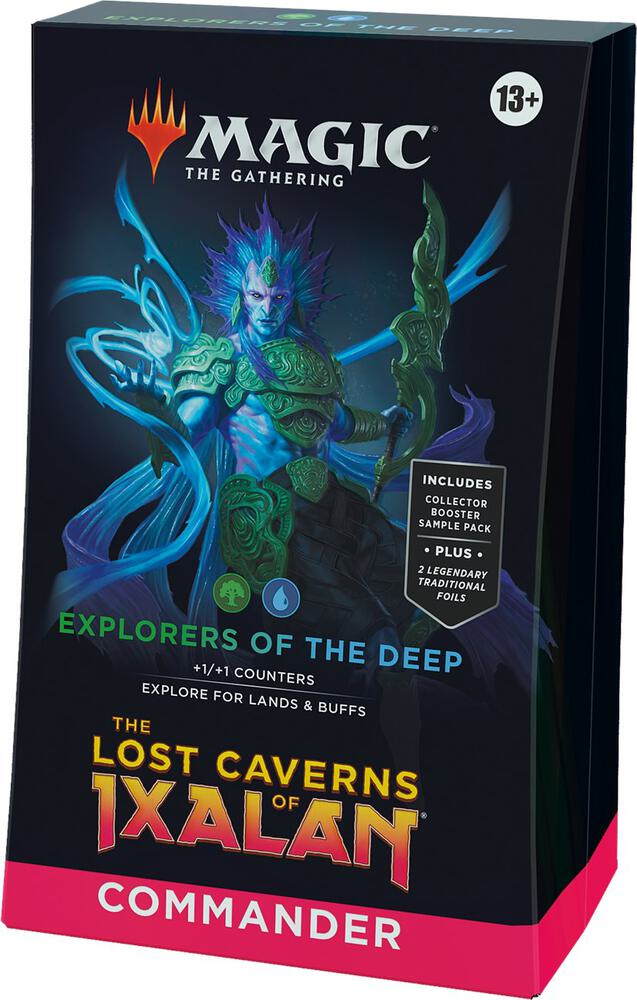
Lost Caverns of Ixalan Commander Deck: Explorers of the Deep
The explore deck - led by Hakbal, the Merfolk commander that makes the whole tribe explore every combat
- ✓Hakbal of the Surging Soul: the best explore engine in the game
- ✓Green-blue +1/+1 counters and Merfolk, ready to play
Explore in MTG is a keyword action: the creature that explores reveals the top card of your library. If it's a land, you put it into your hand. If it isn't, you put a +1/+1 counter on the creature and you may put the revealed card into your graveyard. That is the whole explore mechanic. It never does nothing, and that is why it's so good.
Almost every mechanic in Magic has a failure case. Scry can show you three cards you hate. Cascade can bin your best card. Discover can find nothing worth casting.
Explore has none. Reveal a land and it goes to your hand. Reveal anything else and your creature permanently grows, and you get to decide what your next draw is. There is no third branch, and neither branch is empty.
That guaranteed floor is why explore appears on creatures whose stat lines look underwhelming. A two-mana 2/1 that explores is not a two-mana 2/1 — it is a two-mana card that is at worst a 3/2 with a filtered draw step, and at best a land plus a body.
The catch is that the mechanic hides its skill in a place most players never look: the second choice.
The rule: reveal the top card. Land goes to hand. Nonland gives a counter, then you choose to keep or bin it.
The Explore Mechanic: Rules in MTG
Explore is a keyword action performed by a creature. The reminder text:
Reveal the top card of your library. Put that card into your hand if it's a land. Otherwise, put a +1/+1 counter on this creature, then put the card back or put it into your graveyard.
The structure is a fork with no dead end:
| You reveal | What you get | What you choose |
|---|---|---|
| A land | The land goes to your hand | Nothing — it is automatic |
| A nonland | A +1/+1 counter on the creature | Leave it on top, or bin it |
Two precision points that come up constantly:
The outcomes are exclusive. A land never gives a counter. A nonland never goes to your hand.
The creature does not need to survive. If the exploring creature is gone when the ability resolves, you still reveal and still get the land or the choice. Only the counter is lost.
Explore is not a draw
A nonland explore adds nothing to your hand. It grows a creature and rearranges the top of your library. Cards that say "draw a card" and cards that say "explores" are doing very different things, and a deck that treats explore as card draw will run out of gas.
The Choice Everyone Gets Wrong
Here is where explore stops being automatic.
You reveal a nonland. You take the counter. Now you decide: leave it on top, or put it in the graveyard?
The reflex is to leave it. Leaving it feels safe — you keep the card. But leaving a card on top means your next draw is a card you have already seen and already evaluated. If it is not a card you want right now, you have just spent your draw step on it.
Binning it turns your next draw back into an unknown card, which in most board states is worth more than a spell you cannot use.
| Revealed card | Leave on top | Bin it |
|---|---|---|
| A spell you want to cast now | Correct | Wrong |
| A spell that is dead in this matchup | Wrong — wastes your draw | Correct |
| Expensive card, early game | Usually wrong | Usually correct |
| A card with flashback or escape | Situational | Often correct — the graveyard is a second hand |
| A creature you want to reanimate | Wrong | Correct |
Explore does not ask whether you like the card. It asks whether you want to spend your next draw on it.
The last two rows are why explore is quietly strong in graveyard decks. Binning is not throwing a card away when your deck can cast things from the graveyard — it is putting the card somewhere you can still use it, which is the same logic that makes surveil better than scry in those decks.
Map Tokens
The Lost Caverns of Ixalan added a way to store explore for later.
A Map is a colourless artifact token that reads: one generic mana, tap, sacrifice this artifact — target creature you control explores. Activate only as a sorcery.
This changes the mechanic in two useful ways:
You choose the target. A normal explore trigger grows whichever creature triggered it. A Map grows whichever creature you want, which means you can aim counters at a creature with trample, or one that is about to become relevant.
You choose the timing. Holding a Map means holding a land-or-growth trigger for the turn it matters, rather than taking it on curve.
Maps also make explore work with the whole artifact ecosystem — sacrifice outlets, artifact count matters, and treasure-style payoffs.
Explore Payoffs Worth Building Around
Hakbal of the Surging Soul — makes each Merfolk you control explore at the beginning of combat. In a Merfolk deck this is many explores per turn, and it is the reason Merfolk is explore's home tribe.
Path of Discovery — every creature that enters under your control explores. A single enchantment that converts your whole curve into land-or-growth.
Amalia Benavides Aguirre — a counters-and-lifegain engine that treats explore's +1/+1 counters as fuel.
Nicanzil, Current Conductor and Wayward Swordtooth — both turn the lands explore finds into actual acceleration, by letting you play extra lands or by putting lands directly onto the battlefield.
Over the Edge — a two-mana way to bolt an explore onto a turn you were spending anyway. Miner's Guidewing — a one-mana flier that hands an explore to a creature of your choice when it dies, so even the trade is value.
The land-count interaction
Explore's payout distribution is directly tied to your land count. A deck with 24 lands in 60 cards hits a land about 40% of the time; a Commander deck with 38 in 99 is close to the same. If you build a deck heavy on explore and then cut lands because "explore finds them", you have inverted the mechanic — fewer lands means fewer lands found and more counters you did not need.
In Commander
Explore is strong in Commander for three reasons.
Games are long enough for counters to matter. A +1/+1 counter on turn three is small. Eight of them across a board by turn nine is a real threat.
Land drops stay relevant later. Missing a land drop in Commander is punishing well into the mid-game, and explore smooths that without running more lands.
It is repeatable in a way constructed cannot support. Hakbal, Path of Discovery and Map generation give per-turn engines that a 60-card format rarely has room for.
The main caution is that explore is slow value, not interaction. A deck built entirely on explore triggers grows steadily and does nothing about what the rest of the table is doing. Explore is a support mechanic; it needs a plan attached to it.
History
Explore debuted in Ixalan in September 2017 as the green-blue mechanic of the set's Merfolk and dinosaur factions, and returned in Rivals of Ixalan.
Its real expansion came with The Lost Caverns of Ixalan in November 2023, which brought explore back alongside Map tokens and a much wider set of payoffs — and, notably, alongside discover, giving that set two separate top-of-library mechanics.
Around 46 cards reference exploring, plus everything that produces Maps. It has since appeared outside Ixalan blocks, including on Seasoned Dungeoneer from Baldur's Gate and Astrid Peth from Doctor Who, which suggests Wizards now treats it as a portable mechanic rather than a plane-specific one.
Common Misconceptions
"Explore draws a card." Only when it reveals a land. Otherwise it is a counter and a choice.
"I get a counter and the land." Never both. The outcomes are exclusive.
"Always leave the card on top." This is the most common real mistake. Binning is often correct.
"Explore does nothing if the creature dies." The reveal and the land still happen; only the counter is lost.
"Explore twice means reveal two cards at once." Two sequential explores. If you leave the first card on top, you reveal it again.
"Explore is ramp." It is partly ramp, in proportion to your land count, and partly growth. Do not cut lands for it.
Conclusion: The Value Is in the Second Choice
Explore is the friendliest keyword Magic has printed in a decade. There is no failure case, no timing trap, and no interaction that turns it off. That is exactly why it is easy to play badly — a mechanic that always gives you something rarely gets thought about.
The land half plays itself. The nonland half does not. Every time you leave a card on top you are choosing to spend your next draw on a card you have already rejected once, and over a long game that adds up to real cards lost.
Build it with a graveyard plan if you can, hold your Maps for the creature that matters, and above all keep your land count honest. Explore rewards a deck that was going to work anyway; it does not rescue one that was not.
Citations & Resources
- Wizards of the Coast: Comprehensive Rules — explore and keyword actions
- Scryfall: Every card that causes a creature to explore
- Scryfall: Ixalan — where explore debuted
- Scryfall: The Lost Caverns of Ixalan — Map tokens and the explore revival
Related Guides
- The Ultimate MTG Keywords Glossary — every keyword, with a printable cheat sheet
- The Ultimate Guide to MTG Counters — what explore's +1/+1 counters interact with
- What Surveil Means in MTG — the same bin-or-keep logic, on a different keyword
- What Scry Means in MTG — the other top-of-library filter
- MTG Discover Explained — the other Lost Caverns of Ixalan library mechanic
- MTG Phases and Turn Structure — when a beginning-of-combat explore trigger fires
- Best MTG Commander Decks — where Hakbal and Path of Discovery live
Frequently Asked Questions
🔗 Related Resources
More Reviews:
Related Articles
Discover MTG: Rules, Best Cards and Discover vs Cascade (2026)
Discover in MTG exiles until it hits a nonland card of mana value N or less; cast it free or keep it. Full discover rules, and discover vs cascade.

Monarch and Initiative MTG: Full Rules Explained (2026)
Monarch and the initiative in MTG reward whoever holds them and pass on combat damage. Full monarch rules, initiative rules, and why initiative got banned.
Proliferate MTG: What It Means, Rules and Best Cards (2026)
Proliferate in MTG adds one more of each counter already on the permanents and players you choose. It doesn't target. Full proliferate rules and best cards.