Quick Verdict
A historic crossover that brings the best of Assassin's Creed lore to Magic: The Gathering, featuring exclusive serialized chase cards and powerful Modern staples.
SEALED PRODUCTS
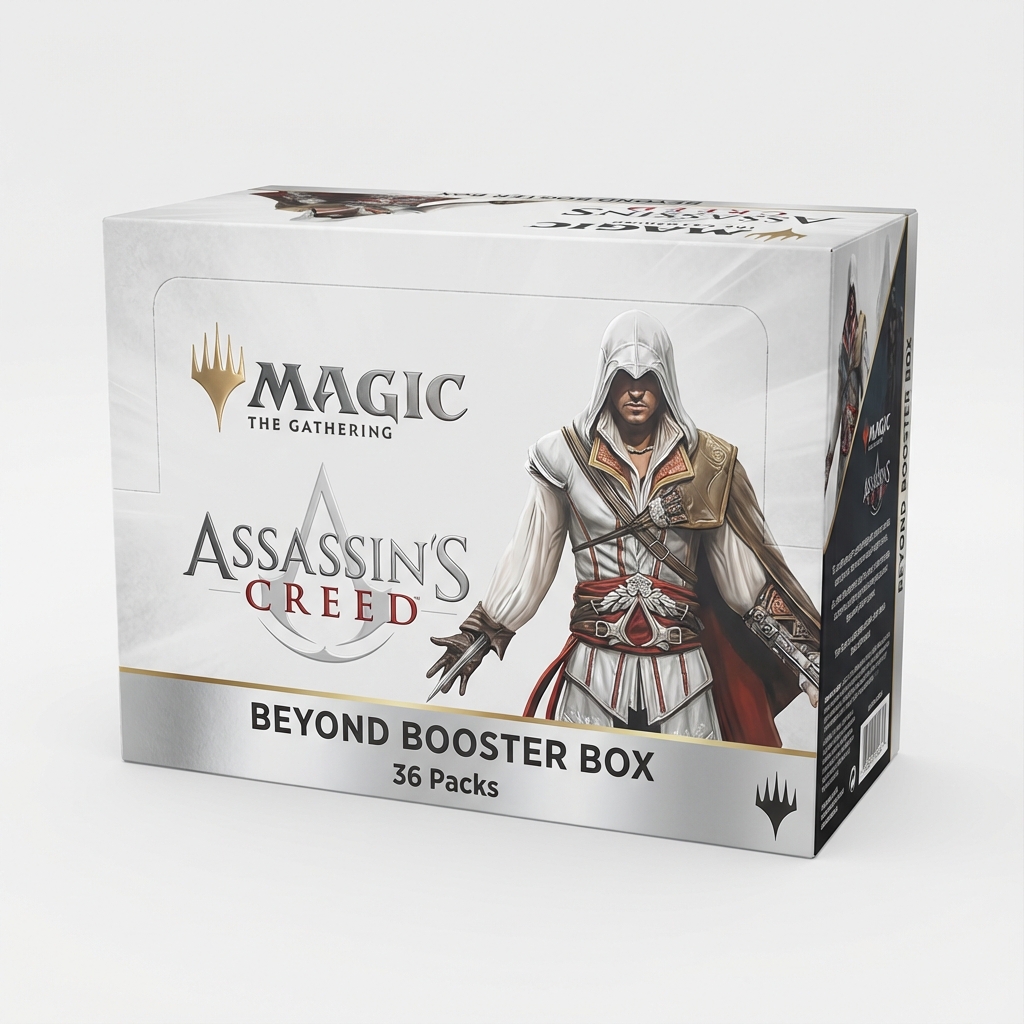
Assassin's Creed Beyond Booster Box
Best for Casual Opening - The standard entry point for the set
- ✓Contains 24 Beyond Booster packs (7 cards each)
- ✓Up to 4 rares per pack

Assassin's Creed Collector Booster Box
For Collectors - Hunt for serialized Historical Figures and Textured Foils
- ✓Contains 12 Collector Booster packs
- ✓Only place to find Textured Foils
"Nothing is true, everything is permitted." This maxim from the Assassin Brotherhood now applies to Magic: The Gathering's modern era. With Magic: The Gathering — Assassin’s Creed, Wizards of the Coast brought one of gaming's best-known franchises to the tabletop.
But this isn't just a reskin or a simple Secret Lair drop. This is a fully fleshed-out "Universes Beyond" set, legal in Modern, that translates the parkour, stealth, and political intrigue of the games into cold, hard cardboard mechanics. Whether you're a Vorthos who knows every ancestor in Desmond's DNA or a Spike looking for the next Modern staple, this set demands your attention.
This guide covers the chase cards, how the Beyond Booster works, and how to build around the Assassin commanders.
Set Overview: A New Era of Universes Beyond
Released on July 5, 2024, Assassin's Creed represents a new product category for Magic: The Gathering. It sits between a full Draft set (like The Brothers' War) and a purely supplemental release (like March of the Machine: The Aftermath).
CRITICAL INTEL: Unlike most Commander-focused crossovers, Assassin's Creed is Modern Legal. This means cards like Ezio Auditore and the Sword of Feast and Famine reprint are playable in one of Magic's most competitive formats, alongside Legacy, Vintage, and Commander.
Wizards lists the set as legal in Modern, Commander, Legacy and Vintage. It isn't legal in Standard or Pioneer, it isn't draftable, and it isn't on MTG Arena.
Mechanics Deep Dive: Parkour and Memory
The designers have translated the visceral feeling of Assassin's Creed gameplay—running across rooftops, blending into crowds, and reliving genetic memories—into a few distinct mechanics.
1. Freerunning (Alternative Cost)
Freerunning is the signature mechanic of the set, representing the Assassin's agility.
- How it works: You can cast a spell for its Freerunning cost (usually cheaper) if you dealt combat damage to a player with an Assassin or Commander this turn.
- Tactical Advantage: This functions similarly to Spectacle or Prowl. It rewards aggression and evasion. Cheap unblockable creatures that count as Assassins (like Changeling Outcast) switch it on early, so your later Assassins come down cheaper.
2. The "Historic" Mechanic
Returning from Dominaria, the Historic mechanic cares about three things: Artifacts, Sagas, and Legendary spells.
- Flavor Win: This is a perfect ludonarrative match. The Assassin's Creed games are literally about exploring history (Sagas), finding Pieces of Eden (Artifacts), and meeting historical figures (Legendaries).
- Synergy: Decks built around this set lean on legendary permanents and artifacts. Abstergo Entertainment, for example, is a legendary land with an activated ability: {3}, {T}, exile it to return up to one historic card from your graveyard to your hand, then exile all graveyards.
3. Disguise & Cloak (Stealth)
Disguise and cloak, the face-down mechanics from Murders at Karlov Manor, return here to represent blending into a crowd. Arno Dorian, Aveline de Grandpré and Bayek of Siwa have disguise, and Become Anonymous uses cloak.
Commander Strategy Guide: The Three Masters
The set gives us three distinct directions for Commander decks, each centered on a different protagonist.
1. The Master Assassin: Ezio Auditore da Firenze
Archetype: 5-Color Assassin Tribal / Alternate Win Power Level: High
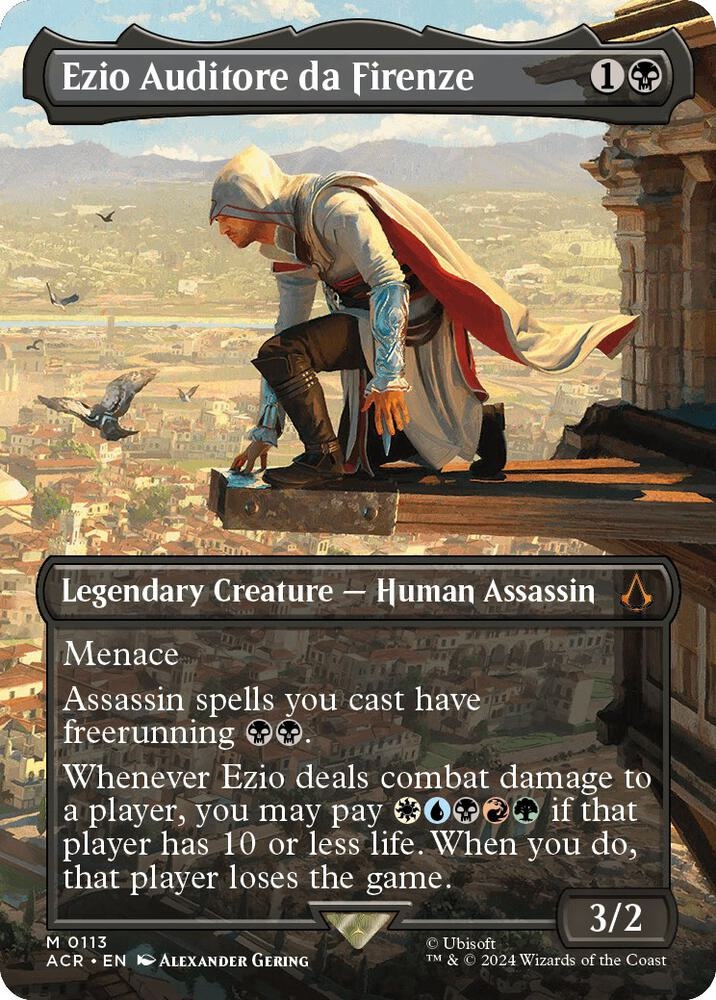
Ezio Auditore da Firenze
The face of the set. A two-mana 3/2 with menace whose rules text includes WUBRG, so his commander colour identity is all five colours. Your other Assassin spells get freerunning for two black mana.
Colors: 5-Color identity (black mana cost)
Key Trait: Alternate win on combat damage
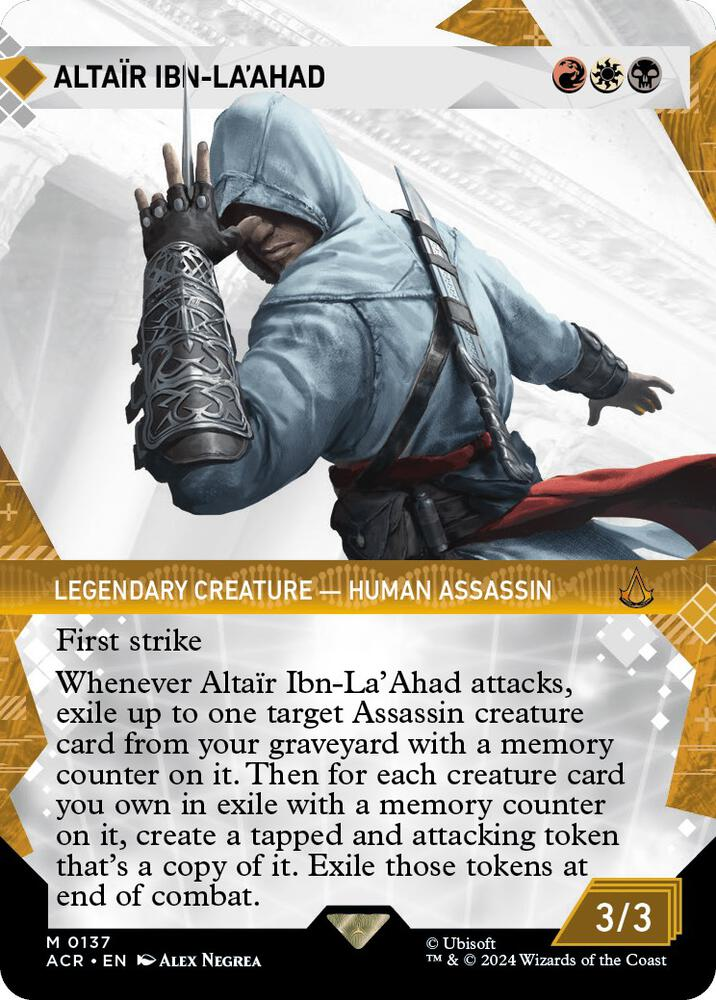
Altaïr Ibn-La'Ahad
The legendary ancestor. When Altaïr attacks, he exiles an Assassin creature card from your graveyard with a memory counter, then makes tapped and attacking token copies of every creature card you own in exile with a memory counter.
Archetype: Mardu Attack Triggers
Power: Temporary attacking copies
The Strategy: Ezio gives you all five colours for a two-mana commander. His win condition: whenever he deals combat damage to a player, you may pay {W}{U}{B}{R}{G} if that player has 10 or less life. If you do, that player loses the game.
- Early Game: Play cheap unblockable Assassins like Changeling Outcast (a changeling, so it counts as an Assassin). Connecting turns on freerunning.
- Mid Game: Cast Ezio for {1}{B}. Once an Assassin or your commander has dealt combat damage to a player this turn, your other Assassin spells can be cast for {B}{B}.
- The Kill: Use Sorin Markov or Magister Sphinx to set an opponent's life to 10, then connect with Ezio (he has menace) and pay WUBRG.
2. The Mentor: Altaïr Ibn-La'Ahad
Archetype: Mardu (R/W/B) Attack Triggers / Memory Power Level: Mid-High (Casual Stompy)
Altaïr is about building an army of memories. He's a {R}{W}{B} 3/3 with first strike. When he attacks, he exiles up to one Assassin creature card from your graveyard with a memory counter. Then, for each creature card you own in exile with a memory counter, he creates a tapped and attacking token copy of it. Those tokens are exiled at end of combat.
- The Engine: You need to fill your graveyard. Cards like Entomb, Buried Alive, and loot effects (Faithless Looting) are essential.
- The Payoff: Only Assassin creature cards can be exiled this way, so non-Assassins like Master of Cruelties (a Demon) don't work. The copies enter already attacking, so "whenever this attacks" abilities won't trigger; Assassins with combat-damage triggers are the best targets.
- Key Card: Reconnaissance allows you to attack safely with Altaïr to get the triggers, then untap him so he doesn't die in combat.
3. The Pirate: Edward Kenway
Archetype: Grixis (U/B/R) Vehicles & Treasure Power Level: Mid
Edward brings the Golden Age of Piracy to Magic. He's a {2}{U}{B}{R} 5/5 who cares about three things: Assassins, Pirates and Vehicles.
- The Jackdaw: At the beginning of your end step, Edward creates a Treasure token for each tapped Assassin, Pirate and/or Vehicle you control. Attacking and crewing both tap creatures, so Vehicles like Smuggler's Copter pay you back in Treasure. The Reaver Cleaver (red Equipment) adds more Treasure on combat damage.
- Theft: Whenever a Vehicle you control deals combat damage to a player, Edward exiles the top card of their library face down and you may play it. He fits a "Steal Your Stuff" shell alongside Admiral Beckett Brass.
Top Chase Cards & Financial Analysis
The "Beyond Booster" has 7 cards per pack and up to 4 rares, but the scarcest versions (textured foil, foil-etched and serialized) are only in Collector Boosters.
The Big Hitters
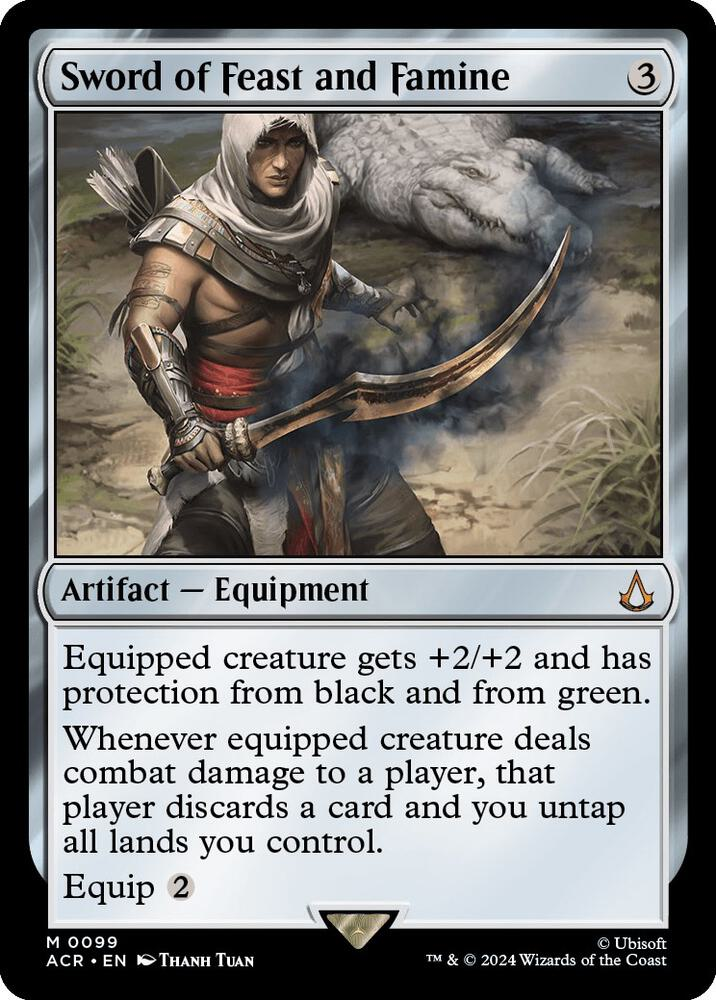
Sword of Feast and Famine
The best-known reprint in the set, about $36.90 on Scryfall in October 2026. Protection from black and green stops Orcish Bowmasters from pinging the equipped creature and Tarmogoyf from blocking it, and untapping all your lands on combat damage is strong in Commander.
Format: Modern/Commander
Price Stability: High
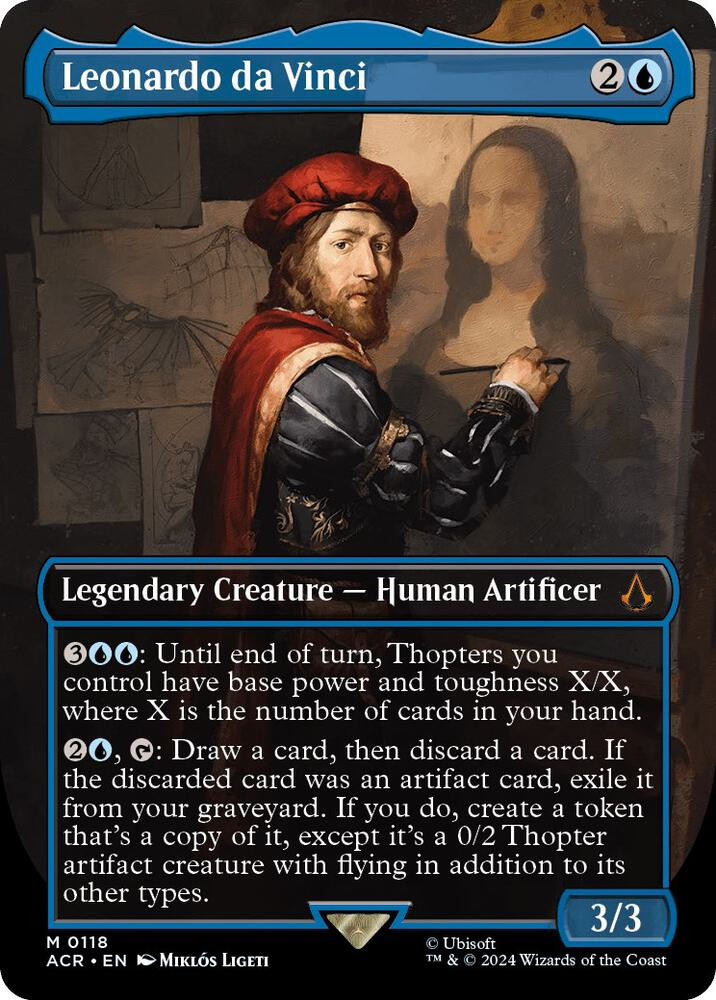
Leonardo da Vinci (Serialized)
The serialized /500 cards are the lottery tickets of the set. Leonardo is printed in Italian.
Copies: 500
Value: about $2,035 on Scryfall (Oct 2026)
Beyond Boosters vs. Collector Boosters: The Math
This set introduced the Beyond Booster, a 7-card pack built for opening rather than drafting.
- Beyond Booster: One guaranteed rare or mythic, and up to 4 in total. Good for casual opening, but poor for hunting specific variants. You CANNOT open Textured Foils, foil-etched cards or Serialized cards here.
- Collector Booster (about $47 a pack at the October 2026 box price): This is the only place to find the textured foil memory corridor mythics (including Ezio), the foil-etched cards and the serialized cards.
- Verdict: If you want specific cards, buy singles. If you want to gamble, Collector Boosters have the only "jackpot" potential.
Product Breakdown: Beyond vs. Collector Boosters
Beyond Booster Box
The standard entry point. Contains 24 packs with 7 cards each. The set is non-draftable, so this is for casual opening.
Collector Booster Box
The premium choice. Contains 12 packs packed with foils, rares, and the chance for serialized cards. The only place to find textured foils.
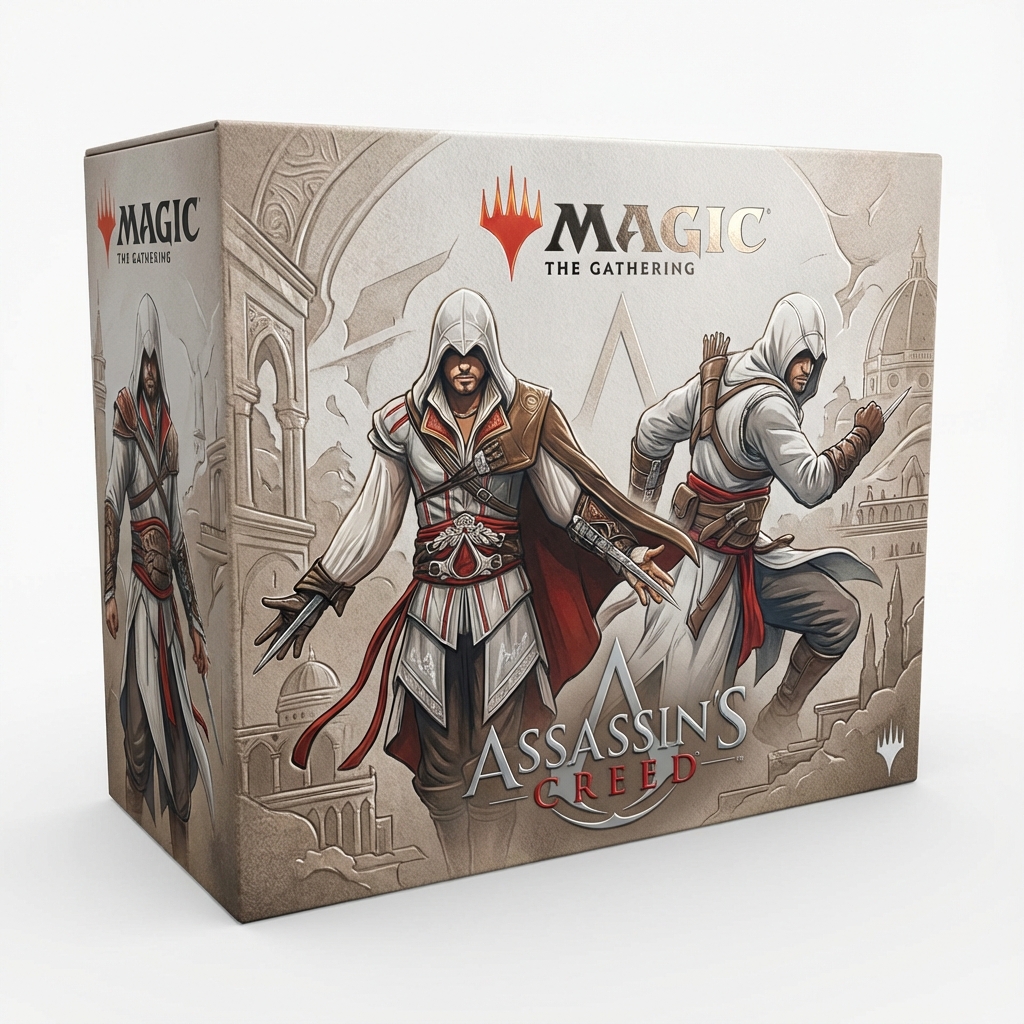
Bundle
Includes 9 Beyond Boosters, a traditional foil alt-art Royal Assassin promo, 20 foil and 20 non-foil full-art lands, a spindown life counter and a storage box.
Confused by the new "Beyond Booster"? Use this chart to decide which pack is right for you.
| Feature | Beyond Boosters | Collector Boosters |
|---|---|---|
| Packs Per Box | 24 | 12 |
| Cards Per Pack | 7 (incl. a token or art card) | 10 + a foil token |
| Rares/Mythics | 1-4 per pack | 4-5 per pack |
| Exclusives | Art cards | Textured foils, foil-etched & serialized |
Collector's Guide: Hunting for Relics
If you're hunting for value, the Collector Boosters are where the real treasure lies.
Textured Foils
The memory corridor showcase frame, inspired by the games, is on 28 cards. The 5 mythic rares in that frame also come as Textured Foils, exclusive to Collector Boosters, and each has a background unique to its character. The textured foil Ezio was about $52.54 on Scryfall in October 2026.
Serialized Historical Figures
For the high-end investor, the chase is all about the Serialized Historical Figures. There are 500 copies each of four cards:
- Leonardo da Vinci (Italian) - about $2,035 on Scryfall, October 2026
- Cleopatra, Exiled Pharaoh (Greek) - no Scryfall price listed
- Sokrates, Athenian Teacher (Greek) - about $824
- Mary Read and Anne Bonny (English) - about $600
Leonardo, Cleopatra and Sokrates are printed in the language the character spoke. All four use the double rainbow foil treatment.
Advisory: Serialized cards are highly liquid but volatile. Always check the latest sold listings on TCGPlayer or eBay before buying or trading.
Meet the Assassins: Who Are They?
For Magic players who haven't played the games, here is a quick dossier on the key legends you'll find in the set.
Altaïr Ibn-La'Ahad (The Pioneer)
- Era: Third Crusade (1191 AD)
- The Lore: The original protagonist, who reshaped the Brotherhood. He wrote the Codex and established many of the tenets used by future assassins.
- The Card: He exiles Assassins from your graveyard with memory counters and brings them back as temporary attacking copies, a nod to reliving ancestors' memories.
Ezio Auditore da Firenze (The Master)
- Era: Italian Renaissance (1476 AD)
- The Lore: A charismatic nobleman turned assassin after his family was executed. He is arguably the most beloved character in the franchise, known for rebuilding the Brotherhood in Rome and Constantinople.
- The Card: His five-colour identity represents his mastery of all aspects of the creed. Making an opponent at 10 or less life lose when he connects mirrors his "Hidden Blade" assassinations.
Edward Kenway (The Pirate)
- Era: Golden Age of Piracy (1715 AD)
- The Lore: A privateer turned pirate turned assassin. He is the grandfather of Connor Kenway (Assassin's Creed III) and is more interested in gold and glory than the creed's philosophy initially.
- The Card: Treasure for tapped Assassins, Pirates and Vehicles (his ship, the Jackdaw) is a literal translation of his pirate lifestyle.
Eivor Varinsdottir (The Viking)
- Era: Viking Invasion of England (873 AD)
- The Lore: A fierce Viking raider who becomes entangled in the Assassin-Templar conflict. She builds a settlement in England, seeking glory for her clan.
- The Card: She has two cards. Eivor, Battle-Ready (Boros) is the Equipment one: whenever she attacks, she deals damage to each opponent equal to the number of Equipment you control. Eivor, Wolf-Kissed (Naya) is a 7/6 with trample and haste that mills cards on combat damage and lets you put a Saga and/or a land from among them onto the battlefield.
Flavor Wins & Easter Eggs
The set is packed with subtle nods that only hardcore fans will notice.
- Haystack: One of the funniest cards in the set. It's an artifact that lets you pay {2} and tap it to phase out a creature you control. In the games, hiding in a haystack makes you invisible to guards. In Magic, it saves your creature from removal. Perfection.
- Excalibur, Sword of Eden: Finally, the legendary sword makes its debut. It gives a creature +10/+0, referencing its god-like power in Assassin's Creed Valhalla.
- The Animus: A legendary artifact that exiles legendary creature cards from graveyards with memory counters, then lets a legendary creature you control become a copy of one of them until your next turn. That's "reliving memories" as a copy effect.
Set Pros & Cons
Should you buy sealed product or singles? Here's our breakdown:
Why We Love It
- Incredible art direction that respects the source material
- High-value reprints like Sword of Feast and Famine
- Modern legality adds long-term value to staples
Considerations
- High cost per card in Beyond Boosters ($5-7 for 7 cards)
- Small set size (105 cards plus 10 full-art basics) leads to frequent duplicates in boxes
- Non-draftable nature limits gameplay options
Conclusion
Magic: The Gathering — Assassin’s Creed is a triumph for collectors and Vorthos players. While the pack structure (Beyond Boosters) is a bit controversial due to the price-per-card, the singles market is thriving with amazing treatments.
Whether you're building an Ezio Commander deck or hunting for that elusive serialized Leonardo, this set offers a unique blend of history and fantasy that fits perfectly into the Magic multiverse.
The Assassin Timeline
From Altaïr in the Crusades to Eivor in the Viking Age, the set spans over a thousand years of human history, all connected by the Brotherhood.
- 49 BC: Cleopatra (Ancient Egypt)
- 1191 AD: Altaïr Ibn-La'Ahad (Holy Land)
- 1476 AD: Ezio Auditore (Renaissance)
- 1715 AD: Edward Kenway (Golden Age)
Related Guides
- Most Valuable MTG Cards 2026 — how serialized cards are valued across the market
- How to Value MTG Cards — pricing chase cards before you buy or sell
- Where to Sell MTG Cards — the right venue for a serialized single
- Complete Guide to MTG Formats — what Modern legality means for this set
- Best MTG Sleeves 2026 — protecting the chase cards you pull
- Every Universes Beyond Set — where Assassin's Creed sits in the crossover line