

Quick verdict
Convoke lets you tap creatures while casting a spell, and each creature tapped pays for one generic mana or one mana of that creature's own colour. Because tapping for convoke is a cost rather than an activated ability, summoning sickness does not prevent it — a creature that entered this turn can convoke immediately. Convoke never reduces the spell's mana value, which matters for everything that cares about cost.
WHERE TO FIND CONVOKE CARDS
Convoke in MTG lets your creatures help cast a spell: each creature you tap while casting it pays for {1} or for one mana of that creature's color. Convoke doesn't use the tap symbol, so creatures that just entered can convoke too. A wide board turns an expensive spell into a free one.
Magic normally keeps its resources in separate boxes. Lands make mana. Creatures attack and block. Ramp moves you up the curve by adding lands or mana rocks, and the two systems rarely touch.
Convoke tears that wall down. Your board of creatures is your mana, on demand, for one spell.
The consequence is a curve that does not behave like a curve. A deck with four creatures on turn three does not have three mana available — it has up to seven. And the creatures do not need to have been there long, because of a rules detail that surprises almost everyone the first time they meet it: summoning sickness does not stop convoke.
A token created this turn can pay for a spell this turn. That is the whole engine.
The rule: tap untapped creatures while casting; each pays one generic or one mana of its own colour.
Convoke Rules in MTG
Convoke is a static ability that provides an alternative way to pay. The reminder text:
Your creatures can help cast this spell. Each creature you tap while casting this spell pays for {1} or one mana of that creature's color.
Four points that decide every convoke:
You tap while casting. This happens during the process of casting the spell, as you pay costs.
Each creature pays exactly one. Not one per power, not one per colour it has — one mana, full stop.
Generic or its own colour. A green creature pays {1} or {G}. A white-blue creature pays {1}, {W} or {U}. A colourless creature pays {1} only.
The creature must be untapped. Already-tapped creatures cannot help.
| Creature tapped | Can pay for | Cannot pay for |
|---|---|---|
| A green creature | {1} or {G} | {W}, {U}, {B} or {R} |
| A white-blue creature | {1}, {W} or {U} | {B}, {R} or {G} |
| A colourless creature | {1} only | Any coloured mana |
| A creature that entered this turn | Normally — summoning sickness is irrelevant | Nothing extra |
| A creature that already attacked | Nothing — it is tapped | Unless it has vigilance |
The summoning sickness rule is the whole mechanic
Tapping for convoke is paying a cost, not activating an ability with the tap symbol. Summoning sickness only prevents attacking and activating abilities with {T} in the cost. It has no bearing on convoke at all. This is why token decks and convoke are permanently married: make three tokens, tap all three for the next spell, on the same turn.
The Mana Maths
Convoke's real effect is on your effective curve. Worked through with a board of four creatures on turn three:
| Situation | Lands available | Creatures available | Effective mana |
|---|---|---|---|
| Turn 3, no creatures | 3 | 0 | 3 |
| Turn 3, two creatures | 3 | 2 | 5 |
| Turn 3, four creatures | 3 | 4 | 7 |
| Turn 3, four creatures, one attacked | 3 | 3 | 6 |
| Turn 4, wide token board of 6 | 4 | 6 | 10 |
The trade is explicit and it is the mechanic's only real cost: every creature you convoke with is a creature that cannot attack or block this turn. Convoke converts board presence into mana, one for one, for one turn.
Convoke does not make your spells cheaper. It lets you spend your board instead of your lands, and that is a different bargain entirely.
What Convoke Does Not Do
The most common misunderstanding, and it has real consequences.
Convoke does not reduce mana value. A five-mana spell paid for entirely with five creatures still has mana value five. That matters for:
- Cascade, which looks for a card that costs less than the cascading spell
- Discover N, which caps at mana value N
- Counterspells and effects that check cost thresholds
- Anything reading "mana value X or less"
Our guides to cascade and discover cover why the distinction between what a spell costs and how you paid comes up constantly.
Convoke does not untap anything. It only taps.
Convoke cannot pay for costs that are not mana. A spell with an additional cost of sacrificing a creature or discarding a card still requires that.
Convoke does not generate floating mana. Tapping five creatures for a three-mana spell wastes two of them. Tap exactly what you need.
The Cards Worth Knowing
Chord of Calling — {X}{G}{G}{G}, instant speed, search your library for a creature with mana value X or less and put it directly onto the battlefield. The definitive convoke card, because a wide board pays for a large X and is exactly the board state where you want a specific creature immediately.
March of the Multitudes — {X}{G}{W}{W}, instant speed, X 1/1 lifelink Soldier tokens. It makes the creatures that pay for the next one.
Knight-Errant of Eos — convoke plus a payoff that scales with how many creatures convoked it, turning the mechanic's cost into its own reward.
Hour of Reckoning — seven mana, destroy all nontoken creatures, convoked by the token board that walks away from it. A one-sided wrath a Selesnya deck can cast for almost nothing, precisely because the creatures paying for it are the ones the spell does not touch.
Clever Concealment and Lethal Scheme — modern instants that let you convoke at the exact moment your board is about to be answered.
Just over 100 cards now carry the keyword.
In Commander
Convoke is strong in Commander for a reason that does not apply in constructed: the boards are enormous.
A token deck in a four-player game routinely has eight or more creatures by turn six. That is eight extra mana available for a single spell, on top of your lands — enough to cast something the format considers a finisher, several turns early.
Three things to build around:
Token producers first. Convoke is only as good as your creature count, and tokens are the cheapest creature count there is.
Vigilance is a genuine payoff. Attacking normally taps your creatures out of convoke range. Vigilance lets you attack and convoke with the same board in the same turn.
Instant-speed convoke is the strong version. Holding Chord of Calling or Clever Concealment means your untapped board is simultaneously a blocking wall and a mana pool, which is exactly the kind of double duty that wins multiplayer games.
The main caution is board wipes. A convoke deck's mana base is its creatures, so a wrath does not just cost you a board — it costs you the ability to cast your way back out.
History
Convoke debuted in Ravnica: City of Guilds in October 2005 as the mechanic of the Selesnya conclave, whose whole flavour is a community pooling its strength. It is one of the cleanest mechanic-to-flavour matches Magic has ever printed.
It sat out the Return to Ravnica block — Selesnya's mechanic there was populate — and came back to the plane in Guilds of Ravnica in 2018. It has since escaped Ravnica entirely, with its two largest showings in Magic 2015 and March of the Machine, and further cards in Duskmourn, Lorwyn Eclipsed and the 2026 Commander sets.
Its power level is usually controlled by the same lever: convoke cards are printed at costs that assume you have a board, so they are dead early and excellent late. That self-balancing property is why the keyword has aged as well as it has — but it is not a guarantee. Hogaak, Arisen Necropolis pairs convoke with delve so that it can be cast without spending mana at all, and it is banned in Modern. The lesson is the usual one: convoke is safe right up until a card lets you pay the entire cost with something other than mana.
Common Misconceptions
"Summoning sick creatures can't convoke." They can. This is the biggest one.
"Convoke reduces the spell's cost." It changes how you pay. Mana value is unchanged.
"Each creature pays one mana per power." One mana per creature, regardless of size.
"A green creature can pay for any colour." Only generic, or its own colour.
"I can convoke with a creature that attacked." Only if it has vigilance and is still untapped.
"Over-convoking gives me floating mana." It does not. Excess creatures are simply wasted.
Where to Find Convoke Cards
Convoke is back in current Standard: Lorwyn Eclipsed (January 2026) has more new convoke cards than any set since March of the Machine.
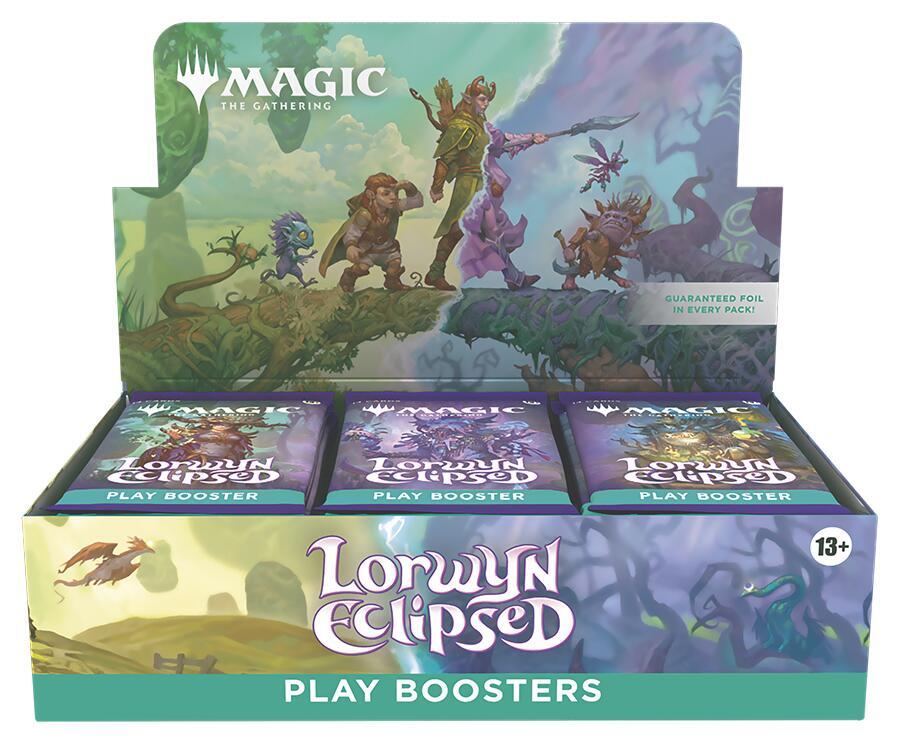
Lorwyn Eclipsed Play Booster Box
- Released January 2026
- Standard-legal
- Trading below its ~$130 MSRP
Conclusion: Spend the Board, Not the Turn
Convoke is one of the oldest mechanics in Magic and still one of the best-designed, because its cost and its benefit are the same resource. The wider your board, the more mana you have — and the more you spend, the less board you have to attack or block with this turn.
The rule that unlocks it is the one nobody expects. Summoning sickness does not apply, so tokens made this turn can pay for a spell this turn, and a deck that makes creatures cheaply is a deck that makes mana cheaply.
Just keep the distinction straight when it matters. However you paid for it, the spell still costs what it says. Cascade, discover and everything else that reads a mana value will see the printed number, not the creatures you tapped.
Citations & Resources
- Wizards of the Coast: Comprehensive Rules — convoke and alternative costs
- Scryfall: Every card with convoke
- Scryfall: Ravnica: City of Guilds — where convoke debuted
- Scryfall: Chord of Calling — the definitive convoke card
Related Guides
- The Ultimate MTG Keywords Glossary — every keyword, with a printable cheat sheet
- What Does Cascade Mean in MTG — why convoke never changes what a spell costs
- MTG Discover Explained — the same mana-value distinction, on a fixed ceiling
- MTG Vigilance Explained — attacking and convoking with the same creatures
- MTG Color Combination Names — why convoke is a Selesnya mechanic
- MTG Phases and Turn Structure — when instant-speed convoke is at its best
- Best MTG Commander Decks — where wide token boards live
Frequently Asked Questions
🔗 Related Resources
More Reviews:
Related Articles

Discover MTG: Rules, Best Cards and Discover vs Cascade (2026)
Discover in MTG exiles until it hits a nonland card of mana value N or less; cast it free or keep it. Full discover rules, and discover vs cascade.

Monarch and Initiative MTG: Full Rules Explained (2026)
Monarch and the initiative in MTG reward whoever holds them and pass on combat damage. Full monarch rules, initiative rules, and why initiative got banned.

Proliferate MTG: What It Means, Rules and Best Cards (2026)
Proliferate in MTG adds one more of each counter already on the permanents and players you choose. It doesn't target. Full proliferate rules and best cards.